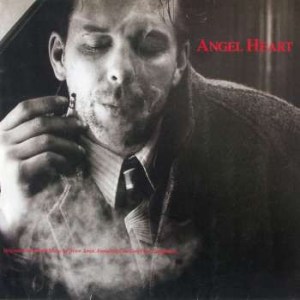
Angel Heart (1987): The Motion Picture Soundtrack

Which 1980s movies have soundtracks that are better than the film? ‘Diva’? ‘Betty Blue’? ‘Risky Business’? ‘Blade Runner’? ‘The Hitcher’? ‘Blow Out’? ‘Friday 13th Part III’? ‘Absolute Beginners’?

You could probably raise an argument for Alan Parker’s 1987 neo-noir/horror ‘Angel Heart’ too. The baffling but intermittently excellent – mainly due to Mickey Rourke’s star turn – movie was scored by South African keyboardist Trevor Jones who had worked on ‘Excalibur’, ‘Runaway Train’ and ‘Labyrinth’ before getting the nod from Parker.

He puts together a jazzy, menacing, enticing original soundtrack featuring brooding synths, sampled vibraphone, acoustic bass and horns, plus some muscular blowing from tenor saxophonist Courtney Pine. Jones’s original music for ‘Angel Heart’ was also very influential, reverberating through the erotic thriller and neo-noir genres of the late 1980s and 1990s.

But it’s the official soundtrack album, released on Antilles/New Directions via Island, that really pulls out all the stops. It’s beautifully compiled, a hallucinatory, engaging 40 minutes of music with ingenious cross-fades and key dialogue lines sprinkled in, many of which still raise a smile (‘I got a thing about chickens…’).

The album is fleshed out with some great deep blues and gospel from LaVern Baker, Bessie Smith and Brownie McGhee, while Glen Gray’s chillingly effective crooner classic ‘Girl Of My Dreams’ (alluded to many times by Pine during his solos) nods to the use of similar in Stanley Kubrick’s ‘The Shining’.

Jones reunited with Parker for the following year’s ‘Mississippi Burning’, then worked on the Al Pacino vehicle ‘Sea Of Love’, and his last notable major film seems to have been Michael Mann’s ‘Last Of The Mohicans’. But what a shame this superb soundtrack album is not in full on streaming platforms (but is available from Discogs). Glad I kept hold of my cassette…

Women In Revolt (Art And Activism In The UK 1970-1990) @ Tate Britain

Behind the shiny, fun, tabloid version of the 1980s, there was an undercurrent of protest, upheaval and misogyny.
In the latter camp, how about the following astonishing UK laws still enshrined at the dawn of the decade: men had a right to have sex with their wives without consent. Welfare benefits were paid to married women via their husbands.

A fascinating new exhibition at London’s Tate Britain investigates the woman artists and activists whose work was a reaction to these and other issues. There’s a strong presence for punk, post-punk and industrial musicians: Gina Birch of The Raincoats, Throbbing Gristle’s Cosey Fanni Tutti and Poly Styrene of X-Ray Spex. We see fanzines, posters, gig excerpts.

There’s groundbreaking video art – Vivienne Dick’s ‘Two Little Pigeons’ and Birch’s scream are particularly memorable. We see banners, collages, sculptures and newsletters produced by the women who marched from Cardiff to Greenham Common in September 1981, challenging the decision to house 96 nuclear missiles on the site.

There’s a focus on the British Black Arts Movement, a group of artists who gathered in the wake of various uprisings in the early 1980s, from Toxteth to Brixton, and also Four Indian Women Artists, the first UK exhibition organised by and exclusively featuring women of colour.

Margaret Thatcher cut arts funding drastically in the mid-’80s, a decision which ushered in corporate sponsorship and prompted a backlash from many woman artists who began to show their work in local spaces, community centres, libraries, cafes and homes. We see much of this material and learn about its contexts.

And then of course there are the famous sexist advertising billboards, wittily defaced.

The exhibition constantly undermines Thatcher’s comment to Woman’s Own magazine in 1987 that ‘there’s no such thing as society’. And there’s a surprise around every corner. It’s moving, amusing, disturbing and educational in equal measures, and a reminder that protest and assemblage can create change. But the exhibition is also very large and probably takes two visits to really appreciate.

Women In Revolt! runs at the Tate Britain until 7 April 2024. A new podcast interviews some of the key artists.

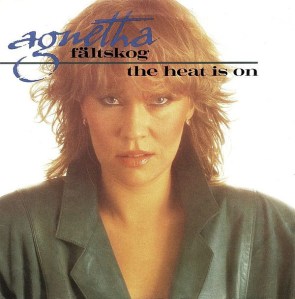
Agnetha Faltskog: The Heat Is On

One of the many pleasures of listening to the Forgotten 80s radio show is hearing a hit of which you have absolutely no memory whatsoever.

A classic example came on the air a few weekends ago. The intro featured a ramshackle, lumbering, almost-reggae groove with party voices, sleazy horns and a good bass player (revealed when listening on a decent system, but it’s almost impossible to find out which musicians played on the single) before a strident, excellent, slightly familiar voice took centre stage.

Eddi Reader? Basia? Debbie Harry? Lene Lovich? Wrong, wrong, wrong, wrong. I was gobsmacked to hear that it was actually the first solo single by Agnetha Faltskog of ABBA, released just over 40 years ago (her bandmate Frida had just had her own hit, ‘I Know There’s Something’s Going On’, produced by Phil Collins).

‘The Heat Is On’ got to #1 in Sweden, Denmark, Norway, Finland, and Belgium, #2 in The Netherlands and Germany, #29 in the USA and #35 in the UK.

The incredibly catchy number turns out to be a cover of a 1979 near-hit by Australian singer Noosha Fox. Written by Florrie Palmer and Tony Ashton, it was also massacred by Manfred Mann’s Earth Band in 1980 in a truly screwed up version retitled ‘On The Run’.

But back to Agnetha. Her version of ‘The Heat Is On’ was produced by Mike Chapman, on a particularly hot streak in early 1983 having just helmed Blondie’s biggest albums and Altered Images’ classic single ‘Don’t Talk To Me About Love’.

Faltskog’s accompanying album Wrap Your Arms Around Me is not so great but has apparently sold approximately 1.5 million copies worldwide to date (her second solo album, 1985’s Eyes Of A Woman, was produced by 10cc’s Eric Stewart). She has also been the subject of a BBC Four documentary (a dubious honour?) in the UK.

Now, got to get this damn song out of my head – almost an impossible task once heard a few times…

Movie Review: Killers Of The Flower Moon (2023)

Based on David Grann’s non-fiction book about series of mysterious deaths among the Osage Native American tribe in 1920s Oklahoma, Martin Scorsese’s new three-and-a-half hour movie is currently in the middle of a brief cinema run before showing on Paramount + (who also co-financed alongside Apple TV).

A new Scorsese movie is always an event. Co-starring Leonard DiCaprio, Robert De Niro and Lily Gladstone, ‘Killers Of The Flower Moon’ is another epic ‘creation of modern America’ movie, the flipside of ‘Goodfellas’, ‘Casino’, ‘The Irishman’, ‘Once Upon A Time In America’ and ‘The Godfather’, whilst also nodding to the oil boom of the 1920s and development of the FBI (‘Killers’ was reportedly reformatted during the Covid era to focus less on the FBI and more on the Osage).

The first thing to address is the giant running time. It’s quite extraordinary – and sometimes quite a challenge – watching a three-and-a-half-hour movie in 2023. And if, at times, it feels very much like an elongated TV show, its huge budget is all up there on the screen, with peerless attention to detail, meticulous mise en scene and truly hefty star performances.

You’re in the hands of a master, though Scorsese fans wanting elaborate camera movements and zippy set pieces will be disappointed – this is a sober, slow film, gaining its power from an accumulation of moods and images.

But ‘Killers’ is a true story of such simple, unremitting horror that you may also question why you are sitting so passively watching an exceptionally unpleasant, shameful episode in American history – all very apt in a long, non-fiction book or article, less so in a feature film of such extreme length.

One generally wants to look away from the casual, regular violence, unpleasantly forensic detail and focus on sometimes passive, unwell women. There’s exposure of intense anxiety and physical threat to child actors. There are also many longeurs, often undercut by Robbie Robertson’s pretty much wall-to-wall music (influenced by Kubrick’s ‘Barry Lyndon’ and ‘The Shining’?) with occasional Daniel Lanois-esque ‘funky’ breakdowns and slightly disconcerting inserts of blues and bluegrass.

But it’s the performances that linger longest in the mind after viewing. It’s thrilling watching intimate ‘behaviour’, as per Scorsese’s assessment of Marlon Brando in ‘On The Waterfront’, played out in the midst of such an epic, sprawling movie.

There are two key De Niro/DiCaprio stand-offs – it’s an absolute treat to see these two actors sparring on the big screen at such close quarters (and remember De Niro gave Leo his first big break in ‘This Boy’s Life’).

For his part, DiCaprio channels Brando, jutting out his bottom jaw, desperate to dial down the joie de vivre, excellently portraying a weak man who just wants to be left alone to enjoy money and gambling but is drawn into evil deeds. De Niro, in the meantime, seems to channel Trump. Gladstone burns very brightly during the first hour of the picture but fades fast, through no fault of her own, despite regrouping for a powerful final scene with DiCaprio.

There are shades of ‘Goodfellas’ and ‘The King Of Comedy’ in the film’s finale which summarises the hideous plot via a trite, ‘comic’ supper-theatre show, enjoyed by a middle-class audience and featuring a weird, uncharacteristically emotional cameo from the director.

So ‘Killers’ is not exactly Marty’s ‘Heaven’s Gate’ but a disappointment after ‘The Irishman’. Movingtheriver would put it alongside ‘Gangs Of New York’, ‘The Aviator’ and a few others in the ‘heroic failures’ camp. But is it worth seeing on the big screen? Of course. And Scorsese turns 81 on 17 November.