 Despite the twin threats of streaming and AI, it’s gratifying to see that there seems to be an increasing appetite for indepth writing about the good old long player.
This is especially true if you’re into the rich catalogues of the great artists from the ‘60s, ‘70s and ‘80s.
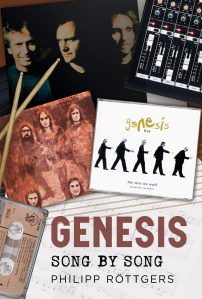
Fonthill Media have put together the latest (hardback) series of ‘song by song’ studies, covering similar territory to Sonicbond’s ‘on track’ series.
Author Philipp Rottgers (he’s also a historian and drummer with the band PARIAHLORD) now enters the fray with an enjoyable new study of pop/prog behemoths Genesis.
The book offers entries on every single song they ever recorded, plus sections on tours, album artwork and contemporaneous critical reactions. There’s also an impressive selection of colour photos, including singles covers new to this writer. There’s no index but an extensive reference section and long bibliography.
Genesis provides an interesting challenge for the discerning author, with such a weighty catalogue and two distinct eras. Rottgers preference seems to be for the 1975-1992 period, when Phil Collins fronted the band.
But the book still offers lots of tasty morsels regarding the band’s earlier Peter Gabriel period. For example, it’s interesting to note that the live debut of ‘Supper’s Ready’ took place at Brunel University, Uxbridge, on 10 November 1972 (one wonders if It Bites knew about this when they played a fantastic 16-minute version of ‘Once Around The World’ at the venue in February 1988).
And Rottgers reveals that Noel Gallagher of all people was influenced by an early track called ‘The Conqueror’.
We skim through the band members’ early biographies pretty quickly (weirdly Rottgers neglects to mention the location of each founding members’ birth) and learn a lot about the patronage and early promotion of impresario/songwriter Jonathan King (whose subsequent ‘dodgy’ dealings are skirted over completely, probably for good reason…).
There’s some great stuff about Collins’ audition for the band, though it would have been nice to know what they played on that Surrey afternoon. There are fascinating muso details about the middle period, like the fact that Banks, Rutherford and Collins were each given a CR-78 drum machine during the Japanese tour of 1978 as gifts from manufacturers Roland, and it became a key sound of the Duke album (and Collins’ Face Value).
There are some superb tidbits about the band’s mid-1980s commercial peak – the analysis of ‘Land Of Confusion’ is particularly detailed – and Rottgers reminds us that the band did a remarkable FOUR nights at Wembley Stadium in 1987.
The final chapter impressively reviews the farewell 2022 concerts in full and also explains the legacy of the band and also the contributions that Banks, Collins and Rutherford made to their instruments and songwriting in general.
Whilst ‘Genesis: Song By Song’ is a huge achievement and obviously a labour of love for Rottgers, there are some strange omissions. He generally eschews musical analysis, surprising given Genesis are famed for their top-notch playing.
And fans of the early work may occasionally scratch their heads at the lack of space given to important, complex early pieces like ‘Mad Man Moon’ and ‘Can Utility & The Coastliners – both only get three lines each! And some Lamb Lies Down tracks also get short shrift.
But all in all, this is an enjoyable and worthwhile book, doing a good job of taking one back to the music afresh. Looking forward to Rottgers’ upcoming book on Collins.
 If any more proof was needed as to how far the UK pop charts have declined since the mid-1990s, look no further than the fact that Genesis’s ‘Mama’ – released 40 years old this week – was their biggest hit, going all the way to #4.