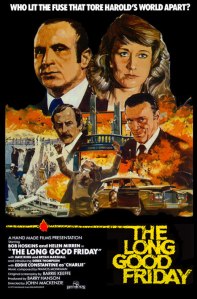
The Cult Movie Club: The Long Good Friday (1980)

Every post-1971 British crime movie has had ‘Get Carter’ and ‘Performance’ in its rearview mirror.

Made in summer 1979 but not released until 18 months later, ‘The Long Good Friday’ (original title: ‘The Paddy Factor’) has often been mentioned in the same breath as ‘Carter’. Is that justified?

Initially bankrolled by legendary impresario and producer Lew Grade, it was written by proper East Ender Barrie Keeffe (who reportedly knew Ronnie Kray), directed by Scotsman John Mackenzie and starred Brit acting ‘royalty’ Bob Hoskins and Helen Mirren.

When completed, the suits almost refused it a cinema run, deeming it too nasty, hoping to recut it and farm it out to television. A disgusted Mirren asked her friend Eric Idle to attend the premiere at the London Film Festival towards the end of 1980.

Idle was impressed and passed it on to his mate George Harrison, the main moneyman at newly-formed HandMade films. Harrison apparently loathed it but agreed it had hit potential. HandMade bought it for £700,000, funded by ‘Life Of Brian’ profits.

But how does ‘The Long Good Friday’ stack up in 2024? I watched the posh new 4K restoration – looks fabulous, but this film really belongs in a mid-’80s Cannon fleapit. With its casual racism/sexism/ableism and overlong dialogue scenes, it’s also now more redolent of ‘Sweeney!’, ‘The Squeeze’ and ‘Villiain’ than ‘Performance’ or ‘Get Carter’ – but is still fascinating and memorable.

There’s some real Brit nastiness, or ‘virtuoso viciousness’, as Pauline Kael called it in her ‘Carter’ review. Mackenzie comes up with three or four memorable set pieces (and a great final five minutes, apparently the first thing they shot, during which apparently the director drove the car and ‘fed’ Hoskins the entire plot of the film) which have given the movie legs. He also uses the London locations with some elan.

Keeffe comes up with some preposterously funny lines – ‘It’s like Belfast on a bad day!’ etc. – and Francis ‘Sky’ Monkman’s disco/prog/fusion score adds value. There’s also an amazing array of ‘Hey, it’s that guy/girl!’ actors, from Pierce Brosnan (whose swimming pool scene seems to have influenced Bronksi Beat’s ‘Smalltown Boy’ vid) to Gillian Taylforth.

Sadly though the key performance by Derek Thompson (Charlie in ‘Casualty’!) weighs the film down with its stoned insouciance and dodgy London accent (ironically, Thompson was born in Belfast).

And though some have compared Hoskins with Edward G Robinson and James Cagney (Keeffe apparently pictured a cockney Humphrey Bogart!), despite some amusing line readings these days he comes across more like Alan Sugar after a few too many espressos, whereas Michael Caine in ‘Carter’ had a kind of timeless, glacial rage.

Apparently under the influence of ‘Lock, Stock and Two Smoking Barrels’, Empire magazine – astonishingly – voted ‘The Long Good Friday’ the #1 greatest British film in a 2000 poll. Hard to think it would get that accolade today. Still, it’s a fascinating snapshot of London on the brink of Thatcher’s decade, and a must-see for fans of 1980s cinema.

Further reading: ‘Very Naughty Boys’ by Robert Sellers

10 Classic 1980s Singles Featuring Brushes

Some brushes, yesterday

When you think of 1980s pop music, which drum sounds come to mind?

They’re probably pretty loud and the infamous gated snare possibly looms large: ‘Let’s Dance’, ‘In The Air Tonight’, ‘Hey Mickey’, ‘Uptown Girl’, ‘A Town Called Malice’, ‘Born In The USA’.

But there’s a whole alternative world of 1980s hits where the drummer played very quietly, with brushes rather than sticks. Stuff like Buddy Holly’s ‘Raining In My Heart’, The Beatles’ ‘When I’m 64’ and Lou Reed’s ‘Walk On The Wild Side’ probably laid down the gauntlet, but you can’t imagine any producers or focus groups demanding that the drummer play brushes to create a hit (and when was the last hit that featured brushes?).

Here are some classic 1980s singles that somehow got away with it (all chart placings from the UK).

10. Echo & the Bunnymen: ‘Killing Moon’
Powered by Pete de Freitas’s subtle and unexpected brushwork, the classic single got all the way to #9 in early 1984.

9. George Michael: ‘Kissing A Fool’
The seventh and final single from Faith, written back in 1984, reached the top 20 and was initially mooted to be the title track of that 1987 album. Session player Ian Thomas, soon to play with everyone from Robbie Williams to Scott Walker, overdubbed some brushes on the snare after first recording a pass with sticks.

8. The Cure: ‘The Lovecats’
This stand-alone single was also the band’s first top ten hit, peaking at #7 in October 1983. Drummer Andy Anderson began his career with Hawkwind’s Nik Turner and Steve Hillage, then ended up on Robert Smith and Steve Severin’s The Glove side project. He found himself recording this song in Paris then joined the band for a year, playing on 1984 album The Top and playing brushes on another B-side, ‘Speak My Language’. He then toured with Iggy Pop throughout 1987. Anderson died in 2019.

7. Alison Moyet: ‘That Ole Devil Called Love’
This stand-alone single reached a heady #2 during March 1985, produced by ’18 With A Bullet’ singer Pete Wingfield. But who’s the drummer? Answers on a postcard please.

6. Robert Wyatt: ‘Shipbuilding’
Not much is known about drummer Martin Hughes, but he did a nice job on this classic single which reached #35 in April 1983.

5. Chris Rea: ‘Driving Home For Christmas’
Written in 1978, it was originally intended for Van Morrison. Rea first recorded it as a B-side to the 1986 single ‘Hello Friend’, with drummer Dave Mattacks playing almost with a country feel. But the most famous version features on Rea’s 1988 New Light Through Old Windows compilation album with drums by Martin Ditcham, best known for his percussion work.

4. Chris Isaak: ‘Wicked Game’
Kenney Dale Johnson played some very subtle drums on this classic single released in July 1989, going on to become a huge sleeper hit in the US and UK.

3. Elton John: ‘Blue Eyes’
Recorded at AIR Studios in Montserrat, this touching ballad was the lead-off single from John’s Jump Up! album, reaching the top ten in 1982. The very slow 6/8 groove was beautifully marshalled by Jeff Porcaro. See also Toto’s ‘Don’t Stop Me Now’ and Ray Charles’ ‘Still Crazy After All These Years’ for some classic Porcaro brushwork.

2. Fairground Attraction: ‘Perfect’
It reached UK #1 in May 1988 – is it the only chart-topper to feature a drummer playing brushes? London jazzer Roy Dodds did the honours on this.

1. Rain Tree Crow: ‘Blackwater’
Cheating a bit here. It wasn’t released until 1991 but was recorded in December 1989 at Chateau Miraval in Southern France. It was the reformed Japan’s only single, reaching #62. In the band biography ‘Cries And Whispers’, drummer Steve Jansen makes the remarkable claim that his whole performance was pieced together using samples. Weird…

Any other 1980s hits that feature brushes? Drop us a line below.

Gig Review: Bill Frisell @ Cadogan Hall, 25 October 2024

Though the American guitarist’s 1980s sonic explorations with the likes of John Zorn, Power Tools and on solo albums such as Before We Were Born are long gone, Frisell’s fascinating (and much quieter) late-career boom continues abound.

He’s a regular visitor to the Big Smoke but, revelling in his newfound freedom at Blue Note Records, this Cadogan Hall gig felt like his most ‘jazz’ outing for years.

That’s chiefly due to the presence of A-list collaborators, in concert and on recent album Four: Gerald Clayton on piano, Gregory Tardy on various reed instruments and Johnathan Blake on drums. Close readers will notice one word notable by its absence: bass. It’s a credit to Frisell that the instrument wasn’t really missed here, nor did he or Clayton particularly resort to vamps to make up for the absent low-end.

Consequently, the meticulously arranged and rehearsed set, strongly foregrounding collective improvisation, had a lovely ‘floating’ atmosphere. (Two touchstones may be Louis Armstrong’s Hot Five and The Jimmy Guiffre 3, the latter of course featuring Frisell hero Jim Hall on guitar.)

Themes came and went, with many segues. Somewhat sombre recent compositions such as ‘Waltz For Hal Willner’ and ‘Claude Utley’ – both named for recently departed friends of Frisell – bumped up against familiar pieces such as Paul Motian’s ‘Conception Vessel’ (taken at a very leisurely clip) and Bacharach/David’s ‘What The World Needs Now’, as well as two fast bebop-style heads which nodded to Ornette Coleman (though the Monk-ish treat ‘Holiday’ was sadly missing).

In short, it was business as usual for Frisell, who unapologetically places melody at the heart of everything he does, whether playing ‘60s pop, country, avant-garde or bebop. Hall really does seem to be his totem these days, though he still knows when to add disconcertingly witty moments of found sounds and dissonant loops via his pedal board.

And while the ensemble occasionally felt like it was kept on unusually tight leash, Clayton added much-needed harmonic colour and elaborate flourishes, touching variously on stride piano, systems music and glorious call-and-response lines reaching back to Tatum and Hines. Tardy brought the blues feeling, laying down three or four fantastic solos, while Blake – the man with the lowest drum set in the world, barely above his knees – played at a perfect volume in the very boomy Cadagon Hall, and with great taste.

All in all, this quartet has legs. One would hope they could gather for another album on Blue Note, and we might get another enjoyable gig like this too. The standing ovation seemed to come as quite a surprise to this most modest master of the electric guitar.