Gig Review: Mel Gaynor @ 606 Club, 25 September 2025

Mel Gaynor spent almost 30 years playing superb drums with Simple Minds in studios, stadiums and sports halls across the globe.

But it’s also oft-forgotten that he was also one of the key British session drummers of the 1980s, working with Joan Armatrading, Elton John, Heaven 17, Pretenders, Kirsty MacColl and others (and, in a 1992 Sunday Times poll, was named the world’s best rock drummer by Stewart Copeland, no less).

So it’s always interesting seeing such behemoths of the drums in tiny venues, often un-mic’d and playing small kits. And they don’t come much more intimate or friendlier than the 606 – though the club always has excellent acoustics.

Gaynor’s latest live project eschews the heavy rock of last year’s Come With Me album and returns him to the fusion and jazz/funk of his youth (he started his career playing with Britfunk legends Central Line), alongside pianist John Watson, who has also worked with Sister Sledge, Imagination and Mica Paris, and impressive young bassist Issy Brown. On this gig, they were also joined by MOBO and Mercury-winning saxophonist Denys Baptiste – a real coup.

A fit, healthy and happy-looking Gaynor settled behind the kit with no fuss and counted off ‘Got The Message’, a Crusaders-style, medium-tempo slow-burner, with Baptiste outlining a pretty melody and Brown digging in with excellent tone and judicious use of his low B string. Gaynor was the epitome of taste and groove here, but still found time for one explosive ‘Alive And Kicking’-style snare fill towards the end.
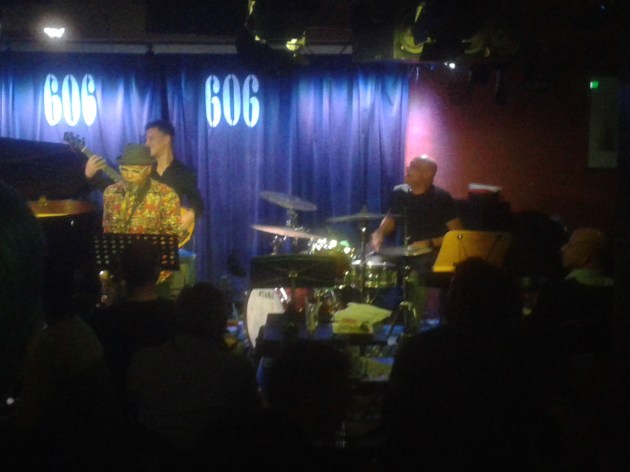
Denys Baptiste, Issy Brown and Mel Gaynor @ the 606

‘Beyond The Stars’, touchingly dedicated by Gaynor to his late father, started with an African-tinged 6/4 drum loop, before settling into another pretty, gentle tune with a touch of Jason Rebello’s writing about it.

‘Preludio’, written by Watson, chugged along with a nice Morrissey-Mullen-style samba groove, and became a feature for Baptiste’s tenor, wittily quoting Dennis Edwards’ ‘Don’t Look Any Further’, with which it shared a chord sequence.

Baptiste also elevated ‘Zeta’ – apparently Gaynor’s manager’s favourite tune. The saxophonist can do it all, from Grover Washington Jr. soul to sixteenth-note meltdown, Michael Brecker-style. It was nice to hear Watson lay out for a while too, then return to trade spicy fours with Baptiste. Gaynor also raised the volume level by about 25%, suddenly shifting into fifth gear with some terrific Tony Williams-style fills around the toms.

This was not an evening of cutting-edge jazz/rock, with not a broken beat nor drum-and-bass groove in sight, nor was it volatile fusion in the Mahavishnu or Lifetime mold. But if Mel’s music leans more towards the softer style of the late 1970s/early 1980s, from Average White Band to The Crusaders via Incognito and Morrissey-Mullen, it’s no worse for that.

And the set showed Gaynor to be an excellent ‘pocket’ drummer, with much power in reserve. But then you already knew that from his work with Simple Minds.
Movie Review: Spinal Tap II (The End Continues)

The question is not so much why they’re back for a big-screen sequel, but why it’s taken so long.

But, after various copyright problems, the wait is over. ‘Tap II’ is here. And it’s worth the wait.

One of the many good portents for ‘Tap 2’ was the fact that Rob Reiner was returning to direct and co-star as Marty DiBergi. You know you’re in the hands of a master. Then there’s the fact that all surviving original cast members are present and correct, and that their improvisational modus operandi is basically intact.

Your correspondent is not going to reveal any of the many pleasant surprises from the movie, such as the return of various secondary characters from the first film (and appearances from four or five big rock stars), but suffice it to say that the plot is a little like ‘Anvil! The Story Of Anvil’.

A contract clause dictated by band manager Ian Faith before his death states that Tap must do one final comeback concert. The only problem is that the three surviving members of Tap (Nigel Tufnel, David St Hubbins, Derek Smalls) are at loggerheads and haven’t seen each other for years.

We find Nigel selling cheese and guitars in Berwick-upon-Tweed (just the sight of him wearing shopkeeper’s hat and overall is worth the price of admission alone), David making ‘on-hold’ music and Derek running a glue museum.

Various scenes from the first film are mirrored here, and they even use the same font for the onscreen graphics. Thank goodness too they mostly stay away from ‘dark’ comedy. There are few concessions to identity politics, and the humour is basically quite sweet (but agreeably foul-mouthed). These are some seriously old dudes trying to rock out again.

The casting once again nods to a richly-observed Anglophilia with Chris Addison hilarious as the hapless/humourless marketing man, a mixture of Simon Cowell and Simon Fuller, and Kerry Godilman doing fine as Ian Faith’s Sharon Osbourne-like daughter.

Once again they’ve got the music spot-on too, showing the detail you’d expect from real music fans and good musicians – you won’t find any poorly-sync’d snare hits from the drummer here. It looks like they played and sung everything live with multiple cameras running.

One small gripe? The actual band reunion scene is a bit flat and looks like it may have been the victim of some rather severe editing. But that’s nitpicking, isn’t it?

So Tap fans – there’s nothing to fear here. Go to ‘The End Continues’ with confidence. At 80 minutes, it’s a perfect length and sticks in the head afterwards. There’s little ‘learning’, just laughs. This writer chuckled approximately every 20 seconds. Looking forward to the DVD extras, there must be hours of extra improvisations.

Anthony Braxton: Quartet (England) 1985

Anthony Braxton has one of the largest discographies in music history, encompassing a huge variety of styles and formats: operas, pieces for two pianos, orchestras, solo saxophone, 100 tubas, jazz quartets, ‘found’ objects and many more.

The saxophonist/composer/teacher turned 80 in June, and has also just been inducted into the illustrious DownBeat Hall of Fame.

This writer has long championed ‘Forces In Motion’, Graham Lock’s excellent book about Braxton’s November 1985 tour of England, and a large portion of that tour can now be heard on a thrilling digital box set Quartet (England) 1985, for which Lock has provided new liner notes (he also recorded all the material on a portable cassette player).

The quartet, which comprised Braxton on various reed instruments, Marilyn Crispell on piano, Mark Dresser on double bass and Gerry Hemingway on percussion, was one of Braxton’s most active bands in the ’80s, but didn’t record in the studio until 1991.

Quartet (England) 1985 presents four complete concerts from Sheffield, Leicester, Bristol and Southampton (the London concert was officially recorded and broadcast by BBC radio). The original mono cassette recordings, captured by Lock as references for his book, have been restored by engineer Christopher Trent.

The package also features bonus recordings of the quartet playing John Coltrane’s ‘After the Rain’ and Miles Davis’s ‘Four’, plus soundcheck recordings of ‘All The Things You Are’ and ‘On Green Dolphin Street’. There are also previously unseen photos taken during the tour and a full list of the compositions played (the set was different every night).

Braxton (in borrowed coat), Dresser, Crispell and Hemingway at Stonehenge, 22 November 1985. Photo by Nick White

There’s no getting away from the fact that these are wild and woolly mono recordings, but pleased to report that Trent has done a superb job of cleaning up the tapes and the audio quality doesn’t hamper the listening experience one bit.

The music varies between good and excellent. ‘Free jazz’ barely covers it – the material is actually generally meticulously composed and arranged (featuring memorable, catchy melodies), though there are improvised sections which mainly serve as connecting interludes.

If you want to hear a collision between Sonic Youth, Ornette Coleman and Gyorgy Ligeti, enlist here. It’s a no-cliché zone, guaranteed to annoy the neighbours, and a valuable detox from the mainly safe, secure sounds of today. Quartet (England) 1985 is highly recommended and a fine 40th anniversary celebration of the 1985 tour.

(Postscript: for an impassioned defence of ‘spontaneous improvisation’, check out Stewart Lee’s appearance on the BBC’s ‘Great Lives’ discussing guitarist Derek Bailey.)

1980s Jazz, Fusion, Soul and Funk Acts I Should Like But Don’t

We’ve looked before at the celebrated 1980s rock and pop acts whose output somehow leaves this writer cold.

But how about the decade’s jazz, soul and fusion artists who always seem to get the props but inexplicably fail to float movingtheriver’s boat?

Rick James
Frequently mentioned in dispatches as a funk pioneer and influence on Prince etc. (and also mentor of Teena Marie?) but for this listener his music is generally coarse and one-dimensional, and his voice nothing to write home about.

Bill Connors
The guitarist made some excellent music for ECM Records in the 1970s both as solo artist and sideman (Jan Garbarek/Stanley Clarke/Return To Forever/Julian Priester etc.) but his 1980s work disappoints. He apparently developed a fixation on Allan Holdsworth’s sound/technique which hampered his progress. Somewhat regrouped in the 1990s and new millennium though.

Kazumi Watanabe
The guitarist employed some fantastic musicians (Jeff Berlin, Steve Jordan, Marcus Miller, Bill Bruford) in the 1980s but, outside of one or two half-decent riffs, seemingly failed to generate much memorable music.

Stanley Jordan
Bassist Anthony Jackson called him a ‘genius’, and he should know, but technical feats notwithstanding (he famously played the guitar exclusively by ‘tapping’ the strings with the fingers of both hands), he seemingly failed to develop his music beyond smoochy smooth jazz during the 1980s.

Chick Corea
Obviously a genius-level musical brain and maker of some memorable material in the 1970s but generally his ‘80s music and stage presentation was a bit embarrassing (though I have a penchant for the Light Years and Eye Of The Beholder albums). A great mentor though (Dave Weckl, John Patitucci, Frank Gambale, Scott Henderson etc.).

Al Di Meola
See above.

Howard Hewett
Owner of some fantastic pipes and a stellar career co-fronting Shalamar, but for this writer his solo career generally seems like over-produced, underwhelming mush, and he doesn’t seem much of a songwriter. (He did an unforgettable take on Marvin Gaye in the 1990s though.)

Narada Michael Walden
One of the great drummers (Jeff Beck, Weather Report, McLaughlin etc.) and producers (Whitney, Aretha etc.) ended the 1980s with a half-decent album (Divine Emotions) but, to these ears, the rest of the decade’s solo career was unmemorable disco/funk…

Brand X
Often touted as a kind of British Weather Report – fugedaboudit. Their musicianship was competent at best and their compositions somehow didn’t stick in the brain, despite the occasional drumming contributions of a Mr P Collins. Bill Bruford did it much better with a far superior bunch of players (Jeff Berlin, Allan Holdsworth, Jon Clark, Dave Stewart). See also: Pierre Moerlen’s Gong.

Pat Metheny
This writer dug his stereo-chorus sound and musical approach at the dawn of the decade (80/81, American Garage, Travels) but, as the 1980s went on, he seemed to embrace a mushy new-age sensibility and indistinct jazz guitar sound that generally underwhelmed. And his stage presentation is one of the least savoury in music history… (Gary Giddins: ‘intoning plush melodies with excessive sobriety, as though the notes were transmitted directly from God…’). Liked his collaborations with Ornette Coleman and Bowie though.

Jean-Luc Ponty
Valued sideman for ’70s behemoths (Zappa, McLaughlin) but his solo career has generally disappointed this writer (but generally not other jazz/rock fans, who inexplicably seem to love his stuff…), outside of the fact that he doesn’t seem to possess a particularly pleasant violin tone with an annoying penchant for the phaser pedal. He employed some superb players in the ‘80s (Scott Henderson, Rayford Griffin, Baron Browne etc.) but never convinced that he’s much of a composer. Always quite liked this though…