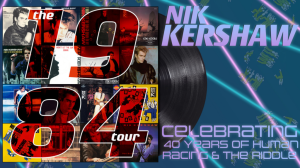
Gig Review: Nik Kershaw @ Shepherds Bush Empire, 16 October 2024

As the male solo artist with the most weeks on the UK singles chart during 1984, it’s not surprising Nik Kershaw is celebrating that year with a lengthy European tour, playing his two top 10 albums Human Racing and The Riddle in their entirety.

He’s still able to command big audiences for his solo gigs, and with good reason – his vocals are if anything much improved since his mid-‘80s heyday and his songs are built to last, with their bold melodies, crafty harmonies and intricate arrangements. But then regular readers already know movingtheriver is a big fan.

So Kershaw’s back catalogue is an embarrassment of riches but also presents some potential problems for a five–piece ‘rock’ band – for a start, how to recreate those dense textures and sequence-heavy arrangements? Thankfully he generally didn’t scrimp on any of that, mostly using the same audio stems and keyboard sounds from the 1980s. There was little or no ‘reimagining’ during this gig, hugely enjoyed by a packed house.

‘Roses’, whose lyrics are still relevant today, was the surprise but effective first song, the band (all middle-aged white guys dressed in black, but then you don’t go to a Kershaw gig expecting bells and whistles) arriving onstage to the opening percussion loop.

‘Know How’ and ‘Wild Horses’ (a favourite of Miles Davis) sounded fantastic, benefitting from bassist Paul Geary’s beefy tone and Kershaw’s fluid guitar lines.

He delivered a great vocal on ‘Wide Boy’, while ‘City Of Angels’ – written about ‘a city I’d never been to’ – featured a lovely laidback performance from drummer Bob Knight, though at times during the gig he lacked the dynamics and smooth grooves of original Human Racing/Riddle sticksman Charlie Morgan.

Geary had his work cut out aping Mark King on ‘Easy’, but he did a pretty good job if somewhat lacking the Level 42 man’s precise percussiveness and syncopated slides. Impressively, keys player Phil Peckett seemed to take care of all the track’s fast sixteenth-notes in real time rather than relying on a sequencer. The whole band did pretty much the same on ‘Don Quixote’.

Self-deprecating to the last (he’s always claimed he’s just a ‘muso’ who was thrust into the limelight), Kershaw played down his Green credentials before ‘Save The Whale’, claiming it had been written as a last-minute ‘rent-an-issue’ song for The Riddle.

The excellent ‘You Might’ featured ‘too many chords’, according to Kershaw, while the first set closed with the album’s perennially popular title track, featuring tasty duel lead guitars though with a rather stiff ‘rock’ feel compared to the slinky sixteenth-note groove of the original.

Set two featured Human Racing in its entirety, and this is where the now rather dated zaniness of Kershaw’s early stuff became apparent, the superbly sung title track and ‘Wouldn’t It Be Good’ aside, though the latter was played surprisingly early in the set.

There was a lengthy tribute to and applause for producer Peter Collins who passed away in June before Kershaw closed up Human Racing with ‘I Won’t Let The Sun Go Down On Me’, rescued by the frontman’s lengthy Holdsworth-like guitar solo.

He seemed genuinely delighted by the ecstatic crowd reaction, signing off with a breezy ‘You’ve made an old man very happy’, before encoring with mass singalongs ‘When A Heart Beats’ (complete with superb note-for-note solo from second guitarist Adam Evans), should-have-been-a-hit ‘The Sky’s The Limit’ and ‘The One And Only’.

A great night of classy music and enjoyable nostalgia. Who knows – maybe Nik will amaze us with Radio Musicola @ 40 in 2026.

Bronski Beat: ‘Smalltown Boy’ @ 40

40 years ago, gay artists weren’t just occasional visitors to the British pop charts – they were leading the agenda.

A famous top three of August 1984 featured George Michael at #1, Frankie Goes To Hollywood at #2 and Bronksi Beat’s ‘Smalltown Boy’ at #3.

Remarkably, the latter was also the Bronskis’ debut single, coming from debut album The Age Of Consent. And what a trailblazing/timeless classic it is, danceable and tearjerking, with a once-in-a-lifetime vocal performance from Jimmy Somerville and that winning chord sequence.

Bernard Rose’s sombre video (which has had 121 million YouTube views at the time of writing) was obviously a huge part of the song’s success, combining the ‘realist’ style of Mike Leigh and Ken Loach with a few poetic touches to brilliant and moving effect.

Producer Mike Thorne’s role on the track is often undervalued too – there was a touch of his ‘Tainted Love’ in his bass sound and extensive use of top-end on synths and drums, and he also gets a pat on the back for leaving in a few mistakes (check out the shockingly-played synth lead line in the first 30 seconds, a section that also seems to speed up a lot).

The legacy of ‘Smalltown Boy’ is rather sad though – writers/co-founders Steve Bronski and Larry Steinbachek have both died recently, deaths that seems to have been somewhat under-reported in the media.

Madonna @ The MTV Video Music Awards: 40 Years On

40 years ago this weekend, Madonna stunned the music biz with her premiere performance of ‘Like A Virgin’ on the MTV Awards at the Radio City Music Hall, NYC.

Not a household name at the time, she sung live in full wedding regalia, perched atop a giant cake, before shedding her shoes and veil and ending up writhing around the stage, her underwear exposed.

In terms of landmark pop TV moments, some have compared it to The Beatles on ‘The Ed Sullivan Show’ or Michael Jackson’s moonwalking on ‘Motown 25’. Others saw it as summing up the coarsening of popular culture.

But Madonna’s stylist Maripol later claimed to Classic Pop magazine that MTV ‘tried to destroy her that day…they put the camera under her skirt.’ And it’s hard to see the performance outside the context of Prince’s highly sexualised ‘Purple Rain’ movie (released in the US two months earlier) and attendant live shows.

It’s also widely forgotten that this performance came a month before ‘Like A Virgin’ was released as a single, so this was the first time most people had heard the song (‘Borderline’, from Madonna’s self-titled debut album, was only just peaking in Europe in September 1984). Bravely, Madonna refused to perform either ‘Borderline’ or ‘Holiday’ for MTV.

Still, manager Freddy DeMann was reportedly furious with Madonna, believing the performance to be career suicide. But of course it was just the opposite, helping propel her to megastardom. Happy birthday to a groundbreaking moment of 1980s pop.

(Postscript: As for the MTV Awards, they’re still going strong – Madonna spawned quite a monster…)

Van Halen @ Monsters Of Rock, Donington Park: 40 Years On

40 years ago this month, Van Halen were the penultimate act at Monsters Of Rock, Castle Donington, part of what is generally considered the greatest ever bill at the illustrious rock festival.

And now some sizzling side-of-stage footage from Saturday 18 August 1984 has emerged (but sadly has been removed from YouTube as of March 2025…), shot by Ross Halfin, showing the first iteration of the band at their commercial peak (they would break up in acrimony shortly after, and this was their last ever British concert).

The sound is not brilliant and some fans have complained about the setlist and length of both the Van Halen brothers’ solos, but it’s instructive and exciting to see exactly what goes down backstage/onstage.

Lee Roth is a superb master of ceremonies, singing well, dancing his tail off and firing off some amusing bits of banter: ‘Don’t stick your tongue out at me unless you’re gonna use it… If you wanna throw something at me, I’m gonna come down there and f*ck your girlfriend!’ etc. etc.

Though the footage starts off with Lee Roth and Alex Van Halen sharing a laugh (in a recent Classic Rock piece about the gig, Halfin claims the former was ‘stoned’ throughout), tensions among the band were high and nobody present was very surprised when they went their separate ways shortly after.

But it’s quite a thrill to get such a close-up view of such a legendary gig. The tempos are brisk but everything has VH’s inimitable swing and swagger.

England v West Indies @ Lord’s 40 Years Ago Today

Sir Vivian Richards batting for West Indies in 1984

movingtheriver’s love of cricket was sparked during Botham’s Ashes in 1981, and then thrived during New Zealand’s visit to British shores in 1983.

But it was the summer 1984 England v West Indies series that really sealed the deal, boosted by a trip to Lord’s for the third one-day international which took place 40 years ago today. There was so much demand for tickets that my dad and I were put on the hallowed turf near the old Mount Stand, about five feet from the boundary rope (visible in the clip below).

We sat on the grass surrounded by noisy, friendly West Indies fans, in those golden days when drums, conch shells, whistles and whatever else were all permitted in the ground. So 4 June 1984 remains one of the most exciting days of live cricket I’ve ever seen, and we were also treated to a superlative display by arguably the greatest team of all time (no, I don’t mean England…) including a famous run-out by Roger Harper and a match-winning innings by Viv Richards.

The Blue Nile: A Walk Across The Rooftops 40 Years Old Today

‘Every record should be compared to silence. Silence is perfect. What are you going to put on it?’
Paul Buchanan, 1984

The Blue Nile’s debut album A Walk Across The Rooftops – released 40 years ago today – embraced silence. The first minute of the title track was a case in point. Buyers all over the UK were wondering if their tapes and records were faulty.

In a superb year for debut albums, the Scottish trio stole a march on David Sylvian, beating his Brilliant Trees by two months, though Scott Walker was first out of the traps with Climate Of Hunter. Both Sylvian and Walker reportedly adored A Walk, as did Peter Gabriel and Brian Eno.

The album has a funny/weird backstory involving the Bee Gees, Krankees and Spice Girls, well worth checking out. But how does my original Linn/Virgin CD (catalogue number LKHCD1) sound 40 years on? Fantastic. Seldom have acoustic drums and pianos been better recorded, the songwriting is solid and every electronic noise has its place.

‘Tinseltown In The Rain’ and ‘Heatwave’ would make for superb hi-fi testers. Buchanan’s voice is original and affecting. Lyrically, his speciality seems to be life-changing realisations in ordinary settings. The title track, for instance, was reportedly inspired by the view outside his Edinburgh kitchen window.

A Walk only got to #80 in the UK on release but became a formidable sleeper hit and has apparently sold way beyond the band’s wildest expectations. They waited five years to release followup Hats, an album many rate as superior to A Walk. Not this writer though. A great debut album in a decade full of them.

Michael Hedges: Aerial Boundaries @ 40

Alternate guitar tunings were nothing new in 1984. Many flamenco and folk guitarists deviated from the standard EADGBE, and of course John Martyn and Joni Mitchell were innovators whose own ingenious tunings aided their compositions.

But when Sacramento-born guitarist Michael Hedges recorded the title track from his album Aerial Boundaries – released 40 years ago this weekend – he created something new under the sun.

For a start, it’s remarkable that all of this sound came from one guitarist – no overdubs. He used hammer-ons, pull-offs, tapping (often ‘clawed’ or barred with one finger), finger-picking and harmonics to build up layers of counterpoint. The independence of limb is pretty staggering. This guy must have been a great drummer. And all performed on a bog-standard steel-string acoustic guitar (reportedly with heavy strings and a very high action).

Other contemporary guitarists like Stanley Jordan and David Torn used tapping and hammering-on to a great extent too but arguably never to the smooth, rolling, melodic effect that Hedges achieves.

‘Aerial Boundaries’ is certainly a jewel in the Windham Hill Records’ crown, and sounds completely unlike any of the label’s other solo guitarists. Hedges called it a ‘systems’ piece, a la Steve Reich, Philip Glass etc. The tuning is CC(an octave higher)DGAD but he pretty much used a different one for every composition. Most guitarists try a common alternate tuning and then noodle around until they find something interesting. Not Hedges. It seems the music came first, then the tuning.

It’s a real challenge to play and has inspired many YouTube cover versions – this guy has nailed it. Hedges made it look ridiculously easy when he played it live and sometimes even added in a riff or two from Iron Butterfly’s ‘In-A-Gadda-Da-Vida’.

Hedges’ music is frequently described as ‘new age’ but he was actually a big Prince and Genesis fan who died in a car crash in 1997 at the age of just 43. Arguably he never topped ‘Aerial Boundaries’. Happy 40th birthday to a solo guitar masterpiece.

Yngwie J Malmsteen: Rising Force 40 Years On

When movingtheriver started playing guitar and buying muso magazines in the late 1980s, the name Yngwie J Malmsteen seemed to inspire awe throughout the whole ‘scene’.

But there was no way you could just happen upon Malmsteen’s music in the UK unless you listened to ‘The Friday Rock Show’ with Tommy Vance.

Then my interest was piqued again when It Bites’ Francis Dunnery mentioned him in a Guitarist magazine interview from October 1989. Almost immediately after that I found Malmsteen’s debut solo album Rising Force – released 40 years ago this month – in a bargain bin at the Richmond Our Price.

You could make an argument that the Swede – born Lars Lannerback! – was THE rock guitarist of the 1980s, having as much of an impact as Eddie Van Halen did five years before. Rising Force was a perfect bridge between the UK, Genesis and Yes albums I was investigating and the heavier influences coming in from Steve Vai and Van Halen.

But, as with any freaky guitar virtuoso, the main issue was finding the right musical context. Rising Force has its duff songs (though always with brilliant guitar playing) but delivers two of the most stunning instrumentals in rock history, ‘Black Star’ and ‘Icarus Dream Suite Op.4’. And to think he was just 20 when he recorded them.

With Malmsteen’s scalloped Strat and nods to Paganini, Bach, Albinoni and Mozart, he achieved (and achieves) a remarkable control of vibrato, both via fingers and whammy bar – demonstrating possibly influences from Allan Holdsworth and Al Di Meola at this early stage – and superb tone, plus a mastery of those baroque passing chords.

I saw Yngwie live once at The Marquee on Charing Cross Road on 11 June 1994. It was thrilling seeing him at such close quarters but I kept wanting the singer to shut up. Eventually said vocalist got into a spat with someone at the front and smashed the mic stand down on his head.

Yngwie then set his Strat alight, kicked it to pieces and chucked the neck towards the sound desk, just missing my head and landing about 15 feet away. The venue was evacuated, and as we chatted nervously outside, a laughing kid ran past brandishing the smoking neck. Wonder where it/he is now.

I no longer have the CD of Rising Force for some reason – wish I had held onto it because the album is not on any streaming platforms at the time of writing. Malmsteen’s career continues at great pace – he’s just played two gigs in London and done a great interview with Rick Beato.

And for those who like reaction videos, The Daily Doug has put together a neat musical analysis of ‘Icarus Dream Suite’ here.

Culture Club: ‘Karma Chameleon’ Hits US #1 40 Years Ago Today

The Second British Invasion hit its imperial phase 40 years ago today, a week after Newsweek had put Annie Lennox and Boy George on its cover.

Off the back of Eurythmics’ ‘Sweet Dreams’ hitting #1 in the US during September 1983, ‘Here Comes The Rain Again’ peaked at #4 at the beginning of February 1984.

In the same week, Culture Club’s ‘Karma Chameleon’ hit #1, their only American chart-topper to date. The band then won Best New Artist at the 1984 Grammy Awards on 28 February, Boy George giving one of the most famous music-award thank-yous of all time:

Regarding the Newsweek photoshoot, George later reported in his autobiography ‘Take It Like A Man’: ‘I heard Annie telling the make-up artist Lynne Easton not to make her look like Boy George. Annie was my female counterpart, the tomboy to my tomgirl. I enjoyed the irony of my being photographed with her; I was the fan made good, even if she didn’t want Boy George eyebrows.’

Both Culture Club and Eurythmics then toured the US during April 1984, the latter enjoying a famous residency at The Ritz in New York City. Did you see either of them live in ’84? Let us know your memories below.

John Lennon/Yoko Ono: Milk and Honey @ 40

Milk and Honey – planned as the followup to Double Fantasy long before John Lennon’s death on 8 December 1980 – was finally released 40 years ago this weekend, on 27 January 1984.

I believe it was the second vinyl album owned by movingtheriver – the first was The Beatles’ Magical Mystery Tour soundtrack.

Polydor did John and Yoko proud, with striking front/back photos and a gatefold sleeve complete with Ono’s liner notes, Lennon’s ‘Grow Old With Me’ lyrics and some Robert/Elizabeth Barrett Browning poetry.

But Milk and Honey was somewhat of a commercial disappointment, reaching #3 in the UK and just #11 in the US. And it seems one of the least remembered Lennon-related albums these days. Why? Listening again after a few years this weekend was a pleasurable experience, with a few exceptions, and the breadth of musical styles (reggae, calypso, new-wave, piano balladry, rock’n’roll) is impressive.

Six John solo tracks recorded during and before the Double Fantasy sessions made it onto the album. They’re all pretty good, a few classic, mostly tougher than the previous material. John sounds on great form. His spoken-word moments and count-ins are amusing and he’s frequently heard ‘coaching’ the band (and studio staff) through the songs, Prince-style, with various instructions: ‘Boogie!’, ‘Hold it down’, ‘Groove!’, ‘All right, you can get out now’ etc.

The Lennon tracks also showcase a great band playing pretty much live in the studio. John plays lots of guitar – in that famous Jann Wenner interview, he said ‘I can make a guitar speak’, and you can hear it here. Drummer Andy Newmark lays off the hi-hat most of the time, letting the rhythm guitars fill in the top end.

Three UK singles were released from the album, with diminishing returns: ‘Nobody Told Me’ got to #6, ‘Borrowed Time’ (studio sessions reveal that John used an interesting reference source for the song) #32 and ‘I’m Stepping Out’ #88.

Yoko recorded her tracks during 1982 and 1983, mostly with a very good NYC rhythm section (Neil Jason on bass, Yogi Horton on drums), and they range from the intriguing to extremely corny. ‘Don’t Be Scared’ possibly influenced David Bowie, particularly the title track of Tonight, recorded three months after Milk and Honey was released:

Yoko also enlisted some ‘remix engineers’ who apparently added a lot of post-production effects to John’s vocals, the drums and guitars (she had fallen out with Double Fantasy producer Jack Douglas over unpaid royalties and refused to credit him on the album).

Revisiting Milk and Honey was certainly a bittersweet experience, but it’s an easy album to recommend, and it only makes you miss John all the more. The dunderheaded/ill-informed contemporary critical reactions are explored in this very good video: