You know the drill – it’s a few days after Christmas and the house is finally quiet.
You sink into the sofa with a deep wish to indulge in some comfort viewing.
A guilty pleasure would be perfect, maybe a light Hollywood comedy, late-’80s style, something along the lines of ‘Vice Versa’, ‘Baby Boom’, ‘Innerspace’ or ‘The Money Pit’.
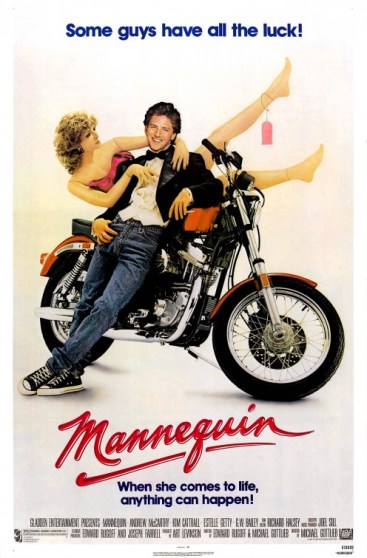
‘Mannequin’, starring Andrew McCarthy, James Spader and Kim Cattrall, would appear to fit the bill.
You haven’t heard of the director (Michael Gottlieb) but surely he can’t fail with that kind of ammo.
So you settle in expectantly. But after a few minutes it’s pretty clear that ‘Mannequin’ is sub-‘Splash’, high-concept dross, and it becomes hard to take your eyes off a bona fide turkey…
McCarthy plays a ‘quirky’ department-store window dresser who falls in love with a showroom dummy (Cattrall). The kicker is that she ‘comes alive’ at night only for him, a state of affairs closely monitored by the shop’s prissy vice president (Spader) and Rambo-obsessed security guard (GW Bailey).
Spader – one of my all-time favourite actors – gets top marks for effort but is hideously miscast. He usually has the ability to rise above apparently ‘unsuitable’ material (see ‘The Rachel Papers’ and ‘The Music Of Chance’) but not here.
James Spader
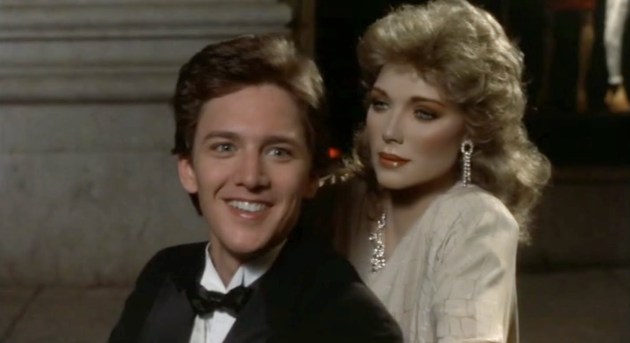
Ditto McCarthy. As an actor, on the evidence of ‘Class’, ‘Pretty In Pink’ and ‘St Elmo’s Fire’, he definitely had something, even if often ‘helplessly sucked down by the undertow of female desire’ with ‘a pair of panicked eyes that bulge out like those of a deer caught in headlights and a mouth stuck in the permanent pucker of a cat’s asshole’, in the memorable words of Jonathan Bernstein.
Andrew McCarthy and dummy. The dummy is on the right.
But here he (quite understandably) fails to decipher any character motivations, ending up either gazing ‘soulfully’ into the middle distance or yelping nonsensically. Not helped by a horrendous script, his line-readings barely make sense.
Poor Cattrall has a completely thankless role as an oppressed Ancient Egyptian who is put under a spell and then reincarnated as a mannequin (don’t ask). Elsewhere, Steve Vinovich makes for a terrible baddie, his performance barely exceeding am-dram level.
Gay and black stereotypes are hurled around willy-nilly and there’s even a large dose of weird corporate sexism thrown in for ‘comedy’ purposes. The director and editor conspire to extend every shot just too long, killing any potential giggles.
The score is awful too, with blaring sub-Harold-Faltermeyer synths and over-loud drum machines throughout (though there have been many worse movie themes than the Albert Hammond/Dianne Warren-composed, Narada Michael Walden-produced ‘Nothing’s Gonna Stop Us Now’, the UK’s second-biggest-selling single of 1987).
But, in its own way, ‘Mannequin’ laid down a marker in Hollywood, arguably influencing the crap/ infamous ‘caper’ movies of the early ’90s such as ‘The Adventures Of Ford Farlaine’ and ‘Hudson Hawk’ etc. So we have that to ‘thank’ it for…
Madchester aside, the late-’80s may be the least-heralded period of British pop, but the era also produced a surprising amount of intelligent, original bands that arguably never got their commercial due: Love And Money, Danny Wilson, The Bible, The Lilac Time, It Bites, Stump…
The list of ‘under-achievers’ is long and varied. But one name often forgotten is How We Live.
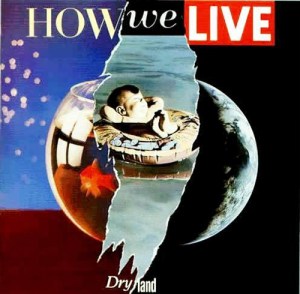
Most famous for featuring a pre-Marillion Steve Hogarth on vocals and keyboards, the band emerged from the ashes of new-wave popsters The Europeans to release their one and only album Dry Land in 1987.
Originally appearing on CBS offshoot Portrait Records but now given a shiny new remaster by Esoteric/Cherry Red, the album certainly ticks lots of ‘quality 1980s pop’ boxes: it was recorded at Crescent Studios in Bath with XTC/Peter Gabriel producer David Lord and The The/Deacon Blue engineer Warne Livesey, and features Tears For Fears’ drummer Manny Elias on a few tracks. Peter Gabriel and XTC get a thank-you on the inside cover.
Colin Woore and Steve Hogarth
Malcolm Dome’s incisive liner notes for this re-release outline the record-company shenanigans which dramatically shortened How We Live’s lifespan, whilst also acknowledging how Hogarth and fellow ex-European Colin Woore’s songwriting was very much informed by the other quality British pop of the time – Talk Talk, David Sylvian, Gabriel, Hue & Cry (Hogarth apparently being a big fan of Pat Kane’s vocals), Kate Bush.
And while it’s tempting to view Dry Land as the prelude to Marillion’s second phase, it’s pretty clear that Hogarth already had an extremely strong presence as a singer, songwriter and keyboard player long before he joined the Brit-prog behemoths.
Dry Land‘s opening 1-2-3 of ‘Working Girl’, ‘All The Time In The World’ and the title track (latter taken into the top 40 by Marillion) is pure dream-pop bliss. The latter benefits from a dramatic string arrangement, missing from the Marillion version, though connoisseurs might rue the big snare-drum sound.
‘Working Girl’ is simply a classic, with a haunting verse and swooning, truly uplifting chorus. How that and ‘All The Time’ didn’t crack the top 40 is still a mystery, though, according to manager Mark Thompson, CBS were spending most of their time and money trying to break Deacon Blue during this period.
Whilst the rest of Dry Land can’t quite maintain the quality of the first three tracks, there are plenty of other pleasures: ‘Games In Germany’ is a fine fusion of late-’80s PiL and Season’s End-era Marillion, a crashing new-wave groove with a fabulous, wrong-footing chorus.
Classy ballad ‘Lost At Sea’ is somewhat reminiscent of David Sylvian’s work of the same period, while ‘In The City’ takes a left turn into jazzy pop with great aplomb; its shimmering synths, swinging groove and catchy trumpet melody bring to mind such late-’80s movie soundtracks as ‘The Big Blue’ and ‘Betty Blue’.
‘India’ is unfortunately a bit more Chris De Burgh than It Bites, though Dave ‘Taif’ Ball’s elegant fretless bass impresses, as it does throughout Dry Land. ‘The Rainbow Room’ is perhaps the most ‘prog’ track on the album, powered along by an intricate keyboard sequence and guitar motif.
Unfortunately Dry Land was a dead end for How We Live – it stalled outside the top 40, and, although there were some big gigs including a Munich show on the same bill as Eurythmics and Tina Turner in front of 100,000 people, they called it a day in late 1987.
Hogarth was enquiring about becoming a milkman when he heard from his publisher that Marillion had been in touch. He was back in business, and remains so to this day. But Dry Land is a fascinating and worthwhile precursor.
It all came back to me recently when I heard some church bells in Totnes ringing out the opening bass melody from ‘We Could Send Letters’.
Although always one of my AC favourites, I hadn’t heard the song in years. Cue a period of rediscovery and a realisation that Roddy Frame penned four or five stand-out songs of the ’80s.
The guy had it all – intelligent lyrics, guitar chops, classic songcraft, good looks. Arguably the only thing missing was the classic album that his talent warranted.
But no matter: there were plenty of treats anyway. Here are a few:
4. We Could Send Letters (1983)
The low-key beginning builds into an epic, love-lorn pop gem, oddly never released as a single. Though dated by its Syndrum fills and airy production, the song however is water-tight with that lovely hike up into the chorus. An ’80s break-up classic.
3. Oblivious (1983)
Summery, Flamenco-tinged pop gem that reached #18 in the UK singles chart. Frame works the minor/major thing beautifully (minor-key verse, major chorus), nails a very tricky acoustic guitar part and also pulls off the seldom-achieved trick of writing something catchy but not annoying.
2. Deep And Wide And Tall (1987)
Openly states the pressing question perhaps underlying all great pop music: are we going to live together? Roddy and producer Russ Titleman achieve the Scritti groove sought throughout the Love album. A mixture of spine-tingling backing vocals and major-seventh chords fuse to gorgeous effect. Inexplicably reached a lowly #87 in the UK.
1. Working In A Goldmine (1987)
Roddy’s ‘blue-eyed-soul’ period wasn’t an outright success but this shimmering ballad with its fine Rob Mounsey arrangement is a standout. Seemingly about the unknowability of a lover (‘We love/What shines/Before our eyes/Why can’t we learn/What hides?’), it features one of the most sublime middle-eights (or, more accurately, middle-sixes) of late-’80s pop.
The late ‘80s was a great period for avant-garde guitar playing with the likes of Vernon Reid, Reeves Gabrels, Adrian Belew, Arto Lindsay, Fred Frith, Dave Fiuczynski, Stevie Salas, Sonny Sharrock, Skip McDonald, Robert Quine, Steve Vai and Bill Frisell laying down some seriously mind-bending tones and textures.
Cloud About Mercury, David Torn’s second ECM solo album, definitely put him into the same league. Though just as influential as many of the aforementioned guitarists, he has never really gained as much of a public profile despite occasional solo albums and stellar sideman work with the likes of David Bowie and David Sylvian.
My dad used to get sent a lot of music for his work and I vaguely remember him passing Cloud About Mercury onto me, knowing I was a big fan of early-’80s King Crimson.
My muso mates and I quickly grew to like the album’s perverse musical concepts and silly song titles. With a superstar avant-rock rhythm section of Bill Bruford and Tony Levin on board, it came on a bit like the follow-up to Crimson’s Three Of A Perfect Pair, but also offered a strikingly original take on jazz/rock.
I recall a contemporary review of Cloud About Mercury in Q magazine which said something like: ‘Torn luxuriates in the silence for a bit…and then goes KRAOOOOOOW!’ But in its louder moments, CAM is definitely one to annoy the neighbours. Torn’s Trans-Trem guitar enables him to create some very novel effects and original lines, with micro-tones and Middle Eastern flavours, and you can really get lost in his ambient loops.
CAM is also a very uncharacteristic ECM album, being much more in-your-face and rockist in its mixing and playing than most of the label’s output. In fact, it’s not really fair to judge it as a ‘jazz’ album at all.
But sometimes Torn seems much happier playing solo or in duet with Isham; his superb rhythm section is underused, and the tunes rely too heavily on one-chord improvisations. Consequently Bruford and Levin sound somewhat muted and can’t quite bring the sort of forward-motion dynamics so crucial to jazz/rock.
Torn toured extensively to promote CAM (but presumably not London or I surely would have been there…) with ex-Japan bass player Mick Karn replacing the unavailable Tony Levin. An excellent decision, both musically and commercially.
The band sounded fantastic and the tunes really came to life. Torn and Isham then accompanied David Sylvian on the ‘In Praise Of Shamen’ world tour which I caught at the Hammersmith Odeon in 1988.
Two quick questions to end, prompted by a discussion with my brother about Torn the other day: why isn’t there any music like this around these days? Or is there?
I was a 12-year-old pop fan when Let’s Dance hit, perfectly placed to love it and its usually-maligned follow-up Tonight.
I enjoyed almost everything Bowie did in ’85 and ’86 too, from ‘Dancing In The Street’ and ‘This Is Not America’ to ‘Absolute Beginners’ and ‘When The Wind Blows’.
But 1987 is another story altogether. Even as a 15-year-old, right from the start I sniffed something dodgy about Never Let Me Down and its accompanying Glass Spider tour. I’ve found a couple of things to love about the former in the years since (especially the great Lennonesque title track) but can’t find anything good about the latter.
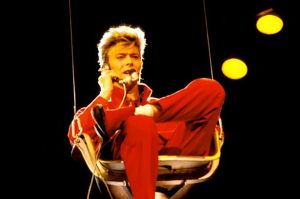
Bowie at the Never Let Me Down/Glass Spider Tour London press conference, 20th March 1987
The show was certainly ahead of its time with its tightly-choreographed, narrative vignettes – just look at Prince’s Lovesexy and Madonna’s Blond Ambition tours for evidence of its influence.
If you’re a big Bowie fan, the opening moments are amusing if a bit tasteless – guitarist Carlos Alomar attempts some ill-advised, sub-Van Halen guitar pyrotechnics while an offstage David repeatedly screams ‘Shut up!’ in ‘It’s No Game’ style.
There then follows an outrageous opening medley featuring a bizarre, lip-synched version of ‘Up The Hill Backwards’ followed by a hilariously hammy spoken word section by Bowie which closely resembles Nigel Tufnel in Stonehenge mode. Is he taking the piss? Usually this question doesn’t cross your mind with Bowie, no matter how much he ‘tests’ his audience, but it does here.
Then there’s a brutal depiction of gang warfare juxtaposed with Bowie’s cheesy, reassuring grin, a typically unsettling mixture of menace and child-like innocence. But he seems generally uncomfortable throughout the show. His attempts at audience interaction are always awkward and nothing links the songs; almost all end in blackout before another lumbers into view.
The Glass Spider tour also features surely the most dated-sounding band in Bowie’s history, with huge, triggered drums, rambling synth solos, garish, unpleasant DX7 factory sounds and lots of cod-raunchy guitar from Alomar and Peter Frampton. This is a far too ‘muso’ bunch of musicians for Bowie. The fanfare of synth horns at the end of ‘Fame’ is just unforgivable.
‘Heroes’ is stripped of all romance and majesty and becomes a jaunty throwaway. ‘Sons of the Silent Age’ coasts in on a nicely Middle Eastern-ish vibe, a huge relief from the bombast, but is nearly ruined by Frampton’s nasal lead vocals. None of these versions come close to being definitive. Also the fact that Bowie only plays four tracks from the Never Let Me Down album just a few months after its release pretty much goes to show what he thinks of it.
Bowie famously burnt the huge stage set in a field at the end of the tour. He must have wished he’d never set eyes on it. But within a year, he’d hooked up with avant-metal guitarist Reeves Gabrels, started work with influential dance troupe La La La Human Steps and embarked on some very interesting new musical adventures.
Since 1987, there have been a number of two-guitar celebrity summits but ex-Bill Evans bassist Marc Johnson’s superb ECM solo albums, ’85’s Bass Desires and Second Sight, both featuring John Scofield and Bill Frisell,quite possibly started off the whole trend.
1987’s Second Sight was considered somewhat of a disappointment on its original release, but for me this is the superior album of the two. I was a major Scofield fan when I bought it in ’87 but didn’t know Frisell’s name at all. Some of the interplay between the two is nothing less than miraculous, although one could hardly think of two more different guitarists in approach.
They leave each other space to play and at times even inadvertently double parts. The ever-reliable Peter Erskine slightly overplayed on the first Bass Desires album but here expertly marshals the material without ever being overbearing, and the compositions are so fresh, memorable and catchy.
Only the opening ‘Crossing The Corpus Callosum’ sounds like a studio jam session, but this is no ordinary jam; Scofield’s emotive bluesy cries dissolve into a fantastically-eerie Frisell ambient soundscape, leading the track inexplicably into David Lynch territory. ‘Small Hands’ and ‘Hymn For Her’ are shimmering, moving ballads, with the guitarists’ approaches meshing beautifully. ‘Sweet Soul’ is a soulful slow swinger full of fantastic Scofield soloing.
‘1951’ is a superb Frisell composition evoking Thelonious Monk’s best work. ‘Thrill Seekers’ simply swings like hell and features a classic Frisell fuzzbox solo. ‘Twister’ is great fun, Scofield’s affectionate ode to surf rock with some very funky bass and guitar interplay and a short drum solo almost as memorable as Ringo’s on Abbey Road.
As far as I know, the band toured Europe but never the UK. Would love to have seen them. The performance below is really special. No wonder Frisell is grinning like a Cheshire cat throughout.
I came across a review of Meet Danny Wilson in Q magazine which drew comparisons between Gary Clark’s voice and Donald Fagen of Steely Dan’s (spot-on).
That was enough incentive for a massive Steely fan like me to check it out. I wasn’t disappointed. Meet Danny is one of the most arresting, original debut albums of the ’80s, and it stands up extremely well today.
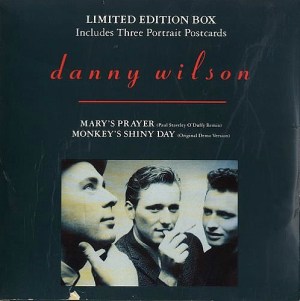
I would annoy my school friends bigging up the album and trying to get it played during art lessons – to no avail. U2, Simple Minds, The The, Fleetwood Mac and INXS couldn’t be usurped. But my enthusiasm was slightly justified when the gorgeous ‘Mary’s Prayer’ was finally a big hit at the third attempt (UK number 3, US number 23).
Danny Wilson shared a love of jazz, the Great American Songbook and Steely Dan with contemporaries Hue and Cry, Swing Out Sister, Sade and various other late-’80s acts, but (fortunately?) Meet Danny Wilson doesn’t sound remotely like any of them.
Gary graciously answered my questions in the middle of a very busy period of travelling, writing and recording. We talked about the inspiration behind the timeless ‘Mary’s Prayer’ single, hanging out with Billy Mackenzie, the golden age of Virgin Records and busking on transatlantic flights…
MP: Could you give a quick summary of how you started making music as Danny Wilson with your brother Kit (keyboards) and Ged Grimes (bass)?
GC: Ged was at school with me and clearly one of the most talented kids so we naturally gravitated towards each other and stayed together from the school band stage all the way through to Danny Wilson. Kit is my younger brother. When Ged and I returned from London we wanted to re-think the band and Kit, in our absence, had grown into a formidable musician, writer and singer so he was a natural choice to bring onboard.
What were the musical influences that went into the pot for Meet Danny Wilson? Any contemporary mid-’80s artists?
Well, I really found my voice as a writer when I stopped trying to sound contemporary. Ged and I spent three years in London living in a squat, gigging and trying to get a record deal and it seemed like the labels wanted us to sound like what was already on the radio at that time. If you can remember radio in 1984/85, everything was super- polished, super-quantised and very synthesised. Even guitars all tended to be layered in multi-effects. I very consciously decided to go in the opposite direction and return to my musical roots; all the music I loved was devastatingly unfashionable at the time. Off the top of my head, the main influences for that album were not contemporary at all: Sinatra, Bacharach and David, Jimmy Webb, Becker and Fagen, Tom Waits, a little bit of Hall and Oates, heavy dollops of the Great American Songbook and a ton of soundtrack records.
How did Danny write songs? Were all the tracks co-written or did you provide the blueprints?
I wrote all of the songs on that album and they were all written and mostly demoed prior to recording. The only exception I recall is finishing ‘Five Friendly Aliens’ at the piano in Puk studios after we’d started recording the rest of the album.
How did you come to be signed to Virgin? Were you fans of the label beforehand?
We played a gig in a bar in Edinburgh and a music journalist called Bob Flynn was there. He wrote a review in NME that literally changed our lives. The review was so good and the band were so unknown that the record labels who had systematically rejected us only months before were calling Bob asking how they could get in touch with the band. We had really served our time in the trenches live and in the studio so we were really ready for it when it came. The next gig we did in Edinburgh was packed and half of the audience were A&R and publishers from London. We literally had the choice of every major label and almost signed to Warners. In the end, a mixture of Virgin’s reputation as an artistic label, their sheer passion for the music and their willingness to give us complete artistic control won the day.
Can you remember your inspiration for ‘Mary’s Prayer’ and where you wrote it?
Yes, I wrote it in the squat in London quite a few years before it was released. My friend, the songwriter Ali Thomson, loaned me a Roland Juno 60 synth and I just switched on the first preset and immediately played the verse chords without thinking (they’re all white notes!). The melody and a large chunk of the first verse lyric came to me instantly. I liked it but couldn’t get a chorus that did the verse justice and it took about another year of me coming back to it until I finally hit on the chorus.
How did you come to include Lester Bowie’s Brass Fantasy on the album? Definitely not an obvious choice of special guests! Weren’t they signed to Virgin at the time?
They were signed to ECM. The Virgin connection came later through us. Howard Gray (later of Apollo 440) was producing the first half of our album at Puk. They had an incredible system in there and we liked to blast records on the big speakers at the start of the day and at the end of the night with some fine Elephant beers for refreshment. Digital was in its infancy and ECM were making some of the first records that could be legally labelled ‘DDD’ which meant ‘recorded, mixed and mastered without leaving the digital domain’. Howard played us Lester’s ‘I Only Have Eyes For You’ one of those nights as an example of how great this process could sound and we all fell instantly head over heels in love. By sheer mind-bending coincidence, we saw that Lester Bowie’s Brass Fantasy were playing Copenhagen when we were still in Denmark. We went to the gig, one of the greatest live shows I have ever seen, and accosted Lester afterwards. It’s a little-known fact that because of budget restrictions, Ged, Kit and I busked our fare on a very early Virgin Atlantic flight to New York so we could be there for the sessions! Pre-9/11, of course… But we actually got free flights for entertaining the passengers in mid-air.
Your amazing vocal on ‘You Remain An Angel’ always reminded me of The Associates’ Billy Mackenzie – were you a fan and did you know him at all?
Well, thank you. I’m a huge fan of Billy’s work but I can honestly say that The Associates were nowhere near my mind when we did that song. There is a B-side called ‘Living To Learn‘ that has a huge Associates influence. Billy and I are from the same home town, Dundee in Scotland, and I got to know him a little. We would all hang out at a place called Fat Sam’s cocktail bar where they played great music and had great live acts passing through. We saw some amazing bands in their infancy back then. Billy was always so wonderful, charming and encouraging to me.
Meet Danny Wilson has a really pleasing mix of acoustic instrumentation and late-’80s technology – was there any pressure to be ‘produced’ and make a very modern-sounding record? I have a B-side version of ‘Aberdeen’ that was subtitled something like ‘The Way It Should Have Been‘…
No. Virgin were great like that. I think they understood that we had just as much chance commercially by being true to ourselves as we would have had conforming to some blueprint of what radio sounds like. I wish that vision was more prevalent in the music business today. I will say that although we used the most up-to-date technology available at the time, we didn’t use it to sound modern but to get what was in our heads onto the recording. On ‘Aberdeen’, for instance, we used a Fairlight to get the trumpet and string sounds but the production is probably more ’60s in tone than ’80s. That B-side was an interesting one; we had made a very early stripped back Portastudio demo of that song before the album and it had a certain beatboxy charm that we all kind of harked back to. The tape was lost so that B-side was our attempt to recreate that vibe. Never a great idea!
How do you feel about Meet Danny Wilson and its place in the 1980s musical landscape now?
I feel pretty much the same as at the time. It’s very me, very honest, very heartfelt and, just like me, doesn’t fit in anywhere. Exactly what we were going for, I suppose.
What are you working on at the moment?
I’m always writing and recording with other artists. That’s what I do these days and have a whole heap of stuff in the pipeline but aside from that I’ve just written the music with John Carney (Once, Begin Again) for his next movie (‘Sing Street’) which I’m very, very excited about. As it happens, he got in touch with me because Meet Danny Wilson was a record his brother had turned him onto as a young kid growing up in Dublin in the ’80s. That neatly brings this interview to a lovely, rounded conclusion so I’d better shut up now!
I came across this gem in a big crate of reduced cassettes in the old Our Price shop in Richmond town centre.
I was a huge fan of Miles and Marcus’s ’80s work but Siesta had somehow passed me by. It was hardly reviewed anywhere despite the fact that it was the official follow-up to Tutu, possibly because it was ‘just’ a movie soundtrack and – even worse – the soundtrack to a really terrible movie.
But it quickly became the soundtrack to my summer of 1988 along with Prefab Sprout’s From Langley Park to Memphis, Prince’s Lovesexy, Thomas Dolby’s Aliens Ate My Buick and Scritti Politti’s Provision. Its Spanish-tinged melancholia, beautiful playing by Miles and stunning bass/keyboard work and production by Miller drew me in immediately.
Miles’s stock was rising high at the beginning of 1987. He was healthy, enjoying critical and commercial success with Tutu and playing to packed concert halls. The question was, how would he follow Tutu? A film soundtrack was definitely not the predictable option.
Of course, Davis was no stranger to the world of movie scoring, even though his famous Ascenseur Pour L’échafaud (Lift to the Scaffold) soundtrack was mostly improvised in just two days, and his music for Jack Johnson was similarly spontaneous though subject to detailed post-production work by Teo Macero.
But when Davis got a call from the producers of Siesta after their request to use Sketches Of Spain on the film’s soundtrack was turned down, he turned to the trusted Miller for help. Miller was also on a roll at the beginning of ’87. Fresh from co-producing and co-composing Tutu, his career was branching out in all directions.
He hadn’t done any soundtrack work before and embraced the project, thrilled to work with Miles again and rightly sensing that the movie’s Spanish elements might open up some dramatic musical possibilities. But the clock was ticking, the budget was tight and time was of the essence.
Siesta is a fascinating companion piece to Tutu and it features some of the most arresting and spontaneous Miles trumpet playing from the last decade of his life. Indeed, some Davis-watchers such as critic Paul Tingen reckon it’s the pinnacle of Miller and Miles’s ’80s collaborations.
Miles sounds fit and strong, investing the material with both power and pathos, consistently providing a sound that someone once described as ‘a little boy looking for his mummy’. Apparently when Miller played the elegiac ‘Los Feliz‘ to an assembled cast and crew, several people broke down in tears.
Miles solos at length with glorious open horn on several tracks. The dramatic, flamenco-tinged ‘Conchita‘ was used by American ice skater Nancy Kerrigan for her 1992 Olympic routine – she got a bronze medal.
The ghost of Sketches of Spain/Miles Ahead arranger Gil Evans looms large and the album is dedicated to him, ‘The Master’. One can only imagine how ‘Los Feliz’, ‘Siesta’ or ‘Lost In Madrid‘ might have sounded with Evans’ full orchestral backing and arranging, but Miller and main collaborator Jason Miles consistently find just the right musical ingredients with gorgeous piano voicings, subtle synths and fretless bass.
As George Cole pointed out in his great book ‘The Last Miles‘, only Michel Legrand, Gil Evans and Miller’s names have shared a Miles Davis album cover, and that really proves how highly Miles rated Miller’s efforts. According to Miller, there is much more Siesta music residing in the Warner Bros vaults – here’s hoping the album gets the ‘Special Edition’ treatment soon.

 You know the drill – it’s a few days after Christmas and the house is finally quiet.

 It all came back to me recently when I heard some church bells in Totnes ringing out the opening bass melody from ‘We Could Send Letters’.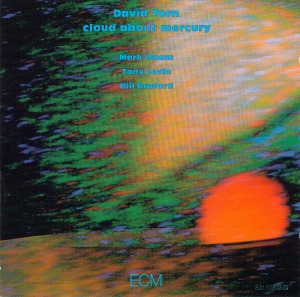
 I was a 12-year-old pop fan when Let’s Dance hit, perfectly placed to love it and its usually-maligned follow-up Tonight.



 movingtheriver.com