Michael Jackson’s ‘Thriller’ Video Premiere: 40 Years Ago Today

“‘Thriller’ made MTV. ‘Thriller’ created the home video business. ‘Thriller’ created so many things.”
John Landis

It’s hard to overestimate the cultural impact of the ‘Thriller’ video. Frequently parodied and ripped-off but still powerful, it premiered on Channel 4 and MTV 40 years ago today.

In the UK, it was shown (without any end credits) during a special late-night edition of ‘The Tube’ just before midnight on Friday 2 December 1983. I recall being allowed to stay up and watch it. It was one of the most exciting things I’d ever seen on TV, and also one of the scariest… Here’s how the special ended:

Let’s rewind to July 1983. The Police’s Synchronicity had just bumped Jackson’s Thriller album off the top of the Billboard charts. Jackson’s label Epic quickly formulated a plan to reinstate Thriller, reluctantly suggesting that its title track be released as a single (executives reportedly believed it to be a ‘novelty’ record!).

The catalyst for the groundbreaking video, which was part-financed by MTV, was Jackson phoning director John Landis in August 1983. He professed his love for Landis’s ‘An American Werewolf In London’, told him about the impending single release of ‘Thriller’ and then uttered the immortal words: ‘Can I turn into a monster?’

The rest is history. The video helped double Thriller’s album sales almost overnight, arguably broke down racial barriers in popular entertainment and helped raised the music-video format into a serious art-form. It also has to be said: it’s probably the last time Michael seemed relatively ‘normal’ (though his line ‘I’m not like other guys’ still raises a titter…).

“The only video we ever paid for was ‘Thriller’. We were playing it every hour, and announcing when it would next air. It brought people to MTV for the first time, and it made them stay and watch it again and again. Now everybody was into MTV.”
Bob Pittman, MTV executive

“When MTV started, it wanted nothing to do with Black artists. I thought, Wow, are we gonna miss out on this? But then I gave them ‘All Night Long’ after Michael had broken down the door. And from then on I was on MTV.”
Lionel Richie

“Michael Jackson had taken hold of the video form and shown everyone what you’re supposed to do with it. We all thought: Oh, OK – dancing!
Rick Springfield

Let us know your memories of watching ‘Thriller’ for the first time.

All quotes are taken from the excellent book ‘I Want My MTV’.

Check out Anthony Marinelli’s YouTube channel for lots of great muso stuff on the making of the Thriller album.

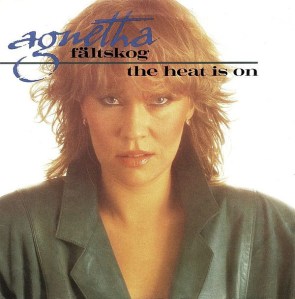
Agnetha Faltskog: The Heat Is On

One of the many pleasures of listening to the Forgotten 80s radio show is hearing a hit of which you have absolutely no memory whatsoever.

A classic example came on the air a few weekends ago. The intro featured a ramshackle, lumbering, almost-reggae groove with party voices, sleazy horns and a good bass player (revealed when listening on a decent system, but it’s almost impossible to find out which musicians played on the single) before a strident, excellent, slightly familiar voice took centre stage.

Eddi Reader? Basia? Debbie Harry? Lene Lovich? Wrong, wrong, wrong, wrong. I was gobsmacked to hear that it was actually the first solo single by Agnetha Faltskog of ABBA, released just over 40 years ago (her bandmate Frida had just had her own hit, ‘I Know There’s Something’s Going On’, produced by Phil Collins).

‘The Heat Is On’ got to #1 in Sweden, Denmark, Norway, Finland, and Belgium, #2 in The Netherlands and Germany, #29 in the USA and #35 in the UK.

The incredibly catchy number turns out to be a cover of a 1979 near-hit by Australian singer Noosha Fox. Written by Florrie Palmer and Tony Ashton, it was also massacred by Manfred Mann’s Earth Band in 1980 in a truly screwed up version retitled ‘On The Run’.

But back to Agnetha. Her version of ‘The Heat Is On’ was produced by Mike Chapman, on a particularly hot streak in early 1983 having just helmed Blondie’s biggest albums and Altered Images’ classic single ‘Don’t Talk To Me About Love’.

Faltskog’s accompanying album Wrap Your Arms Around Me is not so great but has apparently sold approximately 1.5 million copies worldwide to date (her second solo album, 1985’s Eyes Of A Woman, was produced by 10cc’s Eric Stewart). She has also been the subject of a BBC Four documentary (a dubious honour?) in the UK.

Now, got to get this damn song out of my head – almost an impossible task once heard a few times…

Level 42: Rockpalast 40 Years On

It’s not surprising that a lot of Level 42 fans cite 1983 as the peak of the band’s career.
Messrs. King, Lindup, Gould and Gould had just released their first UK top 10 album Standing In The Light (and arguably their greatest single ‘The Sun Goes Down’) but were still very much holding on to their jazz/funk/rock roots, despite Polydor Records wanting more hits and less instrumentals.

The band were also still very much an in-your-face live act in 1983, a year off adding sequencers, drum machines and a much more commercial sheen to their sound. They toured Standing extensively during the autumn, including a dynamite show filmed 40 years ago today in Bochum, Germany, recently released on DVD.

It’s Exhibit A for those who love the early days of the band. And, for Level fans like movingtheriver who only came onboard around 1985, discovering the broadcast was gold dust. Also it’s not every day you see a bass player laying down deliciously funky lines while dancing like Max Wall (at around 4:30 below) and telling the fans to ‘Clap, you sods!’.

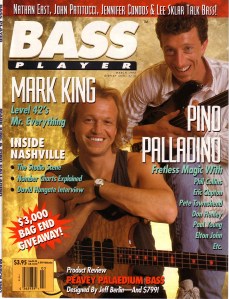
It’s interesting though that Mark King himself to this day strongly questions the live potency of the band during this era. In the March 1992 issue of Bass Player magazine, he came out with all guns blazing, discussing their November 1983 ‘Whistle Test On The Road’ appearance at the Brixton Ace (now the Academy):

‘I dug up an old one of us doing a live BBC programme… I thought, “Oh yeah, they were the good old days”. So I put on the video – and it was crap. The audience were fine, the lights were fine, the sound was fine. The band was crap. It was just so unsure, so uncertain…’

So which Level do you prefer? The choice is yours… In any case, it’s exciting to report that they’re currently in the middle of a UK tour celebrating 40 years of ‘The Sun Goes Down’.

Further reading: ‘Level 42: Every Album, Every Song’.

Then Jerico: Now That’s What I Call…Not Bad

Of course it was just teenage aggro/jealousy, but my schoolmates and I were always a bit suspicious of those late-‘80s pop acts who were much fancied by our female friends: Morten Harket, Richard Marx, Jason Donovan, the Goss brothers, Marti Pellow, Nathan out of Brother Beyond, those blokes from Big Fun.

But Mark Shaw of Then Jerico was probably their favourite, instantly putting his band’s music into the dumper, even though we probably all had a soft spot for their 1987 hit ‘The Motive’.

Listening back now on a good system, it’s a superb-sounding single – impactful, clean and shiny, with great instrument separation. It typified late-1980s British pop/rock helmed by excellent producers who had learnt their trade in the golden age of commercial recording studios, people like Tim Palmer, Rhett Davies, Peter Henderson, Andy Richards, Jon Kelly, Rick Nowels, Mike Shipley, Bruce Lampcov, Peter Collins, Julian Mendelsohn, Gary Langan et al.

Of course Trevor Horn was an overarching influence, representing the gold standard. It Bites’ Francis Dunnery mocked ‘Big Area’ (see below) producer Langan (collaborator with Horn on Yes’s 90215, Malcolm McLaren’s Duck Rock and FGTH) in a 2021 interview for PROG magazine: ‘Everyone who had ever walked past Horn was given a record to produce. I think Trevor’s milkman produced Then Jerico and had a hit!’

Yes, there was a fair amount of turd-polishing but these producers inspired the late-1980s rock comeback, generating hits for Breathe, Fuzzbox, Cutting Crew, Paul Young, Love & Money, Deacon Blue, Killing Joke, All About Eve, The Mission.

And Then Jerico. Maybe they were actually pretty good. Their best songs – ‘Sugar Box’, ‘The Motive’, ‘Big Area’ – marry a sort of U2/Simple Minds/Tears For Fears ‘thing’ with Shaw’s tremulous vocals to strirring effect, something akin to the sound of falling in love. When any of them come onto ‘Forgotten 80s’, it’s impossible to turn off. Though one is still slightly reticent about checking out a whole album in one sitting.

And guess what – Shaw has reformed the band, and they’re touring extensively this year. And he has rather a juicy/chequered recent past to tell of too.


XTC: Mummer 40 Years On

There can’t be many more pleasurable summer activities than reclining in an English garden.

But XTC’s chief songwriter/vocalist Andy Partridge cut somewhat of a sad figure during May and June 1982 as he sat hunched over his acoustic guitar, working on new compositions, detoxing from Valium addiction and contemplating the end of his concert career.

Still, those songs were some of his best ever. But they appeared on an extremely inconsistent album called Mummer, named for the silent actors (keeping ‘mum’) who travelled around 18th century Britain and Ireland, released 40 years ago this week and very nearly titled Fruits Fallen From God’s Garden.

Japan (Tin Drum) producer Steve Nye was summoned for the project, recorded at Martin Rushent’s Genetic Studios and The Manor – a strange choice. He is good with the close-mic’d, dry-sounding, beautifully recorded acoustic-based tracks but not the heavier ones which were later remixed by Phil Thornalley, while the legendary Alex Sadkin redid ‘Wonderland’.

But Nye had his work cut out – the album is schizophrenic to say the least. The best songs sound like a decent band playing pretty much live in the studio – ‘Love On A Farmboy’s Wages’ (has there been a better English pop song about poverty?), ‘Great Fire’, ‘Ladybird’ (Andy discusses his jazzier influences in this great video), ‘Me And The Wind’. All wonderful. Dave Gregory is coming into his own with superb contributions on guitar and keyboards.

But the worst songs are rhythmically plodding – it’s understandable that Andy was trying to get away from 4/4 rock drums but ended up with too many cyclical grooves (putting pay to Terry Chambers’ tenure on the kit) – and melodically extremely challenging. Colin Moulding is not in great writing form either, ‘Wonderland’ excepted, though that too might have benefitted from a simpler treatment.

Mummer was initially rejected by Virgin A&R agent Jeremy Lascelles, who demanded another single. The excellent ‘Great Fire’ was Andy’s last-minute response, produced by Haircut 100 helmer Bob Sargeant, but it disappeared without trace – Radio 1 reportedly played it only once!

Along with The Big Express, Mummer was XTC’s worst selling album, reaching a barely believable #51 in the UK album charts and doing little business elsewhere, just over a year after ‘Senses Working Overtime’. It has to be said it was also not served well by its awful cover. But it features plenty of great music.

Further reading: ‘XTC Song Stories’ by Neville Farmer

Genesis: ‘Mama’ @ 40

If any more proof was needed as to how far the UK pop charts have declined since the mid-1990s, look no further than the fact that Genesis’s ‘Mama’ – released 40 years old this week – was their biggest hit, going all the way to #4.
Not bad for a nearly-seven-minute song without a proper chorus about a young man’s troubled relationship with a sex worker.

In my opinion, ‘Mama’ is one of the great singles of the 1980s, epic and menacing, and the last decent showing for post-Gabriel Genesis (I couldn’t/can’t get anywhere with its attendant 1983 self-titled album, nor any of their subsequent projects).

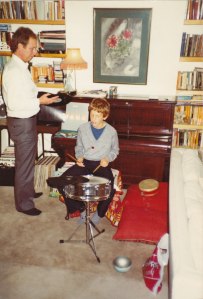
In autumn 1983, I was vaguely aware of Phil Collins, my ears having been piqued by my dad’s frequent playing of Face Value around the house. But when my uncle bought me the ‘Mama’ 12-inch single, I’m pretty sure I’d never heard of Genesis. But Uncle Jim wrote ‘Side A is the good side!’ on the front for guidance, knowing I’d love Phil’s immense drum sound (to these ears, still just as ‘shocking’ as ‘In The Air Tonight’). For me, this is the apex of Phil’s best era – roughly 1976 to 1983.

The author with his first snare drum, his dad the DJ about to put on ‘Mama’, circa autumn 1983

‘Mama’ was recorded at the band’s Farm studio near Chiddingfold, Surrey, and co-produced by Hugh Padgham. Phil set up in the new drum room modelled on the famous Townhouse Studio 2 in Shepherds Bush.

There are still so many pleasures – Phil’s sibilant, Lennon-influenced vocals (including a homage to Melle Mel), making full use of the slapback echo which went straight onto tape rather than being added later. Banks’s ominous synth layering and wacky lead tones. Mike Rutherford’s Linn drum programming, played through a guitar amp.

Also listen out for the way Phil avoids metal completely until the beginning of the fade, when his enormous crash cymbal is a huge release.


Prince: Sign “O” The Times Revisited

It’s possible that ‘Sign “O” The Times’ (the single) had the same effect on one generation of music lovers as ‘Waterloo Sunset’, ‘Arnold Layne’, ‘Purple Haze’ or ‘Penny Lane/Strawberry Fields’ (all released between March and May 1967) did on another.

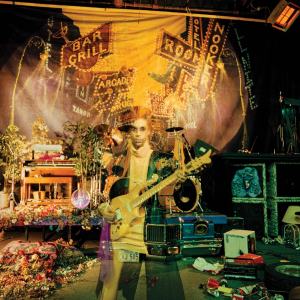
Released on 13 March 1987, it’s hard to think of another top 10 single of the 1980s with as much as space in it (and uncharacteristically deep reverb on Prince’s vocals, presumably utilising the famous Sunset Sound echo chamber). Apart from his guitar and voice, it was all performed on a Fairlight synth/sampler.

Adorned with a back cover featuring Cat Glover, the single drew lyrical inspiration from various news items read in The LA Times during the week of Monday 14 July 1986: Reagan’s ‘Star Wars’ program, the AIDS crisis, the investigation into January’s space shuttle disaster and the inner-city drug wars.

Lisa Coleman reports that she heard Prince’s amazing programmed drum groove blasting out of the venue speakers during a soundcheck in Denver in early July 1986.

Famously barred from releasing a three-album set by Warner Bros. – a process outlined in detail in Duane Tudahl’s wonderful recent book – Prince regrouped, quickly creating new material and then making the title track his new double album’s centrepiece.

Sign became the sound of summer 1987 in my corner of west London. Prince had been on my radar before – Parade was a definite sleeper – but this was it. And yet it still seems one of those ‘classic’ albums that gets talked about more than listened to.

So I listened to it. In one sitting. Probably for the first time in about five years. It’s probably even better than I remembered it. Has anyone ever captured a ‘party in the studio’ vibe better than Prince on ‘Housequake’ and ‘Play In The Sunshine’? And usually he only had Susannah Melvoin and engineer Susan Rogers for company. Of course this was in a sense a throwback to classic Little Richard and Chuck Berry, as well as James Brown tracks such as ‘Get Up Offa That Thing’.

He begins each side with groundbreaking tracks for him that took a while to record. We’ve discussed ‘Sign’. Then there was ‘It’, actually his first song exclusively using the Fairlight (apart from his guitar and vocals). Then ‘U Got The Look’, which was drastically sped up at the eleventh hour, ratcheted up a few semitones. Then ‘The Cross’, written and recorded the day after the infamous Los Angeles earthquake of 12 July 1986. Prince’s drums on this track speed up a lot – Rogers reportedly noticed but decided not to point it out.

Rogers also reports that she occasionally badgered Prince about the seemingly ‘lo-fi’ nature of these recordings, but he didn’t budge, and the album benefits from that ‘unfinished’ quality, even if it features a lot less bass than most modern music.

Sign features probably Prince’s greatest music, but we could all debate which tracks could have been left off. I could do without ‘It’, ‘Forever In My Life’, ‘Slow Love’, ‘The Cross’, ‘Adore’ (and would have preferred ‘Power Fantastic’, ‘Dream Factory’, ‘Crucial’, ‘Sexual Suicide’ and ‘Good Love’, but Prince had long jettisoned them by early 1987…).

Also why does the superb album design get short shrift? It’s a key part of the package. Hail photographer Jeff Katz and graphic designer Laura (niece of Tommy) LiPuma.

Terence Trent D’Arby: ‘Wishing Well’ Hits #1 35 Years Ago Today

Of the four hits from Terence Trent D’Arby’s superb debut album Introducing The Hardline According To…, it comes as somewhat of a surprise to report that only ‘Wishing Well’ got to #1 on the US singles chart.

Co-written by Terence and former Rip Rig + Panic bassist Sean Oliver, it reached the top spot 35 years ago today after a remarkable 17-week climb (only Eurythmics’ ‘Sweet Dreams’ endured a longer run to US #1 during the 1980s).

Not bad for a song without a proper chorus. But it hardly matters – it’s such an infectious groove with a fine vocal performance.

The album, all but one track co-produced by Terence and Heaven 17’s Martyn Ware, also reached its peak US position of #4 on this date in 1988. It’s still one of the most consistent, exciting debut collections of the decade, well worth revisiting.

Equally impressively, Terence also won a Best Male R&B Vocal Grammy award at the 1988 ceremony, beating off some very heavy company (though he lost out in the Best New Artist category to Jody Watley).

Gig Review: Hue and Cry @ Pizza Express Holborn, 31 March 2023

Hue and Cry: brothers Pat and Greg Kane. Photo by Phil Guest.

Some artists in the 1980s pop firmament (Paul Weller, Everything but the Girl, Simply Red) got away with marrying ‘aspirational’ music with supposed ‘socialist’ principles.

But Hue and Cry (brothers Pat and Tom Hanks-lookalike Greg Kane) had a tougher time. After their first two years of hits (‘Labour Of Love’, ‘Looking For Linda’, ‘Violently’), somehow their marriage of Sinatra-meets-Steely music and ‘political’ lyrics started to seriously wind people up in the age of grunge and Britpop.

Their 1988 album Remote (featuring an astonishing lineup of guest players including Michael Brecker, Tito Puente, Roy Ayers and Ron Carter) is certainly a desert-island disc but, by their third collection, 1991’s low-key Stars Crash Down, the momentum had been lost, typified by a famous hatchet job in Q magazine’s 100th edition begging them to split up (‘Britain’s Most Hated Band’!) – though it’s oft forgotten that the Melody Maker, NME, Sounds and Smash Hits quite liked them during their pop peak.

Since then, Radio 1’s loss has been Radio 2’s gain. The brothers Kane have ploughed on, recording the occasional album, generally eschewing the 1980s ‘nostalgia’ tours in favour of regular, relatively low-key live work. The duo format seems to be suit them very well – see 1989’s excellent Bitter Suite – and it’s been their preferred modus operandi over the last 20 years or so.

This Pizza Express gig was your correspondent’s first time seeing them live for 35 years, and anticipation was quite high, though I don’t exactly have happy memories of their 4 December 1989 gig at Hammersmith Odeon complete with ‘wacky’ horn section and less-than-stellar musicianship.

It’s not enough for 1980s acts to just play live now – the audience wants stories, and these boys have some good ones. But first Pat – in excellent voice throughout – laid down the gig’s house rules: 1. Things will only progress at a stately pace. 2. If you DON’T film our best songs and post them on twitter, you’re out.

Pat revealed that two of their early singles were written as a result of ‘being educated by a triumvirate of feminists at Glasgow University from 1981 to 1984’: indeed ‘I Refuse’ and ‘Violently’ were revelatory here. ‘Looking For Linda’, meanwhile, concerning a ‘Northern powerhouse’ who has never revealed herself to the Kane brothers since the song’s success, was a winner but missed a few neat chord changes/modulations from the original.

Their penchant for winding people up – gleefully acknowledged by Pat – emerged with new song ‘Everybody Deserves To Be Loved’ which sounded like The Blue Nile doing EDM, and there were less than essential covers of ‘Black And Gold’ and ‘Take Me To Church’.

But their best songs were harmonically-interesting, subtle explorations of adult relationships. Comparisons with Bacharach and David’s work wouldn’t be out of order. ‘Long Term Lovers Of Pain’, the ‘comeback’ single from Stars Crash Down, might just have been a Deacon Blue-style hit, but their luck had run out by then.

‘Just Say You Love Me’ and ‘Pocketful of Stones’ sounded every inch like modern standards, while excellent new song ‘Heading For A Fall’ borrowed verses from ‘The Message’ and ‘Inner City Blues’ – ‘three for one!’ trumpeted Pat.

The Kane brothers ended with a medley of ‘Shipbuilding’ and ‘The Man With The Child In His Eyes’, showcasing Pat’s rich, expressive voice to great effect. While Hue and Cry’s catalogue is unlikely to reach the critical heights of those songs’ classic status, this enjoyable gig shone a light on some underrated gems well worth discovering/rediscovering. There’s life in the duo yet.

ZZ Top: Eliminator @ 40

So here we are. ZZ Top’s breakthrough album, 20 million sales and counting. Not bad for a lil’ ole blues’n’boogie trio from Texas.

But Eliminator, released 40 years ago this week, also carries some controversy around with it. As they say: where there’s a hit, there’s a writ.

Along with Sgt. Pepper’s, Roxy’s Flesh & Blood and a few others, it was one of the first albums your correspondent remembers enjoying all the way through. And, if you were a burgeoning drummer, ‘Gimme All Your Lovin’’ was the one all your schoolmates wanted you to play.

It’s a lesser known bit of 1980s muso gossip that ZZ guitarist/chief vocalist Billy Gibbons was one of the first major figures to get hold of a Fairlight synth/sampler. He experimented with it on the band’s 1981 album El Loco, but that was a stiff, selling half as many copies as 1979’s Deguello.

It was time for a rethink. First port of call – the beats. It wasn’t easy to dance to ZZ. Gibbons asked chief engineer Terry Manning to research new grooves, so he hit the discos. Inspired by OMD, Devo, Human League, Depeche Mode et al, Manning bought an Oberheim DMX drum machine and the band started working up new material in their Memphis bolthole.

Moving to drummer Frank Beard’s home studio in Houston, a chap called Lindon Hudson helped a lot with the new technology and songwriting (uncredited on Eliminator, he later won substantial damages after a lawsuit). He also claimed 124 beats-per-minute was the sweetspot.

A move to Memphis’s Ardent Studios saw Gibbons hit the city’s after-hours joints. ‘TV Dinners’ was apparently inspired when a woman entered a club wearing a white jumpsuit with those words emblazoned on the back. He also claimed that ‘I Got The Six’ was inspired by a visit to peak-punk London in 1977.

All in all, Eliminator took about a year to make. It still has many pleasures, Gibbons’ blues soloing and frequent surreal vocal interjections/lyrics chief amongst them. Gibbons and Dusty Hill also play in some strange, unguitar-friendly keys, possibly because some of the material was written on keyboards. Try playing along.

Gibbons’ 1933 Ford coupe on the cover was a tax write-off and helped to make Tim Newman’s vids for ‘Legs’, ‘Sharp Dressed Man’ and ‘Gimme’ bona fide 1980s classics. The band’s nine-month world tour kicked off in May 1983, aided by Manning’s beefy sound mix courtesy of the album’s four-track masters.

It’s fair to say that Eliminator massively influenced Prince, the Stones, Van Halen and Def Leppard, and arguably changed the way rock artists used technology forever.

Happy 40th birthday to a 1980s classic. But hey, don’t forget to credit Manning and Hudson…