
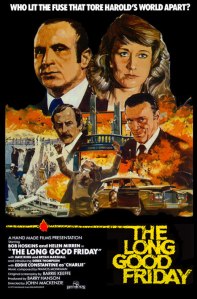
 Every post-1971 British crime movie has had ‘Get Carter’ and ‘Performance’ in its rearview mirror.
Made in summer 1979 but not released until 18 months later, ‘The Long Good Friday’ (original title: ‘The Paddy Factor’) has often been mentioned in the same breath as ‘Carter’. Is that justified?
Initially bankrolled by legendary impresario and producer Lew Grade, it was written by proper East Ender Barrie Keeffe (who reportedly knew Ronnie Kray), directed by Scotsman John Mackenzie and starred Brit acting ‘royalty’ Bob Hoskins and Helen Mirren.
When completed, the suits almost refused it a cinema run, deeming it too nasty, hoping to recut it and farm it out to television. A disgusted Mirren asked her friend Eric Idle to attend the premiere at the London Film Festival towards the end of 1980.
Idle was impressed and passed it on to his mate George Harrison, the main moneyman at newly-formed HandMade films. Harrison apparently loathed it but agreed it had hit potential. HandMade bought it for £700,000, funded by ‘Life Of Brian’ profits.
But how does ‘The Long Good Friday’ stack up in 2024? I watched the posh new 4K restoration – looks fabulous, but this film really belongs in a mid-’80s Cannon fleapit. With its casual racism/sexism/ableism and overlong dialogue scenes, it’s also now more redolent of ‘Sweeney!’, ‘The Squeeze’ and ‘Villiain’ than ‘Performance’ or ‘Get Carter’ – but is still fascinating and memorable.
There’s some real Brit nastiness, or ‘virtuoso viciousness’, as Pauline Kael called it in her ‘Carter’ review. Mackenzie comes up with three or four memorable set pieces (and a great final five minutes, apparently the first thing they shot, during which apparently the director drove the car and ‘fed’ Hoskins the entire plot of the film) which have given the movie legs. He also uses the London locations with some elan.
Keeffe comes up with some preposterously funny lines – ‘It’s like Belfast on a bad day!’ etc. – and Francis ‘Sky’ Monkman’s disco/prog/fusion score adds value. There’s also an amazing array of ‘Hey, it’s that guy/girl!’ actors, from Pierce Brosnan (whose swimming pool scene seems to have influenced Bronksi Beat’s ‘Smalltown Boy’ vid) to Gillian Taylforth.
Sadly though the key performance by Derek Thompson (Charlie in ‘Casualty’!) weighs the film down with its stoned insouciance and dodgy London accent (ironically, Thompson was born in Belfast).
And though some have compared Hoskins with Edward G Robinson and James Cagney (Keeffe apparently pictured a cockney Humphrey Bogart!), despite some amusing line readings these days he comes across more like Alan Sugar after a few too many espressos, whereas Michael Caine in ‘Carter’ had a kind of timeless, glacial rage.
Apparently under the influence of ‘Lock, Stock and Two Smoking Barrels’, Empire magazine – astonishingly – voted ‘The Long Good Friday’ the #1 greatest British film in a 2000 poll. Hard to think it would get that accolade today. Still, it’s a fascinating snapshot of London on the brink of Thatcher’s decade, and a must-see for fans of 1980s cinema.
Further reading: ‘Very Naughty Boys’ by Robert Sellers
 One of the few positives of this lockdown may be investigating your local area more than usual, courtesy of the ‘permitted’ (approved by UK government) daily walks.
 movingtheriver.com