Book Review: Formation (Building A Personal Canon Part 1) by Brad Mehldau

There’s a history of controversial jazz autobiographies that would have to include Mezz Mezzrow’s ‘Really The Blues’, Charles Mingus’s ‘Beneath The Underdog’, Sidney Bechet’s ‘Treat It Gentle’, Billie Holiday’s ‘Lady Sings The Blues’, Dizzy Gillespie’s ‘Dizzy’ and Art Pepper’s ‘Straight Life’.

It may be somewhat of a surprise to report that the apparently mild-mannered, urbane Mehldau – modern master jazz pianist and probably best known for his majestic Radiohead and Beatles covers – joins that list with ‘Formation’, charting his musical and personal rites of passage from the mid-’70s to late 1990s.

The general fan may have heard Mehldau make vague references to his previous junkie life – here we get the full story, and it’s both revelatory and somewhat disturbing. Also, unlike some of the books listed above, ‘Formation’ is certainly not ghostwritten, hardly a surprise when one considers some of the extensive liner essays Mehldau has penned, particularly 2000’s Places.

Growing up in mid-‘70s New Hampshire, Mehldau’s young life is all very Judy Blume, soundtracked by Billy Joel, Beethoven, Fleetwood Mac, the Eagles, Steve Miller and Supertramp, with the twin undercurrents of organised religion and the Cold War.

At the turn of the new decade, piano lessons become increasingly important and he becomes a major prog fan, Pink Floyd and Rush becoming key touchstones, though he also relates the loneliness in his own life to the music of Miles, Billie Holiday and Brahms.

A move to Hartford, Connecticut, precipitates the first major instances of bullying, outlined in shocking detail, a theme that will echo throughout his time in formal education. It’s hardly surprising that alcohol and drug use become regular companions during his late-teenage life, as do doubts about his sexuality.

In the age of Reagan, Stallone and Schwarzenegger, Mehldau becomes a true ‘outsider artist’, finding solace in the works of Thomas Mann, the Beats, German philosophers and Bob Dylan. Meanwhile high school hastens the flowering of his jazz piano talent.

From there, it’s a short ride to Mehldau’s relocation to New York in the late 1980s, and his jazz piano initiation at great lost venues such as Augie’s and the Village Gate. It’s hard to think of another book which better explores that fabled NYC jazz scene of the late 1980s to mid 1990s, nor one that better explores the thought processes and doubts of a nascent jazz pianist.

There are touching tributes to his piano teachers and also contemporary ivory-ticklers such as Larry Goldings, Bill Charlap and Kevin Hays. The book closes with lengthy accounts of his time playing with Joshua Redman, David Sanchez and Pat Metheny, undertaken in the shadow of heroin addiction, though the book ends with hope and a sense of rebirth.

Though always engaging, Mehldau’s writing style is wildly unpredictable – sometimes intimate and conversational, sometimes dry and analytical, often shockingly fly, with scant consideration for political correctness. But his intelligence flies off the page, hardly a surprise to anyone who’s heard him weave magic at the piano.

He’s honest about his own faults as well as the faults of others, and there’s no getting away from it – he paints a mostly harsh, violent picture of America in the 1980s, certainly no country for old men or those of a sensitive disposition. ‘Formation’ is also graced with the author’s own sizeable photo collection.

A fine if sometimes shocking addition to the pantheon of great jazz autobiographies, we eagerly await part two of ‘Formation’. Meanwhile Brad’s playing career goes from strength to strength – I’m looking forward to the Wigmore Hall solo gig in September.
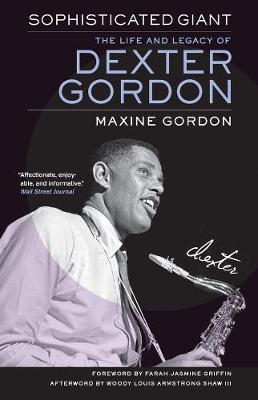
Book Review: Sophisticated Giant (The Life And Legacy Of Dexter Gordon) by Maxine Gordon

Jazz books written by ‘jazz widows’ are pretty rare. Only a few come to mind: Laurie Pepper’s ‘Art: Why I Stuck With A Junkie Jazzman’, Sue Mingus’s ‘Tonight At Noon’ and Jo Gelbart’s ‘Miles And Jo: Love Story In Blue’.

But, as Val Wilmer’s ‘As Serious As Your Life’ demonstrated some 50 years ago, behind a great jazzman is often a great jazzwoman, and usually one equally worthy of a tome.

And so it proves with Maxine Gordon’s excellent ‘Sophisticated Giant’. She was the wife and tour manager of Dexter Gordon – bebop pioneer, Blue Note saxophone great and Oscar-nominated actor – in the years leading up to his death in 1990.

The book serves as a gripping biography and much more besides. It came about as a direct result of Dexter’s unfulfilled ambition to publish his autobiography. He wrote periodically throughout his life, and many illuminating excerpts are included here.

The early pages portray an oft-neglected, Los Angeles-centred survey of how the swing scene developed into the bebop revolution; we get an inside story of Dexter’s work with the Louis Armstrong Orchestra and famous Billy Eckstine Band, hothouse for future stars Art Blakey, Gene Ammons and Sonny Stitt.

We move onto Dexter’s productive spell with fellow bebop pioneer and close friend Dizzy Gillespie, and then his famous Savoy and Dial sessions (though there are sobering details of the contracts he signed throughout his life).

We get the story of Dexter’s dark years from 1955 to 1960, when he had frequent struggles with addiction and crime. He considered them ‘un’ years and planned to leave them out of his autobiography completely.

But things very much look up with his signing for Blue Note Records on 7 November 1960. This is the most gripping section of the book and the one that will hook most jazz fans. We learn about the recording of classic albums Our Man In Jazz and Go, and read many touching letters that Dexter sent label owners Alfred Lion and Francis Wolff while on tour.

We learn about Dexter’s move to Paris and subsequent settlement in Copenhagen, Denmark, where he was resident for 12 years and became a much-loved local face, frequently visible riding his bicycle around the city.

Maxine then explores Dexter’s triumphant return to New York in 1977, when he was welcomed back like a hero with a shiny new Columbia record deal and a host of memorable albums and gigs.

Finally there’s a long, arresting section on the making of classic 1987 jazz film ‘Round Midnight’, which almost gave Dexter a Best Actor Oscar and earned him plaudits from none other than Marlon Brando.

‘Sophisticated Giant’ slots right into the canon of great jazz books, a must for the general fan and anyone who loves Dexter’s Blue Note sides or performance in ‘Round Midnight’. It’s also notable for featuring some previously unseen photos, including a beautiful shot of Dexter, Alfred Lion and Francis Wolff, taken by Rudy Van Gelder.

‘Sophisticated Giant’ by Maxine Gordon is published by the University Of California Press.

Ben Sidran: Talking Jazz (An Oral History)

They say that if you want to understand why an instrumentalist plays the way he or she plays, listen to them speak.

That makes total sense when hearing Wayne Shorter or Ornette Coleman being interviewed. And now, courtesy of Ben Sidran, there’s never been a better chance to hear other examples of this.

Sidran is a renowned pianist/composer and author of three excellent music books: ‘Black Talk’, ‘The Ballad Of Tommy LiPuma’ and ‘Talking Jazz’. The latter was based on a series of interviews broadcast on USA’s National Public Radio between 1984 and 1990. And now we can hear them in their entirety.

What a fascinating collection it is. Many interviewees go against type: those with a reputation for being somewhat ‘taciturn’ (Paul Motian, Donald Fagen, Tony Williams, Miles) are open, light-hearted and often giggly.

Some have their axes with them – we hear modern masters Chick Corea, McCoy Tyner, John Scofield, John Patitucci, David Sanborn and Steve Khan demonstrate their harmonic hallmarks. I asked the latter for his recollections of the ‘Talking Jazz’ interview:

It was done on 23 October 1984 at Roxy Recording, located at 648 Broadway, NYC – which was downtown, near Soho. It was conducted from 1-3pm! How about THAT?!

Elsewhere, Art Blakey talks touchingly about his appeal to a young, eager London crowd, Carla Bley is amusingly honest and Kevin Eubanks sounds 30 years ahead of his time, discussing global warming and environmental disasters.

It’s also fascinating to hear lost masters’ voices on tape, speaking with such candour: Gil Evans, Johnny Griffin, Chick Corea, Dizzy Gillespie, Freddie Hubbard, and many more. Sidran is a great host/interviewer, friendly and hip to the artists’ work but not scared to ask the tough questions.

Don’t miss. Listen to the interviews on Bandcamp.

Story Of A Song: Chaka Khan’s ‘And The Melody Still Lingers On’ (1982)

Jazz regained some ground in the ’80s.

After a chastening period in the late-’60s and ’70s when rock pretty much swept all before it, major labels took a renewed interest in established jazz acts and underground movements flourished (no wave, acid jazz, harmolodic funk, neo-bop). Wynton Marsalis, Miles, Courtney Pine and Loose Tubes even put jazz back on primetime TV.

But when Chaka Khan recorded ‘And The Melody Still Lingers On (Night In Tunisia)’, the dramatic centrepiece of her What Cha’Gonna Do For Me album, she arguably set the whole revival in motion.

Dizzy Gillespie, Arif Mardin and Chaka Khan

Dizzy Gillespie, Arif Mardin and Chaka Khan, Atlantic Studios 1981

It was producer Arif Mardin’s idea, his mind wandering during a flight between New York and LA. The album was one song short – so how about a tribute to the bebop masters of the ’40s using the crème de la crème of the early ’80s soul/R’n’B/jazz session players? They could use Dizzy Gillespie and Frank Paparelli’s 1942 bebop classic ‘A Night In Tunisia’ as a template.

Chaka loved the idea. Mardin hoped to find a lyricist but deadlines were pending so he tackled it himself with Chaka adding the final touches. Mardin made a demo of the arrangement which cheekily inserted Charlie Parker’s famous 1946 alto break.

Charlie Parker in 1946, photo by Ted Giola

Charlie Parker in 1946

A lengthy chart was quickly made up (resembling a ‘Chinese laundry list written in cuneiform’, according to Mardin) which included eight spare bars for the insertion of the Parker lick.

The musicians – Casey Scheuerell on drums, David Foster and Ronnie Foster (no relation) on keys, Abe Laboriel on bass and Paulinho Da Costa on percussion (mostly heard on shaker in the first verse and congas in the second) – were booked and smashed the tune in one take.

Herbie Hancock later contributed a brilliant synth solo. Chaka then added her sublime vocals. Her four-part big-band harmonies and spine-tingling ad-libs bring the song right up to date.

But there was still space for an opening head melody and a solo in the final verse. Dizzy had been sent the demo by Mardin with a note asking him to contribute.

But the bebop legend replied that he would be on tour and so couldn’t make the recording session – but he suddenly arrived two days before the album’s mastering date at New York’s Atlantic Studios to add his part. The track was complete.

Chaka and Mardin attempted to repeat the trick a few years later with ‘Bebop Medley’ but it lacked the finesse of this timeless classic.