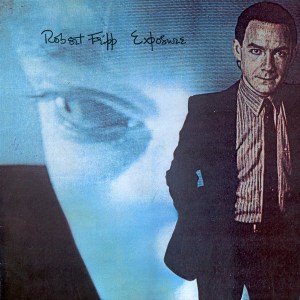
Robert Fripp: Exposure (The Definitive Edition) @ 40

Fripp’s debut solo album, originally recorded at New York’s Hit Factory between January 1978 and January 1979, has endured endless tinkering from the artist including various remixes/reversions.

But his 1985 (or should that be 1983?) remix, carried out at London’s Marcus Studios alongside Brad Davies, is the best.

But calling Fripp completists: is this version of Exposure even available on any format apart from the original cassette? (Thank goodness I still have my copy, signed by Fripp at the Virgin Megastore circa 1988, because I bought the noughties CD version to find that it featured completely different vocal takes, and the current streaming version is just as obtuse…).

The 1985 version of Exposure adds some sonic wallop to the drums, pushes Barry Andrews’ keyboards way back in the mix, comps the best of Daryl Hall and Peter Hammill’s vocals and features arguably Peter Gabriel’s best ever version of ‘Here Comes The Flood’ (with Frippertronics prelude).

It’s also a completely personal album, Fripp’s Face Value, the musings of an uptight Englishman in NYC, a prog/fusion version of ‘Annie Hall’. There are funny vocal interjections/indiscretions from his mother (‘You never remember happy things’), Fripp himself (‘Incredibly dismal, pathetic chord sequence’) and Eno (‘Can I play you some new things that I think could be commercial?’).

Gabriel fluffs the opening of ‘Here Comes The Flood’, Hall layers his vocals in strikingly avant-garde fashion, JG Bennett’s words are often layered in (with permission from his widow), arguments are eavesdropped upon and there are striking ‘audio verite’ sections. And lots of Frippertronics.

Fripp also uses silence to great effect. Don’t play this album too loud. But then there are the gorgeous ballads, ‘North Star’, featuring delightful pedal steel from Sid McGinnis and wonderful Hall vocals, and ‘Mary’, featuring Terre Roche (she also screams away on the cool reversion of Gabriel/Fripp’s title track).

And drummers: you gotta hear this album. Forget Narada Michael Walden’s playing with Weather Report, Jeff Beck, Tommy Bolin and the Mahavishnu Orchestra – this is his most outrageously brilliant drumming on record. Phil Collins plays well too, as do Allan Schwartzberg and Jerry Marotta.

1985 was a good year for Fripp. Alongside this fantastic Exposure remix, he met future wife Toyah, recorded some brilliant stuff with David Sylvian and also set up his ‘study group’ The League Of Crafty Guitarists.
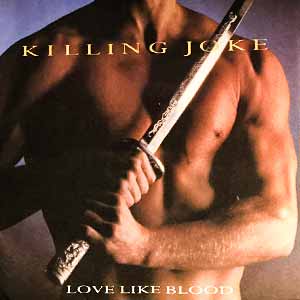
Killing Joke: Love Like Blood @ 40

Look up ‘intense’ in the dictionary and you might just see a photo of Jaz Coleman.

One of the best bits of post-Lockdown ‘normality’ was walking into Fopp in Covent Garden and quite by chance seeing the erstwhile Killing Joke frontman/keyboardist doing a signing session in full make-up.

His band’s ‘Love Like Blood’ hit its peak position of #16 in the singles chart 40 years ago this month. It was their sole top 40 single of the 1980s and biggest hit to date, a brilliant highlight of that Goth/ post-punk sound/attitude.

But, in a decade full of literary pop music, the song has an interesting and surprising genesis. Recently, Coleman told Songfacts:

That was inspired by the author Yukio Mishima… It was his views on writing with your blood as an artist that really inspired me. It’s a metaphor for the commitment an artist must take to his art form. When I was reading ‘Spring Snow’, one of Mishima’s novels, I really couldn’t speak for 24 hours after reading that book – it hit me so hard. The song itself was a distillation of everything that we hold dear, and one must aspire to walk and talk what you write about in your songs – actually live it. That’s the other part of art, isn’t it? You can’t just be conceptual, writing songs. It’s the way you live your life as well. It’s as important as the way you play your instruments or the music you create…

Musically, it’s fascinating too, the late great Kevin ‘Geordie’ Walker’s doom-laden guitar (with a very odd tuning), scary keyboards (played by Coleman) and a powerful, influential groove – apparently no click track here. Attendant album Night Time was a hit too, featuring the single ‘Eighties’ which Nirvana ripped off for ‘Come As You Are’.

The real corker though was this live performance of ‘Love Like Blood’ from ‘The Tube’. Makes you hanker for a time when bands really meant it… No mucking about. Audiences too. Like to have been there.


Roxy Music: Flesh + Blood 40 Years On

Couldn’t let 2020 squeak by without celebrating 40 years of Flesh + Blood.

As a young whippersnapper, along with Sgt. Pepper’s, it was probably the first LP I enjoyed all the way through. But these days it’s often mentioned as an afterthought to Avalon and the early albums (maybe Peter Saville’s cover rankles?).

It featured not one but three classic singles (‘Oh Yeah’, ‘Same Old Scene’, ‘Over You’), two distinctive cover versions, and was arguably one of the most influential collections of the 1980s.

It also perfectly compliments such contemporary new-wave/disco work from Blondie, Duran Duran and Japan (also sharing with those acts a reliance on the Roland CR-78 rhythm box, heard prominently in the intro of the below).

Flesh + Blood is the last Roxy studio album where Andy Mackay (sax) and Phil Manzanera (guitar) were major players if not songwriters (all tracks were written by Ferry apart from the covers, though Manzanera had a hand in ‘Over You’, ‘No Strange Delight’ and ‘Running Wild’). Both add memorable solos and nice ensemble work throughout.

It’s also a classic early-’80s bass album: reliably excellent Alan Spenner and Neil Jason joined new boy Gary Tibbs, fresh from his acting role in Hazel O’Connor’s ‘Breaking Glass’ movie and about to become one of Adam’s Ants.

The great Andy Newmark piled in on drums, having just completed work on Lennon/Ono’s Double Fantasy, alongside fellow NYC sessionman Allan Schwartzberg (who plays a blinder on ‘Same Old Scene’).

Londoner Rhett Davies was on board as co-producer, fresh from groundbreaking work with Brian Eno (both are apparent influences on the psychedelic/ambient outros to ‘My Only Love’ and ‘Eight Miles High’, and atmospheric overdubbing throughout), working with the band at his favourite Basing Street Studios (later Sarm West) in London’s Notting Hill. There were also occasional sessions at Manzanera’s Gallery Studios in Chertsey, Surrey.

Burgeoning star NYC mixing engineer Bob Clearmountain took time off his work with Chic to add some hefty bottom-end and fat drums at the fabled Power Station studios. Bob Ludwig’s ‘definitive’ 1999 CD remaster is one of the loudest, bassiest re-releases of the last few decades (but not a patch on the original cassette!).

But basically Flesh + Blood is very much Ferry’s show, layering Yamaha CP-80 piano (in his trademark ‘no thirds’ style) and synths to great effect, and even adding some amusingly sleazy guitar on the title track. He also sings superbly, delivering a particularly impassioned performance on ‘Running Wild’.

Even when he veers slightly out of tune, as on ‘Rain Rain Rain’, it’s an artful, conscious move (unlike these days…), a la Dylan or Bowie. His lyrics are generally fascinating – dreamlike, elliptical, odes to unrequited love and possibly one or two illicit substances.

Flesh + Blood was a big hit in the UK, reaching #1 on two separate occasions between May and September 1980. But surprisingly it didn’t quite work in the States, just scraping into the top 40, possibly not helped by a stinking review in Rolling Stone (‘…such a shockingly bad Roxy record that it provokes a certain fascination…’!).

But Ferry could see a path ahead, and would repeat the winning formula (drum machine + piano + painstaking overdubs + much-pondered-over lyrics/melody lines) for the rest of the decade. Rhett Davies had his work cut out – he moved on to work with Robert Fripp on the classic King Crimson reunion album Discipline.

Bill Bruford’s Earthworks: 30 Years On

earthworks

Some musicians have a unique touch – you can identify them within a few notes.

In Bill Bruford’s case, his snare drum is his main audio imprint. But he also always had a highly-original composing style before his retirement in 2009, and both are very much in evidence on the excellent Earthworks album.

Bruford had spent the mid-’80s winding down Crimson and duetting with ex-Yes keyboardist Patrick Moraz, mostly in spontaneous improvisation mode, but now a new musical approach was called for.

He had based his career on defying expectations and he did it again in 1986, forming a quartet made up two young jazz tyros best known for their work in big-band-extraordinaire Loose Tubes (keys man Django Bates and saxist Iain Ballamy) plus acoustic bassist Mick Hutton.

bruford-inside

Bruford chose well: Bates and Ballamy were excellent and prolific composers too. Also key to this new band was Bruford’s development of a very advanced electric/acoustic kit whereby he could play chords and melodic ideas alongside a ‘standard’ jazz setup.

This approach also chimed well with Bates’ propensity on both acoustic piano and synth. On the latter instrument, he was fast becoming almost as recognisable as Jan Hammer, Joe Zawinul, Chick Corea or George Duke.

All the ingredients add up to one of the key British jazz albums of the ’80s, showcasing a band equally at home playing Weather Report-style fusion, Eastern themes and odd-time prog as they were with ECM-flavoured chamber jazz of the type played by obvious heroes Kenny Wheeler and John Taylor.

Ballamy’s opener ‘Thud’ (inspired by the Rosenhan psychology experiment?) almost has a ska feel – if Madness had tried their hand at quirky instrumental jazz/rock, they might come up with something like this. ‘Pressure’ is possibly the album’s standout, a superb mini-suite featuring some classic odd-time Bruford mischief and lyrical piano playing from Bates.

Ballamy’s ballad ‘It Needn’t End In Tears’ still sounds like a jazz-standard-in-waiting to this writer, though its possibly a bit saccharine for some. Bruford unleashes a fine drum solo on ‘My Heart Declares a Holiday’ while Bates’ ‘Emotional Shirt’ veers humourously between an early hip-hop groove and free-jazz freakout. ‘Bridge Of Inhibition’ fuses Turkish modes with high-speed bebop.

Buoyed by state-of-the-art production (maybe a bit too state-of-the-art) and stylish packaging, Earthworks was a palpable hit by ‘jazz’ standards, selling well and turning up in several ‘best of 1987’ lists. Some critics were of course suspicious of Bruford’s jazz credentials, but he probably couldn’t have cared less; he had always considered himself a jazz drummer anyway and knew he was onto a winner with Bates, Ballamy and Hutton.

The latter wouldn’t last beyond this first album, but Earthworks (the band) would continue to make some excellent music throughout the rest of the ’80s and for two decades beyond that. Bruford had successfully defied expectations yet again.

King Crimson: Discipline 35 Years Old Today

crimson-cover14 April 1981: King Crimson – or Discipline, as they are currently named – are rehearsing new material in deepest Dorset.

But all is not well. Guitarist/de facto leader Robert Fripp is getting seriously ticked off with Bill Bruford’s drumming.

He outlines the pertinent issues in his diary (available to read in the remastered CD’s liner notes):

Bill is really getting to me, so I’m trying to understand how he works:
1. He’s a very busy player and doesn’t enjoy playing sparsely.
2. His parts have lots of fills and major changes of texture.
3. His fills are dramatic ie., they shock.

So Fripp comes up with some suggestions for Bruford:

1. Repeat yourself.
2. Take your time.
3. Leave room.
4. Listen to everybody else.
5. Develop a new set of clichés.
6. Develop a new vocabulary of drum sounds.
7. Listen to the sound of what you play.

Bruford’s autobiography outlines his general attitude to these instructions. But he gamely meets Fripp halfway and adapts his style accordingly, laying off the hi-hats, ride and crash cymbals unless absolutely necessary and adding a set of Octobans, a China cymbal and a few electric drums to his kit.

There are other Fripp stipulations. The music’s high frequencies should be saved for the electric guitar (Fripp was perhaps influenced by the ‘rules’ set by Peter Gabriel for his groundbreaking third album) and the 16th notes usually played by the hi-hat or ride cymbal should also now be the guitarists’ responsibility.

The formula was set. And one of the great albums (and bands) of the ’80s was born.

There was something very exciting in the air around late ’70s/early ’80s rock. The talk was all of ‘village music’ – an African concept wherein each player’s contribution is vital but only a small part of the mighty whole.

Talking Heads’ Remain In Light, Brian Eno/David Byrne’s My Life In The Bush Of Ghosts, David Bowie’s Lodger, Japan’s Tin Drum and Gabriel III showed how ‘world’ influences could integrate with ‘rock’ to thrilling effect, and Discipline fits in very neatly with those albums.

Musical references might come from Mozambique, Java, China, Bali or South Africa, or from the soundworlds of Karlheinz Stockhausen, Glenn Branca, Philip Glass and Steve Reich. Like Talking Heads, King Crimson filtered these influences through a New York art-rock/post-punk perspective but, arguably, no one integrated them more successfully.

Fripp and Bruford recruited Adrian Belew (who chose Crimson over Talking Heads) and Tony Levin in New York. Belew had grown into an incredibly assured vocalist – according to Bruford, he was literally incapable of singing out of tune – and master of unusual guitar textures. His solos featured tones and approaches never heard before.

Levin had already played bass with a plethora of heavyweights including Paul Simon, John Lennon and Gabriel, and had also just turned down an invitation to join Weather Report at the beginning of 1981. He unleashed a new weapon for the Crimson gig – the ten-stringed Chapman Stick, played by tapping or ‘hammering on’ (heard to great effect during the opening of ‘Elephant Talk’).

Back in the mid-’80s, my brother and I used to peruse Discipline‘s liner notes for clues as to the powerful and mysterious music therein. We didn’t have a clue what a ‘Stick’ was, concluding wrongly that it must be the slightly synthetic woodblock sound heard throughout ‘The Sheltering Sky’ and title track (I’m still not sure what that sound is – maybe a ‘triggered’ Bruford hi-hat?).

Tony Levin and Chapman Stick

Tony Levin and Chapman Stick

The band wrote an hour of new material fairly quickly and toured modestly in the UK during April and May 1981, calling themselves Discipline. The album of the same name was recorded over the summer at Island’s Basing Street Studio in Notting Hill (later Trevor Horn’s Sarm complex) with producer Rhett Davies, fresh from helming Roxy Music’s Flesh And Blood.

By September, pleasantly surprised by the quality of music in the can, Fripp was issuing a lengthy (and fairly incomprehensible) press release explaining why the band would henceforth be known as King Crimson.

As Bruford says in his book, ‘For a couple of years at the beginning of the ’80s, we were the right band in the right place at the right time – not to get hits, but to do useful, fascinating and right work.’

He also says that the Crimson drum stool was one of the three best rock gigs in the last few decades of the 20th century, naming the other two as Gabriel and Frank Zappa. Hard to argue with that.