1980s Jazz, Fusion, Soul and Funk Acts I Should Like But Don’t

We’ve looked before at the celebrated 1980s rock and pop acts whose output somehow leaves this writer cold.

But how about the decade’s jazz, soul and fusion artists who always seem to get the props but inexplicably fail to float movingtheriver’s boat?

Rick James
Frequently mentioned in dispatches as a funk pioneer and influence on Prince etc. (and also mentor of Teena Marie?) but for this listener his music is generally coarse and one-dimensional, and his voice nothing to write home about.

Bill Connors
The guitarist made some excellent music for ECM Records in the 1970s both as solo artist and sideman (Jan Garbarek/Stanley Clarke/Return To Forever/Julian Priester etc.) but his 1980s work disappoints. He apparently developed a fixation on Allan Holdsworth’s sound/technique which hampered his progress. Somewhat regrouped in the 1990s and new millennium though.

Kazumi Watanabe
The guitarist employed some fantastic musicians (Jeff Berlin, Steve Jordan, Marcus Miller, Bill Bruford) in the 1980s but, outside of one or two half-decent riffs, seemingly failed to generate much memorable music.

Stanley Jordan
Bassist Anthony Jackson called him a ‘genius’, and he should know, but technical feats notwithstanding (he famously played the guitar exclusively by ‘tapping’ the strings with the fingers of both hands), he seemingly failed to develop his music beyond smoochy smooth jazz during the 1980s.

Chick Corea
Obviously a genius-level musical brain and maker of some memorable material in the 1970s but generally his ‘80s music and stage presentation was a bit embarrassing (though I have a penchant for the Light Years and Eye Of The Beholder albums). A great mentor though (Dave Weckl, John Patitucci, Frank Gambale, Scott Henderson etc.).

Al Di Meola
See above.

Howard Hewett
Owner of some fantastic pipes and a stellar career co-fronting Shalamar, but for this writer his solo career generally seems like over-produced, underwhelming mush, and he doesn’t seem much of a songwriter. (He did an unforgettable take on Marvin Gaye in the 1990s though.)

Narada Michael Walden
One of the great drummers (Jeff Beck, Weather Report, McLaughlin etc.) and producers (Whitney, Aretha etc.) ended the 1980s with a half-decent album (Divine Emotions) but, to these ears, the rest of the decade’s solo career was unmemorable disco/funk…

Brand X
Often touted as a kind of British Weather Report – fugedaboudit. Their musicianship was competent at best and their compositions somehow didn’t stick in the brain, despite the occasional drumming contributions of a Mr P Collins. Bill Bruford did it much better with a far superior bunch of players (Jeff Berlin, Allan Holdsworth, Jon Clark, Dave Stewart). See also: Pierre Moerlen’s Gong.

Pat Metheny
This writer dug his stereo-chorus sound and musical approach at the dawn of the decade (80/81, American Garage, Travels) but, as the 1980s went on, he seemed to embrace a mushy new-age sensibility and indistinct jazz guitar sound that generally underwhelmed. And his stage presentation is one of the least savoury in music history… (Gary Giddins: ‘intoning plush melodies with excessive sobriety, as though the notes were transmitted directly from God…’). Liked his collaborations with Ornette Coleman and Bowie though.

Jean-Luc Ponty
Valued sideman for ’70s behemoths (Zappa, McLaughlin) but his solo career has generally disappointed this writer (but generally not other jazz/rock fans, who inexplicably seem to love his stuff…), outside of the fact that he doesn’t seem to possess a particularly pleasant violin tone with an annoying penchant for the phaser pedal. He employed some superb players in the ‘80s (Scott Henderson, Rayford Griffin, Baron Browne etc.) but never convinced that he’s much of a composer. Always quite liked this though…
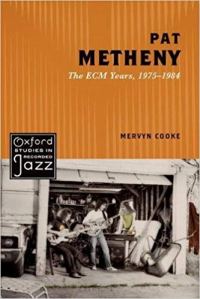
Book Review: Pat Metheny (The ECM Years 1975-1984) by Mervyn Cooke

You know the guy: long, bushy hair, beatific grin, jeans, sneakers, long-sleeved T-shirt, usually rhapsodizing intensely via some kind of guitar gizmo.

Despite his many stylistic detours, Pat Metheny is a brand all right, and his music inspires a devotion and attendant sales profile that has rarely – if ever – been afforded to ‘jazz’ musicians.

If you – like me – aren’t always enamoured by the bulletproof sincerity of his stage presentation (in Gary Giddins’ memorable words, he ‘intones plush melodies with excessive sobriety, as though the notes were transmitted directly from God’ – the main reason why I’ve always preferred his stuff on record rather than live…), it’s beyond doubt that Metheny is one of the great guitar soloists.

Mervyn Cooke’s superb new book ‘Pat Metheny: The ECM Years, 1975-1984′ sheds light on the first – and, for me, best – decade of the guitarist’s recording career, when he was the famous European jazz label’s top turn.

It’s an academic study, though never boring and certainly never predictable, with close attention played to Pat’s guitar styles, musical history, tunings, key collaborators (loads of new stuff about Jaco, Charlie Haden, Michael Brecker, Gary Burton and Lyle Mays here), equipment, album cover designs and inspirations.

There are fascinating details, like Metheny’s obsession with flat ride cymbals (hence his deliberate placement of drummers onstage, ride cymbals always in close proximity to his left ear) and his singular band-leading philosophies. There are solo transcriptions and quotes from archive interviews.

Cooke also shrewdly compares Metheny’s studio work in this era to that of Weather Report’s, drawing parallels between both acts’ meticulous sculpting of ‘spontaneous’ musical performances and attempts to concoct ‘through-composed’ – rather than vamp-based – material.

Metheny fans will love ‘The ECM Years’, as will anyone who has even the faintest interest in guitar trends of the last 40 years. It also serves as a rich biography of ECM Records in its early years, with numerous revelations about label boss Manfred Eicher.

Reading the book sent me running back to choice cuts from Pat’s early albums that I liked during my teenage years – Bright Size Life, American Garage, 80/81, As Falls Wichita, So Falls Wichita Falls, Travels, Rejoicing, First Circle, Song X.

Revisiting As Falls Wichita in particular has been somewhat of a revelation. (Prog fans: check out side one. It’s a cinematic masterpiece, analysed in great detail by Cooke.)

Mervyn Cooke’s ‘Pat Metheny: The ECM Years, 1975-1984’ is published by Oxford University Press.

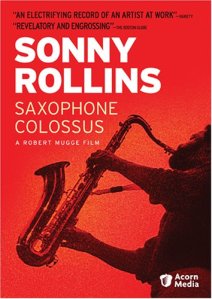
Sonny Rollins: Saxophone Colossus

51dnFsTtIPLEvery serious jazz fan seems to have a favourite Sonny Rollins story.

A good one is recited by musician Matt Glaser in Ken Burns’ ‘Jazz’ documentary. Sonny was playing a late-night Carnegie Hall gig on Easter Saturday during the 1990s. He embarked on a typically Herculean solo at around 11:30pm. This went on for quite a while. At EXACTLY ten seconds to midnight he quoted from Irving Berlin’s ‘Easter Parade’…

Truth or fiction, it’s the kind of story that has followed the brilliant Harlem-born saxophonist around throughout his career. It also speaks volumes about his intellectual and musical vigour.

Robert Mugge’s excellent 1987 documentary ‘Saxophone Colossus’ spawns yet more Sonny stories, inadvertently filming an extraordinary moment during an outdoor New York gig. Jumping off the stage mid-solo to join the audience, he misjudges the height and breaks his heel in the process. Lying stricken on the floor, alone and unaided though still holding his horn, there’s the briefest of pauses before he continues soloing as if nothing was amiss.

The film also features fascinating interviews with Sonny and his wife/manager/producer (and now sadly departed) Lucille. Writers Gary Giddins, Francis Davis and Ira Gitler contribute intelligent, revealing summations of Rollins’ career. There’s also some superb concert footage of Sonny’s ‘Concerto For Tenor Saxophone And Orchestra’ premiere in Japan.

Watching the film again has led to a period of Sonny woodshedding, and I’m unearthing some real gems. It’s exciting that he has continued to be an absolutely vital presence on the jazz scene, performing when possible and frequently contributing to media debates about the music.

He has also written obituaries for his long-time producer Orrin Keepnews and long-time bassist Bob Cranshaw in recent issues of JazzTimes magazine. More power to Mr Rollins. Here’s some of that woodshedding, in chronological order: