The Cult Movie Club: Fletch @ 40

Quentin Tarantino recently drew an interesting comparison between the 1980s careers of Chevy Chase and Bill Murray.

Both had reputations for being difficult but it was Murray who sought ‘positive’/’learning’ scripts through the decade and early 1990s. Chase didn’t: his characters generally started out as wise-cracking assholes, and ended the films the same way.

And the always amusing ‘Fletch’ – a movingtheriver favourite which premiered 40 years ago this weekend – is exhibit A. Based on the 1974 novel by Gregory McDonald (who subsequently wrote ten other Fletch books), it came into existence when Michael Douglas got on board as producer (later to be replaced by his brother Peter) and Universal finally took it on after many false starts.

McDonald had star approval though, and Burt Reynolds, Mick Jagger, Richard Dreyfuss and Jeff Bridges nearly played Irwin R Fletcher, before Chevy got the nod. After a few lean years, he was hot in 1984 after the success of ‘National Lampoon’s Vacation’. In the meantime Andrew ‘Blazing Saddles’ Bergman had written a screenplay with uncredited help from Phil ‘All Of Me’ Alden Robinson too.

Director Michael Ritchie must take a lot of credit for the success of ‘Fletch’. Helmer of bittersweet classics ‘Smile’, ‘The Candidate’, ‘Downhill Racer’ and ‘Prime Cut’ (and, after ‘Fletch’, ‘The Golden Child’ and ‘Cool Runnings’), he keeps things moving fast and reportedly encouraged Chase’s surreal ad-libs. ‘Nugent. Ted Nugent’, was the first, apparently uttered totally spontaneously by Chevy.

His stoned delivery and anti-establishment wisecracks hit the spot time and time again. This writer always giggles when someone shoots out Fletch’s back windscreen and Chevy shouts ‘Thanks a lot!’, ditto the entire ‘airplane investigation’ scene. Chase is always one step ahead of the material, sharing a joke with the audience, assuming it’s intelligent and on his side.

But watching it again, ‘Fletch’ certainly seems more suitable for adults than teenagers (borne out by the fact that when I first saw it at the Putney Odeon during school summer holidays in 1985, the teens around me mainly threw popcorn and talked amongst themselves). The plot is hard to follow and the stakes never seem very high, despite the film’s noir leanings (one key character is named Stanwyk).

The film benefits from some excellent supporting turns – female co-star Dana Wheeler-Nicholson is delightfully natural (though weirdly didn’t make another movie for five years after ‘Fletch’) and Joe Don Baker, M Emmet Walsh, Geena Davis, Richard Libertini and George Wendt (RIP) do solid, enjoyable work.

Harold Faltermeyer’s memorable synth soundtrack still raises a smile. And though ‘Fletch’ would seem to be influenced by ‘Beverly Hills Cop’, it was actually shot around the same time as that Eddie Murphy vehicle, summer 1984, in and around Los Angeles during the Olympics.

‘Fletch’ was a surprisingly big hit, grossing around $60 million against an $8 million budget. Roger Ebert and Pauline Kael quite liked it, Gene Siskel loved it. Kevin ‘Clerks’ Smith tried and failed to reinvigorate the Fletch brand in the 1990s. But Jon Hamm has just played him in 2022’s ‘Confess, Fletch’ – any good? Doubt it… Peak Chevy is a hard act to follow.
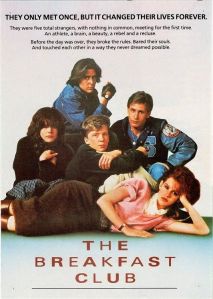
The Breakfast Club @ 40: 17 Things You Didn’t Know About The Classic Teen Movie

Despite a few bum notes, ‘The Breakfast Club’ – which premiered 40 years ago this month – remains one of the essential 1980s movies, a must-see for generation after generation of teenagers.
Like or loathe it (some contemporary critics such as Pauline Kael lamented its whinier aspects, while others such as Roger Ebert were surprisingly sympathetic), its superb cast act as if their lives depended on it, and writer/director John Hughes’s attention to detail and comic timing are as spot-on today as they must have seemed in 1985.

But what was going on behind the scenes? Where was the film shot? Which famous actors nearly got cast? Which actors didn’t get along? Movingtheriver has done some digging (with spoilers)…

17. The film was edited by Hollywood royalty Dede Allen, who had worked on ‘The Hustler’, ‘Bonnie & Clyde’, ‘Serpico’, ‘Dog Day Afternoon’ and ‘Reds’ (apparently she was put to work on John Hughes’ original three-hour cut…).

16. Theme song ‘Don’t You Forget About Me’ was written by Keith Forsey after witnessing the scene where Brian (Anthony Michael Hall) asks his fellow detention attendees if they’ll still be friends the next day. Simple Minds turned it into a US #1 but Bryan Ferry was Forsey and Hughes’ first choice – he turned it down, busy mixing Boys & Girls.

15. Hughes wrote the first draft of the film over one weekend.

14. Universal weren’t behind the film, wanting more teenage hi-jinks and nudity a la ‘Porky’s’. They weren’t even sure Hughes should direct.

13. Anthony Michael Hall and Molly Ringwald were just 16 years old during filming – all the other ‘schoolkids’ were well into their 20s.

12. Jodie Foster, Laura Dern and Robin Wright all auditioned for the part of Claire, the prom queen. Molly Ringwald got the role despite initially being cast as Alison, the misfit. Emilio Estevez was initially cast as the ‘bully’ John Bender until Judd Nelson came in at the last minute (Nicolas Cage, John Cusack and Jim Carrey all almost played Bender too). Rick Moranis was due to play Carl the janitor but left the film just before shooting.

11. It was shot between March-May 1984 at Maine North High School in Des Plaines, Illinois, the same abandoned school used for ‘Ferris Bueller’s Day Off’. Most of the film takes place in a library – this was actually a set built in the school gymnasium.

10. The cast rehearsed for three weeks before the cameras rolled. They were running lines and bonding even as sets were being built around them. The film was also shot in sequence, a rarity.

9. Researching his role as Bender, Judd Nelson went ‘undercover’ at a nearby high school with fake ID and formed a real clique of naughty teens.

8. The cast didn’t smoke real pot in the famous ‘truth-telling’ scene – it was oregano.

7. Anthony Michael Hall’s real life mother and sister talk to him in the car at the beginning (and Hughes has a cameo as his dad).

6. Ringwald tried to get Hughes to remove the scene where Bender hides under the desk and looks between her legs, but he refused.

5. Bender’s famous, defiant/celebratory fist-raise at the end was improvised by Judd Nelson.

4. The scene where the characters sit around and explain why they are in detention was all improvised.

3. The original cut was 150 minutes long – they had to lose 53 minutes, including a long dream sequence and a whole character (a sexy gym teacher). Some deleted scenes have appeared on DVDs and on YouTube but many outtakes have never been seen.

2. The iconic poster photo was taken by Annie Leibovitz and later satirised by ‘Texas Chainsaw Massacre 2’.

1. The budget was just under $1 million! The film made over $51 million during its initial run…

The Cult Movie Club: The Long Good Friday (1980)

Every post-1971 British crime movie has had ‘Get Carter’ and ‘Performance’ in its rearview mirror.

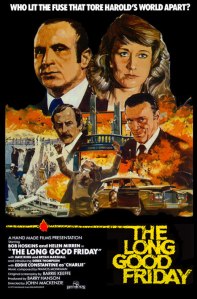
Made in summer 1979 but not released until 18 months later, ‘The Long Good Friday’ (original title: ‘The Paddy Factor’) has often been mentioned in the same breath as ‘Carter’. Is that justified?

Initially bankrolled by legendary impresario and producer Lew Grade, it was written by proper East Ender Barrie Keeffe (who reportedly knew Ronnie Kray), directed by Scotsman John Mackenzie and starred Brit acting ‘royalty’ Bob Hoskins and Helen Mirren.

When completed, the suits almost refused it a cinema run, deeming it too nasty, hoping to recut it and farm it out to television. A disgusted Mirren asked her friend Eric Idle to attend the premiere at the London Film Festival towards the end of 1980.

Idle was impressed and passed it on to his mate George Harrison, the main moneyman at newly-formed HandMade films. Harrison apparently loathed it but agreed it had hit potential. HandMade bought it for £700,000, funded by ‘Life Of Brian’ profits.

But how does ‘The Long Good Friday’ stack up in 2024? I watched the posh new 4K restoration – looks fabulous, but this film really belongs in a mid-’80s Cannon fleapit. With its casual racism/sexism/ableism and overlong dialogue scenes, it’s also now more redolent of ‘Sweeney!’, ‘The Squeeze’ and ‘Villiain’ than ‘Performance’ or ‘Get Carter’ – but is still fascinating and memorable.

There’s some real Brit nastiness, or ‘virtuoso viciousness’, as Pauline Kael called it in her ‘Carter’ review. Mackenzie comes up with three or four memorable set pieces (and a great final five minutes, apparently the first thing they shot, during which apparently the director drove the car and ‘fed’ Hoskins the entire plot of the film) which have given the movie legs. He also uses the London locations with some elan.

Keeffe comes up with some preposterously funny lines – ‘It’s like Belfast on a bad day!’ etc. – and Francis ‘Sky’ Monkman’s disco/prog/fusion score adds value. There’s also an amazing array of ‘Hey, it’s that guy/girl!’ actors, from Pierce Brosnan (whose swimming pool scene seems to have influenced Bronksi Beat’s ‘Smalltown Boy’ vid) to Gillian Taylforth.

Sadly though the key performance by Derek Thompson (Charlie in ‘Casualty’!) weighs the film down with its stoned insouciance and dodgy London accent (ironically, Thompson was born in Belfast).

And though some have compared Hoskins with Edward G Robinson and James Cagney (Keeffe apparently pictured a cockney Humphrey Bogart!), despite some amusing line readings these days he comes across more like Alan Sugar after a few too many espressos, whereas Michael Caine in ‘Carter’ had a kind of timeless, glacial rage.

Apparently under the influence of ‘Lock, Stock and Two Smoking Barrels’, Empire magazine – astonishingly – voted ‘The Long Good Friday’ the #1 greatest British film in a 2000 poll. Hard to think it would get that accolade today. Still, it’s a fascinating snapshot of London on the brink of Thatcher’s decade, and a must-see for fans of 1980s cinema.

Further reading: ‘Very Naughty Boys’ by Robert Sellers

The Cult Movie Club: About Last Night… (1986)

It’s well documented that none of the so-called Brat Pack enjoyed a particularly easy ride – both professionally and personally – after their imperial 1983-1985 period (though many have made fascinating recent late-career comebacks, but that’s a whole ‘nother article…).
Demi Moore and Rob Lowe were less than a year on from the enormo-hit ‘St. Elmo’s Fire’ when they co-starred in ‘About Last Night…’, one of the least well-known but best films of their entire careers and a movie your correspondent returns to every three or four years and always enjoys.

Based on David Mamet’s 1974 play ‘Sexual Perversion In Chicago’ and directed by future ‘thirtysomething’ TV show co-creator Edward Zwick, it concerns the social lives of four young, fresh-out-of-college twentysomethings (erroneously described as ‘yuppies’ in some reviews of the film), struggling to commit to relationships while navigating AIDS and post-adolescence loneliness.

Lowe plays Dan, enjoying a relatively carefree existence of one-night stands, drinking games and weekend softball, spurred on by his constant, crass companion Bernie, excellently played by James Belushi (a part his brother John was originally pencilled in to play back in 1981, alongside Dan Aykroyd). That’s until Dan meets Debbie, nicely portrayed by Moore – he’s instantly smitten, totally tongue-tied.

The problem is they’re totally mismatched. The result is funny and sad, a kind of down-at-heel ‘When Harry Met Sally’ or freewheeling/comic ‘Nine Half Weeks’. The Chicago setting roots the movie in an agreeably specific milieu. Lowe acts his little socks off in surely the best performance of his career. Elizabeth Perkins, in her screen debut a few years before her big breakthrough with Tom Hanks in ‘Big’, is an absolute hoot as Debbie’s best friend.

Much of Mamet’s original dialogue is retained (though the role of Bernie is drastically reduced) resulting in several classic scenes and some coruscating one-liners. Sadly the movie doesn’t quite have courage of its convictions though – it occasionally cops-out with a few MTV-style montages and superfluous, ‘shocking’ nudity.

But ‘About Last Night…’ is extremely subtle in its depiction of a relationship that never really had a chance (or did it? Watch right through to the end…) and bears repeated viewings. The film was a success in the box office too, grossing nearly $40 million against a budget of $9 million, and earning glowing reviews from Roger Ebert and Pauline Kael.

Oh, and it was remade in 2014…

The Cult Movie Club: Lenny Henry Live And Unleashed (1989)

In her book ‘Hooked’, legendary movie critic Pauline Kael said that the only fresh element in American films of the 1980s may have been what comedians (Robin Williams, Steve Martin, Bill Murray et al) brought to them.

Could we say the same about British films of the 1980s? Looking at ‘Supergrass’, ‘Eat The Rich’, ‘Morons From Outer Space’ and, er, Cannon & Ball’s ‘The Boys In Blue’, it would seem not. A shame, and strange in a way that the ‘Comic Strip’ generation couldn’t quite make the transition to the big screen.

But Lenny Henry – best known as a British TV star in the 1980s – made a damn good fist at the stand-up concert movie with ‘Lenny: Live And Unleashed’, mostly shot at London’s Hackney Empire, taking on the Americans (Eddie Murphy’s ‘Raw’, Richard Pryor’s ‘Live On The Sunset Strip’ etc.) at their own game, complete with a posh credit sequence featuring brilliant impressions of Martin, Murphy and Pryor plus a not-very-funny skit with Robbie Coltrane as the most annoying taxi driver in the world (Why didn’t Lenny fit in another impression there? Couldn’t he have dusted off a De Niro?).

His flashes of surrealism evoke Alexei Sayle and Martin and also it’s clear that by 1989 Lenny had developed into a superb physical actor. He addresses political and racial topics head-on, beginning one skit with the simple statement: ‘We need to see more Black faces on British TV.’

There’s a great celebration of Black music (evidenced also in his appearance on the BBC’s Desert Island Discs just before this was filmed) with homages to Prince and Bobby McFerrin, a good bit on Michael Jackson’s ‘Bad’ tour, and the striking ‘Fred Dread’ section featuring Dennis Bovell’s natty dub soundtrack.

Other character favourites Delbert Wilkins, Deakus and the Teddy Pendergrass-lampooning Theophilus P Wildebeeste (you couldn’t do that sketch these days…) get a lot of stage time – superb portraits, with heart and soul. A new character, ageing blues singer Hound Dog Smith, gets a workout too, featuring an amusing guest spot from Jeff Beck (who also turned up in a few Comic Strip films around this time).

The box-office performance of ‘Lenny: Live And Unleashed’ is hard to uncover but does it have enough appeal to a non-British audience? Judge for yourself (and I must check out Henry’s next foray into the movie world, 1991’s ‘True Identity’, at some point…)…

The Cult Movie Club: Diner (1982)

I knew it was good, but, revisiting it again last week, I’d forgotten quite how good ‘Diner’ was.
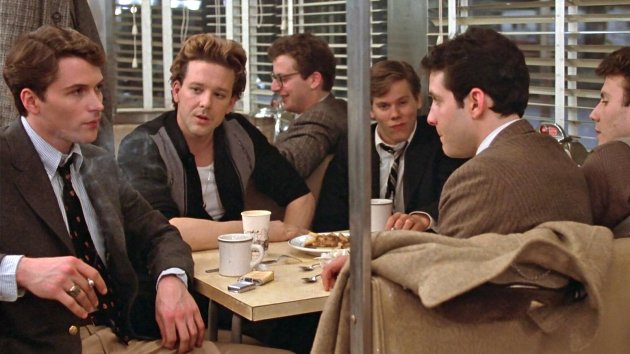
Barry Levinson’s directorial debut was the very definition of a sleeper movie when it first came out in March 1982. MGM virtually buried it on its initial release (and their appalling trailer didn’t help – see below), disappointed that it scrimped on the ‘Porky’s’/’Animal House’-style hijinks.

It took a private screening set up by Levinson and executive producer Mark Johnson and subsequent rave review from one attendee – legendary film critic and movingtheriver.com favourite Pauline Kael – to secure it an audience.

Some have made bold claims that ‘Diner’ is the most influential film of the 1980s, pointing forward to ‘This Is Spinal Tap’, Tarantino, ‘Seinfeld’, ‘The Sopranos’, Judd Apatow and beyond.

Set in Baltimore during December 1959 (it definitely counts as a Christmas movie), it focuses on a group of friends in their early 20s, trying to negotiate relationships and get through their working lives, but always finishing off the night at the Fells Point Diner (based on the real Hilltop Diner in northwest Baltimore) for a chin-wag about Sinatra and a fill of French fries with gravy (or a roast beef sandwich, fought over in one of the film’s most famous scenes).

Daly, Rourke, Stern, Bacon, Guttenberg and Reiser in ‘Diner’

Though there are shades of ‘American Graffiti’, ‘Animal House’ and even ‘Porky’s’ (Kael rather evoked Fellini’s ‘I Vittelloni’), the protagonists in ‘Diner’ seem older than in those movies, though you wouldn’t always know it – they seem totally at ease with themselves but struggle with members of the opposite ‘camp’. In fact, sadly, the sexual politics in ‘Diner’ ensure that it would probably struggle to get a green light these days.

The movie features almost of a who’s-who of ’80s talent: Mickey Rourke, Steve Guttenberg, Daniel Stern, Paul Reiser, Kevin Bacon, Timothy Daly, Ellen Barkin, all acting as if their lives depended on it. Arguably, none have done better work than ‘Diner’.

One wonders how much rehearsal and/or ‘team-building’ Levinson was able to secure for them (quite a lot according to this excellent documentary), because they’re absolutely at ease with each other. And, though almost entirely scripted (Levinson’s screenplay was nominated for an Oscar), the movie has a loose, dreamy feel. These guys feel just like your – my – mates, from that golden era when everyone was rooted in the same spot and going through the same stuff.

Levinson packs the action with memorable secondary characters – the local screwball obsessed with ‘Sweet Smell Of Success’, Carol Heathrow (who unfortunately locates Rourke’s ‘pecker’ in her popcorn), the kindly pool-hall owner, Big Earl (who eats the whole left side of the menu), the picky TV-store customer, Bagel, Kevin Bacon’s smarmy brother, and many more.

He also creates a totally believable environment on a budget, replete with classic cars and almost-deserted suburban streets, and an impressive opening one-take shot introducing us to the main characters. He also brings in interesting period details like the glimpse of Kind Of Blue in Shrevie’s sacred vinyl collection, and the soundtrack is also brilliant, from R’n’B to doo-wop (though the only bum note is the very ’80s-sounding ‘live’ track played in the go-go bar towards the end of the movie).

‘Diner’ also has an almost ‘Withnail’esque finale, looking uncertainly into the next decade with its famous freeze-frame ending. And, like all the best coming-of-age movies, it has you wondering what the hell happened to these characters.

Did Boogie make a go of it in the home improvement trade, and stay with Jane Chisholm? Did Modell ever get himself a car? How did Shrevie and Beth’s marriage turn out, not to mention Eddie’s? Barry – any chance of a sequel?

(Postscript: A musical version of ‘Diner’ made a brief appearance a few years ago. Sheryl Crow wrote the songs. The less said the better…)

The Cult Movie Club: Yellow Submarine (1968)

No, ‘Yellow Submarine’ doesn’t really have anything to do with the ’80s (or does it? See below…), but this website wouldn’t exist without the Fabs.
And whilst obviously not strictly a ‘cult’ movie, it does feel somewhat forgotten these days, showing only once on terrestrial TV during my lifetime and rarely seen in the cinema.

But watching it on the big screen last week during its short 50th anniversary re-release, it struck me as the ultimate psychedelic artefact, a feast of day-glo imagery, pop psychology, Scouse kidology and mind-blowing music. The tale of the evil Blue Meanies’ battle against John, Paul, George and Ringo was a total trip and has aged well – my young nieces loved it.

Most importantly, the music sounded fantastic: it was a treat to hear ‘It’s All Too Much’, ‘All Together Now’, ‘Hey Bulldog’ and ‘Only A Northern Song’ loud and proud. The other Beatles may not have particularly cared for George’s former and latter but they were revealed as true psych classics, with kickin’ bass and drums and disturbing/babbling string and horn cut-ups.

Ian MacDonald sums up ‘It’s All Too Much’ brilliantly in his classic book ‘Revolution In The Head’: ‘Lyrically very much the locus classicus of English psychedelia. The revolutionary spirit then abroad in America and Europe was never reciprocated in comfortable and sceptical Albion, where tradition, nature and the child’s-eye-view were the things which sprang most readily to the LSD-heightended Anglo-Saxon mind.’

I’m not a big cartoon fan but even I can tell that the animation in ‘Yellow Submarine’ is pretty special, a big influence on Monty Python, XTC (see the cover of Oranges And Lemons) and a myriad of ’80s video directors. The ‘Eleanor Rigby’ section is moving, unique, memorable.

And then there’s the more-than-decent script: playwright Lee Minoff and screenwriter Erich Segal, later to hit big with ‘Love Story’, probably supply the spiritual oomph and ‘Odyssey’-like plot, while poet Roger McGough presumably added the authentic Scouse.

Of course, some object to the representation of the Fabs in ‘Yellow Submarine’. As Pauline Kael pointed out in her original New Yorker review, they were no longer rock stars but non-threatening family favourites, offering up an already nostalgic vision of ‘love’.

Accordingly, the film was a reasonable hit in the UK but much bigger one in the States, released in the year of the Tet Offensive and deaths of Martin Luther King Jr./Robert Kennedy. Escapism was needed. And maybe still is. But do see ‘Yellow Submarine’ on the big screen if you can. And if you’re like me, you may even shed a quiet, nostalgic tear during ‘When I’m 64’.

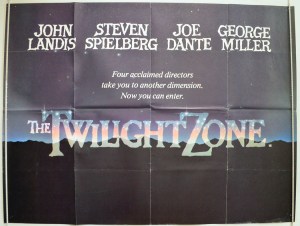
Wanna See Something Really Scary? Two Takes On ‘The Twilight Zone’

‘Wanna see something really scary?’ Day Aykroyd’s ‘Twilight Zone: The Movie’ catchphrase was an open invitation to me back in 1983.

I had just seen John Landis’s ‘Thriller’ video, George Romero’s ‘Creepshow’ and John Carpenter’s ‘Halloween’ and was rapidly becoming a ‘confirmed ghost story and horror film addict’, as Jack calls Wendy in ‘The Shining’.

‘Twilight Zone: The Movie’ was briefly a big VHS hit in my house. Though these days it looks like a bit of a misfire (decent Joe Dante and George Miller sections, less-than-decent Spielberg and Landis), I mainly loved the flavour of the 1983 movie’s Landis-directed-and-scripted opening and closing tags.

I can still randomly remember chunks of dialogue, especially Albert Brooks’ little ad-libbed songs (‘Look at those two apes/This must be where they live’ etc…).

Then my recent Cassette Revisitation Program brought round The Manhattan Transfer’s ‘Twilight Zone’, recorded a couple of years before the movie was released. Jay Graydon and Alan Paul adapt the original source music (either composed by Bernard Herrmann or Marius Constant, depending on which websites you trust…) with aplomb.

Though the track comes a bit too close to disco for my liking, I was knocked out by Janis Siegel’s lead vocal; her phrasing and enunciation are really something.

And what a band: Graydon on guitar, Jai Winding on keys and Toto in the engine room. Graydon’s stunning harmonized solo should possibly have been in my ‘wackiest guitar solos of the 1980s’ list and Winding lays down some excellent Fagen-esque keys.

I like the lyric too: ‘Unpretentious girl from Memphis/Saw the future through her third eye…’ Throw in a spot-on impression of Rod Serling (or is it actually Rod?) and you’ve got a great tribute song. Released as a single in June 1980, it made #25 in the UK and #30 in the US.

But anyway, where were we? Back to the movie. ‘Happy’ Halloween, heh-heh-heh…

Magic Mickey: ‘Angel Heart’ 30 Years On

angel_heartIn 1987, Mickey Rourke was fast becoming one of the most controversial movie stars of the era, the go-to guy (alongside Michael Douglas) for potentially commercial but decidedly ‘off-colour’ material.

Even David Bowie rated Rourke as one of the coolest people on the planet in ’87 – to my knowledge, only Mickey, Iggy Pop, Tina Turner and Al B Sure! ever shared ‘lead vocals’ on a Bowie solo album (though their collaboration was less than essential…).

‘Angel Heart’ turns 30 this week. I’ve been a Mickey fan since randomly renting the video circa 1988. If, as Marlon Brando attested, acting (or at least good acting) is essentially ‘behaviour’, Rourke delivers one of the great modern screen performances.

He mumbles lines, adds strange emphases (‘Yeah, I could be free‘) and quirky ad-libs, smirks inappropriately and generally shambles around in his filthy linen suit; Pauline Kael memorably wrote that ‘he has enough dirt on him to sprout mushrooms’. But also he carries off the action sequences with aplomb, looking like he could take care of himself in a bar fight.

Most importantly, Rourke tempers the increasingly hokey supernatural elements of the film with a believable, sympathetic, relatively down-at-heel protagonist: Harry Angel seems to be a regular knockaround guy in Brooklyn. ‘He likes the simple life, going for a beer, getting laid whenever he can. He minds his own business. He just gets by. He works, reads the comics, he takes a walk,’ Rourke told his biographer Christopher Heard.

William Hjortsberg’s screenplay for ‘Angel Heart’, based on his New York-set novel ‘Falling Angel’ (described by Stephen King ‘as if Raymond Chandler had written “The Exorcist”’), had been hanging around Hollywood for a while.

First it looked like Robert Redford would produce and star. Then ‘Midnight Express’/’Fame’ director Alan Parker came onboard, rewrote the script (with the questionable decision to relocate most of the action to New Orleans) and offered the lead role to naysayers Jack Nicholson, Al Pacino and Robert De Niro, the latter taking the role of Louis Cyphre (geddit?) instead.

Enter Mickey. Parker made it clear to Rourke that he was nowhere near his first choice, but was interested in what he could bring to the role. Rourke was disillusioned with acting in general and Hollywood in particular but desperately needed the part: ‘I was about to lose my big-assed house in California and needed a big paycheck fast…’ Parker warned Rourke that he wouldn’t put up with any funny business, also apparently giving him many a dressing-down on set.

But how does ‘Angel Heart’ stack up these days? It’s still very watchable, salvaged by the Rourke/De Niro scenes and Mickey’s eccentric ‘behaviour’. Bonet is a refreshingly natural presence and De Niro hams it up semi-convincingly.

Trevor Jones’ original soundtrack (recorded at the aptly-named Angel Studios in Islington, North London) still holds the attention alongside some great crooner and blues tunes. But Parker searches in vain for his inner Nicolas Roeg (or Ken Russell?), showing his background in advertising with a succession of beautiful, if clichéd, images of ‘evil’ (a glistening, freshly-extracted human heart, ceiling fans, lift shafts, writhing bodies, blood-stained walls), memorable crane shots and disorientating flashbacks, but it all feels way too slick.

Kael again: ‘There’s no way to separate the occult from the incomprehensible. Parker simply doesn’t have the gift of making evil seductive, and he edits like a flasher.’ There’s also a lack of memorable secondary characters – Charlotte Rampling and Brownie McGhee seem miscast and barely register.

‘Angel Heart’ just about broke even at the box office but has enjoyed a healthy cult following since. My brother tells me that it most definitely worked on the big screen, delivering a real sense of impending doom. I don’t doubt it, ably aided by some classic Mickey.