Movie Review: Spinal Tap II (The End Continues)

The question is not so much why they’re back for a big-screen sequel, but why it’s taken so long.

But, after various copyright problems, the wait is over. ‘Tap II’ is here. And it’s worth the wait.

One of the many good portents for ‘Tap 2’ was the fact that Rob Reiner was returning to direct and co-star as Marty DiBergi. You know you’re in the hands of a master. Then there’s the fact that all surviving original cast members are present and correct, and that their improvisational modus operandi is basically intact.

Your correspondent is not going to reveal any of the many pleasant surprises from the movie, such as the return of various secondary characters from the first film (and appearances from four or five big rock stars), but suffice it to say that the plot is a little like ‘Anvil! The Story Of Anvil’.

A contract clause dictated by band manager Ian Faith before his death states that Tap must do one final comeback concert. The only problem is that the three surviving members of Tap (Nigel Tufnel, David St Hubbins, Derek Smalls) are at loggerheads and haven’t seen each other for years.

We find Nigel selling cheese and guitars in Berwick-upon-Tweed (just the sight of him wearing shopkeeper’s hat and overall is worth the price of admission alone), David making ‘on-hold’ music and Derek running a glue museum.

Various scenes from the first film are mirrored here, and they even use the same font for the onscreen graphics. Thank goodness too they mostly stay away from ‘dark’ comedy. There are few concessions to identity politics, and the humour is basically quite sweet (but agreeably foul-mouthed). These are some seriously old dudes trying to rock out again.

The casting once again nods to a richly-observed Anglophilia with Chris Addison hilarious as the hapless/humourless marketing man, a mixture of Simon Cowell and Simon Fuller, and Kerry Godilman doing fine as Ian Faith’s Sharon Osbourne-like daughter.

Once again they’ve got the music spot-on too, showing the detail you’d expect from real music fans and good musicians – you won’t find any poorly-sync’d snare hits from the drummer here. It looks like they played and sung everything live with multiple cameras running.

One small gripe? The actual band reunion scene is a bit flat and looks like it may have been the victim of some rather severe editing. But that’s nitpicking, isn’t it?

So Tap fans – there’s nothing to fear here. Go to ‘The End Continues’ with confidence. At 80 minutes, it’s a perfect length and sticks in the head afterwards. There’s little ‘learning’, just laughs. This writer chuckled approximately every 20 seconds. Looking forward to the DVD extras, there must be hours of extra improvisations.
David Bowie’s Stonehenge: The Glass Spider Debacle

David-Bowies-glass-spiderI was a 12-year-old pop fan when Let’s Dance hit, perfectly placed to love it and its usually-maligned follow-up Tonight.

I enjoyed almost everything Bowie did in ’85 and ’86 too, from ‘Dancing In The Street’ and ‘This Is Not America’ to ‘Absolute Beginners’ and ‘When The Wind Blows’.

But 1987 is another story altogether. Even as a 15-year-old, right from the start I sniffed something dodgy about Never Let Me Down and its accompanying Glass Spider tour. I’ve found a couple of things to love about the former in the years since (especially the great Lennonesque title track) but can’t find anything good about the latter.

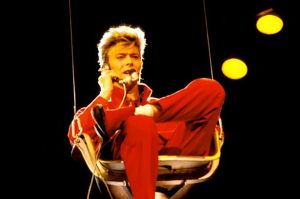
Bowie at the Never Let Me Down/Glass Spider Tour London press conference, 20th March 1987

Bowie at the Never Let Me Down/Glass Spider Tour London press conference, 20th March 1987

The show was certainly ahead of its time with its tightly-choreographed, narrative vignettes – just look at Prince’s Lovesexy and Madonna’s Blond Ambition tours for evidence of its influence.

If you’re a big Bowie fan, the opening moments are amusing if a bit tasteless – guitarist Carlos Alomar attempts some ill-advised, sub-Van Halen guitar pyrotechnics while an offstage David repeatedly screams ‘Shut up!’ in ‘It’s No Game’ style.

There then follows an outrageous opening medley featuring a bizarre, lip-synched version of ‘Up The Hill Backwards’ followed by a hilariously hammy spoken word section by Bowie which closely resembles Nigel Tufnel in Stonehenge mode. Is he taking the piss? Usually this question doesn’t cross your mind with Bowie, no matter how much he ‘tests’ his audience, but it does here.

Then there’s a brutal depiction of gang warfare juxtaposed with Bowie’s cheesy, reassuring grin, a typically unsettling mixture of menace and child-like innocence. But he seems generally uncomfortable throughout the show. His attempts at audience interaction are always awkward and nothing links the songs; almost all end in blackout before another lumbers into view.

The Glass Spider tour also features surely the most dated-sounding band in Bowie’s history, with huge, triggered drums, rambling synth solos, garish, unpleasant DX7 factory sounds and lots of cod-raunchy guitar from Alomar and Peter Frampton. This is a far too ‘muso’ bunch of musicians for Bowie. The fanfare of synth horns at the end of ‘Fame’ is just unforgivable.

‘Heroes’ is stripped of all romance and majesty and becomes a jaunty throwaway. ‘Sons of the Silent Age’ coasts in on a nicely Middle Eastern-ish vibe, a huge relief from the bombast, but is nearly ruined by Frampton’s nasal lead vocals. None of these versions come close to being definitive. Also the fact that Bowie only plays four tracks from the Never Let Me Down album just a few months after its release pretty much goes to show what he thinks of it.

Bowie famously burnt the huge stage set in a field at the end of the tour. He must have wished he’d never set eyes on it. But within a year, he’d hooked up with avant-metal guitarist Reeves Gabrels, started work with influential dance troupe La La La Human Steps and embarked on some very interesting new musical adventures.

Six Great ’80s Album Openers

vinyl-goldSequencing an album can be a real headache but it’s surely one of the dark arts of the music business.

One thing’s for sure: the lead-off track is key. You know the old A&R cliché – ‘You gotta grab ’em from the first bar!’ But sometimes quiet and enigmatic can be just as effective as loud and arresting.

Repeated listening and nostalgic reverie possibly cloud the issue but it’s almost impossible to imagine some albums with different opening tracks. Revolver kicking off without ‘Taxman’? Rubber Soul without ‘Drive My Car’? Pretzel Logic without ‘Rikki Don’t Lose That Number’? Unthinkable.

So here are six of my favourite album-openers from the ’80s:

6. Phil Collins: ‘In The Air Tonight’ from Face Value (1981)
Love or hate Phil, no one can deny this is one of the killer intros. He programmes his own ‘Intruder’ beat on a Roland CR-78 drum machine, adds some slabs of heavy guitar, some moody chords (in D minor, the saddest of all keys…) and chills all and sundry.

5. Yes: ‘Owner Of A Lonely Heart’ from 90125 (1983)
A blast of sampled Alan White drums (later co-opted for Art Of Noise’s ‘Close To The Edit’) and we’re away! Trevor Rabin’s gargantuan power-chord intro became an MTV mainstay and gave the prog-rock survivors their only US number one single. But, arguably, they shot their load too early – the rest of the album never comes close to this lavish opener.

4. Simple Minds: ‘Up On The Catwalk’ from Sparkle In The Rain (1984)
I’m a sucker for drummer count-ins and this is one of the best. There’s a lovely contrast between the unproduced timbre of Mel Gaynor’s yelp and stick-clicks and the subsequent blizzard of gated drums and Yamaha CP-70 piano in the classic Gabriel/Lillywhite/Padgham style.

3. Tears For Fears: ‘Woman In Chains’ from The Seeds Of Love (1989)
A less-than-great song from a less-than-great album, but messrs Olazabal and Smith weave a rather delicious, Blue Nile-influenced intro that promises great things, before Phil Collins’s stodgy drums and some chronic over-production buries it in bombast.

2. PiL: ‘FFF’ from Album (1986)
‘Farewell my fairweather friend!’ bawls Johnny over a cacophony of gated drums (played by jazz legend Tony Williams, fact fans) and angry guitars.

1. The Blue Nile: ‘A Walk Across The Rooftops’ from A Walk Across The Rooftops (1984)
Another one that asks, ‘Hang on, is there something wrong with this CD?’ Subtle synths ruminate in near-silence before some found sounds (coins being inserted into a slot machine?) and a lonesome trumpet gently prod a classic album into life.