
 Continuing our look at some of the finest jazz/rock albums of the 1980s. You can find part 1 here.
Jaco Pastorius: Twins (1982)
A classic double album (an edited version was released as Invitation) recorded live in Japan just after the bass pioneer left Weather Report. Jaco’s brand of fusion took in jazz, Cuban, soul and R’n’B – no guitars here, but brilliant bass playing and powerful solos from Toots Thielemans, Lew Soloff, Jon Faddis and Bob Mintzer.
Frank Gambale: Live! (1989)
The Australian guitarist’s outrageous live debut was recorded at the Baked Potato in LA, and it finally showed just what he’s capable of – electrifying, original solos. His compositions are memorable too and there’s fantastic Latin/fusion drumming from Joey Heredia.
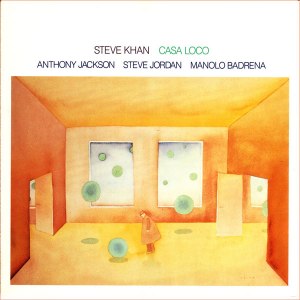
Steve Khan: Casa Loco (1983)
An album which still amazes musicians the world over. Arguably guitarist Khan, bassist Anthony Jackson, drummer Steve Jordan and percussionist Manolo Badrena have never done better work – that’s saying something considering who they’ve all played with.
Bill Bruford’s Earthworks: Dig? (1989)
Both of Bruford’s 1980s Earthworks albums were really good but this gets the nod due to Django Bates being given free reign, contributing superb keyboard solos, a cool reimagining of Petula Clark’s ‘Downtown’ and classic composition ‘Dancing On Frith Street’.
Paquito D’Rivera: Why Not! (1984)
An underrated album from the Cuban alto sax and clarinet star, also featuring Claudio Roditi on trumpet, Michel Camilo on keys and a wonderful performance from drummer Dave Weckl on the opening ‘Gdansk’.
Lyle Mays: Street Dreams (1988)
The Metheny Group keyboard player chucks in everything he knows on this big-budget project – ambient post-jazz, widescreen fuzak, big-band swing and Fagen-style fusion, and it’s all good. Some, like this writer, may also prefer the more red-blooded guitar playing of Bill Frisell to Metheny.
Pat Metheny Group: American Garage (1980)
No one is too sure if this came out in late 1979 or early 1980 but it’s this writer’s favourite Metheny album, though the guitarist himself seems to have almost disowned it. He loosens up and allows some rock and Steely Dan influences, driven along by Danny Gottlieb’s superb drums.
Level 42: A Physical Presence (1985)
A lot of it’s not strictly ‘fusion’, of course, but any album featuring such brilliant live versions of ‘Mr Pink’, ‘Foundation And Empire’ and ‘88’ has to make this list.
Mark King: Influences (1984)
The Level 42 mainman amazes with his 18-minute fusion classic ‘The Essential’, plus an eerily assured tribute to early Return To Forever called ‘There Is A Dog’. Plus he played almost everything on it.
John Patitucci: On The Corner (1989)
Both of the bassist’s 1980s solo albums were good but this gets the nod courtesy of the sheer variety of grooves from drummers Vinnie Colaiuta, Dave Weckl and Alex Acuna, and the leader’s exciting solos and excellent compositions, all memorable.
John Abercrombie: Getting There (1988)
A rare excursion into jazz/rock for ECM Records, the guitarist’s most dynamic ‘80s album featured Michael Brecker on sax, a hefty ‘rock’ mix courtesy of James Farber and arguably drummer Peter Erskine’s heaviest recorded performance to date.
Joni Mitchell: Wild Things Run Fast (1983)
She littered the album with influences from the Police but the main driver was the brilliant jazz/rock musicianship of bassist Larry Klein, drummers Colaiuta and John Guerin, saxist Wayne Shorter and keys player Russell Ferrante. ‘Moon At The Window’, ‘Be Cool’, ‘Ladies Man’ and ‘You’re So Square’ smuggled fusion into the album charts.
Miles Davis: Star People (1983)
Blues, blazing jazz/rock, chromatic funk and general weirdness combine for arguably Miles’s most exciting album of the decade, featuring all-time great guitar from Mike Stern and John Scofield.
John Martyn: Glorious Fool (1981)
John’s music was now bringing in influences from Weather Report, Latin and spiritual jazz, and Phil Collins, keyboard player Max Middleton, percussionist Danny Cummings and bassist Alan Thompson made for a fantastic rhythm section.
Bruford: Gradually Going Tornado (1980)
Any album featuring ‘Gothic 17’, ‘Land’s End’, ‘Joe Frazier’ and ‘Palewell Park’ has to be on this list. Epochal work from bassist Jeff Berlin, keys man Dave Stewart and the drummer himself.
Bubbling under:
Terje Rypdal: The Singles Collection (1988)
Power Tools: Strange Meeting (1987)
Stanley Clarke: If This Bass Could Only Talk (1988)
Terri Lyne Carrington: Real Life Story (1989)
Chick Corea Elektric Band: Eye Of The Beholder (1988)
Bill Frisell: Before We Were Born (1989)
Loose Tubes (1984)
Players (Jeff Berlin, Scott Henderson, Steve Smith, T Lavitz) (1986)
(PS. If you like the sound of any of these albums, please consider buying them on physical formats to best support the artists and their families.)
 The sad death of soprano/tenor sax titan Wayne Shorter has inspired many column inches but, reading most of the obituaries, you might be forgiven for thinking that he was completely dormant during the 1980s.
 movingtheriver.com