
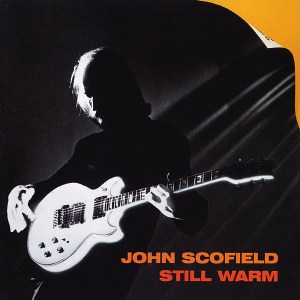
 You could put forward a pretty good case that John Scofield was THE guitarist of the 1980s.
Probably best known for his incendiary playing in Miles Davis’s band between 1982 and 1985, he also enjoyed a distinguished solo career.
Whilst focusing on straightahead jazz during the early part of the decade, his stellar ‘fusion’ period between 1984 and 1988 – encompassing classic albums Electric Outlet, Still Warm, Blue Matter, Pick Hits Live and Loud Jazz – featured excellent original compositions and formidable players such as David Sanborn, Don Grolnick, Omar Hakim, Darryl Jones, Dennis Chambers, Hiram Bullock and George Duke.
In the meantime Sco was much in demand as a sideman, playing with everyone from Terri Lyne Carrington to Tommy Smith (this playlist gathers some of his greatest music of the 1980s) whilst also teaming up with fellow guitarist Bill Frisell, drummer Peter Erskine and bassist Marc Johnson in the latter’s Bass Desires project that produced two classic albums on ECM Records: Bass Desires and Second Sight.
Immediately recognisable with his chorus/overdrive sound and molten, legato style – always informed by the blues – Scofield’s solo career has since gone from strength, and we now find him ensconced in a highly productive spell on ECM, his latest album being Uncle John’s Band.
movingtheriver caught up with John to talk about his wonderful 1980s as he prepared for a European tour with keyboardist John Medeski – he’s ever the road warrior and seems full of energy and good humour.
MTR: I’d love to know a little about how/when you signed with Gramavision Records, and did you consider other options for your mid-‘80s solo career such as ECM?
JS: I signed with Gramavision shortly before I recorded Electric Outlet. They were very interested and made us a good deal when no one else had contacted me. After I met (ECM founder/producer) Manfred Eicher at the Bass Desires recording session he expressed interest but I had already signed a multi-record contract with Gramavision. After that I stayed with other New York-based companies (Blue Note and Verve) because I met those people here at home and they were major international labels. I’m quite happy now that I’ve found a home at ECM that is aligned with my current musical direction.
Drummer Steve Jordan plays some wonderful stuff on Electric Outlet – was he overdubbed at the end after you’d tracked everything with a drum machine?
Yes, exactly. I had bought a Roland drum machine and used it to make a four-track demo at home with me playing guitars and bass. I recreated that in the studio and had Steve overdub on all the tunes. He was incredible and nailed them so quickly. We’d played together a bit before – he was on my Who’s Who album in 1978.
I’m fascinated by the work you did with saxophonist George Adams during the 1980s, especially More Sightings (1984) – can you tell me how that came about?
I had played with George in New York on gigs with the Gil Evans Orchestra and then did a tour and album as a guest with the George Adams/Don Pullen band. Then George wanted to do the tour with Hannibal Marvin Peterson. They invited me and we ended up recording a live show in Zürich. I loved George’s playing and we were friendly. I even got him to come in to record with Miles for Columbia in 1983, but it seems that that recording session was lost somehow. I believe it was at The Hit Factory on Broadway. When they were putting together some CBS tapes for reissue, I was told by Michael Cuscuna that they didn’t find anything from that session… That’s all I know. It was Miles‘s band but with George on saxophone. (Adams is understood to have guested with Miles’s band in the studio on 16 June 1983 and also in concert at the Avery Fisher Hall in NYC on 26 June 1983, and was also part of the big band which played with Miles at Montreux in 1991 – Ed.)
Is it true that Kenny Kirkland was supposed to play keyboards on Still Warm but didn’t show at the last minute? And please tell me how the fabulous Omar Hakim came to play on the album.
Yes, Kenny was a friend and I was lucky enough to get to play with him a bunch, but somehow he didn’t show up at rehearsal so I asked Don Grolnick. I think Kenny just had his dates mixed up maybe? I’m not sure. It was a real loss that he died so young. Omar and Darryl Jones were playing with Sting at that time and I knew Omar although I had never played with him but I thought that he and Darryl could really lock it in. They sounded fantastic together.
So was Still Warm recorded just after you left Miles?
I think it was before the last tour. The last stuff I did with Miles was later in the summer in Europe and then Japan.
How much rehearsal time did you get with the bands in general for Still/Blue/Loud? Or did you give the band demos to learn in advance? Because a few of these compositions are treacherous, I’m thinking of stuff like ‘Trim’ and ‘Loud Jazz’ – how did Dennis learn them (he famously doesn’t read music – Ed.)?
For Still Warm, I think we probably had one rehearsal, then one in the studio. I think I made demos of the tunes to give everybody, but I can’t remember. By Blue Matter and Loud Jazz we were a working band. I had been playing some of the Blue Matter songs with a different keyboardist and drummer along with Gary Grainger. Gary recommended Dennis and I guess he learned the songs at rehearsal. Maybe I made demos… I just remember Dennis trying a go-go beat on ‘Blue Matter’ which I hadn’t tried before. I think I wrote that song just before the session and had never played it live. Then we played a week at Fat Tuesday before going into the studio with Dennis and Mitch Forman. For Loud Jazz, we rehearsed but also played the tunes live on tour before the recording.
Regarding producer Steve Swallow’s role, did he select material? The albums have stood the test of time so well because they’re generally free of 1980s production clichés.
Steve has been a friend and mentor to me since the ‘70s. He was interested in production and multi-track recording and I knew he would be great at it. Although he didn’t select the material, he probably helped me with selecting my own tunes. He was really involved in mixing and had suggestions for the arrangements. Because Gramavision had their own studios, we were allowed to mix for many hours and treated mixing more like we would for a pop record. We were really lucky to have the great engineer Joe Ferla, to whom we deferred for many of the mix ideas. Along with Steve, he was responsible for the sound.
Can you tell me a bit more about the tune ‘Gil B643’ – presumably it’s a tribute to Gil Evans? And was the title at all influenced by the movie ‘THX 1138’?
B643 was Gil‘s apartment number! We lived at the same building in Manhattan.
I’d love to know a bit more about ‘Picks And Pans’ and its 6/8 feel, it strikes me that it’s a very influential tune in ‘fusion’ but was it influenced by Joe Zawinul’s ‘The Juggler’ (from Weather Report’s Heavy Weather)?
I liked Joe’s tune but I don’t think I got the beat especially from that…but there were other examples of that kind of beat. Probably lots of them. Maybe it first came from Afro-Cuban music like Mongo Santamaria’s ‘Afro Blue’. Or you can take a jazz waltz and just put a backbeat in there!
Which is your favourite of the two terrific Bass Desires albums and why?
I can’t say that I really have a favourite, but I just remember the chemistry for the first record was really exciting and it was great when we realized we could play together and that the group had a different sound, largely because of Bill Frisell and his unique approach. Also the sound with the two of our styles working together. That’s not to take anything from Marc and Peter, who really contributed so much and brought in material and if it weren’t for Marc having the idea of putting us all together, it would never have happened. I remember we played some gigs together before we went in the studio as well as rehearsing. I think we played a strange cabaret club in New York City. I can’t remember the name of the place and we probably also played a gig in Boston as well before we went into the studio with Manfred Eicher.
How did Dennis Chambers and Gary Grainger come onboard for the Blue Matter band – did you headhunt them, did they audition, or a bit of both?
I was looking for an electric bass player and my friend, the keyboard player Marc Copland, recommended Gary who he had played with in Washington DC. He said Gary could play anything on electric bass and it turned out he was absolutely correct. I then played with Gary in another configuration and he recommended Dennis. Gary and Dennis grew up together in Baltimore and were old friends. I had heard about Dennis with The P-Funk All Stars and was so surprised to learn that he was looking to play more jazz/fusion. Actually, Darryl Jones had played me a great board tape and said, ‘Isn’t this drummer fantastic?’ But we didn’t know who it was. I found out later that it was Dennis so I was a fan already even though I didn’t know it!
Hiram Bullock is an inspired rhythm-guitar choice on Blue Matter – was he a Steve Swallow recommendation?
No, I knew Hiram was great. I knew him from the New York scene and we were friends. I wanted rhythm guitar on that one track and I thought he would do a better job than I did – I think he did.
Was ‘Blue Matter’ influenced by Miles’s ‘Tutu’ (composed by Marcus Miller)?
I just had a generic triplet-ish backbeat in mind. It had no relation to ‘Tutu’ – not at all. ‘Tutu’ sounds a bit like (Burt Bacharach tune) ‘The Look Of Love’, right?!
How did you achieve the final minute of ‘Time Marches On’ where you solo over that ‘drone’ – was it a slowed down tape loop?
No, we just did it in real time.
I’d love to know your favourite guitarists of the 1980s, any genre…
Mainly I liked the jazz guys Wes Montgomery, Jim Hall, George Benson, Pat Martino. But I always loved the blues guys starting with Hendrix and Clapton back in the ’60s, plus Otis Rush, Albert King and BB King. I always admired my contemporaries Metheny, Stern, Frisell, Abercrombie, Mick Goodrick… I went in the fusion direction because of my experience with Miles. If it wasn’t for him, I probably would’ve been just playing bebop and giving guitar lessons!
The only time I saw the Blue Matter band in London was a really weird but brilliant gig in the East End in summer 1987 I think, maybe it was called the Mile End Theatre? Do you remember that? And in general do you have good memories of touring the UK and Europe?
Was that the Half Moon Theatre? I’ll never forget the gig. The late John Cumming brought us to London and I played many gigs subsequently for him. Maybe it was my first one in London as a leader? Not sure? That band was so strong. We really had some success in UK/Europe in those days.
Did Miles ever give you feedback on your 1980s solo career, or did you ever seek it out?!
I know he liked my tunes because I wrote ‘You’re Under Arrest’ for him and gave him a demo of a bunch of other stuff, some of which ended up on my records. He said he was gonna record everything but then when I quit the band in order to go out on tour with Blue Matter, I didn’t get a chance to do any of that with Miles. He had moved on to Tutu. I remember I played him some of Blue Matter for him once and he was really blown away by Dennis’s playing…
Finally, how do you look back on your 1980s career in general? Was it a great era for guitar-based music?
It was an incredible time. It was great because of getting to play with Miles and all the exposure it got me, and then starting my own career, playing funk/jazz with those guys. I was so influenced by Miles and his direction in the ‘80s. But, for me, Weather Report and Herbie’s Head Hunters were the greatest. I think it was a really good era for guitar when you think of Holdsworth, Stern, Metheny, Robben Ford and so many more. And of course the classic rockers like Clapton and Beck were around. Pop music in general had some pretty hot-shot guitar stuff in there, and funk was really everywhere. Thanks to Sly…
Thanks John and good luck on the European tour…

John Scofield at the Cape Town Jazz Festival, 2003. Photo by William Ellis
Special thanks to William Ellis, George Cole and Jan Lohmann for their help with this piece.
 movingtheriver.com