
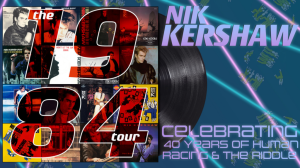
 As the male solo artist with the most weeks on the UK singles chart during 1984, it’s not surprising Nik Kershaw is celebrating that year with a lengthy European tour, playing his two top 10 albums Human Racing and The Riddle in their entirety.
He’s still able to command big audiences for his solo gigs, and with good reason – his vocals are if anything much improved since his mid-‘80s heyday and his songs are built to last, with their bold melodies, crafty harmonies and intricate arrangements. But then regular readers already know movingtheriver is a big fan.
So Kershaw’s back catalogue is an embarrassment of riches but also presents some potential problems for a five–piece ‘rock’ band – for a start, how to recreate those dense textures and sequence-heavy arrangements? Thankfully he generally didn’t scrimp on any of that, mostly using the same audio stems and keyboard sounds from the 1980s. There was little or no ‘reimagining’ during this gig, hugely enjoyed by a packed house.

‘Roses’, whose lyrics are still relevant today, was the surprise but effective first song, the band (all middle-aged white guys dressed in black, but then you don’t go to a Kershaw gig expecting bells and whistles) arriving onstage to the opening percussion loop.
‘Know How’ and ‘Wild Horses’ (a favourite of Miles Davis) sounded fantastic, benefitting from bassist Paul Geary’s beefy tone and Kershaw’s fluid guitar lines.
He delivered a great vocal on ‘Wide Boy’, while ‘City Of Angels’ – written about ‘a city I’d never been to’ – featured a lovely laidback performance from drummer Bob Knight, though at times during the gig he lacked the dynamics and smooth grooves of original Human Racing/Riddle sticksman Charlie Morgan.
Geary had his work cut out aping Mark King on ‘Easy’, but he did a pretty good job if somewhat lacking the Level 42 man’s precise percussiveness and syncopated slides. Impressively, keys player Phil Peckett seemed to take care of all the track’s fast sixteenth-notes in real time rather than relying on a sequencer. The whole band did pretty much the same on ‘Don Quixote’.
Self-deprecating to the last (he’s always claimed he’s just a ‘muso’ who was thrust into the limelight), Kershaw played down his Green credentials before ‘Save The Whale’, claiming it had been written as a last-minute ‘rent-an-issue’ song for The Riddle.
The excellent ‘You Might’ featured ‘too many chords’, according to Kershaw, while the first set closed with the album’s perennially popular title track, featuring tasty duel lead guitars though with a rather stiff ‘rock’ feel compared to the slinky sixteenth-note groove of the original.
Set two featured Human Racing in its entirety, and this is where the now rather dated zaniness of Kershaw’s early stuff became apparent, the superbly sung title track and ‘Wouldn’t It Be Good’ aside, though the latter was played surprisingly early in the set.
There was a lengthy tribute to and applause for producer Peter Collins who passed away in June before Kershaw closed up Human Racing with ‘I Won’t Let The Sun Go Down On Me’, rescued by the frontman’s lengthy Holdsworth-like guitar solo.
He seemed genuinely delighted by the ecstatic crowd reaction, signing off with a breezy ‘You’ve made an old man very happy’, before encoring with mass singalongs ‘When A Heart Beats’ (complete with superb note-for-note solo from second guitarist Adam Evans), should-have-been-a-hit ‘The Sky’s The Limit’ and ‘The One And Only’.
A great night of classy music and enjoyable nostalgia. Who knows – maybe Nik will amaze us with Radio Musicola @ 40 in 2026.
 40 years ago, gay artists weren’t just occasional visitors to the British pop charts – they were leading the agenda.
 movingtheriver.com