Narada Michael Walden: Looking At You, Looking At Me/The Nature Of Things/Divine Emotion

Singing drummers: the ’80s were chock-a-block with ’em.

But Narada seems a somewhat forgotten example, at least compared to the far more popular Phil C, Don H, Stevie W and Sheila E.

Yet he started the decade as the one you’d probably have put your money on, ending the ’70s as he did with an impressive run of R’n’B hits.

Narada had of course started his music career as a jazz/rock drumming tornado in the second incarnation of John McLaughlin’s mighty Mahavishnu Orchestra, going on to record famous fusion sides with Jeff Beck, Weather Report, Tommy Bolin, Alphonso Johnson and Jaco Pastorius.

During the ’80s, he was one of the most in-demand producers on the planet, helming Whitney Houston’s ‘I Wanna Dance With Somebody’, Aretha Franklin/George Michael’s ‘I Knew You Were Waiting For Me’ and Starship’s ‘Nothing’s Gonna Stop Us Now’. But his solo career was somewhat in limbo during this period, so it’s fascinating to check out a new, nicely-appointed three-album survey of his 1983-1988 output.

Looking At You, Looking At Me (1983) is the best of the three albums, but a frustratingly inconsistent record. Listening to the superb title track, you’d think he might have found hit his true metier, a languid, luxurious, West Coast pop/jazz, similar to the kind of music Al Jarreau or Manhattan Transfer were making at the time.

But an OK duet with Angela Bofill, passable cover of ‘Reach Out (I’ll Be There)’ and sick drum-machine/horn workout ‘Shake It Off’ aside, the rest of the album is fairly unmemorable R’n’B with occasional virtuosity from guitarist Corrado Rustici and bassist Randy Jackson.

The followup, 1985’s Nature Of Things, is even more problematic, sounding mainly like a kind of soft R’n’B version of the ‘Top Gun’ soundtrack, with way too many synth-based ballads. But Divine Emotion (1988) was a partial return to form, led by the effervescent title track (with one of the great ’80s basslines) which gave him a timely UK hit. Narada had obviously been prompted into action by his highly successful production work – his vocals and arrangements have never been better.

But while Divine Emotion sounds like a million dollars, there are still issues on the songwriting front. Put simply, only the title track, ‘But What Up Doh’ and closer ‘We Still Have A Dream’ have memorable hooks (the latter also features some brilliant jazz/rock kit work from Narada).

One wonders what might have happened if he had hooked up with some great ‘pop’ songwriters like Kenny Loggins, Rod Temperton, Michael McDonald, Carole Bayer Sager or even Burt Bacharach at the outset of the decade rather than relentlessly ploughing his own furrow; ‘Looking At Me, Looking At You’ offers tantalising possibilities.

But looking at his career as a whole, it’s all turned out fine – Narada’s always been one of the coolest, most talented musician/producers around, and apparently he’s a joy to work with.

Mark Isham: Vapor Drawings 35 Years On

Did any music of lasting worth come out of the early ’80s ‘New Age’ boom?

Mark Isham’s brief but inspired Windham Hill catalogue still cuts the mustard.

The trumpeter/keyboardist/composer’s Vapor Drawings, released 35 years ago this weekend, was a remarkably assured, fully-formed debut album, recorded when he was part of Van Morrison’s band and also enjoying a varied session career.

I distinctly remember hearing a track from it in the mid-1980s on a short-lived ‘new age’ BBC radio show whose name escapes me. And weirdly, Isham mixed the album 100 yards from my childhood home during spring 1983 at John Kongos’s Tapestry Studios.

Synths are Vapor Drawings’ main ingredient but Isham uses them in subtly original ways, using sequencers to build Steve Reich-inspired ‘systems’ or – one of his trademarks – getting them to hang in the air like sky lanterns.

The music defies categorisation, mostly hovering in the hinterland between ambient, minimalism, electronica and jazz (he even throws in a quote from Sonny Rollins’ ‘Oleo’ on ‘Raffles In Rio’).

But there’s always the human element courtesy of his superb trumpet and piano playing. Erik Satie is also an apparent inspiration, and possibly what David Sylvian picked up on when he invited Isham into the studio to record Brilliant Trees later in 1983.

It’s no surprise Isham has become one of the most in-demand soundtrack composers of the last 30 years – ‘On The Threshold Of Liberty’ (named after a Magritte painting), ‘Men Before The Mirror’ and ‘Sympathy And Acknowledgement’ are epic and rousing.

’83 proved to be a bit of an annus mirabilis for Isham, hooking up with Sylvian and also working with Gil Evans at the Montreux Jazz Festival. Vapor Drawings is the first and best of his solo albums. Happy birthday to an unsung classic.

David Bowie: The Serious Moonlight Tour 35 Years On

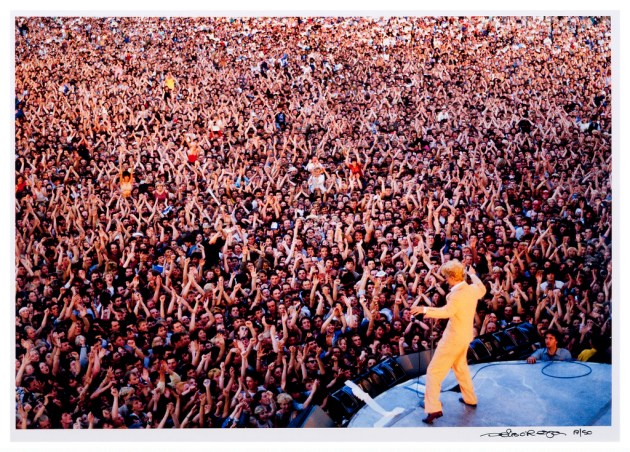
David Bowie, Milton Keynes Bowl, 3 July 1983. Photo by Denis O’Regan

The current London heatwave has sent me back to the summer of 1983 when it seemed like the sun shone every day and the radio was set to ‘fun’, blurting Men At Work, Thompson Twins, Kid Creole, KC and the Sunshine Band, Dexys Midnight Runners and Culture Club.

But Bowiemania trumped them all. In July ’83, all my parents’ friends were dancing to Let’s Dance and David’s Serious (or should that be Sirius?) Moonlight Tour was the hottest ticket in town.

Apologies to Milton Keynes natives, but Londoners of a certain generation will probably always suppress a titter at the mention of the new town’s name (The Style Council didn’t help with their satirical 1984 single ‘Come To Milton Keynes’).

Maybe Bowie tittered a bit too when three Milton Keynes Bowl dates (1/2/3 July 1983) were swiftly added to the tour due to unprecedented demand in the London area (he had already done a night at Wembley Arena and a charity show at the Hammersmith Odeon).

But the gigs were a huge success, and Denis O’Regan’s photo marking the occasion is surely one of the great ’80s music documents.

According to O’Regan, who had unparalleled access to Bowie and his entourage throughout the world tour, David had never been happier: ‘He talked about it being his Phil Collins period but this was heavily in retrospect. At the time, I know he loved it. It was the happiest and most successful he’d ever been’, O’Regan recently told MOJO magazine. Bowie was also making a bit of money at last, freed from dodgy record and management deals.

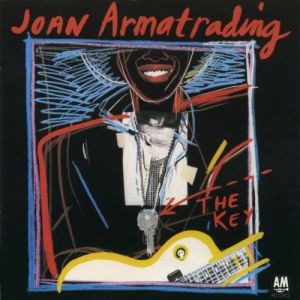
Joan Armatrading: The Key 35 Years Old Today

A&M Records, released 28 February 1983
Produced by Steve Lillywhite (except ‘Drop The Pilot’ and ‘What Do Boys Dream?’ produced by Val Garay)

Principally recorded at The Townhouse, Shepherd’s Bush, London

UK Album Chart position: #10
US Album Chart position: #32

Musicians include Adrian Belew, Jerry Marotta, Tony Levin, Stewart Copeland, Daryl Stuermer, Larry Fast, Annie Whitehead, Guy Barker, Tim Pierce


Thompson Twins: Quick Step & Side Kick 35 Years On

‘We’re not worthy!’ It was Wayne and Garth’s catchphrase but it could just as easily have been uttered by Thompson Twins’ frontman Tom Bailey in response to the band’s worldwide fame during 1983 and 1984.

He told Channel Four in 2001 (see below) that, at the peak of their success, he always felt on the verge of being ‘found out’ – an intruder at the 1980s Pop High Table. 

And then there was the ignominy of being christened ‘The Thompson Twats’ by that naughty Frankie Goes To Hollywood.

They were being a tad harsh; The Thompson Twats made some great pop in the early ’80s. But Quick Step – released 35 years ago this week – is fiendishly difficult to ‘place’, representing a kind of musical Year Zero.

The only real antecedents seem to be Bowie, Gary Numan and Thomas Dolby (who I can’t believe is not a guest keyboard player on the album – if he is, he’s not credited).

After the Twins’ first two records – when they were a kind of Grebo/agitprop/post-punk outfit – Bailey sacked half the band (including bass ace Matthew Seligman) and formed a lean, mean three-piece (Bailey took care of the music, Alannah Currie and Joe Leeway the image and stage show, though all got songwriting credits).

The final masterstroke was recruiting star Grace Jones/Talking Heads/Robert Palmer producer Alex Sadkin.

The formula worked a treat on Quick Step, recorded at Compass Point Studios on the Bahamas and one of the first albums I loved all the way through. Sadkin plays a blinder, adding loads of percussion, perambulating synths and those much-imitated, elastic bass sounds.

There are so many classic early ’80s pop tunes that it’s almost indecent. Just hearing the intros to ‘Lies’ and ‘Love Lies Bleeding’ makes me want to jump up and down like my 12-year-old self.

‘Watching’ – featuring Grace Jones’ hysterical vocals – and ‘We Are Detective’ are also good clean pop fun. The latter even throws in some Piazzolla-style fake accordion for good measure.

Quick Step & Side Kick was a big hit in the UK, hitting #2. Those anti-capitalist ideals were quickly waylaid. US sales were helped no end when the ever-prescient John Hughes chose ‘If You Were Here’ for a key moment in his 1984 movie ‘Sixteen Candles’, but the Twins didn’t really hit the jackpot in the States until the follow-up album Into The Gap. They even played at Live Aid – in Philadelphia, not London.

N.B. Michael White wrote a really nice, little-known memoir about life in the Twins called ‘Thompson Twin’. He played live keyboards with the band during their pop peak. Spoiler alert: it was not a bed of roses…

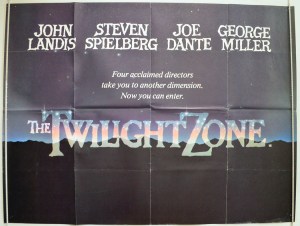
Wanna See Something Really Scary? Two Takes On ‘The Twilight Zone’

‘Wanna see something really scary?’ Day Aykroyd’s ‘Twilight Zone: The Movie’ catchphrase was an open invitation to me back in 1983.

I had just seen John Landis’s ‘Thriller’ video, George Romero’s ‘Creepshow’ and John Carpenter’s ‘Halloween’ and was rapidly becoming a ‘confirmed ghost story and horror film addict’, as Jack calls Wendy in ‘The Shining’.

‘Twilight Zone: The Movie’ was briefly a big VHS hit in my house. Though these days it looks like a bit of a misfire (decent Joe Dante and George Miller sections, less-than-decent Spielberg and Landis), I mainly loved the flavour of the 1983 movie’s Landis-directed-and-scripted opening and closing tags.

I can still randomly remember chunks of dialogue, especially Albert Brooks’ little ad-libbed songs (‘Look at those two apes/This must be where they live’ etc…).

Then my recent Cassette Revisitation Program brought round The Manhattan Transfer’s ‘Twilight Zone’, recorded a couple of years before the movie was released. Jay Graydon and Alan Paul adapt the original source music (either composed by Bernard Herrmann or Marius Constant, depending on which websites you trust…) with aplomb.

Though the track comes a bit too close to disco for my liking, I was knocked out by Janis Siegel’s lead vocal; her phrasing and enunciation are really something.

And what a band: Graydon on guitar, Jai Winding on keys and Toto in the engine room. Graydon’s stunning harmonized solo should possibly have been in my ‘wackiest guitar solos of the 1980s’ list and Winding lays down some excellent Fagen-esque keys.

I like the lyric too: ‘Unpretentious girl from Memphis/Saw the future through her third eye…’ Throw in a spot-on impression of Rod Serling (or is it actually Rod?) and you’ve got a great tribute song. Released as a single in June 1980, it made #25 in the UK and #30 in the US.

But anyway, where were we? Back to the movie. ‘Happy’ Halloween, heh-heh-heh…

Mike Leigh’s Meantime (1983): An Interview With Producer Graham Benson

There definitely seems to be something in the London air this summer.

The Grenfell Tower tragedy and various other events have brought some deeply unpleasant issues to light (again).

Revisiting Mike Leigh’s 1983 TV film ‘Meantime’ recently, it seemed eerily relevant. A withering portrait of Thatcher’s Britain featuring a brilliant cast, it’s still a striking piece of work, at times difficult to watch but finally offering cause for hope.

Its essential Englishness also echoes through the work of Suede and Blur; an alternative soundtrack might include ‘My Insatiable One’ or ‘Bank Holiday’.

Mainly set and shot in Haggerston, East London, ‘Meantime’ focuses on two generations of the Pollock family: parents Frank (Jeffrey Robert) and Mavis (Pam Ferris); their sons Colin (Tim Roth) and Mark (Phil Daniels); Mavis’s sister Barbara (Marion Bailey) and her husband John (Alfred Molina).

Frank, Mavis, Colin and Mark live in a rundown council high-rise (Bryant Court in Whiston Road, where a two-bedroom flat now goes for £330,000) while Barbara and John have escaped to middle-class respectability in Chigwell, Essex.

From Uncle John’s condescending opening line – ‘Barbara, the boys can take their shoes off and leave them in the kitchen, all right?’ (note that he doesn’t tell Colin and Mark himself) – we know we’re deep in Leighland. The performances are uniformly superb, with Roth, Daniels and Bailey possibly never better.

Oldman delivers a remarkable turn as the skinhead Coxy, smashed on the Special Brew, looking for trouble but also deeply vulnerable, while Peter Wight is excellent as the insouciant, blithely idealistic estate manager.

Gary Oldman as Coxy

Mark, Colin, Coxy and Frank are stuck in a grim, sometimes demeaning cycle of unemployment, but there seems to be glimmer of hope when Auntie Barbara offers Colin a painting job in her home. Mark has other ideas. Anyone growing up in London during the early 1980s knew kids like Colin, Mark and Coxy. The latter two are quick-witted and sharp but totally wasted, with no structure in place for them to thrive.

Andrew Dickson’s soundtrack – a duet for tack piano and soprano sax – is unforgettable. And, for a director known more for his characters and situations than a visual sense, Leigh comes up with many striking images: Mark and Coxy dodging the falling detritus from a freshly-bulldozed block of flats; Colin wandering uncertainly in front of the Winston Churchill statue at Woodford Green; Coxy rolling around a giant, hollow metal canister, attacking its insides impotently with a stick.

I asked legendary TV producer Graham Benson about his memories of working on ‘Meantime’ (which you can watch in HD below, at least until it’s taken down…).

MP: How did you come to the project and what was its genesis? I gather it was your first (and only) experience working with Mike Leigh.

GB: Yes, it was my one and only time working with Mike and a very enjoyable, rewarding time. The producer’s job is very much one of support, encouragement and of being there when needed in various aspects of the films progress. We initially wanted to make a feature film when I was running Robert Stigwood’s European film and TV company. We nearly got a deal with Warner Bros but the lack of script (Leigh famously develops his scripts through intensive improvisations in collaboration with the actors – Ed) scared the moguls. Eventually a combination of Channel 4 and David Rose together with Central Productions and Margaret Matheson delivered the commitment and budget. I am pleased and proud to have been a part of Mike’s journey and have to say that producing a Mike Leigh film was an example in my career of working with a supremely professional, responsible, collegiate and multi-talented film-maker, and a good-humoured, decent bloke to boot!

‘Meantime’ was made for Channel 4. It’s hard to imagine such a hard-hitting feature-length film getting shown on a terrestrial station today. Do you see that period as a golden age for British TV?

Well, Channel 4 were Mike Leigh enthusiasts as they remain now. He’s always had them and the BBC. I don’t see why it couldn’t be made now really. These days he has other places in Europe to go and get additional monies – for now, anyway…

The film showcases an incredible array of Brit acting talent: Marion Bailey, Gary Oldman, Tim Roth, Peter Wight, Pam Ferris, Alfred Molina, etc etc. Did you have any casting input?

We discussed the casting as we went along. It was a stunning cast but they were all much less well-known then. Like so many others, they were cutting their teeth on hard-hitting UK dramas.

Though often a difficult watch, the ending arguably shows chinks of light – Barbara finally stands up to John and the two brothers seem to come to a new understanding. Is that how you see it?

Yes. Though it’s a bleak and critical view of Thatcher’s Britain, it is a hopeful film. The human spririt will win through. But we must be watchful, as we see today.

What do you think is the legacy of the film, if there is one?  

Oh, it proved Mike could handle a wider canvas and could deal with a slightly bigger budget. It solidified his method of working as a successful one and a genre all of its own. Soon afterwards he’d get his opportunity on the bigger screen.

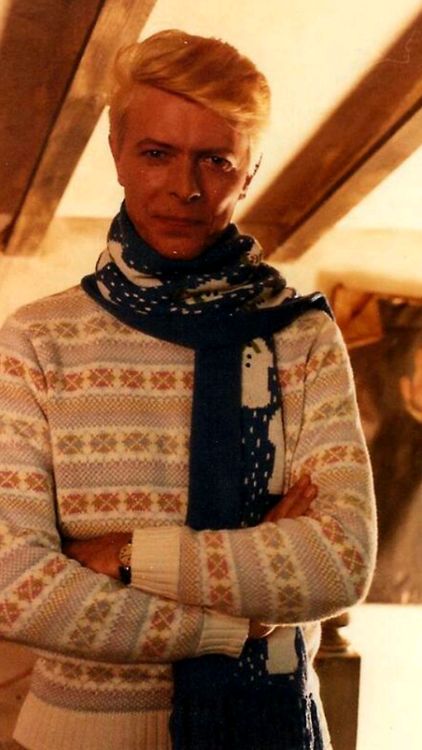
David Bowie & The Snowman

bowieDavid Bowie’s 1977-1985 period was one of his most fascinating and contradictory.

On the one hand, there were the ‘adult’ themes embedded in Heroes, Lodger, Scary Monsters, ‘The Elephant Man’, ‘Christiane F’, ‘Cat People’, ‘Merry Christmas Mr Lawrence’, ‘Baal’ and ‘The Hunger’.

But then there were the projects that were, on the face of it, more typical of a well-respected, part-of-the-furniture ‘family entertainer’; the 1977 Bing Crosby TV duet, the 1978 recording of Prokofiev’s children’s classic ‘Peter And The Wolf’, the ‘unthreatening’ pure pop of Let’s Dance and Tonight, the ‘Labyrinth’ movie and soundtrack, the huge investment of time and effort in various Band Aid/Live Aid ventures.

Were these karmic ‘atonements’ for those bleak Los Angeles and Berlin periods of the mid-’70s? Possibly, though his work had always touched on childhood themes, and he was apparently also very keen, whenever possible, to take on projects his young son could enjoy.

snowman

So, in early December 1983, when Bowie was – albeit briefly – probably the biggest ‘rock’ star on the planet, he found time to contribute a touching, heartfelt introduction to Dianne Jackson’s film of Raymond Briggs’ ‘The Snowman’.

First shown on British TV 33 years ago today (I can remember how much of an event it was in my house), it’s yet another fascinating piece of early-’80s Bowie ephemera, and his involvement was surely quite a coup for the film-makers.

Though ‘The Snowman’ has become a perennial Christmas favourite, it is often transmitted without the introduction. So here it is in all its glory. Merry Christmas.

Story Of A Song: Rolling Stones’ ‘Undercover Of The Night’ (1983)

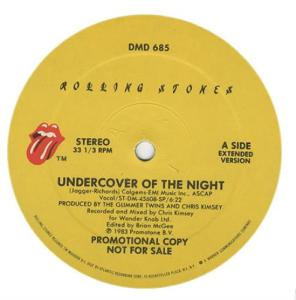
Rolling+Stones+Undercover+Of+The+Night+-+Stoc+141290bSo here it is: The Stones’ last great single.

‘Undercover’ is essentially a one-chord groove with powerful lyrics, stinging guitar licks, a memorable hook and notable video.

Though Mick and Keef share a writing credit, the song was apparently largely a Jagger composition, with Richards later saying: ‘Mick had this one all mapped out. I just played on it. There was a lot more separation in the way we were recording at that time. Mick and I were starting to come to loggerheads…’

Guitarist Ronnie Wood concurred but also had reservations: ‘There was a great acoustic version which is the kind of song it should be. The final, polished version may have been Mick’s vision of the song…’

Reading between the lines, Jagger was clearly keen to bring outside players into an increasingly dysfunctional band situation. Recording took place during the summer of 1983 at Compass Point Studios in Nassau, giving Jagger the opportunity of using some great local players, many of whom light up ‘Undercover Of The Night’.

A raft of percussionists including Sly Dunbar, Martin Ditcham, Moustapha Cisse and Brahms Coundoul accompany drummer Charlie Watts on various instruments including bongos, Simmons drum and even a timpani (there are rumours that a complete different version of the song exists featuring a rhythm section of Sly and Robbie). Producer Chris Kimsey also enters into the spirit of things with an ingenious ‘dub’-style arrangement (or is that the work of Brian McGee, credited as ‘editor’ on the vinyl label?).

Jagger claimed that his lyric was heavily influenced by William Burroughs’ 1981 novel ‘Cities Of The Red Night’. The song is a disturbing vision of Latin America’s Dirty War. This was, after all, an era in which thousands of ‘political prisoners’ were tortured and killed in the ESMA detention camp in Buenos Aires, less than a mile from the stadium where the 1978 football World Cup Final was taking place (according to many reports, the cheers of the fans obscured the screams of suffering prisoners).

Excellent documentary ‘The Shock Doctrine’ claims that many torture techniques used by the Chilean and Argentinian junta (including rape and genital mutilation) may have been ‘learned’ in the US-run School Of The Americas. Jagger manages to crystallise many of these disturbing aspects in a powerful lyric:

Hear the screams of Centre 42
Loud enough to bust your brains out
The opposition’s tongue is cut in two
Keep off the street cos you’re in danger
One hundred thousand disparos
Lost in the jails in South America

Cuddle up baby, cuddle up tight
Cuddle up baby, keep it all out of sight
Undercover of the night

The sex police are out there on the streets
Make sure the pass laws are not broken
The race militia has got itchy fingers
All the way from New York back to Africa

All the young men, they’ve been rounded up
And sent to camps back in the jungle
And people whisper, people double-talk
And once-proud fathers act so humble
All the young girls they have got the blues
They’re heading on back to Centre 42

Down in the bars, the girls are painted blue
Done up in lace, done up in rubber
The johns are jerky little GI Joes
On R&R from Cuba and Russia
The smell of sex, the smell of suicide
All these sweet things I can’t keep inside

Undercover, all out of sight
Undercover of the night

Julien Temple directed the controversial video, shot in Mexico City. As he relayed in the book ‘I Want My MTV’, his dealings with Jagger and Richards gave him a pretty stark insight into the state of their relationship:

‘I wrote an extreme treatment about being in the middle of an urban revolution, and dramatised the notion of Keith and Mick really not liking each other by having Keith kill Mick in the video. I never thought they would do it. Of course they loved it. I went to Paris to meet with the band. Keith was looking particularly unhappy. He was glowering with menace and eventually said, “Come downstairs with me.” My producer and I went down to the men’s room. Keith had a walking stick and suddenly he pulled it apart. The next thing I know he’s holding a swordstick to my throat. He said, “I want to be in the video more than I am.” So we wrote up his part a bit more. That was Keith’s idea of collaboration!’

The video was initially considered too violent for MTV (though they did eventually air an edited version after 9pm) and it was heavily censored when shown on British television, leading to a fractious interview on ‘The Tube’ during which presenter Muriel Gray questioned Jagger and Temple about the extreme content and their motives for making the video.

‘Undercover Of The Night’ was released as the first single from the accompanying Undercover album on 1 November 1983. It got to #9 in the US and #11 in the UK. Not bad. It was their highest chart placing to date.