Just a quick one today to wish Mr Lydon a very happy 60th birthday. He continues to be an intelligent, irreverent, funny and fascinating figure.

Just a quick one today to wish Mr Lydon a very happy 60th birthday. He continues to be an intelligent, irreverent, funny and fascinating figure.
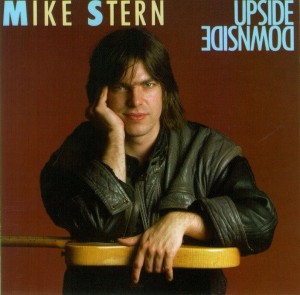
There’s no telling how a jazz musician will react to a bad review, whether from a critic or fellow player.
Some, like Miles Davis, take a – how shall we put it – stoic view, either refusing to read any press or choosing his writer friends very carefully (Leonard Feather, Quincy Troupe).
But for every naysayer, there’s an aggressor; drum master Tony Williams laid into jazz scribe Stanley Crouch for his less-than-flattering comments on Miles’ electric-era music, while Weather Report famously took Downbeat magazine to task for its one-star slagging of 1978 classic Mr Gone.
Though guitarist Mike Stern had studied at the famous Berklee music school in the mid-‘70s and then landed a top gig with jazz/pop supergroup Blood Sweat & Tears, he wasn’t prepared for bandmate Jaco Pastorius’s succinct review of his guitar playing after a dodgy run through Chick Corea’s ‘Spain’ on tour with BS&T one night – ‘Stern, you know that sh*t wasn’t happening at all! You’ve got to learn faster tempos!’
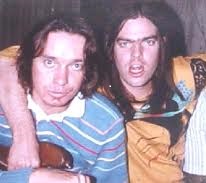
Jaco and Mike, 1980
To his great credit, Stern listened to his friend, learnt the tune note by note and in the process became one of the greatest players of his generation. His slick bebop lines played with a ‘rock’ sound were quite new when he came of age playing with Billy Cobham’s band.
Miles was also listening closely while he was in the early stages of putting together his ‘comeback’ band in early 1981. The story goes that he appeared in the front row of The Bottom Line club in New York City and poached Stern during a break, apparently even calling Cobham off the bandstand in the middle of a tune to issue his intentions!
Stern was then summoned to the Columbia Records studio to record the electrifying half-time strut ‘Fat Time’ (Miles’s nickname for Stern) in one take. The track appeared on the Man With The Horn album and Stern was then invited to go out on the road with Miles.
My dad took me to see Miles at the Hammersmith Odeon in 1982, my first proper gig. I’m sad to say that I don’t recall much about it apart from Miles’s white suit and someone shouting: ‘Turn the trumpet up!’
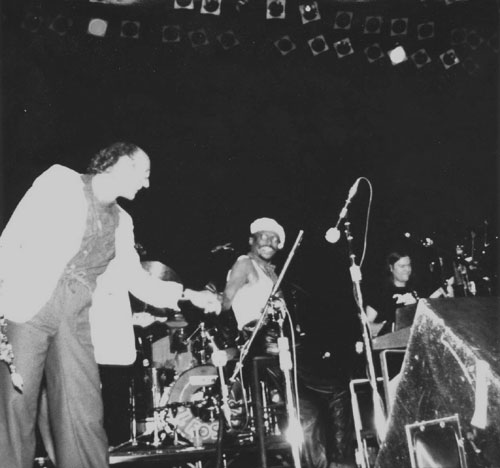
Dave Liebman, Miles and Mike Stern, 1981. Photo by Julie Coryell
Critics were harsh on Stern, not believing that a chubby, jeans-wearing, long-haired guy playing a white Strat with a fuzzbox could play ‘jazz’, but with hindsight he did a brilliant job of holding down the harmony and delivering powerful, surprising solos in the keyboard-less quintet.
But the demons that haunted some of his early career wouldn’t go away. Stern recently said, ‘I played about two gigs in my life between the ages of 12 and 32 when I was sober’.
Miles even got John Scofield into the band as second guitarist to cover for his increasingly unreliable secret weapon. Stern eventually missed a flight and got the boot, but after a successful spell in rehab returned to play with old friend Michael Brecker and Mike Mainieri’s fusion supergroup Steps Ahead.
Stern also put together a solo record deal with Atlantic Records and began working on Upside Downside in early 1986 with his late friend and fellow shit-hot guitarist Hiram Bullock in the producer’s chair.
The album is a great excuse for Stern to play the hell out his guitar in a variety of idioms. The uptempo tracks are blessed with typically fiery solos while the ballads beautifully demonstrate Stern’s lyrical side, his Telecaster screaming emotively above Dave Weckl’s subtle drumming and Mark Egan’s springy bass.
Jaco completists will enjoy one of his very last recorded contributions on the raucous ‘Mood Swings’ while saxophonist David Sanborn’s playing on ‘Goodbye Again’ is spine-tingling. But mainly the album is a must for any lover of the guitar. His sound is a little more fluid and widescreen than on recent albums and there’s no-one quite like Stern at the top of his game, a fusion of Charlie Parker and Roy Buchanan.
Mike made two excellent follow-up albums later in the ’80s, Time In Place and Jigsaw, both produced by the fine guitarist Steve Khan. For me, this was Stern’s best era, when his raunchy playing was closer to blues and rock than the lighter Methenyesque jazz and World music vibes of recent times. I also saw him live at the Town and Country Club in 1989, a memorable gig featuring the mind-blowing Dennis Chambers on drums.
Further reading: ‘The Extraordinary And Tragic Life Of Jaco Pastorius’ by Bill Milkowski

I first heard brilliant English guitarist John McLaughlin on record as a very impressionable 15-year-old when stumbling across the unsettling, brilliant ‘Dance Of Maya’, by his Mahavishnu Orchestra. I was instantly excited and intrigued.
But Adventures In Radioland, the second album from the ’80s reincarnation of Mahavishnu, was released in probably the least-heralded era of John’s music, a time when jazz and fusion seemed to be going in diametrically opposite directions and decent record deals were hard to come by.

With hindsight, it seems the mid-’80s popularity of Pat Metheny was having a huge influence on many instrumentalists and John was no exception; the decade was full of guitarists utilising synthesizer technology and looking to Brazilian songforms for inspiration (an obvious example is Al Di Meola’s Soaring Through A Dream).
But McLaughlin’s take on Metheny was far more raunchy, rooted in bebop and the blues (though the bridge of ‘Floriannapolis’ sounds suspiciously like Metheny’s ‘James’). And what a shocking record Adventures In Radioland was coming from a mainstream jazz artist, a two-finger-salute to the Young Lions neo-bop boom represented by the Marsalis brothers et al.
John seemed to be going out of his way to annoy the jazz purists but in doing so produced some material of worth. Like some of the best fusion music of the ’80s, its deceptively slick production obscures some pretty radical improvisations.
Is the album title wishful thinking? Is this John’s idea of ‘smooth jazz’, designed for radio play? If so, he must be living in a parallel universe because this is one of the weirdest albums of his career.
But, as he said himself in a 1996 interview with Guitar Player magazine, ‘Without madness or fantasy, music’s boring’. This album sure ain’t boring, especially if you’re a guitar fan, but devotees of The Inner Mountain Flame may struggle a bit…
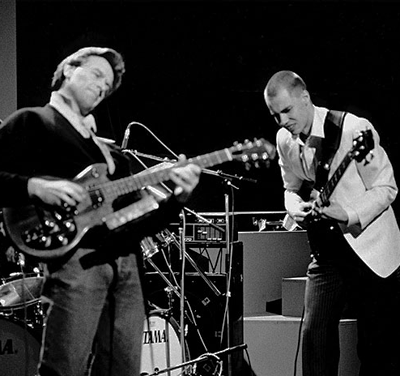
John McLaughlin and Jonas Hellborg
Opener ‘The Wait’ luxuriates in pleasant synth washes and a gorgeous chord sequence for a while before McLaughlin grabs the Les Paul and unleashes one of his most intense solos over quite a funky little R’n’B bass vamp.
‘The Wall Will Fall’ fuses a gargantuan blues riff with nutty Simmonds drums fills, and McLaughlin’s furious solo over high-speed bebop changes is both funny and exhilarating.
‘Florianapolis’ initially steers dangerously towards Metheny territory with its breezy, major-chord cod-Latin groove and nasty DX7 synth sounds. But before you know it, McLaughlin has ripped into an absolutely outstanding acoustic solo, full of rhythmic/melodic risk-taking.
‘Jozy’ is a dramatic, swinging tribute to Joe Zawinul, beautifully marshalled by drummer Danny Gottlieb with some outstanding fretless bass work from Jonas Hellborg. ‘Gotta Dance’ comes on like a fusion Mr Bungle, rattling through mellow acoustic guitar, big-band jazz, Mark King-style slap bass and industrial drums all in the space of four minutes.
‘Half Man Half Cookie’ is even weirder, a kind of post-Scritti Politti pop/funk groove interrupted by yet another incongruous big-band interlude from a multi-tracked (or sampled?) Evans.
But your proclivity for this album will probably be based on your acceptance of the mid-’80s Big Drum Sound. It certainly features some absolutely superb music. McLaughlin regrouped after Adventures and played the nylon-string acoustic exclusively for a few years – make of that what you will.

In the slipstream of Live Aid, when Stock, Aitken and Waterman ruled the charts, house and techno were warming up and ‘indie’ (Housemartins, Smiths, Cure) was thriving, this gifted pop/prog four-piece from Cumbria crept under the radar and even managed to secure a big hit with their second single ‘Calling All The Heroes’.
It Bites blended their influences – Gabriel-era Genesis, Weather Report, Yes, Japan, Level 42, Steve Arrington, George Benson – superbly, creating an excellent debut and minor hit album.
My mate Nige and I loved The Big Lad. The soundtrack to our after-school games of pool would either be Sting’s Bring On The Night or this, and I quickly grew to love its pristine production, challenging song structures, brilliant guitar playing and cool chord sequences.
As a teenager, I’d listen to it on my Walkman very loudly while studying David O’Connor’s superb, enigmatic cover art or reading Stephen King’s Christine… What larks.

Singer/guitarist Francis Dunnery once labelled The Big Lad ‘nutter’s music’, an apt description when you listen to songs like ‘Turn Me Loose’ and ‘I Got You’ which are almost pop but then pull the carpet from under your feet with bizarre, brilliant, extravagant middle sections and Dunnery’s off-mic vocal histrionics.
Producer Alan Shacklock – once the guitarist in Babe Ruth and future helmer of Chesney Hawkes’ ‘The One And Only’ – delivers a vibrant, state-of-the-’80s sound, with huge, gated drums and punchy bass.
It Bites’ early career as a souped-up pop covers band served them well – melody and groove are their priorities, and of course they were always a superb live act too.
Dunnery was (and is) also a very underrated Brit guitar hero whose playing could consistently deliver the sound of surprise with fluid legato, furious speed picking, dissonant intervals and whammy-bar abandon.
His solo on ‘You’ll Never Go To Heaven’ is a thrilling marriage of Allan Holdsworth and John McLaughlin and one of the great bits of over-the-top playing in Brit Rock.
He also delivered marvellously insane breaks on the Michael Jackson-meets-Duran Duran ‘Wanna Shout’ and barmy soft-rock ballad ‘Cold, Tired and Hungry’. Also worth checking out is B-side ‘Strange But True’ which, in its full version, becomes a vehicle for Dunnery’s increasingly demented solos.
‘Calling All The Heroes’ is actually a pretty good distillation of It Bites’ sound with Bob Dalton’s ingenious ‘reverse’ tom fills, Dunnery’s excellent melodies, John Beck’s intricate keyboards and Dick Nolan’s super-tight bass playing.
It was their only big hit though; other singles ‘All In Red’ and ‘Whole New World’ were catchy pop tunes with interesting instrumental flourishes and inventive vocal harmonies but neither troubled the charts.

The music magazines of the time generally ignored It Bites. If they did get a mention, it was generally to mock their unfashionably-superb musicianship or lack of London street-cred.
I remember Dunnery making an emotional pre-song announcement onstage at a London Astoria gig in 1988 lambasting the ‘trendy’ music press.
The Big Lad wasn’t a huge hit but did just well enough, peaking at #35 in the UK. It Bites were up and running and their best was yet to come.
Hardcore fans alert: a very nice person has posted all the Big Lad demos on YouTube.
 movingtheriver.com