The rather despairing NME headline during October 1986 said it all: ‘When The Little Girls Have All Grown Up…’
After releasing two albums in the space of barely six months, Kershaw took his time over the third. He settled in to North London’s Swanyard Studios for most of 1986 to work on the self-produced Radio Musicola, employing the cream of the English session scene (The Kick Horns, Charlie Morgan, Mark Brzezicki, Wix, Andy Richards, Simon Phillips etc).
Yes, Musicola was Kershaw’s chance to take on the Trevor Horns of this world and deliver a big-budget, endlessly-fussed-over studio ‘project’… Perhaps unsurprisingly, given his meteoric rise to fame, the main themes of the album are press intrusion and tabloid sensationalism.
And, in a neat irony, the rise of technology-led, assembly-line music was also in Kershaw’s sights, despite Musicola making liberal use of all the latest sampling and synthesizer technology. So let’s get Musicola‘s duff tracks out the way first – ‘What The Papers Say’, ‘Nobody Knows’ and ‘Running Scared’ are jarringly overproduced, though the latter had real potential.
But there are loads of treats elsewhere – ‘Life Goes On’ is a musically-rich, very pretty ballad with swooning chord changes and fine vocals from Kershaw. ‘LABATYD’ is pure class, a half-time shuffle with tasty Mark Brzezicki drums, an excellent Kick Horn arrangement and soaring synth by either Wix or Andy Richards.
The title track blew a lot of musicians’ minds back in 1986. It really was state-of-the art and still sounds pretty novel today, as striking as the title track of Level 42’s World Machine a year before. I remember eagerly tuning in to ‘The Tube’ to see Kershaw performing the song live. You can hear a lot of the ‘little girls’ turning off their TVs as he lays into the opening guitar solo…
‘Don’t Let Me Out Of My Cage’ is pretty damn ambitious fare for a pop album, a fast swing number featuring some cracking Phillips drums and effective close-harmony backing vox from Mrs Kershaw (Sheri). The excellent ‘James Cagney’ chugs along with a Level 42 groove (and features an interesting ‘New Man’ lyric) and great Felix Krish bass part that sounds uncannily like Mr King.
‘When a Heart Beats’, an excellent, intricate slice of pop/prog in the It Bites mould, gave Kershaw his last top 40 chart appearance (peaking at a disappointing #27) when it was released in November 1985.
The closing ‘Violet To Blue’ is possibly Kershaw’s finest and most ambitious recording to date, featuring some rousing vocals from the London Community Gospel Choir and superb, driving drum work from Phillips (much imitated in my music room back in the day).
An interesting album which clearly fell between the stools of art and commerce, Radio Musicola reached a barely believable #46 in the UK album chart, just over a year after Kershaw had played Live Aid. It disappeared without trace in the US.
The little girls had definitely grown up. Or maybe it was the new haircut. But 18 months is a long time to leave between albums when you’re hot, though Kershaw didn’t seem bothered about his new ‘selective’ popularity; in fact, he seemed genuinely relieved, but wondered how MCA were going to sell him now that he was focused on being a musician rather than a pop star.
Despite the poor album sales, Kershaw embarked on a sold-out UK tour in early 1987 including three nights at London’s Town & Country Club. And he would be back once more before the ’80s were out to deliver perhaps his finest solo album to date.
Recorded at Utopia Studios, Woodstock, upstate New York
UK album chart position: #90 (!)
US album chart position: #70 (!)
Terry-Thomas in ‘School For Scoundrels’
Side One:
1. ‘Summer’s Cauldron’
Andy Partridge (composer): ‘Something about the words reminded me of Dylan Thomas. Not that I’m saying I’m a Dylan Thomas. More of a Terry-Thomas, really…’
2. ‘Grass’
Colin Moulding (composer): ‘A lot of people think the song’s about marijuana – it isn’t. Todd said: “Don’t sing so deep. You sound like a bit of a molester.” So I just did the Bowie thing and added an octave above it…’
3. ‘The Meeting Place’
Moulding: ‘Because the riff was a bit like “Postman Pat”, we were just figures on a Toytown landscape viewed from above. It was me meeting her (future wife Carol) at the gates for a sandwich in The Beehive pub, embroidered with the suggestion of a lunchtime quickie…’
4. ‘That’s Really Super, Supergirl’
Partridge: ‘I’d go into his (guitarist Dave Gregory) little room, smelling of aftershave and guitar wax and dead mice, and he’d be rehearsing this solo over and over again. I can still see him playing it. I remember when we were recording the song that Todd was trying to master it on keyboard, and Dave whispered to me, “He’s got the chords wrong!” He thought the chords were major, and they’re not. I was hearing it a lot more clangorous…’
5. ‘Ballet For A Rainy Day’ (Partridge)
6. ‘1000 Umbrellas’
Partridge: ‘There was very little time to do the strings. They had one run-through and then recorded it. Their balls were on the line but they turned in a pretty fine performance…’
7. ‘Season Cycle’
Partridge: ‘I felt that I had maybe laid the ghost of Ray Davies ‘fore me and written a song that could stand up against “Shangri-La” or even, dare I suggest, “Autumn Almanac”.’
Side Two:
8. ‘Earn Enough For Us’ (Partridge)
9. ‘Big Day’
Moulding: ‘I’d been messing around with the chords of Labi Siffre’s “It Must Be Love” and, with a little moving around, it became this sort of fanfare to a big event, a ticker-tape parade for a big day.’
10. ‘Another Satellite’
Partridge: ‘I regret writing it because things turned out so marvellously with the person (Erica Wexler) it’s all about. The story had a happy ending because Erica and I finally got to express the emotional bond that was always there.’
11. ‘Mermaid Smiled’ (Partridge)
12. ‘The Man Who Sailed Around His Soul’
Partridge: ‘It just says you’re born, you live and you die. Why look for the meaning of life when all there is is death and decay? Todd said, “Let’s do a John Barry thing” and, literally overnight, came up with his arrangement with brass and flutes. It’s bang on. Cod spy music.’
13. ‘Dying’ (Moulding)
It frightens me when you come to mind The day you dropped in the shopping line And my heart beats faster when I think of all the signs, all the signs When they carried you out your mouth was open wide The cat went astray and the dog did pine for days and days And I felt so guilty when we played you up When you were ill, so ill What sticks in my mind is the sweet jar on the sideboard
And your multicoulored tea cozy What sticks in my mind is the dew drop hanging off your nose Shrivelled up and blue And I’m getting older, too But I don’t want to die like you
14. ‘Sacrificial Bonfire’
Moulding: ‘There was a touch of “The Sorcerer’s Apprentice” and a bit of Arthur Brown’s “Fire” in it, I suppose. But I wasn’t moralising. It was just that this was an evil piece of music and good would triumph over it. (The strings) were a bit too Vivaldi for me, but it had to go somewhere, I suppose…’
Recorded at Angel Studios, North London, 21-23 July 1986
UK album chart position: #39
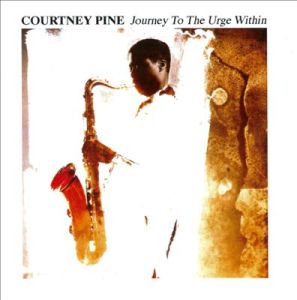
Gifted saxophonist Courtney Pine‘s career is one of British jazz’s great success stories. Starting out in the early ‘80s as a sideman with reggae act Clint Eastwood & General Saint and various Britfunk bands, he became disillusioned with the outlawing of jazz as a respected, popular music in the climate of the early ’80s London scene.
As he memorably put it in the BBC’s excellent ‘Jazz Britannia’ doc, ‘I would add different notes in the scale the way Sonny Rollins did and people would say, “No man, we don’t want that.” They were saying to me, “If you’re black and you want to play jazz in this country, you’d better go and live somewhere else!”’
But all that changed when he caught US trumpeter Wynton Marsalis on TV one afternoon. Marsalis’s professionalism and dynamism were a revelation to Pine (not to mention his youthfulness); if Marsalis could bring jazz to a wide audience, he could too.
A period of intense woodshedding paid off – soon Courtney was guesting with Art Blakey’s Jazz Messengers and The Charlie Watts Big Band, blowing all over the ‘Angel Heart‘ soundtrack and blowing people away with his solos in Gary Crosby’s groundbreaking Jazz Warriors and Jazz Jamaica groups.
Island Records came calling, and Journey To The Urge Within made the Top 40 in the UK, an almost-unheard-of state of affairs for a jazz album. This writer fondly remembers the day when, on opening the NME, he unexpectedly found Pine and Miles Davis sharingthe album chart. Happy days.
It’s well known that FGTH’s deal with ZTT was one of the worst recording contracts in pop history (outlined in embarrassing detail in vocalist Holly Johnson’s ‘A Bone In My Flute’ autobiography).
But the band were already starting to show signs of subordination by late 1984 – they refused to record the Velvet Underground’s ‘Heroin’ as the B-side to ‘The Power Of Love’, part of ZTT ideas man Paul Morley’s bizarre plan* to get the label’s acts to write a history of pop through cover versions.
FGTH also scuppered ZTT’s plan for them to star in a sci-fi movie which was to be scripted by Martin Amis and directed by Nicolas Roeg (actually, that sounds brilliant…).
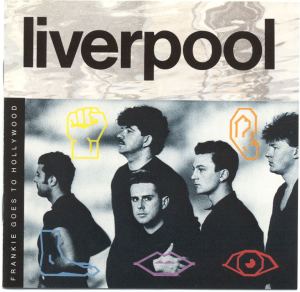
The band then insisted that they actually play on their second album Liverpool rather than let session players lay down the basic tracks, a request that seems to have been granted. Guest players this time were few and far-between, and it’s quite hard to identify Trevor Rabin, Steve Howe and Lol Creme.
Sensing trouble, Trevor Horn took the role of ‘executive producer’ and passed production duties over to the gifted Stephen Lipson, who clearly had his work cut out. A schism was opening up between Holly Johnson and the rest of the band, or ‘The Lads’, as he dubbed them (Lipson discusses the making of Liverpool in this excellent podcast).
Tensions were also running high in the UK – by mid 1986, unemployment had topped three million and anti-Thatcher feeling had reached its peak. Oxford University refused her an honorary degree. So the frivolity and epicurean excesses of Welcome To The Pleasuredome were definitely out.
Holly Johnson and Paul Rutherford
Still, Liverpool is a sumptuous-sounding album, with immense care taken over recording, mixing and mastering – apparently to the tune of a whopping £760,000.
It stands up pretty well today especially if taken as a separate entity to Pleasuredome, even if the songs – not surprisingly – are not as memorable as the debut’s.
Lipson pulls out all the stops, playing some superb fuzz-toned lead guitar, particularly on ‘Maximum Joy’ and ‘Rage Hard’, and piecing together an album of musically-rich, prog-influenced hard rock.
Synth players Andy Richards and Peter-John Vettese contribute intriguing intros and outros, often involving backing vocalist Betsy Cook too.
And though Liverpool is obviously a more ‘serious’ album than Frankie’s debut, there are still amusing spoken-word inserts in broad Scouse (‘In the common age of automation, where people might eventually work ten or twenty hours a week, man for the first time will be forced to confront himself with the true spiritual problems of livin”!).
‘Warriors Of The Wasteland’, ‘Rage Hard’ and ‘Kill The Pain’ are tough techno-rock tracks which wouldn’t have sounded out of place on It Bites’ debut album. ‘Rage Hard’ was also subjected to a fantastically overblown extended mix featuring Pamela Stephenson (doing her best Thatcher impersonation?) taking us on a tour of the 12” single.
‘Maximum Joy’ is superb; pure ZTT bliss, while ‘Lunar Bay’ is also brilliant, balls-out prog/pop in the style of Propaganda’s A Secret Wish.
‘For Heaven’s Sake’ is a completely barmy anti-Thatcher ballad (‘She should buy us all a drink’) in queasy 6/8 time, featuring a melody that wouldn’t be out of place in a classic Broadway musical, some Native American chanting by Holly and a weird music-hall middle section.
‘Is Anybody Out There’ is a fitting end to Frankie’s recording career, a majestic, distinctly Suede-like ballad (the guitar solo is totally Bernard Butler) with some beautiful Holly vocals and a subtle Richard Niles string arrangement.
The album was not a commercial disaster, reaching #5 in the UK album chart and the top 10 in many other European countries, but a disappointing #88 in the US. And Thatcher still had four years left in Downing Street.
*Morley’s influence was apparently running amok, evidenced by Liverpool‘s fairly ridiculous liner notes (‘Best wishes to Stan Boardman’) and a choice of album title that suggested he was pretty certain the band would soon be returning to their hometown, banished from pop’s high table. Holly apparently hated the title…
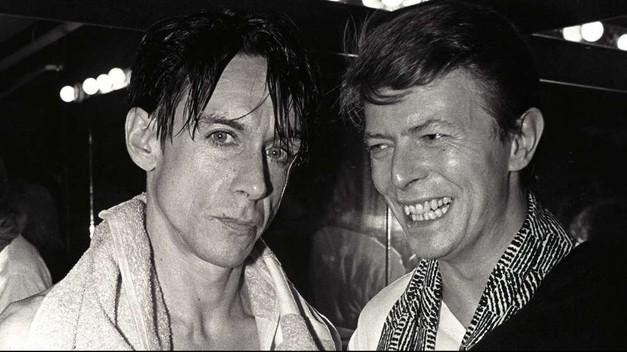
While David Bowie was turning in one of his finest live performances of the 1980s at Live Aid, his good friend Jim Osterberg AKA Iggy Pop was ensconced in LA, writing songs with ex-Sex Pistol Steve Jones.
Bowie’s use of six Iggy lyrics on the Let’s Dance and Tonight albums had given Osterberg enough royalties to buy some much-needed thinking time after a disastrous run of early ’80s solo albums and the termination of his Arista record contract.
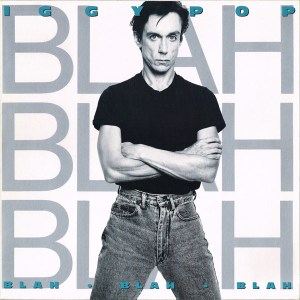
Iggy and Jones came up with nine new songs, three of which – ‘Fire Girl’, ‘Winners And Losers’ and ‘Cry For Love’ – would make it onto Blah-Blah-Blah (though they were clearly inferior to the Bowie/Iggy material).
The latter lyric especially had opened up a new vulnerability in Iggy’s writing. He later said: ‘Just expressing that openness frightened me. I didn’t want to admit I was in need of basic affection.’ Yes, Iggy was now singing boy/girl songs – love songs.
Bowie hooked up with Iggy in late 1985 to hear some of the new stuff. He was impressed. He suggested they co-write some more uptempo material and also offered to produce, apparently telling Iggy: ‘I can make this as commercial as hell.’
They disappeared off to David’s holiday home in Mustique with their respective girlfriends, then undertook a lengthy skiing holiday in Gstaad, taking a four-track tape machine with them. Mountain Studios, owned by Queen and scene of the ‘Under Pressure’ recording, was booked for April 1986, and co-producer/tech guru David Richards came onboard for the sessions too.
Bowie recruited a crack band for Blah-Blah-Blah – Kevin Armstrong played guitar (joined by Steve Jones on one track), fresh from being David’s musical director at Live Aid and doing sessions for Prefab Sprout, Propaganda and Alien Sex Fiend!
Gifted Swiss multi-instrumentalist Erdil Kizilcay, who had worked on the Let’s Dance demos and also epic soundtrack single ‘When The Wind Blows’, played (excellent) bass and shared live drums with the Linn machine borrowed from Queen’s Roger Taylor. Bowie played most of the keyboards.
David was apparently workmanlike and professional in the studio, ticking off daily tasks on a notepad with lots of nervous energy. He was focused on helping his friend to the very best of his ability. ‘He’d be chucking down the coffee and fags, and it would be pretty neurotic and manic around him’, said Armstrong.
But Bowie was also a typically shrewd people-watcher – he apparently wrote the first verse of ‘Shades’ after watching Iggy give his girlfriend Suchi a gift, turning it around to make the guy the grateful, humble recipient.
Blah-Blah-Blah features Iggy’s best singing on record. He has developed a gloriously dark croon and finally has the right material to showcase it. ‘Winners And Losers’ particularly shows off his improved vocal range.
It’s also a very funny album. Bowie and Iggy clearly had a great laugh writing these songs, with some preposterous couplets thrown in, especially on ‘Isolation’ (‘I need some lovin’ like a body needs a soul/I need some lovin’ like a fastball needs control, here I am!‘).
‘Baby It Can’t Fail’ features some of the best opening lines in 1980s rock: ‘You have loved me with energy/Backed up hard work and guts!‘ Iggy’s committed delivery always prompts a smile.
There’s some excellent, genuinely uplifting material in the shape of ‘Shades’, ‘Isolation’ (with gorgeous Bowie backing vocals) and ‘Hideaway’.
The title track is a sample-heavy curio in the style of Sigue Sigue Sputnik’s ‘Love Missile F1-11’ (which Bowie later covered) with amusing ‘geeky’ vocal stylings by Iggy and some wilfully-gormless lyrics (‘Shimon Peres, whatcha gonna do?/I’m from Detroit’ etc etc).
‘Little Miss Emperor’ tellingly quotes Allen Ginsberg and features a classic Bowie piano flourish in the ‘Absolute Beginners’/’Life On Mars’ style. Blah-Blah-Blah even spawned Iggy’s first UK singles chart showing (#10) with ‘Real Wild Child’, a cover of Australian rock’n’roller Johnny O’Keefe’s only hit.
Promotional duties led to a very memorable appearance on the regional British kids’ TV show ‘Number 73’ wherein Iggy decided to simulate sexual relations with an oversized teddy bear.
Apparently Richard Branson heard an early pressing of Blah-Blah-Blah and phoned Iggy personally to invite him to Virgin Records. But he eventually went with A&M and delivered a reasonable hit for the company; the album went gold in Canada and made a decent dent in both the UK and US charts.
So is Blah-Blah-Blah the best Bowie-related album of the ’80s? It’s certainly up there. Older Iggy fans may have been shocked by the ‘poppy’ nature of some of the material, but there’s always an edge.
The album was also arguably an influence on bands like The Mission, Sisters Of Mercy and Miss World with its monolithic drum programming, deep vocals and anthemic songcraft.
To a certain extent, Bowie tried to repeat the formula on his own decidedly patchy Never Let Me Down album, but the news was better for Iggy; he embarked on a ten-month world tour, laying off the booze and drugs for the entirety.
For the band, however, it was a different story – apparently Kevin Armstrong and drummer Gavin Harrison were in a pretty terrible state by the time they got home to London in summer 1987.
But Bowie had done it again – he’d helped kickstart Iggy’s career for the fourth time and delivered probably the commercial apex of his solo work; Blah-Blah-Blah is definitely due a critical reappraisal.
Further reading: ‘Open Up And Bleed’ by Paul Trynka
Recently, I was honoured to be asked by photographer William Ellis to contribute to his One LP project where he asks musicians, writers and music business figures to speak about the album that has been most important to them.
Here’s what I said about Gone To Earth (with a few edits):
I was given the album by my parents on my 14th birthday. I had heard the single ‘Taking The Veil’ a few weeks before and it had struck me immediately as something I needed to check out. Concurrently, I was getting into Japan, Sylvian’s band from the early ’80s.
But Gone To Earth had a whole new influence: ECM-style jazz. Kenny Wheeler plays some beautiful solos, John Taylor features strongly on piano, and Harry Beckett blows all over ‘Wave’. Back in the mid-’80s, pop music embraced jazz with ease, but now it seems like the two worlds have completely diverged. Sylvian combines both elements really nicely.
When I delved deeper into Sylvian’s lyrics, I realised that they could be related to romantic affairs – there was a ‘pop’ element to them – but they could also be spiritual in nature, about ‘the other’ in general, touching on religious ideas, metaphysical ideas. That concept has fascinated me as I’ve got older.
Side two of Gone To Earth is completely instrumental. Sylvian loathed the term ‘new age’ and instead produced ambient music which was more environmental, geared towards self-reflection and an appreciation of nature. He once said, ‘If I didn’t live in a city, I wouldn’t need to make this music.’
On ‘The Healing Place’, German artist Joseph Beuys speaks about his vision of art. Another track features Robert Graves reciting his poem ‘The Foreboding’. The voice of JG Bennett makes a few appearances, familiar from Fripp’s Exposure.
And then, of course, there’s Sylvian’s voice. I think of it as an instrument. Some people find him a bit doomy, depressing, po-faced, but I’m always inspired by his melodies. He’s also a great, natural musician, very underrated/understated on keyboards and guitar.
The story goes that Virgin didn’t want to fund the second instrumental side. You can imagine, can’t you? They said, ‘This pop singer’s trying to an album of instrumentals? What’s going on?’, even though Bowie had done it ten years before. In this fascinating interview from 1986, Sylvian explains that he had to work on side two in his ‘spare’ time, away from Virgin’s watchful eye. I’m glad he did.
Musically, the album is also a guitarists’ dream: Robert Fripp, Phil Palmer, Bill Nelson and Sylvian himself contribute memorable, considered work. Nelson in particular is a revelation. Sylvian gives him space to sculpt and layer his parts, and he delivers some brilliant solos. BJ Cole adds some dreamy pedal steel.
In 1988, I saw Sylvian at the Hammersmith Odeon with a great band featuring Mark Isham on trumpet, David Torn on guitar and Steve Jansen on drums. It was tremendously exciting; there was a kind of ‘goth’ element at the gig which surprised me and lots of young women screaming for Sylvian!
He was still holding onto his ‘pop’ status – it’s no mean feat for an 80-minute, half-instrumental album to reach 24 in the charts. It was a time when pop music had a lot more mystique; you had to scan The Face, Wire, NME or Melody Maker to glean any snippets of information about artists of Sylvian’s calibre.
Every time I listen to Gone To Earth, I notice something new. It’s such a layered, beautiful piece of music, almost always to be enjoyed in one sitting, and it came out during an incredibly fertile period for Sylvian – the 1984-1987 run of Brilliant Trees, Gone To Earth and Secrets Of The Beehive surely matches any other artist in ’80s music…
Though he had recorded the very successful You’re Under Arrest and was in some of his best trumpet lip of the ’80s, his relationship with Columbia Records was at an all-time low.
For one, the label’s other star trumpeter Wynton Marsalis was at his peak of popularity, and, as far as Miles was concerned, Columbia boss Dr George Butler only had eyes for Wynton.
Then Miles felt that Columbia had procrastinated over releasing his cover of the Cyndi Lauper song ‘Time After Time‘ as a single. At the time, with typical mordant humour, Miles said, ‘He (George Butler) ignored it because he’s so busy with Wynton Marsalis. He heard us do it at the Montreux Jazz Festival last year and said “We gotta do it! We gotta do it!” I said, “George, I told you man. We already did it!” And he still didn’t release it…’
And the final nail in the coffin seemed to be Columbia’s unwillingness to put any financial clout behind Miles’s stunning collaboration with Danish trumpeter/composer Palle Mikkelborg, Aura, recorded at the beginning of 1985. For unknown reasons, the music didn’t see the light of day until 1989.
Again, in contemporary interviews, Miles rounded up the usual suspects: ‘I wanted $1400 for a digital remix and Columbia wouldn’t pay it. And then George Butler calls me up. He says to me, “Why don’t you call Wynton?” I say, “Why?” He says, “Cos it’s his birthday!” That’s why I left Columbia.’
Later reports had Miles carrying out Butler’s request, barking ‘Happy Birthday!’ to Marsalis and then slamming down the phone.
Miles officially became a Warner Bros. artist in autumn 1985. House producer Tommy LiPuma was delighted to get him – but what to do with him? Miles first took his touring band into the studio and embarked on a kind of You’re Under Arrest part two, covering tunes by Mr Mister, Nik Kershaw and Maze.
But this project was quickly abandoned, and Miles contacted various musicians including Prince (who supplied the rather humdrum ‘Can I Play With U’, later replaced by Marcus Miller’s ‘Full Nelson’), George Duke, Bill Laswell, Paul Buckmaster and Toto’s Steve Porcaro. He was desperate for new music and a new direction.
But he finally settled on an old contact, Randy Hall, the young Chicago multi-instrumentalist who had worked on his comeback album The Man With The Horn back in 1981.
Around a dozen tracks were completed between October and December 1985 in what was now known as the Rubber Band project. However, again for unknown reasons, the project was shelved, LiPuma quoted as saying, ‘I didn’t hear anything. To me, it didn’t sound like nothing was going on.’
Other collaborators were quickly suggested and then discarded including keyboardists Lyle Mays and Thomas Dolby. So Miles went back to George Duke. Their paths had crossed many times over the years, particularly when Duke was playing keyboards with Cannonball Adderley in the early ’70s.
As Duke remembers, ‘When Miles called, I initially thought it was a prank, one of my friends impersonating him. So I didn’t do anything, and a week later he called again. I said, “Who is this?” and he started swearing at me, “Mother****er, write me a song!”‘
It seems finally that George Duke’s demo of ‘Backyard Ritual‘ was deemed a direction worth pursuing by Miles and LiPuma. A strong, drum-heavy track put together by Duke using a Synclavier digital sampler with a simple but memorable main motif, he never intended it to be used as a final version, highlighted by the rather cheesy sampled alto sax solo.
But Miles eventually used almost the whole demo for Tutu, embellishing it only with some slithering percussion by Steve Reid and Paulinho Da Costa and of course his own pristine trumpet playing.
Miles’s take on it was that he respected a quality arrangement, demo or not: ‘A guy like George Duke, he writes a composition, it’s all there. All you have to do is play on it and respect that man’s composition’, he told writer and musician Ben Sidran.
And Duke revealed that he had even played a ‘sampled’ trumpet solo on the original demo, which tickled Miles. Duke: ‘He said to me, “You think that’s the way I play trumpet?” And I said, “That’s the way it sounds to me!”‘
At the beginning of 1986, Marcus Miller phoned Tommy LiPuma out of the blue. The bassist and composer had of course played in Miles’s comeback band from 1981 to 1983.
He had since made two solo albums and worked with a huge variety of artists, from Luther Vandross and Aretha Franklin to Bryan Ferry and Carly Simon, and was aware that Miles had migrated to Warner Bros and wondered if he was looking for new songs.
LiPuma sent him the ‘Backyard Ritual’ demo; Miller was instantly inspired: ‘I thought, “Wow, if Miles is willing to use drum machines and stuff, let me show my take on that.” I wasn’t directly musically influenced by George’s track but it gave me a direction.’
Miller wrote and recorded demos for ‘Tutu‘, ‘Portia‘ and ‘Splatch‘ back-to-back, playing all the instruments himself. Previewing the tracks with Miles and LiPuma in LA in March 1986, he got an immediate green light to turn this into an album project – this was the direction they had been looking for.
Miller began recording the final versions of the three tunes immediately with the help of keyboardist and programmer Adam Holzman.
There’s been a lot of speculation as to why none of Miles’s touring band were invited to play on the Tutu sessions, with opinions differing as to who made the decision. Miller insists, ‘I wasn’t party to the decision not to use the live band but Tommy didn’t push me in any direction. He let me do my thing.’
Miles seemed to resign himself to the convenience of the situation, saying, ‘Rather than get myself, the working band and Tommy into all kinds of hassles by trying to bring my band in the studio to record music I might like, but Tommy doesn’t, we do it this way.’
Consequently, although some choice session players appear on the album, such as drummer Omar Hakim and the aforementioned Paulinho Da Costa, as well as some of Miller’s trusted friends and collaborators like keyboardist Bernard Wright, synth programmer Jason Miles and electric violinist Michal Urbaniak, there’s a unified sound to Tutu that comes directly from Miller’s contributions on fretted and fretless basses, keyboards, drum programming and occasional live drums.
His soprano sax acts as Miles’s main instrumental foil on the album, particularly evident on the call-and-response phrases in ‘Tomaas’.
Once the backing tracks had been laid down, LiPuma and Miller documented Miles’s trumpet playing as spontaneously as possible without resorting to too many ‘comp’d’ takes (final versions made up of several performances).
Apart from this being a necessity as Miles didn’t like to do more than two takes, it was also an intelligent arrangement idea serving as a contrast to the painstaking and meticulous piecing together of the backing tracks.
According to legend, Miles’s solos on the title track and ‘Portia’ are complete takes from beginning to end. Miller found himself performing on soprano sax at the same mic as Miles during the recording of ‘Portia’. He called it ‘one of the most tense experiences I’d ever had’.
But, by most accounts, Miles was a receptive and willing participant in the creative process, once telling Miller, ‘Come on, man, I don’t mind a little bit of direction! You wrote the tunes. Tell me where you want me to play.’ Again, Miles demonstrates his total respect for the composer.
Miles was also reportedly responsible for the inclusion of one of the more controversial cuts on the album, the Scritti Politti cover tune ‘Perfect Way‘. Miles apparently cajoled Miller into recording the song, believing it had the potential to be the new ‘Time After Time’, and even wanted to call the album ‘Perfect Way’ until just before release.
But Miller expressed reservations about replicating Scritti’s legendary ‘Swiss watch’ arrangements, and with good reason – the Tutu version does sound rather laboured and weedy compared to the original. But Miles remained a big Scritti fan and two years later made a memorable guest appearance on their ‘Oh Patti’ single.
So has Tutu stood the test of time? The title track, ‘Portia’ and ‘Tomaas’ would surely be right at home on any Miles best-of, with their majestic themes, engaging harmonies, slinky grooves and strong trumpet playing.
‘Full Nelson‘ remains a great tribute to Prince’s sound circa Parade and Sign Of The Times, while ‘Don’t Lose Your Mind‘ is a classy approximation of Sly and Robbie‘s mid-’80s collaborations. But ‘Perfect Way’, ‘Backyard Ritual’ and ‘Splatch’ unfortunately now sound suspiciously like beautifully-produced filler.
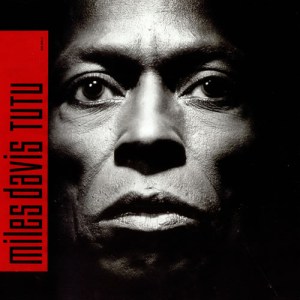
But, taken as a whole, Tutu is a very important album whose success was helped immeasurably by Irving Penn‘s striking cover portrait. It crystallised Miles’s interest in funk, soul and R’n’B more successfully than Decoy or You’re Under Arrest, whilst retaining a crucial ‘jazz’ flavour.
It was also a statement of political intent and black pride, significantly referencing both Archbishop Desmond Tutu and Nelson Mandela in its song titles. And – perhaps most crucially – it was a hit, introducing a whole new generation to Miles’ unique trumpet sound.
For much more on Tutu and Miles’s ’80s work, check out George Cole’s great book ‘The Last Miles’ and also Paul Tingen’s ‘Miles Beyond’.
DVD commentaries come and go, but among the best I’ve heard is for ‘Sideways’, Alexander Payne’s classic 2004 movie starring Paul Giamatti and Thomas Haden Church.
One scene, set at at the fictitious Frass Canyon winery, opens on the shot of a pale, very sincere acoustic guitarist playing a ‘tender’ ballad. On the commentary, Haden Church mutters: ‘Very Windham Hill-ish’, eliciting a chuckle from Giamatti.
You get the feeling that the term ‘Windham Hill’ is a code for something not entirely positive…
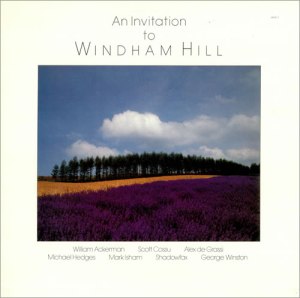
For a brief period in my teens, a cassette copy of An Invitation To Windham Hill was always near the family hi-fi.
It has since become one of those weird, unclassifiable albums that I can’t shake. Why is that? What is this kind of music really about once you subtract the nostalgia?
The Windham Hill label was founded in 1976 by Californian guitarist William Ackerman, who initially used the imprint to sell his own music out of a Palo Alto garage. Just down the road, Steve Jobs was establishing his Apple empire, and guess what: he was a big fan of Windham Hill, as Ackerman later recounted in an interview:
‘Steve fell in love with the aesthetic. All the Apple computers (played) Windham Hill music when you turned them on. It was such an exciting time. Anything seemed possible. People were making dreams come true, and I did feel part of that.’
Early on, the label emphasised solo acoustic instruments, eliciting a ‘back to nature’ vibe. Later, electronic music, contemporary bluegrass, smooth Latin/jazz and Celtic sounds were eased into the mix.
The stark, ‘natural’ style of their album covers was apparently influenced by ECM, as was some of the musical ethos; Keith Jarrett’s Koln Concert and the acoustic guitar work of Ralph Towner, John Abercrombie and Pat Metheny were certainly important to Windham Hill.
Also, in the same way that Jarrett’s album proved a huge sales breakthrough for ECM, a similar thing happened to Windham Hill – George Winston’s Autumn unexpectedly sold over a million copies and changed the label from a modest, regional imprint to nationally-known entity (and Autumn was the first of his seasonal-themed recordings!).
The whole Windham Hill package, both musically and visually, is very ‘white’, very ‘corporate’, very ‘Thirtysomething’. It contributed massively to the mid-’80s popularity of New Age music (and the eventual backlash against it). It also has a lot in common with the Minimalist movement (including geography).
But Ian MacDonald has written persuasively about the infantilising effects of this stuff in his brilliant ‘The People’s Music’:
‘Something happens to people who listen to too much minimalism. They begin to smile facetiously, display a genially indiscriminate omni-tolerance and put their feet on your furniture. Some start wearing dungarees and playing with frisbees’!
There is definitely that element to An Invitation To Windham Hill, but it does also highlight the work of two genuinely excellent artists: Mark Isham and Michael Hedges. Isham has been a first-call soundtrack composer for 30 years now but his 1983 debut album Vapour Drawings is an ambient/electronic classic (more on that to come).
Hedges, who died in 1997, blew guitarists’ minds with the release of his debut album Aerial Boundaries. Thetitle track manages to be both an amazing technical feat (it’s a solo piece for drastically detuned guitar sometimes featuring up to four intertwining melodies, achieved with a mixture of picking, tapping and hammer-ons) and also a substantial composition in its own right.
The other solo guitar tracks by Alex De Grassi and Ackerman are weirdly memorable, as are the solo piano pieces. In fact, the whole album is, and it might make a nice soundtrack to your wine-tasting evening or campfire gathering. Or it might not…
Track listing:
A1 George Winston ‘Thanksgiving’ (3:07),
A2 Alex De Grassi ‘Western’ (4:04),
A3 Mark Isham ‘Love Theme’ (From ‘Mrs. Soffel’) (4:11),
A4 William Ackerman ‘Visiting’ (6:07),
A5 Mark Isham ‘In The Blue Distance’ (4:07),
B1 Shadowfax ‘Angel’s Flight’ (4:00),
B2 Scott Cossu ‘Ohana’ (5:03),
B3 Michael Hedges ‘Aerial Boundaries’ (4:39),
B4 William Ackerman ‘The Bricklayer’s Beautiful Daughter’ (3:50)
B5 George Winston ‘Longing/Love’ (5:11)
Some improvised music hits you at just the right age, to the extent that 30 years later you can still hum along to all the solos.
Baby boomers were lucky enough to have Kind Of Blue, Time Out or Mingus Ah Um but jazz fans brought up on Weather Report and 1980s Miles had albums like Magnetic.
In 1986, recording and instrument technology was moving quickly, maybe too quickly. This development influenced all kinds of music, from rock to fusion, and, in the wrong hands, led to a lot of grossly-overproduced, unmemorable stuff that barely holds up today. As a few people have said, 1986 may be the worst music year of the decade.
But that year also somehow produced some memorable fusion music. Smooth Jazz (AKA The Wave) was just a twinkle in some bored record exec’s eye and the ever-reliable Japanese market was keeping quality electric jazz alive; Lyle Mays, Mike Stern, Wayne Shorter, John Abercrombie, Miles, Bireli Lagrene, John Scofield, Bill Frisell and John McLaughlin were going strong.
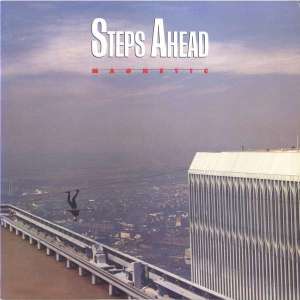
Though Steps Ahead’s Magnetic album embraces technology to a full extent, even more so than on ’84’s Modern Times, given the writing and playing talent (Michael Brecker, Peter Erskine, Mike Mainieri) it’s no great surprise that they pull it off with so much aplomb, aided by formidable ex-Weather Report bassist Victor Bailey.
A timeless classic it ain’t, but Magnetic isn’t any old ‘what does this button do?’ mid-’80s studio creation. Though the sound and mastering are superb, emphasised by the presence of Brothers In Arms producer Neil Dorfsman on engineering duties alongside future back-room stars James Farber and Tom Lord-Alge (fresh from Steve Winwood’s Back In The High Life), the compositions very definitely come first and the audio ‘experiments’ second.
Despite all this, Magnetic is definitely the least-heralded Steps Ahead album amongst jazz critics, probably because it’s a real onslaught of styles and sounds, closer to a ‘pop’ album in concept. The melodic themes are strong without ever getting too sugary and each track has a unique flavour.
It’s hard to believe the same band can come up with ‘Something I Said’ (featuring one of Brecker’s great ballad performances) and also the coruscating avant-fusion of ‘Beirut’ (developed from a band jam session).
Hiram Bullock plays one of his many classic solos on ‘Trains’, adding some much-needed grit, while George Duke co-produces the weird but exciting contemporary R’n’B of ‘Magnetic Love’ featuring some outrageous sampled Brecker tenor lines and killer Dianne Reeves lead vocals (and great backups from Jocelyn Brown, Janice Pendarvis and Diva Gray).
A synthesized cover of Ellington’s ‘In A Sentimental Mood’ proves Steps’ link to the past masters and features some astonishing EWI (an electronic instrument with the same fingering as a sax that looks like an elongated metal lollipop) from Brecker. There’s even time for some banjo-playing on ‘Cajun’, powered along by Erskine’s superb ride cymbal work. Yellowjackets were definitely listening to that. Oh, and is that Philippe Petit on the sneakily-doctored album cover?
It’s weird seeing Steps Ahead playing this material live. They had obviously worked a bit on their stage ‘presentation’ between 1984 and 1986, maybe influenced by Chick Corea’s shenanigans. Peter Erskine and Victor Bailey had left to join Joe Zawinul’s Weather Update tour, so ex-Journey drummer Steve Smith, Sting/Miles bassman Darryl Jones and Stern came in, adding some big-name clout and a much tougher sound.
Magnetic was the last major-label action for Steps Ahead. Brecker and Erskine jumped ship but Mike Mainieri would continue with the name over the next few decades fronting a multitude of line-ups. He even fronted a ‘reunion’ tour in 2016 with a formidable band including pianist Eliane Elias and sax player Donny McCaslin.
‘At the time of coming back, he had tremendous determination. He said do want to make it! I do want to succeed!” Instead of going along with the idea that he is different, special, unique, precious, So was about him saying, “F**k that! I’m going to allow myself to succeed.”’ Jill Gabriel, quoted in ‘Peter Gabriel’ by Spencer Bright
So was the Peter Gabriel album that put him – albeit very briefly – into The Big League, alongside the likes of Madonna, Michael Jackson, Phil Collins, Prince, Hall and Oates and Springsteen, leaving his ‘art-rock’ contemporaries (Laurie Anderson, Brian Eno, Peter Hammill, Robert Fripp) in the dust.
He opened himself up to mainstream success via more direct lyrics and music. And it worked a treat. So still sounds fantastic today; a near-perfect mix of art and commerce.
photo by Steven Toole
In interviews, Gabriel has described the ’83/’84’ period as a dark time in his life. He mixed and released an excellent live album and looked for solace in film soundtrack work, producing two fairly inconsequential tracks: ‘Walk Through The Fire’ from ‘Against All Odds’ and ‘Out Out’ from ‘Gremlins’.
Far more substantial was his soundtrack for Alan Parker’s ‘Birdy’, but, most importantly, it was the project that introduced him to So co-producer Daniel Lanois.
Gabriel later credited Lanois and his then wife Jill for steering him back towards more positive thoughts, and much more ‘up’ music and lyrics.
Gabriel came up with 20 new songs by early 1985. Lanois helped him whittle them down to 12, and then six months of pre-production began, focusing on song structures and arrangements. So was mainly recorded at Gabriel’s home studio, Ashcombe House near Bath.
Working at home was intended to save money on big studio fees and also speed up the creative process, but lyric-writing was still a big problem and a lack of words necessitated two missed release deadlines for So: 31st July 1985 and 14th December 1985.
Virgin were patient. Lanois once even nailed him into a back room to force him to come up with some lyrics – Gabriel was not amused, at least not for a few hours. ‘It is the most upset I’ve seen him at the studio,’ guitarist David Rhodes remarked. Lanois had made his point.
Musically, Gabriel very much leaned on tried-and-tested collaborators such as Rhodes and Tony Levin – it’s hard to imagine anyone else playing bass on So. He’s so much part of the music. Check out his ‘drumstick bass’ (later marketed as Funk Fingers!) on ‘Big Time’.
Joni Mitchell’s then husband Larry Klein also plays some lovely fretless on ‘Mercy Street’. French-African newcomer Manu Katche amazed everyone with his drumming, particularly on ‘That Voice Again’ and ‘In Your Eyes’. He had a new twist on Stewart Copeland’s style and also somehow found the time to fit occasional tom-tom flurries into his grooves too.
Migrant Mother by Dorothea Lange
‘Red Rain’ opens with some resplendent Copeland hi-hat work, and ends with the kind of piano/vocal coda that Simple Minds excelled at – the influences were now flowing both ways.
‘Don’t Give Up’ was inspired by a BBC TV documentary about the effect of unemployment on British family life, and also the photography of Dorothea Lange, portraying dust-bowl conditions during the Great Depression.
‘Mercy Street’, dedicated to poet Anne Sexton, shows evidence of Lanois’ influence; its opening ambient textures resemble Brian Eno’s ‘Under Stars’ which Lanois co-produced.
Gabriel’s low-octave vocals apparently had to be recorded first thing in the morning for maximum deepness. The song’s Brazilian/African groove predates Paul Simon’s Graceland by six months or so.
‘We Do What We’re Told (Milgram’s 37)’, concerning social psychologist Stanley Milgram’s infamous experiments, was originally recorded for Melt in 1980. While musically very rich and dark (I always think of Kate Bush’s ‘Running Up That Hill’ when I hear that opening minor chord), lyrically it is possibly a little half-baked.
‘Big Time’ is Gabriel’s amusing, self-mocking, Randy Newmanesque satire on success and celebrity – ‘This drive for success is a basic part of human nature and my nature’, he later said.
Musically, it’s a potent mixture of driving Copeland drums, treated rhythm guitar, synth bass, quasi-industrial samples and some great Hammond organ by Simon Clark.
Another much rockier version – featuring Jerry Marotta on drums – was also recorded but scrapped just before the mastering stage.
‘Sledgehammer’ was the last song written and recorded for So. Ironically, it dislodged Genesis’s ‘Invisible Touch’ to become a US number one single in July 1986.
A catalogue of sexual innuendos, it’s one of the weirder hits of the 1980s. Its odd cheerfulness may come from the fact that it’s mainly in a major key, a rarity for an R’n’B-influenced track. David Rhodes’ rhythm guitar part is eccentric and the Farfisa organ bizarre.
The opening sampled bamboo flute was copied by hundreds of keyboard players across the UK (or at least a few in my school). The groundbreaking video for the song, directed by Stephen Johnson (who had used similar techniques for Talking Heads’ ‘Road To Nowhere’ clip), required 100 hours of Gabriel’s time.
Apparently Gabriel was obsessed with the album’s sequencing: he made up endless cassettes featuring just song endings/beginnings, testing all the different permutations.
He always wanted ‘In Your Eyes’ to close So, but was persuaded otherwise when told that its drums and bass wouldn’t hold up very well at the end of a long side of vinyl (though it’s hard to ‘hear’ it anywhere else but at the beginning of side two…). He finally got it where he wanted it on the definitive remastered version.
Gabriel’s only concession to the record company was to name the album something apart from ‘Peter Gabriel’. So seemed suitably off-the-cuff – ‘It had a nice shape but very little meaning’, he later said.
He also decided that a simple cover shot would better suit the directness of the music and lyrics than some of the more disturbing covers of albums past. So‘s design and packaging still look fantastic today.
The album topped the charts on both sides of the Atlantic and by summer 1987 had sold over 5 million copies worldwide. Gabriel promoted the album extensively before embarking on Amnesty’s Human Rights Now! with Sting, Tracy Chapman and Bruce Springsteen in 1988.
He had a lot more than music on his mind – he waited a full six years before releasing the official follow-up to So. The commercial assault had paid off but at what cost to his long-term creativity?





 DVD commentaries come and go, but among the best I’ve heard is for ‘Sideways’, Alexander Payne’s classic 2004 movie starring Paul Giamatti and Thomas Haden Church.