Laurie Anderson: Big Science 35 Years On

The 1980s were littered with ‘novelty’ hits but perhaps none was more unexpected – or more powerful – than Laurie Anderson’s John Peel-endorsed, eight-minute UK #2 ‘O Superman (For Massenet)’.

Massenet was a French composer, whose aria ‘Ô Souverain, ô juge, ô père’ (‘O Sovereign, O Judge, O Father’) appeared in the 1885 opera ‘Le Cid’.

‘O Superman’ was totally hip at the time, a slice of NYC avant-garde post-punk appearing in the slipstream of Talking Heads’ ‘Once In A Lifetime’.

David Bowie was a big fan, covering the song during his 1997 Earthling tour. It still sounds unique and pretty hip today, even managing to throw in a little ode to Philip Glass with its brief, circular melodic motif that appears a few times.

A live performance of ‘O Superman’ was recorded in New York City in the week following the 9/11 attacks, and later appeared on the album Live In New York.

In this context, certain lyrics seem to take on greater significance: ‘Here come the planes/They’re American planes/Smoking or non-smoking?’ But Anderson has intimated that the song was inspired by watching television news reports of the Iran hostage crisis of 1979/80.

‘O Superman’ came from Anderson’s performance art/music piece ‘United States I-IV’, and was initially released as a single on the indie One Ten label. When it quickly sold out of its initial run of 1,000 copies, Warners picked it up and also asked for a whole album of music from the show.

What about the rest of Big Science? Not having heard it for a few years, I approached it with trepidation. But there was no need – ‘From The Air’ and ‘Sweaters’ (‘I no longer love the way you hold your pens and pen…cils’) are still very funny, but also oddly disquieting.

Lyrically, Big Science – like the performance piece it comes from – seems to be satirising the rebirth of American ‘heroism’ and industrial might of the Reagan era.

Anderson often speaks with (and mocks) the ‘voice of authority’, someone who, as she later said in an interview, is ‘either a shoe salesman or someone who wants to sell you an insurance policy you don’t want or need’ (now who does that remind you of…).

But there’s always a clash between this technological brave new world and spiritual binds that hold us together – family (‘O Mom and Dad…’), folklore and tradition.

The title track rams home the point with its ‘primitive’ percussion and vocals that sound vaguely like Native American chanting. ‘O Superman’ also does it with its initial focus on a piece of new technology – an answering machine – and then more metaphysical concerns (justice, God, love).

As the 1980s wore on, Anderson’s studio albums possibly suffered from being right on the ‘technological cutting edge’, but Big Science revels in simple acoustic/electric juxtapositions – some Velvet Underground drums here, an analogue synth, Vocoder or Harmonizer there, plus sax, percussion and treated violin.

Occasionally it would be nice to hear an instrumental solo, maybe someone of the NYC-art-rock-approved school such as Shankar or Jon Hassell, but generally Anderson keeps it simple and maintains a very assured minimalist musical style throughout.

Big Science slightly outstays its welcome, its last two tracks quite a stretch, but overall still sounds like a vital piece of work from a major, treasured artist.


David Sylvian: Gone To Earth 30 Years Old Today

David sylvian

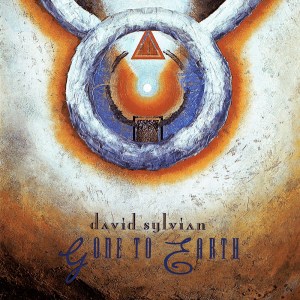
cover artwork by Russell Mills

Recently, I was honoured to be asked by photographer William Ellis to contribute to his One LP project where he asks musicians, writers and music business figures to speak about the album that has been most important to them.

Here’s what I said about Gone To Earth (with a few edits):

I was given the album by my parents on my 14th birthday. I had heard the single ‘Taking The Veil’ a few weeks before and it had struck me immediately as something I needed to check out. Concurrently, I was getting into Japan, Sylvian’s band from the early ’80s.

But Gone To Earth had a whole new influence: ECM-style jazz. Kenny Wheeler plays some beautiful solos, John Taylor features strongly on piano, and Harry Beckett blows all over ‘Wave’. Back in the mid-’80s, pop music embraced jazz with ease, but now it seems like the two worlds have completely diverged. Sylvian combines both elements really nicely.

When I delved deeper into Sylvian’s lyrics, I realised that they could be related to romantic affairs – there was a ‘pop’ element to them – but they could also be spiritual in nature, about ‘the other’ in general, touching on religious ideas, metaphysical ideas. That concept has fascinated me as I’ve got older.

Side two of Gone To Earth is completely instrumental. Sylvian loathed the term ‘new age’ and instead produced ambient music which was more environmental, geared towards self-reflection and an appreciation of nature. He once said, ‘If I didn’t live in a city, I wouldn’t need to make this music.’

On ‘The Healing Place’, German artist Joseph Beuys speaks about his vision of art. Another track features Robert Graves reciting his poem ‘The Foreboding’. The voice of JG Bennett makes a few appearances, familiar from Fripp’s Exposure.

And then, of course, there’s Sylvian’s voice. I think of it as an instrument. Some people find him a bit doomy, depressing, po-faced, but I’m always inspired by his melodies. He’s also a great, natural musician, very underrated/understated on keyboards and guitar.

The story goes that Virgin didn’t want to fund the second instrumental side. You can imagine, can’t you? They said, ‘This pop singer’s trying to an album of instrumentals? What’s going on?’, even though Bowie had done it ten years before. In this fascinating interview from 1986, Sylvian explains that he had to work on side two in his ‘spare’ time, away from Virgin’s watchful eye. I’m glad he did.

Musically, the album is also a guitarists’ dream: Robert Fripp, Phil Palmer, Bill Nelson and Sylvian himself contribute memorable, considered work. Nelson in particular is a revelation. Sylvian gives him space to sculpt and layer his parts, and he delivers some brilliant solos. BJ Cole adds some dreamy pedal steel.

David Sylvian

In 1988, I saw Sylvian at the Hammersmith Odeon with a great band featuring Mark Isham on trumpet, David Torn on guitar and Steve Jansen on drums. It was tremendously exciting; there was a kind of ‘goth’ element at the gig which surprised me and lots of young women screaming for Sylvian!

He was still holding onto his ‘pop’ status – it’s no mean feat for an 80-minute, half-instrumental album to reach 24 in the charts. It was a time when pop music had a lot more mystique; you had to scan The Face, Wire, NME or Melody Maker to glean any snippets of information about artists of Sylvian’s calibre.

Every time I listen to Gone To Earth, I notice something new. It’s such a layered, beautiful piece of music, almost always to be enjoyed in one sitting, and it came out during an incredibly fertile period for Sylvian – the 1984-1987 run of Brilliant Trees, Gone To Earth and Secrets Of The Beehive surely matches any other artist in ’80s music…

Sideways & Steve Jobs: An Invitation To Windham Hill 30 Years On

Windham+Hill+An+Invitation+To+Windham+Hill+164800DVD commentaries come and go, but among the best I’ve heard is for ‘Sideways’, Alexander Payne’s classic 2004 movie starring Paul Giamatti and Thomas Haden Church.

One scene, set at at the fictitious Frass Canyon winery, opens on the shot of a pale, very sincere acoustic guitarist playing a ‘tender’ ballad. On the commentary, Haden Church mutters: ‘Very Windham Hill-ish’, eliciting a chuckle from Giamatti.

You get the feeling that the term ‘Windham Hill’ is a code for something not entirely positive…

frass canyon

For a brief period in my teens, a cassette copy of An Invitation To Windham Hill was always near the family hi-fi.

It has since become one of those weird, unclassifiable albums that I can’t shake. Why is that? What is this kind of music really about once you subtract the nostalgia?

The Windham Hill label was founded in 1976 by Californian guitarist William Ackerman, who initially used the imprint to sell his own music out of a Palo Alto garage. Just down the road, Steve Jobs was establishing his Apple empire, and guess what: he was a big fan of Windham Hill, as Ackerman later recounted in an interview:

‘Steve fell in love with the aesthetic. All the Apple computers (played) Windham Hill music when you turned them on. It was such an exciting time. Anything seemed possible. People were making dreams come true, and I did feel part of that.’

Early on, the label emphasised solo acoustic instruments, eliciting a ‘back to nature’ vibe. Later, electronic music, contemporary bluegrass, smooth Latin/jazz and Celtic sounds were eased into the mix.

The stark, ‘natural’ style of their album covers was apparently influenced by ECM, as was some of the musical ethos; Keith Jarrett’s Koln Concert and the acoustic guitar work of Ralph Towner, John Abercrombie and Pat Metheny were certainly important to Windham Hill.

Also, in the same way that Jarrett’s album proved a huge sales breakthrough for ECM, a similar thing happened to Windham Hill – George Winston’s Autumn unexpectedly sold over a million copies and changed the label from a modest, regional imprint to nationally-known entity (and Autumn was the first of his seasonal-themed recordings!).

The whole Windham Hill package, both musically and visually, is very ‘white’, very ‘corporate’, very ‘Thirtysomething’. It contributed massively to the mid-’80s popularity of New Age music (and the eventual backlash against it). It also has a lot in common with the Minimalist movement (including geography).

But Ian MacDonald has written persuasively about the infantilising effects of this stuff in his brilliant ‘The People’s Music’:

‘Something happens to people who listen to too much minimalism. They begin to smile facetiously, display a genially indiscriminate omni-tolerance and put their feet on your furniture. Some start wearing dungarees and playing with frisbees’!

There is definitely that element to An Invitation To Windham Hill, but it does also highlight the work of two genuinely excellent artists: Mark Isham and Michael Hedges. Isham has been a first-call soundtrack composer for 30 years now but his 1983 debut album Vapour Drawings is an ambient/electronic classic (more on that to come).

Hedges, who died in 1997, blew guitarists’ minds with the release of his debut album Aerial Boundaries. The title track manages to be both an amazing technical feat (it’s a solo piece for drastically detuned guitar sometimes featuring up to four intertwining melodies, achieved with a mixture of picking, tapping and hammer-ons) and also a substantial composition in its own right.

The other solo guitar tracks by Alex De Grassi and Ackerman are weirdly memorable, as are the solo piano pieces. In fact, the whole album is, and it might make a nice soundtrack to your wine-tasting evening or campfire gathering. Or it might not…

Track listing:

A1 George Winston ‘Thanksgiving’ (3:07),
A2 Alex De Grassi ‘Western’ (4:04),
A3 Mark Isham ‘Love Theme’ (From ‘Mrs. Soffel’) (4:11),
A4 William Ackerman ‘Visiting’ (6:07),
A5 Mark Isham ‘In The Blue Distance’ (4:07),
B1 Shadowfax ‘Angel’s Flight’ (4:00),
B2 Scott Cossu ‘Ohana’ (5:03),
B3 Michael Hedges ‘Aerial Boundaries’ (4:39),
B4 William Ackerman ‘The Bricklayer’s Beautiful Daughter’ (3:50)
B5 George Winston ‘Longing/Love’ (5:11)

Talk Talk: April 5th

talk talkIt’s that time of year again.

The birds are swaying, the trees are singing (to quote Dylan Moran) and a young man’s fancy turns to music (to misquote Tennyson).

We all have our favourite spring/summer tracks but in my gaff there isn’t an ’80s tune that does the job better than this gem.

Songwriters Mark Hollis and Tim Friese-Green pinpoint April 5th as the date when spring really kicks in, and this deceptively ramshackle, charmingly off-the-cuff track features elegant piano, Hammond organ, wobbly Variophon, Robbie McIntosh dobro, David Roach soprano sax, subtle percussion programming and a killer chord change.

It was probably the highlight of The Colour Of Spring and forerunner to classic TT post-rock albums Spirit Of Eden and Laughing Stock, highlighting improvisation, lots of space and a much more pastoral sound than before. It floats in like a half-remembered childhood dream and then floats away just as rapidly.

Here she comes
Silent in her sound
Here she comes
Fresh upon the ground

Come gentle spring
Come at winter’s end
Gone is the pallor from a promise that’s nature’s gift

Waiting for the colour of spring
Let me breathe
Let me breathe the colour of spring

Here she comes
Laughter in her kiss
Here she comes
Shame upon her lips

Come wanton spring, come
For birth you live
Youth takes its bow before the summer the seasons bring

Waiting for the colour of spring
Let me breathe you

Talk Talk: The Colour Of Spring 30 Years Old Today

talk talkBy the release of The Colour Of Spring, there was barely any trace of Talk Talk’s previous synth-pop incarnation. Out went the Duran Duran, in came the Debussy, Traffic and Satie.

Instrumentation was generally centred around acoustic piano, acoustic guitar, Hammond organ, electric bass and drums, with the addition of quirky items like the Variophon, Mellotron, melodica, harp and dobro.

The core unit of singer/co-writer/co-producer/keyboardist Mark Hollis, co-writer/co-producer/keyboardist Tim Friese-Green, bassist Paul Webb and drummer Lee Harris distilled their sound to eliminate all but the essentials.

The opening 16 bars of the majestic, haunting ‘Happiness Is Easy’, a winning combination of man and machine (Lee Harris’s drums and a nifty bit of programming, followed a little later by Martin Ditcham and Morris Pert’s percussives) is surely one of the great album intros of the ‘80s. It hooked this writer immediately back in 1986.

The 1980s were full of albums whose big-name guest spots barely made a mark on the music. Not The Colour Of Spring; the session players are chosen with the precision of a good movie casting director.

‘I Don’t Believe In You’, a left turn into doomy, atmospheric rock, features one of the great guitar solos by Robbie McIntosh. David Rhodes’ deliciously swampy lick, with minor but important amendments, holds ‘Life’s What You Make It’ together.

Double bassist Danny Thompson’s tone is immediately recognisable on ‘Happiness Is Easy’, before ex-Average White Band man Alan Gorrie brings in some light funk for the piece’s second half.

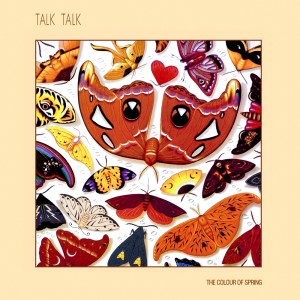
Steve Winwood also adds some tasty Hammond to three tracks, while Friese-Green’s piano on ‘April 5th’ even brings to mind the great Bill Evans. We must also acknowledge James Marsh’s exquisite cover artwork, an auspicious start to his triptych of TT album designs.

Though to my ears The Colour Of Spring tails off around the middle of side two, the album was a hit, reaching #8 in the UK chart and #50 in the US, while ‘Life’s What You Make It’ remains one of the most original singles of the mid-‘80s.

Next stop was the post-rock magnum opus Spirit Of Eden – the retreat from pop would be almost complete.

ECM Goes Rock: David Torn’s Cloud About Mercury

Cloud_About_Mercury

The late ‘80s was a great period for avant-garde guitar playing with the likes of Vernon Reid, Reeves Gabrels, Adrian Belew, Arto Lindsay, Fred Frith, Dave Fiuczynski, Stevie Salas, Sonny Sharrock, Skip McDonald, Robert Quine, Steve Vai and Bill Frisell laying down some seriously mind-bending tones and textures.

Cloud About Mercury, David Torn’s second ECM solo album, definitely put him into the same league. Though just as influential as many of the aforementioned guitarists, he has never really gained as much of a public profile despite occasional solo albums and stellar sideman work with the likes of David Bowie and David Sylvian.

My dad used to get sent a lot of music for his work and I vaguely remember him passing Cloud About Mercury onto me, knowing I was a big fan of early-’80s King Crimson.

My muso mates and I quickly grew to like the album’s perverse musical concepts and silly song titles. With a superstar avant-rock rhythm section of Bill Bruford and Tony Levin on board, it came on a bit like the follow-up to Crimson’s Three Of A Perfect Pair, but also offered a strikingly original take on jazz/rock.

I recall a contemporary review of Cloud About Mercury in Q magazine which said something like: ‘Torn luxuriates in the silence for a bit…and then goes KRAOOOOOOW!’ But in its louder moments, CAM is definitely one to annoy the neighbours. Torn’s Trans-Trem guitar enables him to create some very novel effects and original lines, with micro-tones and Middle Eastern flavours, and you can really get lost in his ambient loops.

CAM is also a very uncharacteristic ECM album, being much more in-your-face and rockist in its mixing and playing than most of the label’s output. In fact, it’s not really fair to judge it as a ‘jazz’ album at all.

But sometimes Torn seems much happier playing solo or in duet with Isham; his superb rhythm section is underused, and the tunes rely too heavily on one-chord improvisations. Consequently Bruford and Levin sound somewhat muted and can’t quite bring the sort of forward-motion dynamics so crucial to jazz/rock.

Torn toured extensively to promote CAM (but presumably not London or I surely would have been there…) with ex-Japan bass player Mick Karn replacing the unavailable Tony Levin. An excellent decision, both musically and commercially.

The band sounded fantastic and the tunes really came to life. Torn and Isham then accompanied David Sylvian on the ‘In Praise Of Shamen’ world tour which I caught at the Hammersmith Odeon in 1988.

Two quick questions to end, prompted by a discussion with my brother about Torn the other day: why isn’t there any music like this around these days? Or is there?

Japan: Oil On Canvas 32 Years On

japan

First of all: the cover. As a teenager, I was instantly intrigued by Frank Auerbach’s artwork, and then the music very definitely lived up to the packaging.

But, though billed as such, it could hardly be called a ‘live’ album. In the recent band biography ‘A Foreign Place’, Jansen reports that the only ‘live’ elements on the album are his drums – everything else was replayed in the studio. Three excellent new all-studio tracks were added too. But Oil On Canvas was released six months after the band’s break-up and proved a near-perfect farewell from one of the key groups of the early ’80s.

The fact that it ended up as Japan’s highest-selling album (shifting over 100,000 in the UK and hitting #5) must have really irked manager Simon Napier-Bell – after year of toil, the band were calling it a day just as they were getting some commercial success (read ‘A Foreign Place’ for a full explanation of the split).

Tin Drum was great but who knows what they might have come up with as a follow-up given the giant strides they had made as musicians, songwriters and arrangers since ’81. Sure enough, within a few months of their split, Duran Duran were taking their sound and image to the bank.

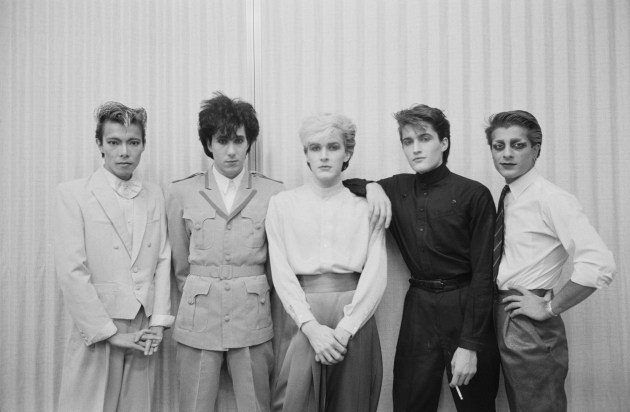
The Oil On Canvas line-up, December 1982: Masami Tsuchiya, Richard Barbieri, David Sylvian, Steve Jansen, Mick Karn. (Photo by Fin Costello/Redferns)

The Oil On Canvas line-up, December 1982: Masami Tsuchiya, Richard Barbieri, David Sylvian, Steve Jansen, Mick Karn. (Photo by Fin Costello/Redferns)

There is so much to enjoy on Oil On Canvas. The Tin Drum tracks have added heft and a bit more air. David Sylvian’s vocals are warmer and more expressive than on the studio albums (though he has since virtually disowned this early singing style), and his Satie-esque title track prefigures the triumphs of his solo career.

‘Ghosts’ is extended with a superb Stockhausen-meets-serialism intro/interlude thrown in while ‘Canton’ becomes a mighty parade of musical colours, with clanging synths, whip-lashing china cymbals and the late great Mick Karn’s increasingly insane bass embellishments.

There has never been a rhythm section quite like Karn and Steve Jansen (drums) and probably never will be again. They revel in open spaces and ‘non-rock’ textures, typified by the deceptively simple and downright spooky ‘Sons Of Pioneers’.

Karn sounded like no one else on fretless bass, exploring Middle Eastern concepts and weird intervals to produce a sound both complex and hilarious. Jansen came up with several of the most ingenious backbeats in pop history while always making them danceable.

Together, they produced classic grooves like ‘Visions Of China’, ‘Cantonese Boy’ and ‘Still Life In Mobile Homes’, and Richard Barbieri’s creative keys playing always emphasises texture and mood over technique. His closing instrumental ‘Temple Of Dawn’ bids a fantastic album farewell first with a chill and then with a brief shot at redemption.

Sylvian escaped to a successful, innovative solo career, Karn also went solo and hooked up with collaborators including Midge Ure, Peter Murphy and, most memorably, Kate Bush. Barbieri and Jansen teamed up regularly in various projects and recorded together as The Dolphin Brothers in 1987 but didn’t enjoy much commercial success. Against all odds, they all got together again at the end of the ’80s for the intriguing Rain Tree Crow project.

Andy Summers & Robert Fripp: I Advance Masked/Bewitched

Andy-Summers-I-Advance-Masked-77760With hindsight, it seems completely logical (not least because they both hail from the county of Dorset, England) for these two guitar giants to record together, and their two 1980s collaborations are engaging if annoyingly inconsistent.
1982’s I Advance Masked is under-produced, tentative and unfinished-sounding, and this approach works fine on the beguiling title track (which prompted one of the worst videos of the decade) and evocative ‘Hardy Country’, where strong themes carry the day.

The album offers fascinating examples of the kinds of guitar woodshedding the players were doing in the early ‘80s. Summers is in full-on Ghost In The Machine mode with meshes of swelling guitar synth and simple, incongruously bluesy solos, while Fripp foregrounds ideas that he would use to greater effect on King Crimson’s Beat album.

But the duo’s limitations as multi-instrumentalists hamper the rest of I Advance Masked – the drum programming is limp, bass playing fairly amateurish and the synth playing simplistic (though sometimes perversely enjoyable in a kind of sub-John Carpenter way). The shorter tracks search in vain for some status as ‘ambient’ or ‘environmental’ music but are too quirky for that purpose.

And, amazingly, I Advance Masked cracked the top 60 in the US Billboard pop charts.

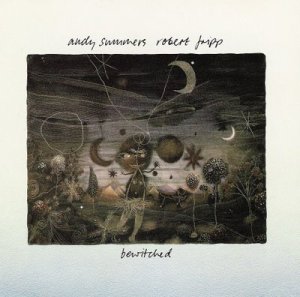
summers and fripp1985’s Bewitched is a dramatic improvement on that debut album. Side one features attractive melodies, well-thought-out song structures, (mostly) real drums, some incredible bass playing from Chris Childs and ex-League of Gentleman/Gang of Four Sara Lee, pristine mastering and more of a ‘band’ sound.

The opener ‘Parade’ flies out of the traps with New Wave drums and an engaging little synth guitar melody. With its major-chord exuberance and very short duration, it could easily have come from side one of Bowie’s Low.

‘What Kind Of Man Reads Playboy’ is pretty much a perfect distillation of the state of the electric guitar in the mid-‘80s. Summers’ ingenious layering takes in wah-wah funk, harmonic washes, bebop, bluesy leads and tasteful guitar-synth textures. Fripp plays one of the most extreme solos of his career while Sara Lee (or is it Chris Childs?) impresses with high-speed soloing and tasty grooving.

Unfortunately, side two is more in line with the debut album, a series of rather uninteresting, short and badly recorded tracks. Think ‘Behind My Camel’ in demo form but without Stewart Copeland. But the best is saved until last, the stunning closer ‘Image And Likeness’ featuring Summers’ cascading harmonics.

By his own admission, Fripp generally takes a back seat and basically provides a framework for Summers’ talents to shine through. An admirable position for sure, but he was becoming a bit like the Wayne Shorter of guitar at this point, happy to be in the shadows.

But this is in general an intriguing and somewhat overlooked collaboration calling to mind an era when big labels were putting some serious money behind instrumental music (though Summers reports that A&M were extremely reticent about this collaboration) and ‘rock’ was allowed to be intelligent.