Bill Bruford: The Comeback

Pop musicians make comebacks all the time – in jazz or jazz/rock, it’s almost unheard of.

Reading King Crimson/Yes/Genesis/Earthworks drum legend Bill Bruford’s fine autobiography, there was no doubt he’d had his fill of the music business when he officially retired from performance on 1 January 2009 (his last headlining gig took place the previous July).

Away from the kit, in recent years he’s achieved a PhD from the University of Surrey, curated an excellent YouTube channel and released the occasional reissue or compilation, the latest of which is The Best of Bill Bruford.

But, as they say in sporting circles, you’re a long time retired. So it’s thrilling to report that Bruford is making tentative steps back to public performance – in a recent interview he described his return to playing as ‘explosive, unexpected, and very sudden’.

He turned up at the John Wetton tribute gig last year, performing ‘Let’s Stick Together’ alongside Phil Manzanera and Chris Difford.

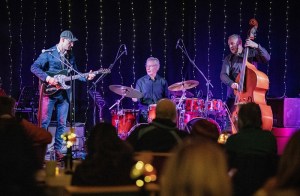
Now he’s joined up with his old drum tech, German ex-pat guitarist Pete Roth, plus bassist Mike Pratt, for some low-key trio gigs. His recent show at the 606 was the busiest your correspondent had seen Chelsea’s treasured jazz club for years.

Roth’s website describes his music as ‘jazz without borders’, and it’s a pretty good summary – they generally avoid fusion clichés like the plague, sounding more like John Abercrombie’s organ trio than anything Bruford recorded with Allan Holdsworth.

His kit was a return to his youth – two tom-toms, angled snare, two cymbals. And he still has that prodigious, propulsive technique on the hi-hats and ride cymbal, even if his snare drum no longer particularly has that distinctive ‘clang’.

‘Billie’s Bounce’ featured Bruford’s trademark figures between the tom-toms and snare drum, and Roth’s organ patch and octave pedal were a novel touch.

‘How Insensitive’ developed from a freeform rubato opening into an Abercrombie-esque mood-jazz piece, though Pratt’s strident bass seemed a little out of place.

‘If Summer Had Its Ghosts’, first recorded by Bruford with Eddie Gomez and Ralph Towner, meshed odd-time fun with the blues, Roth’s guitar at its more Scofield-like.

‘Summertime’ came with a tricky vamp which Pratt and Roth rushed somewhat – never a problem for Bruford, while a section from Dvořák’s Symphony No. 9 was a slowburn success.

Meanwhile band composition ‘Trio of Five’ (or was it ‘Fun’?) was another attractive if a little harmonically inert, vamp-based piece in their favourite 5/4.

Though there were times when Bruford seems to have lost a little of the fluidity of old, it seems churlish to judge a performance thus when the performer and loyal crowd are having so much fun. What an unexpected pleasure to see Bruford back.

Gig Review: Bill Frisell @ Cadogan Hall, 25 October 2024

Though the American guitarist’s 1980s sonic explorations with the likes of John Zorn, Power Tools and on solo albums such as Before We Were Born are long gone, Frisell’s fascinating (and much quieter) late-career boom continues abound.

He’s a regular visitor to the Big Smoke but, revelling in his newfound freedom at Blue Note Records, this Cadogan Hall gig felt like his most ‘jazz’ outing for years.

That’s chiefly due to the presence of A-list collaborators, in concert and on recent album Four: Gerald Clayton on piano, Gregory Tardy on various reed instruments and Johnathan Blake on drums. Close readers will notice one word notable by its absence: bass. It’s a credit to Frisell that the instrument wasn’t really missed here, nor did he or Clayton particularly resort to vamps to make up for the absent low-end.

Consequently, the meticulously arranged and rehearsed set, strongly foregrounding collective improvisation, had a lovely ‘floating’ atmosphere. (Two touchstones may be Louis Armstrong’s Hot Five and The Jimmy Guiffre 3, the latter of course featuring Frisell hero Jim Hall on guitar.)

Themes came and went, with many segues. Somewhat sombre recent compositions such as ‘Waltz For Hal Willner’ and ‘Claude Utley’ – both named for recently departed friends of Frisell – bumped up against familiar pieces such as Paul Motian’s ‘Conception Vessel’ (taken at a very leisurely clip) and Bacharach/David’s ‘What The World Needs Now’, as well as two fast bebop-style heads which nodded to Ornette Coleman (though the Monk-ish treat ‘Holiday’ was sadly missing).

In short, it was business as usual for Frisell, who unapologetically places melody at the heart of everything he does, whether playing ‘60s pop, country, avant-garde or bebop. Hall really does seem to be his totem these days, though he still knows when to add disconcertingly witty moments of found sounds and dissonant loops via his pedal board.

And while the ensemble occasionally felt like it was kept on unusually tight leash, Clayton added much-needed harmonic colour and elaborate flourishes, touching variously on stride piano, systems music and glorious call-and-response lines reaching back to Tatum and Hines. Tardy brought the blues feeling, laying down three or four fantastic solos, while Blake – the man with the lowest drum set in the world, barely above his knees – played at a perfect volume in the very boomy Cadagon Hall, and with great taste.

All in all, this quartet has legs. One would hope they could gather for another album on Blue Note, and we might get another enjoyable gig like this too. The standing ovation seemed to come as quite a surprise to this most modest master of the electric guitar.

Book Review: American Drummers (1959-1988) by Val Wilmer

Val Wilmer has arguably been Britain’s leading jazz photographer (and writer of classic jazz book ‘As Serious As Your Life’) since she started taking pictures of musicians over 60 years ago.

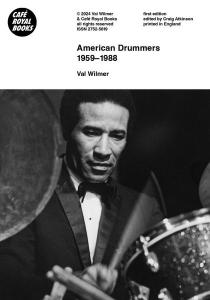
And now Café Royal Books have issued a lovely budget paperback of Wilmer’s photos entitled ‘American Drummers 1959-1988’, which does exactly what it says on the tin (though note ‘jazz’ doesn’t appear – possibly because it’s a word with which some of the musicians therein have expressed difficulty).

To my knowledge, it’s the first book of its kind. And – befitting a truly original artist – Wilmer’s work generally defies expectations. For example it’s nothing like Francis Wolff’s meticulous, pristine, famous photos of players such as Art Blakey and Elvin Jones.

Instead her general focus is on the minutiae of the working drummer’s life – we see Andrew Cyrille and Marquis Foster unloading kits from their cars, Denis Charles practicing on the steps of a New York tenement, Zutty Singleton chatting with Count Basie outside a bar, Papa Jo Jones in a drum store, Ed Blackwell chilling with a newspaper, Blakey backstage.

But of course showmanship is one of the chief tools in the drummer’s armoury, and as such there are exciting shots of all-time great players in performance including Billy Higgins, Tony Williams, Milford Graves, Max Roach, Ronald Shannon Jackson and Kenny Clarke.

And the kicker: this wonderful book retails at around just £6.99 in the UK (as do the other Café Royal titles) – don’t miss it.

Tony Williams, Hammersmith Odeon, London, 1967


Billy Cobham @ 80: Five From The 1980s

The author with Billy Cobham, autumn 2000

Many happy returns to Mr Cobham who turned 80 this week. His drum mastery continues to inspire.

Movingtheriver pretty much learnt to drum by listening to Mr Cobham’s Spectrum, David Sanborn’s (RIP) Hideaway, Steely Dan’s Aja and a few more. His playing was sheer class, something to aim for. There was always an emphasis on technical excellence and good tuning – but the most important thing was the music, the groove.

I was fortunate enough to study with Mr Cobham at the Guildhall School of Music circa 2000. Unforgettable memories.

To celebrate his 80th birthday, here are five key moments from his 1980s. The early part of the decade saw Mr Cobham forge a new life in Switzerland, whilst fronting various bands featuring the likes of Mike Stern, Don Grolnick and Gil Goldstein. Then came the short-lived, controversial tenure in John McLaughlin’s revamped Mahavishnu Orchestra (explored in my book) which nonetheless produced some great music, and then a high-profile return to the solo career via Dave Grusin and Larry Rosen’s GRP Records.

5. Drum Clinic (Part 6), BBC TV, 1982 (?)
Here’s where it all started for movingtheriver. My dad caught it totally by chance on BBC2 and luckily recorded it onto a VHS. It blew the minds of many British drummers including Level 42’s Phil Gould who was reportedly present at the filming.

4. Billy Cobham/Herbie Hancock/Ron Carter: ‘Eye Of The Hurricane’, Lugano, Switzerland, 1983
A period when Billy embarked on various brilliant European collaborations. Still one of the most exciting, propulsive trios I’ve ever heard in acoustic jazz.

3. ‘The Dancer’ (1985)
If memory serves, I was given Mr Cobham’s Warning for my 13th birthday, alongside Joni Mitchell’s Dog Eat Dog and Steely Dan’s The Royal Scam. What a day that was. I still love this album and am glad I kept the vinyl.

2. ‘The Debate’ (1986)
Warning’s followup Power Play didn’t quite have the impact of his GRP debut but Billy’s drums have arguably never been better recorded.

1. Live In Cannes (1989)
A recent find this, worth watching for a rare look at Billy playing timbales (during the first song) and also his fine hookup with percussionist Nippy Noya.

Greg Osby: Season Of Renewal

Of all the musical scenes that emerged during the 1980s, M-BASE – a Brooklyn-originated fusion of jazz and funk with many other influences thrown in – may be the least understood/remembered.

The term was co-authored by saxophonists Greg Osby and Steve Coleman. The M stands for ‘Macro’, BASE is an acronym for ‘Basic Array of Structured Extemporizations’.

The music’s other key practitioners were saxophonists Gary Thomas, vocalist Cassandra Wilson, keyboard player Geri Allen, guitarists Kevin Eubanks, David Gilmore and Kelvyn Bell, bassist Lonnie Plaxico and many more.

M-BASE was an attempt to draw attention away from ‘jazz’ as a catch-all term, and also showcase original material over standards and show tunes. But it certainly has its own sound once you hear a few key albums, totally different to ‘fusion’ or ‘jazz/funk’, relying on tightly structured drum patterns (often in odd-time signatures), funk bass, ‘modal’ keyboards, chattering rhythm guitars and Charlie Parker-influenced horn improvisations.

A key artefact was Osby’s arresting album Season Of Renewal, released 35 years ago on now-defunkt German-based label JMT (which also released many other key M-BASE recordings). Checking it out again now for the first time in a few years, it makes for fascinating, rewarding listening.

Themes are mainly outlined by the bass (Plaxico) and/or keyboards (Renee Rosnes and Edward Simon). Osby’s alto or soprano saxes generally only enter during solo sections. The guitarists (Eubanks and Kevin McNeal) are superb. The synths may bring to mind the 1980s music of Mark Isham. Drummer Paul Samuels produces solid grooves and seems to have been issued with a ‘no tom-toms’ decree by Osby.

‘Dialogue X’, featuring just synths and Osby, hints at the political animus always underlying the M-BASE movement. The closing ‘Spirit Hour’ is absolutely spellbinding, like a waking dream, its haunting melody expertly outlined by Cassandra Wilson.

Osby has gone on to a varied, impressive career, including a well-regarded period on Blue Note Records. But none of his JMT albums are currently on streaming platforms (except for a fairly good quality burn on YouTube, see below) – in fact M-BASE is poorly served there, though a so-so compilation has recently surfaced. Best to search for Osby’s 1980s music via CD marketplaces – a fruitful voyage for the uninitiated.

Revealed! The Ultimate Christmas Present!

Give the only sensible Christmas present this year – the new book ‘John McLaughlin: From Miles and Mahavishnu to The 4th Dimension’, from the chap who brought you 2021’s ‘Level 42: Every Album, Every Song’.

Get informed, keep entertained, stay fashionable and slob out the modern way! Satisfaction guaranteed for you, your friends or family!

Get 30% off the list price by ordering directly on the Rowman & Littlefield website and entering discount code RLFANDF30 at the checkout (available as an eBook too).

Otherwise of course there are many other buying options – all the details here.

The reviews are in:

‘A must-have in every aspiring musician’s personal library.’ Billy Cobham

‘A wonderful insight into a true innovator and colossus of the guitar.’ Mark King (Level 42)

‘Scrupulously researched… A fluent career overview.’ **** MOJO, December 2023

‘The most comprehensive overview of McLaughlin’s career to make it into print thus far.’ **** Shindig!, January 2024

‘Enthralling… Details the many album releases in a highly readable style… Informative and thoroughly enjoyable, it’s easy to recommended this book.’ Jez Rowden, The Progressive Aspect

‘Phillips is the perfect guide through McLaughlin’s byzantine discography, his training enabling him to keep pace with the guitarist’s baffling mastery of time signatures, his passion earning to the trust of anyone still reeling from the early Mahavishnu Orchestra.’ *** Record Collector, December 2023

‘Comprehensive and thoroughly researched, Phillips’ book is a revelation. A must-read for guitar aficionados and McLaughlin devotees.’ Bill Milkowski, author of ‘Jaco’ and ‘Michael Brecker’

‘Riveting… Meticulous storytelling… The book is not just a narrative, it’s a visual feast.’ Jazz In Europe

‘A compelling study of the man, his music and his marvellous creative legacy.’ JazzViews

‘Paints the fullest picture yet of the guitarist’s life.’ Jazzed

‘Thorough and impassioned… The first book to fully illuminate the least-appreciated, least-documented periods in the extraordinary career of this wondrously free-spirited, prolific, perpetually questing artist.’ Booklist

Book Launch: John McLaughlin (From Miles and Mahavishnu to The 4th Dimension)

Matt’s new book ‘John McLaughlin: From Miles and Mahavishnu to The 4th Dimension’ is available now and can be ordered via the links below.

‘A must-have in every aspiring musician’s personal library.’ Billy Cobham, Mahavishnu Orchestra drummer

‘A wonderful insight into a true innovator and colossus of the guitar.’ Mark King, Level 42 bassist/vocalist

‘Scrupulously researched… A fluent career overview.’ **** MOJO, December 2023

‘The most comprehensive overview of McLaughlin’s career to make it into print thus far.’ **** Shindig!, January 2024

‘Comprehensive and thoroughly researched, Phillips’ book is a revelation. A must-read for guitar aficionados and McLaughlin devotees.’ Bill Milkowski, author of ‘Jaco’ and ‘Michael Brecker’

‘Riveting… Meticulous storytelling… The book is not just a narrative, it’s a visual feast.’ Jazz In Europe

‘Paints the fullest picture yet of the guitarist’s life.’ Jazzed

‘Thorough and impassioned… The first book to fully illuminate the least-appreciated, least-documented periods in the extraordinary career of this wondrously free-spirited, prolific, perpetually questing artist.’ Booklist

UK orders:

UK Bookshops

Rowman & Littlefield (Enter discount code RLFANDF30 to save 30% off the list price)

World Of Books

Hive

Blackwell’s

Waterstones

Foyles

WHSmith

USA orders:

Rowman & Littlefield (Enter discount code RLFANDF30 to save 30% off the list price)

Barnes & Noble

BooksaMillion

It’s an exhaustive look at John’s catalogue, live career and spiritual life, with an introductory note by Robert Fripp, testimonials from Mark King, Billy Cobham and Bill Milkowski, interviews with key collaborators and lots of exclusive photographs. I cover John’s early sessions with David Bowie and Donovan, his remarkable sideman work with Tony Williams and Miles Davis, the fabled solo career fronting The Mahavishnu Orchestra and Shakti and various projects alongside the likes of Sting, Jeff Beck, Herbie Hancock and Carlos Santana.

If you’ve enjoyed this website in any capacity, please consider buying this book and getting it to the toppermost of the poppermost… Thank you!

Rewind & Play: Thelonious Monk

It’s a great era for jazz documentaries. The latest exhibit is Alain Gomis’s ‘Rewind & Play: Thelonious Monk’, based around some long-lost footage of the jazz piano giant filming a French TV special at the end of his 1969 European tour.

Some of the edited footage was shown on French TV as ‘Jazz Portraits: Thelonious Monk’ in 1970 (and used in Charlotte Zwerin’s classic 1989 Monk doc ‘Straight No Chaser’), but this film reinstates many outtakes.

We see a broadly-smiling Monk touching down at the airport, travelling by car to the TV studio with wife Nellie and tour manager Jules Colomby, nervously drinking in a hotel bar, petting a dog, eating a boiled egg.

Then Monk is interviewed in the studio by Henri Renaud, a section that is awkward, embarrassing, occasionally a little offensive. Monk answers the questions willingly, honestly and with no little humour. But, as endless retakes are suggested, he becomes frustrated, visibly tiring when no answer is deemed good enough without any explanation given.

(Robin D.G. Kelley has a far more sympathetic take on these proceedings in his peerless Monk biography, though he may well have not seen the outtakes we are privy too here.)

But the sections that really elevate ‘Rewind & Play: Thelonious Monk’ to classic status are the solo piano performances. There are superb renditions of ‘Reflections’, ‘Light Blue’, ‘Nice Work If You Can Get It’, ‘Blue Monk’, ‘Crepescule With Nellie’ and ‘Played Twice’.

Seen on the big screen, we get an oft-forgotten impression of the sheer weight of Monk’s playing, sweat pouring down his face. It’s moving, exciting, essential viewing if you are a fan or just a fan of great piano playing, and telling too: a few months later, he informed his wife that he was ‘really very ill’ and was never quite the same again.

Gig Review: John McLaughlin/Shakti @ Hammersmith Odeon, 28 June 2023

Late July 1976: if you were a British jazz/rock fan, all roads led to the legendary Hammersmith Odeon in West London.

The Billy Cobham/George Duke Band opened three nights of music, followed by John McLaughlin’s Shakti and then the headliners Weather Report. The encores often featured members of all three fusion supergroups.

So how apt that a reformed Shakti should appear at the same venue almost exactly 47 years on. And what a relief that they chose the Hammersmith Odeon (it’ll always be the Odeon to me, I can’t call it the ‘Apollo’…) to kick off this hugely anticipated 50th anniversary tour rather than the predictable Barbican or Royal Festival Hall. Accordingly, this was not your usual ‘jazz’ crowd after a little ‘culture’ – it was a vocal, refreshingly multicultural audience.

An attempt to marry ‘Western’/blues-influenced timbres with both North/South Indian rhythmic/melodic approaches, Shakti released three albums between 1976 and 1978, then reformed as Remember Shakti in 1998 for three more tours and subsequent live albums.

For this iteration, promoting brand new album This Moment, 81-year-old guitar master McLaughlin was joined by regular collaborators Zakir Hussain on tabla, Shankar Mahadevan on vocals and Selvaganesh Vinayakram on sundry percussion, plus youthful new recruit Ganesh Rajagopalan on violin.

There was combustive interplay on the opener ‘5 In The Morning, 6 In The Afternoon’, McLaughlin going back to his youth with some potent blues licks, bringing to mind his playing on Miles’s ‘Right Off’. Is he using an amp again, after years of firing his guitar straight through the PA?

An exquisite ‘Zakir’ came with heartfelt words from John to his friend. ‘Anna’, described as a ‘golden goldie’ by Hussain, featured flawlessly-played classical Indian lines and a brilliantly fluid solo from Rajagopalan.

John’s guitar gained a little more distortion in time for the violinist’s composition ‘Mohanam’, and by the middle of the gig he was in his element, dropping in references to ‘Lila’s Dance’ and Lee Morgan’s ‘The Sidewinder’. New track ‘Bending The Rules’ even saw John inject a lick from his 1980s classic ‘Florianapolis’. ‘Sakhi’ and ‘Lotus Feet’ were very touching, and some incendiary konnakol percussion duels closed the show on ‘Finding The Way’.

There was light and shade, fury and meditation at this excellent gig – the only downside was the incessant filming with mobile phones. Is there no privacy/immediacy at these larger concerts? The Shakti story continues. Who would have predicted that five years ago? Their tour continues through Europe and into the US during August. Don’t miss.

Book Review: Formation (Building A Personal Canon Part 1) by Brad Mehldau

There’s a history of controversial jazz autobiographies that would have to include Mezz Mezzrow’s ‘Really The Blues’, Charles Mingus’s ‘Beneath The Underdog’, Sidney Bechet’s ‘Treat It Gentle’, Billie Holiday’s ‘Lady Sings The Blues’, Dizzy Gillespie’s ‘Dizzy’ and Art Pepper’s ‘Straight Life’.

It may be somewhat of a surprise to report that the apparently mild-mannered, urbane Mehldau – modern master jazz pianist and probably best known for his majestic Radiohead and Beatles covers – joins that list with ‘Formation’, charting his musical and personal rites of passage from the mid-’70s to late 1990s.

The general fan may have heard Mehldau make vague references to his previous junkie life – here we get the full story, and it’s both revelatory and somewhat disturbing. Also, unlike some of the books listed above, ‘Formation’ is certainly not ghostwritten, hardly a surprise when one considers some of the extensive liner essays Mehldau has penned, particularly 2000’s Places.

Growing up in mid-‘70s New Hampshire, Mehldau’s young life is all very Judy Blume, soundtracked by Billy Joel, Beethoven, Fleetwood Mac, the Eagles, Steve Miller and Supertramp, with the twin undercurrents of organised religion and the Cold War.

At the turn of the new decade, piano lessons become increasingly important and he becomes a major prog fan, Pink Floyd and Rush becoming key touchstones, though he also relates the loneliness in his own life to the music of Miles, Billie Holiday and Brahms.

A move to Hartford, Connecticut, precipitates the first major instances of bullying, outlined in shocking detail, a theme that will echo throughout his time in formal education. It’s hardly surprising that alcohol and drug use become regular companions during his late-teenage life, as do doubts about his sexuality.

In the age of Reagan, Stallone and Schwarzenegger, Mehldau becomes a true ‘outsider artist’, finding solace in the works of Thomas Mann, the Beats, German philosophers and Bob Dylan. Meanwhile high school hastens the flowering of his jazz piano talent.

From there, it’s a short ride to Mehldau’s relocation to New York in the late 1980s, and his jazz piano initiation at great lost venues such as Augie’s and the Village Gate. It’s hard to think of another book which better explores that fabled NYC jazz scene of the late 1980s to mid 1990s, nor one that better explores the thought processes and doubts of a nascent jazz pianist.

There are touching tributes to his piano teachers and also contemporary ivory-ticklers such as Larry Goldings, Bill Charlap and Kevin Hays. The book closes with lengthy accounts of his time playing with Joshua Redman, David Sanchez and Pat Metheny, undertaken in the shadow of heroin addiction, though the book ends with hope and a sense of rebirth.

Though always engaging, Mehldau’s writing style is wildly unpredictable – sometimes intimate and conversational, sometimes dry and analytical, often shockingly fly, with scant consideration for political correctness. But his intelligence flies off the page, hardly a surprise to anyone who’s heard him weave magic at the piano.

He’s honest about his own faults as well as the faults of others, and there’s no getting away from it – he paints a mostly harsh, violent picture of America in the 1980s, certainly no country for old men or those of a sensitive disposition. ‘Formation’ is also graced with the author’s own sizeable photo collection.

A fine if sometimes shocking addition to the pantheon of great jazz autobiographies, we eagerly await part two of ‘Formation’. Meanwhile Brad’s playing career goes from strength to strength – I’m looking forward to the Wigmore Hall solo gig in September.