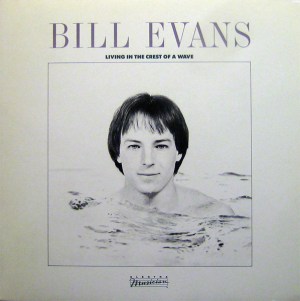
Bill Evans: Living In The Crest Of A Wave/The Alternative Man

When people say ‘I hate jazz’, I sometimes wonder if they’re really saying they know a crap composition when they hear one.

Legions of talented jazz sidepeople have been given solo record contracts only to deliver music that proves they can’t write decent tunes.

A case in point is saxophonist and William Hurt-lookalike Bill Evans. He’s had a very solid career but his solo work is distinctly underwhelming.

(And then there’s the name. If you play jazz, you probably need a stage name if you have exactly the same moniker as a bona fide legend from decades gone by – the pianist Bill Evans died in 1980.)

But give Sax Bill some credit – he was an absolutely vital figure in Miles Davis’s 1980s comeback, a good friend and carer of the trumpeter and player of several gritty solos on record (Star People is a good place to start). But by 1983 Bill found himself inexplicably frozen out, barely getting any solo space from Miles.

He got the message and jumped ship to join John McLaughlin in the new Mahavishnu Orchestra and also embark on a solo career which kicked off with 1984’s Living In The Crest Of A Wave, a pretty anodyne collection of new-agey fusion. Let’s call it The Metheny Effect. Many tried and failed to ape that guitarist’s mixture of Ornette Coleman-inspired melodicism, Latin flavours and down-home, Midwestern, open-sky simplicity.

With its folky themes, puny production, emphasis on soprano sax, fretless bass, ride cymbals and an ‘environmental’ bent, LITCOAW could almost have come out on Windham Hill. Only the closing title track works up any kind of energy or interest, when Evans finally busts out the tenor and blows up a storm over Adam Nussbaum’s frenetic jazz/rock groove.

Evans’ followup, 1985’s The Alternative Man, was his first record for the illustrious Blue Note Records and as such should have been a celebration. Unfortunately it was an object lesson in how not to use technology, and just the kind of ‘80s ‘jazz’ album that illustrates what a brilliant job Marcus Miller did on Miles’s Tutu.

Evans in the main stumbles around with ugly Linn Drum patterns, electric drums, blaring synth pads and raucous hair-metal guitar solos, all topped off with some fairly insipid soprano playing. A few tracks and you’ll be wanting to break out the Albert Ayler or David Murray albums, and fast.

The only interest predictably comes with two more open, organic offerings, the excellent ‘Miles Away’ which reunites Evans with his Miles colleagues Al Foster on drums and Miller on bass. And ’Let The Juice Loose’ is fun, a cool bebop head featuring some enjoyably un-PC Strat-mangling from the late great Hiram Bullock.

But hey – some of this music brings back good memories, when I was digging around the Record And Tape Exchange and Our Price for bargains and closely monitoring the personnel on the back of my favourite Miles and McLaughlin albums.

These albums also definitely represent a weird time for ’80s jazz, when established labels were signing all and sundry, fishing around for the next Young Lion or Metheny.

And thankfully a few dodgy early solo records didn’t hurt Evans’ career much, as he’s gone on to be one of the most respected players on the scene.
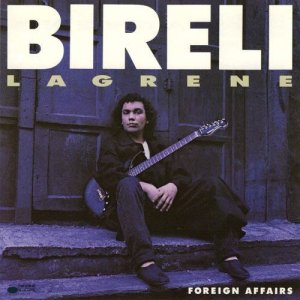
Bireli Lagrene on Blue Note: Inferno/Foreign Affairs

It’s fair to say that many excellent jazz and jazz/rock guitar players emerged during the 1980s.

But arguably none – with the possible exception of Stanley Jordan – made as much of an impact as Bireli Lagrene.

He’s hardly a household name but Bireli recorded a few fine albums for Blue Note Records and toured extensively with Jaco Pastorius just before the bassist’s tragic death.

The French guitarist was seen in many circles as the natural heir to Django Reinhardt at the outset of the ’80s. The teenage prodigy wowed everyone with a few independent releases (initially in a manouche style) and European tours.

The key to his sound seemed to be absolute freedom. Like Jaco and Django, he has no fear. He tries things, always pushing himself. To paraphrase John McLaughlin, he’s swinging before he even starts playing.

Inferno, his debut Blue Note album, featured some excellent, freewheeling electric playing – more Mike Stern and Van Halen than Reinhardt – but the musical settings were a bit stilted and it suffered from too many changes in personnel.

But Bireli found a great foil in producer and fellow guitarist Steve Khan, and their 1988 follow-up Foreign Affairs was a big improvement.

I was mildly obsessed with this album for about a month during spring 1989 – I remember buying it on the same day as seeing ‘Rain Man’ in the cinema, fact fans…

There was far more of a ‘band’ vibe on this sophomore effort, and what a band: monster drummer Dennis Chambers is in Weather Report mode, with Zawinul-style half-time shuffles (‘Josef’) and fast Latin/fusion grooves (‘Senegal’).

And check out his burning solo at the end of the title track. Keyboardist Koono is a huge find and also obviously a big Zawinul fan, and recently departed bassist Jeff Andrews plays as tastily as ever.

Possibly as a result of his sad death in September 1987, Jaco’s influence is all over this album, particularly on the catchy opener ‘Timothee’ which features a mischievous, brilliant fretless bass solo by Bireli in tribute to his friend and mentor.

Elsewhere, Bireli’s sometimes outrageous guitar playing is typified by the screaming octave leap at the end of ‘St Jean’, and he uses a lot more tonal colours than on the debut album.

Tunes wise, Foreign Affairs‘ formula is not really that much different to the classic Blue Note albums of the ’60s – a few originals, a few sideman compositions and a few covers (Herbie Hancock’s ‘Jack Rabbit’ and Ira Gershwin/Vernon Duke’s ‘I Can’t Get Started’).

The latter in particular exemplifies a great production job by Khan, always getting a warm, ambient sound. Foreign Affairs is almost impossible to find on CD or vinyl these days but it’s just been added to streaming platforms, featuring some extra solo acoustic guitar tracks not on the original album. Bireli stayed with Blue Note for a couple more albums in the early ’90s, but they were far more traditional propositions.

Bill Laswell: Baselines Revisited

Bill Laswell has carved out one of the most critic-proof careers in music.

He’s probably best known as the producer of distinctive pop hits (Herbie Hancock’s ‘Rockit’, PiL’s ‘Rise’, Sly & Robbie’s ‘Boops’) and rock/jazz legends in need of a makeover (Mick Jagger’s She’s The Boss, Iggy Pop’s Instinct, Sonny Sharrock’s Ask The Ages, Ronald Shannon Jackson’s Red Warrior).

He was the Miles Davis Estate’s go-to man for reimagining the trumpeter’s 1970s catalogue (Panthalassa) and also hugely important for bringing the P-funk sound into the ’80s and ’90s.

But Laswell is also a highly-original bassist in his own right and was a key figure of the late-’70s/early-’80s Downtown New York scene, featuring in bands like Massacre, Last Exit and Material (though he was pretty disparaging about the ‘scene’, once telling writer Bill Milkowski: ‘There never really was a Downtown community. All that means is that people don’t have enough money to get a better place to live…’).

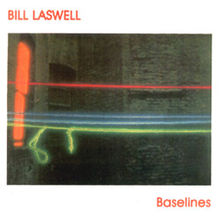
His solo career has been interesting too, latterly showcasing a fusion of ambient, world and dub styles. But it’s his debut album Baselines (released 14 June 1983 on Elektra/Asylum) that really floats my boat. He plays a lot more bass than usual, fusing the soundworlds of Bootsy and Ornette Coleman and doing cool things like sticking objects under the strings or digging out the old Mu-Tron pedal for some memorably funky lines.

To these ears, Baselines is also the project that gave him the perfect vehicle for all his interests – My Life In The Bush Of Ghosts-style found sounds, paranoid funk a la Talking Heads/King Crimson, Afrobeat, early hip-hop, avant-fusion, authentic jazz soloing and even post-punk white noise courtesy of future Chili Peppers/Soundgarden producer Michael Beinhorn.

I wasn’t in New York in 1983 but this album would seem to be a perfect amalgam of all the hippest sh*t that was going down at the time. It’s Laswell’s show, leading from the front on four/six/eight-string fretted and fretless basses and generally keeping the tracks short and sweet. Baselines is also beautifully recorded and produced – it’s easy on the ear despite some abrasive textures.

Shannon Jackson has never sounded better, supplying hilariously scattergun grooves and crunching fills. ‘Upright Man’ still inspires a kind of giggly menace, nearly 40 years on. Who supplies the scary spoken-word part? Whosampled doesn’t reveal, but the smart money’s on Fred Frith (who also plays some amusing violin on country-tinged curio ‘Lowlands’).

Baselines was certainly influential from a bass point of view too – you can bet Jah Wobble, Mick Karn, Stump and Human Chain had well-thumbed copies in their collections. But, to the best of my knowledge, Laswell has never returned to such a bass-led solo project since. A shame. He might have a future there…

John McLaughlin Trio: Live At The Royal Festival Hall 30 Years On

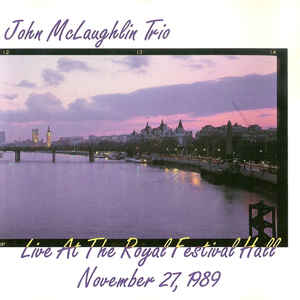
Recorded 30 years ago, Live At The Royal Festival was the beginning of John’s live career in concert halls rather than ‘rock’ venues, at least as far as the UK goes.

I’m not sure why I wasn’t at this gig, but, in those days, even major shows could easily go under the radar. If it wasn’t listed in Time Out or The Wire, you could easily miss it. Or maybe I was just turned off by the lack of ‘stars’ appearing with John.

Which was a big mistake, because this album introduced two monster players, both hitherto unknown to UK audiences. Bassist Kai Eckhardt was yet another miraculous bass find for McLaughlin, apparently fresh out of the Berklee School of Music.

Trilok Gurtu brought the best aspects of American jazz and fusion playing but also rhythmic concepts and sounds from his native Mumbai (including a water bucket and tablas). In short, he was a perfect fit for McLaughlin.

It had been a weird few years for the guitarist, closing down Mahavishnu for good, duetting with bassist Jonas Hellborg and guitarist Paco De Lucia but also recording the fabulous Mediterranean Concerto which was finally released in 1990.

So his return to the acoustic guitar had thus far been a partial success, but Live At The Royal Festival Hall was the beginning of an acclaimed trio that lasted nearly three years (though weirdly it doesn’t appear to have made it to streaming platforms yet).

The album starts slowly but gets better and better; a gentle take on Miles/Bill Evans’ ‘Blue In Green’ is nothing special but demonstrates John’s rich, Gil Evans-inspired chord concept.

Adventures In Radioland tracks ‘Florianapolis’ and ‘Jozy’ are quite superb, beautifully rearranged for the trio. When Gurtu lays into the half-time shuffle on the latter, it’s one of the great bits of modern fusion drumming.

His ‘Pasha’s Love’ is an intricately-arranged version of a track on an impossible-to-find Nana Vasconcelos live album. But the album’s centrepiece is ‘Mother Tongues’, the debut of a tune which is a mainstay of John’s live sets to this day. The only disappointment is the over-extended ‘Blues For LW’, almost derailed by some dodgy group vocals, Gurtu beatboxing and throwaway references to ‘Are You The One?’ and ‘Miles Beyond’.

Eckhardt didn’t stick around for long after this gig, for undisclosed reasons – Dominique Di Piazza came in, yet another Jaco-influenced chops monster. But Trilok stayed on for the decent 1992 studio album Que Alegria. Then it was time for another change – John’s forte.

Scott Henderson/Tribal Tech: Nomad 30 Years On

Who are the most self-critical instrumentalists? Surely guitarists.

And in this age of social media, fans have never had a better insight into musicians’ views of their own work.

Steve Khan, Francis Dunnery, Andy Partridge and James Grant often take a pretty dim view of their own stuff. Allan Holdsworth was virtually unable to listen to his own guitar playing on record.

But brilliant guitarist Scott Henderson may trump them all. He emerged as a poster boy of jazz/rock guitar in the mid-to-late ’80s, when, along with Holdsworth and Frank Gambale, he would often appear alongside metal players du jour in the pages of Guitar World or Guitar Player.

A remarkably fluid improviser with a ‘rock’ sound but ‘jazz’ attitude, Henderson’s technical ability was always tempered by a strong blues feeling (distinguishing him from Holdsworth and Gambale).

In 1985, he formed Tribal Tech with ex-Wayne Shorter bassist Gary Willis whilst pursuing a sideman career with Jean-Luc Ponty and Chick Corea (and, later, Weather Report’s Joe Zawinul).

I first heard Scott in my late teens when a very shrewd guitar-playing college acquaintance played me his third album Nomad, recorded in 1988 but not released until early 1990.

I was instantly smitten, picking up on the strong ‘Weather Report with guitar’ vibe – mainly due to Willis’s fretless bass – but quickly realising they had their own thing going on.

Also, like Weather Report, Tribal Tech were also fortunate to have not one but two fine composers in their ranks. Willis’s ‘Tunnel Vision’ may be Nomad‘s standout, but Henderson was extremely modest about his superb, much-transcribed solo, telling his website:

The opening eight bars is good because it’s not me – it’s a melody written by Willis. I start playing after the first eight bars and things get considerably worse… We had a good laugh when a critic who reviewed the album commented on how great the beginning of my solo was. Then the tune was put into one of the new Real Books and that eight-bar melody was mis-labelled as my solo. Willis said to me: ‘Wow, I’m really making you look good…’

The excellent opener ‘Renegade’ was another embarrassment for Henderson:

On every Tribal Tech album, there are amazingly bad playing and production flaws, because we thought we were capable of producing the albums ourselves, and we clearly weren’t. We had little to no experience in the studio and were learning as we went. An experienced producer would have made those records much better, but we couldn’t afford one anyway, so they are what they are. The funniest solo is mine on ‘Renegade’ – I didn’t have any vocabulary for that 6/4 feel, so I’m clearly playing lines meant for 4/4 and they don’t fit the groove at all. It’s one of my most embarrassing solos…

Then there’s Henderson’s superb album-closer ‘Rituals’, showingcasing a heavy Wayne Shorter influence:

The last time I listened to the Tribal Tech version, I thought I’d throw up. I played the melody in a horribly stiff way, with the thinnest tone ever, and the arrangement sounds like we’re trying to be Journey – very dated and funny. Then there’s the pan flute synth sound… Holy sh*t, talk about corny. It’s one of my favorites but it didn’t get the production it needed. The drum sound is pathetic and the keyboards aren’t loud and clear enough. Those are some badass voicings and sometimes they’re buried. It’s not a tune I could play trio because there’s too much going on, but I’d like to re-record it and make it sound like it should…

Whatever. Nomad is a great album, with excellent compositions and playing from everyone involved, including drummer Steve Houghton, percussionist Brad Dutz and keyboard player David Goldblatt.

Story Of A Song: McCoy Tyner/Phyllis Hyman’s ‘I’ll Be Around’ (1982)

What makes a ‘good’ singer?

In a recent podcast, Donald Fagen spoke about the importance of vocal tone, saying that he’d rather listen to Ray Charles singing a mediocre song completely ‘straight’ than a jazz singer pointlessly embellishing a songbook standard.

It got me thinking about Phyllis Hyman’s crackerjack performance on ‘I’ll Be Around’ (not to be confused with the Alec Wilder standard sung by many including Frank Sinatra and Chaka Khan), from McCoy Tyner’s 1982 CBS album Looking Out.

The song, which has haunted me since I first heard it in the late 1980s, was mainly written by Stanley Clarke and recycled from his lacklustre (despite featuring Stan Getz on saxophone) 1979 track ‘The Streets Of Philadelphia’. ‘I’ll Be Around’ comes from an otherwise fairly mediocre McCoy album, mainly notable for featuring Carlos Santana, Clarke and Gary Bartz on several tracks.

But Tyner’s fabled work with John Coltrane must have seemed a distant memory by 1982. In jazz terms, CBS was obsessed with Wynton Marsalis and neo-classicism, though still had time for Herbie Hancock’s hip-hop explorations and Miles’s comeback.

Phyllis and McCoy in the studio

Maybe McCoy in turn thought he’d hit paydirt by grabbing Santana, Bartz and Clarke (huge Coltrane fans, all), but Looking Out is now barely a footnote to his illustrious career – it was his second and last album for Columbia.

‘I’ll Be Around’ doesn’t feature Santana or Bartz, and was the sole LA-recorded track on the album (the other tracks being recorded at the Power Station in NYC), adding the excellent pairing of Charles ‘Icarus’ Johnson on guitar and Ndugu Chancler on drums.

Chancler and Tyner work together almost telepathically, the former driving the song forward, though always with one ear on the groove, the latter sprinkling on his majestic chord voicings. Hyman’s vocals are huge, luscious, but she also adds some subtle flavours over Tyner’s piano solo, consciously removing vibrato and sometimes singing ever-so-slightly sharp for emotional effect.

Of course it’s virtually impossible now to assess this heartfelt performance without considering her tragic suicide in 1995. But, happily, ‘I’ll Be Around’ gives a different slant on a fine career and shows Hyman’s mastery of Black Music.

Book Review: Pat Metheny (The ECM Years 1975-1984) by Mervyn Cooke

You know the guy: long, bushy hair, beatific grin, jeans, sneakers, long-sleeved T-shirt, usually rhapsodizing intensely via some kind of guitar gizmo.

Despite his many stylistic detours, Pat Metheny is a brand all right, and his music inspires a devotion and attendant sales profile that has rarely – if ever – been afforded to ‘jazz’ musicians.

If you – like me – aren’t always enamoured by the bulletproof sincerity of his stage presentation (in Gary Giddins’ memorable words, he ‘intones plush melodies with excessive sobriety, as though the notes were transmitted directly from God’ – the main reason why I’ve always preferred his stuff on record rather than live…), it’s beyond doubt that Metheny is one of the great guitar soloists.

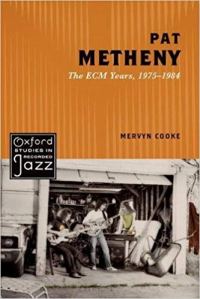
Mervyn Cooke’s superb new book ‘Pat Metheny: The ECM Years, 1975-1984′ sheds light on the first – and, for me, best – decade of the guitarist’s recording career, when he was the famous European jazz label’s top turn.

It’s an academic study, though never boring and certainly never predictable, with close attention played to Pat’s guitar styles, musical history, tunings, key collaborators (loads of new stuff about Jaco, Charlie Haden, Michael Brecker, Gary Burton and Lyle Mays here), equipment, album cover designs and inspirations.

There are fascinating details, like Metheny’s obsession with flat ride cymbals (hence his deliberate placement of drummers onstage, ride cymbals always in close proximity to his left ear) and his singular band-leading philosophies. There are solo transcriptions and quotes from archive interviews.

Cooke also shrewdly compares Metheny’s studio work in this era to that of Weather Report’s, drawing parallels between both acts’ meticulous sculpting of ‘spontaneous’ musical performances and attempts to concoct ‘through-composed’ – rather than vamp-based – material.

Metheny fans will love ‘The ECM Years’, as will anyone who has even the faintest interest in guitar trends of the last 40 years. It also serves as a rich biography of ECM Records in its early years, with numerous revelations about label boss Manfred Eicher.

Reading the book sent me running back to choice cuts from Pat’s early albums that I liked during my teenage years – Bright Size Life, American Garage, 80/81, As Falls Wichita, So Falls Wichita Falls, Travels, Rejoicing, First Circle, Song X.

Revisiting As Falls Wichita in particular has been somewhat of a revelation. (Prog fans: check out side one. It’s a cinematic masterpiece, analysed in great detail by Cooke.)

Mervyn Cooke’s ‘Pat Metheny: The ECM Years, 1975-1984’ is published by Oxford University Press.

Mark Isham: Vapor Drawings 35 Years On

Did any music of lasting worth come out of the early ’80s ‘New Age’ boom?

Mark Isham’s brief but inspired Windham Hill catalogue still cuts the mustard.

The trumpeter/keyboardist/composer’s Vapor Drawings, released 35 years ago this weekend, was a remarkably assured, fully-formed debut album, recorded when he was part of Van Morrison’s band and also enjoying a varied session career.

I distinctly remember hearing a track from it in the mid-1980s on a short-lived ‘new age’ BBC radio show whose name escapes me. And weirdly, Isham mixed the album 100 yards from my childhood home during spring 1983 at John Kongos’s Tapestry Studios.

Synths are Vapor Drawings’ main ingredient but Isham uses them in subtly original ways, using sequencers to build Steve Reich-inspired ‘systems’ or – one of his trademarks – getting them to hang in the air like sky lanterns.

The music defies categorisation, mostly hovering in the hinterland between ambient, minimalism, electronica and jazz (he even throws in a quote from Sonny Rollins’ ‘Oleo’ on ‘Raffles In Rio’).

But there’s always the human element courtesy of his superb trumpet and piano playing. Erik Satie is also an apparent inspiration, and possibly what David Sylvian picked up on when he invited Isham into the studio to record Brilliant Trees later in 1983.

It’s no surprise Isham has become one of the most in-demand soundtrack composers of the last 30 years – ‘On The Threshold Of Liberty’ (named after a Magritte painting), ‘Men Before The Mirror’ and ‘Sympathy And Acknowledgement’ are epic and rousing.

’83 proved to be a bit of an annus mirabilis for Isham, hooking up with Sylvian and also working with Gil Evans at the Montreux Jazz Festival. Vapor Drawings is the first and best of his solo albums. Happy birthday to an unsung classic.

Stanley Clarke: The Message

Stanley’s music first grabbed me sometime in the mid-’80s.

It was the bassist/composer’s incredible 1974 self-titled album featuring Tony Williams on drums, Jan Hammer on keyboards and Bill Connors on guitar.

Clarke remains a hero – I still greet his new albums with some enthusiasm and his career seems to have enjoyed a new lease of life over the last 10 years or so.

2006’s Toys Of Men was a huge return to form, and releases since then have been prolific if less impressive.

Which brings us to Stanley’s new album, The Message. It continues his tried-and-tested formula: some sh*t-kickin’, symphonic jazz/rock, vocal-based R’n’B, acoustic interludes with a classical bent and brief novelty curios featuring some guest star or other (this time Doug E Fresh on rapping and human beatbox).

On previous classics like School Days and If This Bass Could Only Talk, the formula worked a treat. But this time, besides the typically great playing, there are a few issues – with Stanley’s production, compositions and ‘message’.

The opener ‘And Ya Know We’re Missing You’ is a tribute to all of the following: Al Jarreau, Ndugu Chancler, Tom Petty, Chuck Berry and Larry Coryell. It sounds suspiciously like a demo, complete with distortion and rudimentary ‘slap in E’ groove. Sure, he can pay tribute to whoever he likes in whichever way he deems suitable, but this seems a really uncommitted two minutes of music.

A re-tread of the Return To Forever classic ‘After The Cosmic Rain’ also emphasises the problem with contemporary production. The new one sounds hemmed in, dried out, panicky. Drummer Mike Mitchell must take some of the blame too – he has perfected the lightning-fast single-stroke rolls but they get boring very quickly. It doesn’t help that he tunes his drums to choking point.

There are substantial pieces of music here: the title track, ‘The Rugged Truth’ and ‘The Legend Of The Abbas And The Sacred Talisman’ are great compositions which bear comparison with Stanley classics like ‘Light As A Feather’, ‘Life Is Just A Game’ and ‘Song To John’.

The acoustic-bass take on Bach’s Cello Suite is gorgeous too, but a few other tracks are beyond help – the treacly ‘Lost In A World’ and ‘To Be Alive’ irritate, while only Stanley knows what’s behind ‘Combat Continuum’, a nutty futuristic spoken-word/fusion piece about impending war.

What a shame. It could have been a classic, but The Message has 5/10 written all over it. It’s definitely one for filleting on streaming services though, and I’m sure the music will come alive in concert.

The Message is out now on Mack Avenue.

Ornette Coleman & Prime Time: Virgin Beauty 30 Years On

Who are the great pop and jazz melodicists?

Paul McCartney, Brian Wilson, Paddy McAloon, George Gershwin, Cole Porter, Stephen Sondheim, Burt Bacharach, Becker & Fagen, Miles, Paul Desmond, Charlie Parker?

Ornette has to make that list too. He’s virtually incapable of playing a fatuous phrase, even when his accompanists seem to be scrambling eggs.

Virgin Beauty, released 30 years ago, was and will now always remain a bit of an anomaly in his discography, a one-off album on CBS subsidiary Portrait Records (which also released Stanley Clarke’s If This Bass Could Only Talk) and marketed as ‘Ornette does fusion’.

Which is a bit like asking Miles to do ‘pop’: i.e. you can market it any way you want, but it’s gonna be a totally personal vision.

Ornette’s version of fusion contains elements of country and western, space-invader electro, early hip-hop and, of course, pure harmolodic hijinks.

I hadn’t heard Virgin Beauty for years but loved revisiting it this week. It’s on an old cassette sandwiched between Brian Eno’s Nerve Net and George Clinton’s Computer Games – perfect bedfellows.

First of all, it’s worth noting that this writer’s main reaction to hearing it again was pure amusement. It actually inspired a full-on giggling fit. Everything sounds a bit wonky; the Chick Corea Elektric Band it ain’t.

Ornette’s beautiful alto is always just out of tune (though his trumpet playing is surprisingly in tune) and Chris Walker’s fretless-bass intonation is far from perfect.

Two rhythm guitarists (Bern Nix and Charles Ellerbee) chatter away in different keys and Ornette’s son Denardo programs some drum machines, hits some acoustic drums, some electric drums and a slightly incongruous jazz ride cymbal. The Grateful Dead’s Jerry Garcia drops in for a few enjoyably ramshackle guitar solos.

The mix is also distinctly lacking in bass. It’s one of the first albums I’ve listened to in the past few years when I’ve had to turn the bass UP. Which is a good thing, because Al MacDowell’s playing is sometimes fairly astonishing. He even throws in a few quotes from ‘Yakety Sax’.

Virgin Beauty was the natural peak for Ornette’s Prime Time band but a bit of a cul-de-sac career-wise. It would be seven long years before his next solo studio album Tone Dialling. The record companies never got their ‘fusion’ record – thankfully.