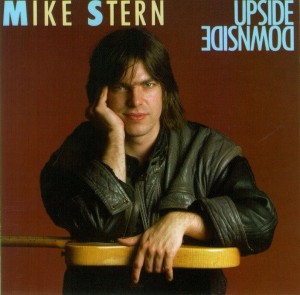
Mike Stern: Upside Downside

mike stern

There’s no telling how a jazz musician will react to a bad review, whether from a critic or fellow player.

Some, like Miles Davis, take a – how shall we put it – stoic view, either refusing to read any press or choosing his writer friends very carefully (Leonard Feather, Quincy Troupe).

But for every naysayer, there’s an aggressor; drum master Tony Williams laid into jazz scribe Stanley Crouch for his less-than-flattering comments on Miles’ electric-era music, while Weather Report famously took Downbeat magazine to task for its one-star slagging of 1978 classic Mr Gone.

Though guitarist Mike Stern had studied at the famous Berklee music school in the mid-‘70s and then landed a top gig with jazz/pop supergroup Blood Sweat & Tears, he wasn’t prepared for bandmate Jaco Pastorius’s succinct review of his guitar playing after a dodgy run through Chick Corea’s ‘Spain’ on tour with BS&T one night – ‘Stern, you know that sh*t wasn’t happening at all! You’ve got to learn faster tempos!’
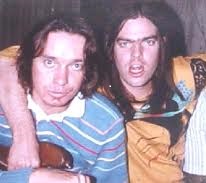
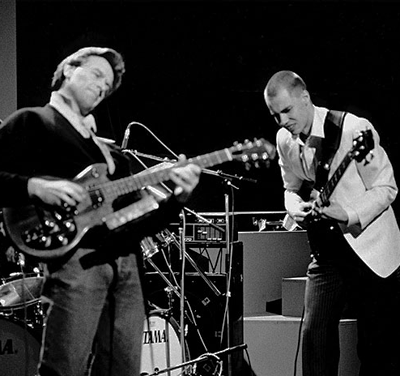
Jaco and Mike, 1980

Jaco and Mike, 1980

To his great credit, Stern listened to his friend, learnt the tune note by note and in the process became one of the greatest players of his generation. His slick bebop lines played with a ‘rock’ sound were quite new when he came of age playing with Billy Cobham’s band.

Miles was also listening closely while he was in the early stages of putting together his ‘comeback’ band in early 1981. The story goes that he appeared in the front row of The Bottom Line club in New York City and poached Stern during a break, apparently even calling Cobham off the bandstand in the middle of a tune to issue his intentions!

Stern was then summoned to the Columbia Records studio to record the electrifying half-time strut ‘Fat Time’ (Miles’s nickname for Stern) in one take. The track appeared on the Man With The Horn album and Stern was then invited to go out on the road with Miles.

My dad took me to see Miles at the Hammersmith Odeon in 1982, my first proper gig. I’m sad to say that I don’t recall much about it apart from Miles’s white suit and someone shouting: ‘Turn the trumpet up!’
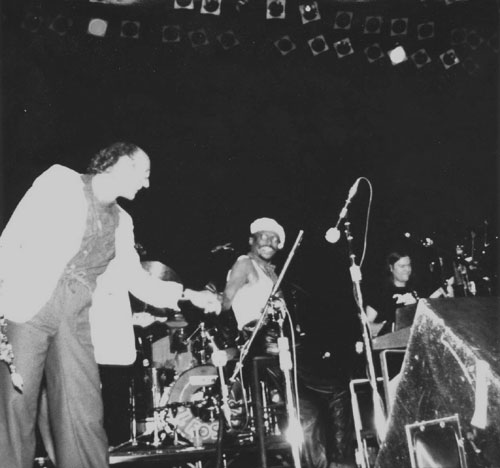
Dave Liebman, Miles and Mike Stern, 1981. Photo by Julie Coryell

Dave Liebman, Miles and Mike Stern, 1981. Photo by Julie Coryell

Critics were harsh on Stern, not believing that a chubby, jeans-wearing, long-haired guy playing a white Strat with a fuzzbox could play ‘jazz’, but with hindsight he did a brilliant job of holding down the harmony and delivering powerful, surprising solos in the keyboard-less quintet.

But the demons that haunted some of his early career wouldn’t go away. Stern recently said, ‘I played about two gigs in my life between the ages of 12 and 32 when I was sober’.

Miles even got John Scofield into the band as second guitarist to cover for his increasingly unreliable secret weapon. Stern eventually missed a flight and got the boot, but after a successful spell in rehab returned to play with old friend Michael Brecker and Mike Mainieri’s fusion supergroup Steps Ahead.

Stern also put together a solo record deal with Atlantic Records and began working on Upside Downside in early 1986 with his late friend and fellow shit-hot guitarist Hiram Bullock in the producer’s chair.

The album is a great excuse for Stern to play the hell out his guitar in a variety of idioms. The uptempo tracks are blessed with typically fiery solos while the ballads beautifully demonstrate Stern’s lyrical side, his Telecaster screaming emotively above Dave Weckl’s subtle drumming and Mark Egan’s springy bass.

Jaco completists will enjoy one of his very last recorded contributions on the raucous ‘Mood Swings’ while saxophonist David Sanborn’s playing on ‘Goodbye Again’ is spine-tingling. But mainly the album is a must for any lover of the guitar. His sound is a little more fluid and widescreen than on recent albums and there’s no-one quite like Stern at the top of his game, a fusion of Charlie Parker and Roy Buchanan.

Mike made two excellent follow-up albums later in the ’80s, Time In Place and Jigsaw, both produced by the fine guitarist Steve Khan. For me, this was Stern’s best era, when his raunchy playing was closer to blues and rock than the lighter Methenyesque jazz and World music vibes of recent times. I also saw him live at the Town and Country Club in 1989, a memorable gig featuring the mind-blowing Dennis Chambers on drums.

Further reading: ‘The Extraordinary And Tragic Life Of Jaco Pastorius’ by Bill Milkowski

Lyle Mays: Street Dreams

lyle maysI was a fan of most things jazz/rock as a teenager, scuttling off to HMV or Virgin in central London to buy the latest John McLaughlin, Mike Stern, Steps Ahead, John Scofield, Bireli Lagrene or Miles.

Whilst Pat Metheny was never a favourite, I dug American Garage and 80/81, and always had a soft spot for Lyle Mays’ keyboard playing. His 1987 debut album featured a fantastic band (Bill Frisell, Marc Johnson, Billy Drewes, Alex Acuna and Nana Vasconcelos) and promised a lot for the future.

1988’s Street Dreams didn’t disappoint. It is to some extent a big-budget ‘vanity project’, full of guest appearances and experiments, but it’s all the better for that and virtually impossible to categorise. Recorded exclusively at the Power Station in New York, Street Dreams has the range and ambition of some key pop albums of the era. It also for the most part avoids the new-age sentimentality that Metheny is sometimes prone to.

Street Dreams was a real Walkman album, creating a movie in one’s mind. To this day, I seldom listen to a tune in separation; I have to check out the whole thing in one sitting. ‘Feet First’ sounds like an outtake from Donald Fagen’s Nightfly with the vocals taken off (and features some classic Steve Gadd); ‘August’ and ‘Hangtime’ are superb tone poems featuring tasteful work from Frisell, Johnson and Peter Erskine.

‘Before You Go’ is space-age muzak with sprawling orchestrations out of the Claus Ogerman book, and ‘Possible Straight’ is cracking big-band jazz with some great drumming by Steve Jordan.

The title track is just bonkers and has to be heard to be believed. It takes in elements of prog rock, minimalism (with its Reich-influenced marimba), New Age textures and a playful, Hermeto Pascoal-style Latin workout with Mays’ piano at its most Keith Jarrett-like.

Compared to the sterility of most major-label jazz releases these days, Street Dreams still sounds pretty fresh, even if it is a touch lighter than what passes for jazz/rock in 2015.

Weather Report: Sportin’ Life 30 Years Old Today

weather report

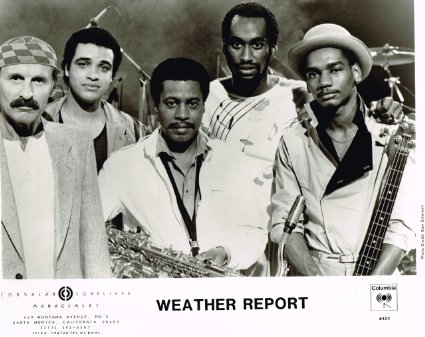
Sportin’ Life represented the second career peak for Weather Report after Heavy Weather.

Featuring the incredible rhythm section of Victor Bailey on bass and Omar Hakim on drums, the band’s penultimate album showcased a line-up that had been building up a real head-of-steam since their debut on 1983’s Procession.

It’s not clear whether Zawinul named the album after the character in Gershwin’s Porgy And Bess but it wouldn’t be a surprise. The vitality of the music on offer here belies the fact that co-leaders Joe Zawinul and Wayne Shorter were aged 53 and 52 respectively when it was recorded.

Hakim was playing with David Bowie, Sting and Dire Straits while making this album, and he brought undeniable star quality to Weather Report.

weather report

Zawinul, Cinelu, Shorter, Hakim and Bailey

Sportin’ Life blew my mind when it came out in ’85. I was already a huge fan of Jaco-era Weather Report and could hear how their music had influenced my other favourites Level 42, Sting and Joni Mitchell, but this was something else altogether. And to say my drumming was influenced by Omar’s playing would be a gross understatement.

While Zawinul is very much in charge on Sportin’ Life (‘Hot Cargo’, ‘Indiscretions’ and ‘Ice Pick Willy’ are basically solo pieces), Wayne has returned to his best form, ex-Miles percussionist Mino Cinelu gets a lot of space and sounds as inventive as ever and Hakim has become a beautifully tasteful drummer. Bobby McFerrin and two other vocalists also contribute intriguing musical colours.

‘Corner Pocket’ may be the best-ever Weather Report album-opener, and that’s saying something. Over a superb drums-and-bass groove (possibly influenced by Trouble Funk/Chuck Brown?), Zawinul delivers a typically arresting, swinging melody and unhinged synth solo. The rhythm section gear-change when Shorter tears into his tenor break is perfectly judged.

‘Face On The Barroom Floor’ is a wonderfully enigmatic Shorter ballad featuring possibly the composer’s finest soprano playing on a Weather Report album. He lets rip here with some impassioned blowing over Zawinul’s moody synths with an uncharacteristically wide vibrato reminiscent of Sidney Bechet.

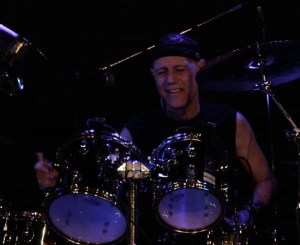
omarhakim550

The cover of ‘What’s Going On’ is funny and touching with Omar’s delicious half-time shuffle deftly moving between sticks and brushes.

Cinelu’s delightfully Santanaesque ‘Confians’ closes with another joyous Shorter soprano solo, one of his most resplendent in latter-period Weather Report.

It’s a shame there wasn’t much of an American audience for this kind of jazz in ’85, especially since Sportin’ Life represented a new high for Weather Report.

Unfortunately the band didn’t tour the album – their last major tour came around the release of ’84’s Domino Theory. I saw them at the Dominion Theatre in London and vividly recall the intense interplay between Zawinul and Hakim.

Shorter and Zawinul would soon go their separate ways but not before leaving us with this last classic. Dig it.


John McLaughlin & Mahavishnu: Adventures In Radioland

john mclaughlin

I first heard brilliant English guitarist John McLaughlin on record as a very impressionable 15-year-old when stumbling across the unsettling, brilliant ‘Dance Of Maya’, by his Mahavishnu Orchestra. I was instantly excited and intrigued.

But Adventures In Radiolandthe second album from the ’80s reincarnation of Mahavishnu, was released in probably the least-heralded era of John’s music, a time when jazz and fusion seemed to be going in diametrically opposite directions and decent record deals were hard to come by.

john mclaughlin

With hindsight, it seems the mid-’80s popularity of Pat Metheny was having a huge influence on many instrumentalists and John was no exception; the decade was full of guitarists utilising synthesizer technology and looking to Brazilian songforms for inspiration (an obvious example is Al Di Meola’s Soaring Through A Dream).

But McLaughlin’s take on Metheny was far more raunchy, rooted in bebop and the blues (though the bridge of ‘Floriannapolis’ sounds suspiciously like Metheny’s ‘James’). And what a shocking record Adventures In Radioland was coming from a mainstream jazz artist, a two-finger-salute to the Young Lions neo-bop boom represented by the Marsalis brothers et al.

John seemed to be going out of his way to annoy the jazz purists but in doing so produced some material of worth. Like some of the best fusion music of the ’80s, its deceptively slick production obscures some pretty radical improvisations.

Is the album title wishful thinking? Is this John’s idea of ‘smooth jazz’, designed for radio play? If so, he must be living in a parallel universe because this is one of the weirdest albums of his career.

But, as he said himself in a 1996 interview with Guitar Player magazine, ‘Without madness or fantasy, music’s boring’. This album sure ain’t boring, especially if you’re a guitar fan, but devotees of The Inner Mountain Flame may struggle a bit…

John McLaughlin and Jonas Hellborg

John McLaughlin and Jonas Hellborg

Opener ‘The Wait’ luxuriates in pleasant synth washes and a gorgeous chord sequence for a while before McLaughlin grabs the Les Paul and unleashes one of his most intense solos over quite a funky little R’n’B bass vamp.

‘The Wall Will Fall’ fuses a gargantuan blues riff with nutty Simmonds drums fills, and McLaughlin’s furious solo over high-speed bebop changes is both funny and exhilarating.

‘Florianapolis’ initially steers dangerously towards Metheny territory with its breezy, major-chord cod-Latin groove and nasty DX7 synth sounds. But before you know it, McLaughlin has ripped into an absolutely outstanding acoustic solo, full of rhythmic/melodic risk-taking.

‘Jozy’ is a dramatic, swinging tribute to Joe Zawinul, beautifully marshalled by drummer Danny Gottlieb with some outstanding fretless bass work from Jonas Hellborg. ‘Gotta Dance’ comes on like a fusion Mr Bungle, rattling through mellow acoustic guitar, big-band jazz, Mark King-style slap bass and industrial drums all in the space of four minutes.

‘Half Man Half Cookie’ is even weirder, a kind of post-Scritti Politti pop/funk groove interrupted by yet another incongruous big-band interlude from a multi-tracked (or sampled?) Evans.

But your proclivity for this album will probably be based on your acceptance of the mid-’80s Big Drum Sound. It certainly features some absolutely superb music. McLaughlin regrouped after Adventures and played the nylon-string acoustic exclusively for a few years – make of that what you will.

Miles Davis & Marcus Miller: Siesta

miles_davis__marcus_miller-music_from_siesta_a

I came across this gem in a big crate of reduced cassettes in the old Our Price shop in Richmond town centre.

I was a huge fan of Miles and Marcus’s ’80s work but Siesta had somehow passed me by. It was hardly reviewed anywhere despite the fact that it was the official follow-up to Tutu, possibly because it was ‘just’ a movie soundtrack and – even worse – the soundtrack to a really terrible movie.

But it quickly became the soundtrack to my summer of 1988 along with Prefab Sprout’s From Langley Park to Memphis, Prince’s Lovesexy, Thomas Dolby’s Aliens Ate My Buick and Scritti Politti’s Provision. Its Spanish-tinged melancholia, beautiful playing by Miles and stunning bass/keyboard work and production by Miller drew me in immediately.

Miles’s stock was rising high at the beginning of 1987. He was healthy, enjoying critical and commercial success with Tutu and playing to packed concert halls. The question was, how would he follow Tutu? A film soundtrack was definitely not the predictable option.

Of course, Davis was no stranger to the world of movie scoring, even though his famous Ascenseur Pour L’échafaud (Lift to the Scaffold) soundtrack was mostly improvised in just two days, and his music for Jack Johnson was similarly spontaneous though subject to detailed post-production work by Teo Macero.

But when Davis got a call from the producers of Siesta after their request to use Sketches Of Spain on the film’s soundtrack was turned down, he turned to the trusted Miller for help. Miller was also on a roll at the beginning of ’87. Fresh from co-producing and co-composing Tutu, his career was branching out in all directions.

He hadn’t done any soundtrack work before and embraced the project, thrilled to work with Miles again and rightly sensing that the movie’s Spanish elements might open up some dramatic musical possibilities. But the clock was ticking, the budget was tight and time was of the essence.

Siesta is a fascinating companion piece to Tutu and it features some of the most arresting and spontaneous Miles trumpet playing from the last decade of his life. Indeed, some Davis-watchers such as critic Paul Tingen reckon it’s the pinnacle of Miller and Miles’s ’80s collaborations.

Miles sounds fit and strong, investing the material with both power and pathos, consistently providing a sound that someone once described as ‘a little boy looking for his mummy’. Apparently when Miller played the elegiac ‘Los Feliz‘ to an assembled cast and crew, several people broke down in tears.

Miles solos at length with glorious open horn on several tracks. The dramatic, flamenco-tinged ‘Conchita‘ was used by American ice skater Nancy Kerrigan for her 1992 Olympic routine – she got a bronze medal.

The ghost of Sketches of Spain/Miles Ahead arranger Gil Evans looms large and the album is dedicated to him, ‘The Master’. One can only imagine how ‘Los Feliz’, ‘Siesta’ or ‘Lost In Madrid‘ might have sounded with Evans’ full orchestral backing and arranging, but Miller and main collaborator Jason Miles consistently find just the right musical ingredients with gorgeous piano voicings, subtle synths and fretless bass.

As George Cole pointed out in his great book ‘The Last Miles‘, only Michel Legrand, Gil Evans and Miller’s names have shared a Miles Davis album cover, and that really proves how highly Miles rated Miller’s efforts. According to Miller, there is much more Siesta music residing in the Warner Bros vaults – here’s hoping the album gets the ‘Special Edition’ treatment soon.

Women And Rhythm Section First: An Interview With Keith Leblanc

keith leblanc

Keith Leblanc

When late, great bass hero Jaco Pastorius was asked about his philosophy of music, he had a stock response – ‘Women and rhythm section first!’

In the world of black music, whether jazz, funk, R’n’B or soul, the hookup between the drummer and bass player has always been pivotal. As the cliché goes, a band is only as good as its engine room.

In jazz, you can’t do much better than Tony Williams with Ron Carter or Philly Joe Jones with Paul Chambers.

In funk, you can’t go wrong with Benny Benjamin with James Jamerson or Clyde Stubblefield with Bootsy. In fusion, you know it’s going to work if Dave Weckl/John Patitucci or Steve Jordan/Anthony Jackson are taking care of business.

But interestingly, possibly the most heralded rhythm section in recent black music hasn’t come out of jazz, funk or soul music (though these undoubtedly went into the mix), but rather hip-hop.

Drummer Keith Leblanc hooked up with bassist Doug Wimbish and guitarist Skip McDonald when they were summoned to work on the label set up by industry veterans Sylvia and Mickey Robinson to showcase the new hip-hop artists emerging from the Bronx and Brooklyn in the mid-’70s.

Just prior to that, Keith had briefly worked with Doug and Skip in the funk band Wood, Brass and Steel but when The Sugar Hill Gang’s controversial ‘Rapper’s Delight’ became a monster hit in ’79, the Robinsons were on the lookout for a house band to lay down the foundations for the follow-up.

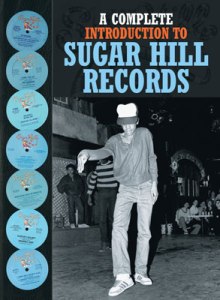
sugar hill records

It seems the call was inevitable, according to Keith, speaking crisply and candidly down the line from his home in Connecticut:

‘Sylvia was looking for Skip and Doug but they initially said no because they’d had a bad experience with her before. But I was new to the band and when I heard the words “recording studio” and “money”, I bugged them until they said yes! And the day we all went up there, we started recording. I didn’t want to know about the business, I just wanted to record.’

The slick, dynamic fusion of funk, rock and jazz laid down by Leblanc, Wimbish and McDonald proved just the ticket for Sylvia and they were in. But in those very early days of hip-hop, the money was tight although luckily for Keith the musicianship was too.

‘I was brought up with James Brown, Muscle Shoals, Parliament/Funkadelic, Gap Band and Cameo, so playing the rap stuff wasn’t much of a stretch from what we were already doing. But the first Sugar Hill Gang album was recorded in the Robinsons’ studio which was falling to bits.’

They moved to the slightly more lugubrious surroundings of H&L Studios in Englewood Cliffs, New Jersey (also home to Rudy Van Gelder’s famous studio where so many classic Blue Note albums were recorded), and so began a golden period of recording characterised by great performances captured sometimes under great duress in the studio.

Extended jams like Funky Four Plus One’s ‘That’s The Joint’, The Sequence’s ‘And You Know That’ and Grandmaster Flash and the Furious Five’s ‘Freedom’ featured jazzy horn charts, challenging stop-and-go arrangements and extended solo sections that had more in common with Duke Ellington or Cab Calloway than Eminem and Jay-Z.

These tracks were not piecemeal studio confections; according to Keith, ‘Back then, playing live in the studio was normal. The arranger Clifton “Jiggs” Chase would get with the rappers and do an arrangement based on what they wanted to use and then make up a chart. Then we’d add things. The musical ethic was really good at that time. You had to get it right or there’d be someone else in there recording the next day.’

The work ethic was almost comparable to the famous Motown production line: ‘We’d cut a track on the Friday, drive home to Connecticut, drive back to New Jersey on the Monday and hear the track on the radio.’

In the time-honoured hip-hop tradition, sometimes sections from other records were ‘replayed’ to give tracks an air of familiarity, most notoriously on the Sugar Hill Gang’s ‘Rapper’s Delight’ which stole Chic’s ‘Good Times’ groove lock, stock and barrel. But this just provided yet another irresistible musical challenge to the young Leblanc: ‘Alot of the time, we were playing maybe a bar of someone else’s music. So we wanted to cut it better than the original!’

But then came the second seismic shift in hip-hop’s history – the release of ‘Planet Rock’, Afrika Bambaataa seminal track which was the first rap tune to properly utilise newly-affordable drum machines and sequencers.

And for Keith, it was both a blessing and curse: ‘When the drum machine first came out, I saw my job opportunities flying out of the window! Now anybody could make a rap record in their bedroom. But then it dawned on me that I could program a drum machine better than any engineer. I did “No Sell Out” just to see what I could do with the technology.’

Featuring a mash-up of Leblanc’s apocalyptic beats and segments of Malcolm X’s oration, the track led to many more intriguing fusions of man and machine in his recorded output and also prefigured the Tackhead project which teamed up Leblanc, Wimbish and McDonald with London dub mixologist Adrian Sherwood to thrilling effect.

Sadly, the Sugar Hill story wouldn’t be complete without reporting its demise – in less than honourable circumstances, according to Leblanc – with lots of law suits, claims and counter claims. But much of the music stands the test of time, particularly the extended jams of the ’80/’81 period which suggested a thrilling fusion of Duke Ellington, George Clinton and Trouble Funk.

Leblanc has continued to work with Doug Wimbish and Skip McDonald regularly over the years in projects such as Little Axe and Mark Stewart and the Maffia.