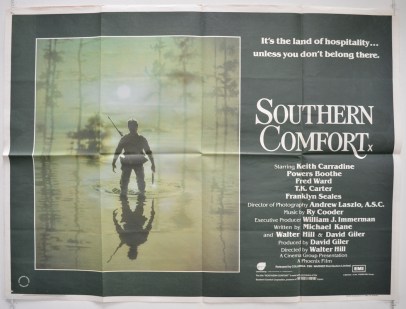
After the extended prologue, when Ry Cooder’s swampy blues riff slides in over a glorious widescreen shot of the Louisiana bayou, you know you’re watching a classic of its kind.
To this day, co-writer/director Walter Hill claims that the superb ‘Southern Comfort’ doesn’t directly allude to the Vietnam War, but it’s hard to conclude otherwise.
Set in 1973, his film concerns a motley group of weekend National Guardsmen whose sojourn into Cajun country (with the promise of prostitutes at the end of the road) turns into a desperate fight for survival when a foolish prank leaves them at the mercy of some particularly vengeful locals.
Hill prefers to call it a ‘displaced Western’, a film about escalating moral dilemmas in unfamiliar surroundings. That rings true too, but watching it again after ten years or so, it’s hard not to compare it to John Carpenter’s ‘The Thing’, another all-male classic about creeping, self-defeating paranoia, fudged leadership and dodgy group-think.
‘Southern Comfort’ might also be described as ‘The Warriors’ meets ‘Deliverance’. It’s that good. This is a pre-irony, pre-CGI action movie, where men are men, decisions have consequences and vengeance is swift and fairly brutal.
The action sequences are gripping, though never tawdry, and look extremely punishing for the cast – there’s a particularly realistic dog attack and a memorable quicksand incident. Apparently the shoot was long, cold and difficult, with camera tripods frequently sinking into the bayou.
The dialogue is fast and loose – the brain has to be in gear to pick up all the political/ethical nuances that fly by – and the acting styles deceptively ‘naturalistic’.
Keith Carradine and Powers Boothe are superb as the reluctant heroes who must overcome their basically apolitical stances to become men of action and moral choice.
Carradine in particular makes for a fascinating action-man (according to Hill, his character is a ‘Southern aristocrat’). The secondary cast of mainly unknowns (the ever-excellent Peter Coyote aside) is also superb.
But ‘Southern Comfort’ was a commercial dud on its 1981 release. Maybe, like ‘The Thing’, it’s far too stark a vision. But it certainly it spawned some new movie clichés and looks like an influence on many ’80s movies from ‘Aliens’ to ‘Predator’.
It’s also a fascinating watch these days considering the state of the US – the film’s message seems to be that peace is impossible while there remain so many internal divisions and prejudices.
There definitely seems to be something in the London air this summer.
The Grenfell Tower tragedy and various other events have brought some deeply unpleasant issues to light (again).
Revisiting Mike Leigh’s 1983 TV film ‘Meantime’ recently, it seemed eerily relevant. A withering portrait of Thatcher’s Britain featuring a brilliant cast, it’s still a striking piece of work, at times difficult to watch but finally offering cause for hope.
Its essential Englishness also echoes through the work of Suede and Blur; an alternative soundtrack might include ‘My Insatiable One’ or ‘Bank Holiday’.
Mainly set and shot in Haggerston, East London, ‘Meantime’ focuses on two generations of the Pollock family: parents Frank (Jeffrey Robert) and Mavis (Pam Ferris); their sons Colin (Tim Roth) and Mark (Phil Daniels); Mavis’s sister Barbara (Marion Bailey) and her husband John (Alfred Molina).
Frank, Mavis, Colin and Mark live in a rundown council high-rise (Bryant Court in Whiston Road, where a two-bedroom flat now goes for £330,000) while Barbara and John have escaped to middle-class respectability in Chigwell, Essex.
From Uncle John’s condescending opening line – ‘Barbara, the boys can take their shoes off and leave them in the kitchen, all right?’ (note that he doesn’t tell Colin and Mark himself) – we know we’re deep in Leighland. The performances are uniformly superb, with Roth, Daniels and Bailey possibly never better.
Oldman delivers a remarkable turn as the skinhead Coxy, smashed on the Special Brew, looking for trouble but also deeply vulnerable, while Peter Wight is excellent as the insouciant, blithely idealistic estate manager.
Gary Oldman as Coxy
Mark, Colin, Coxy and Frank are stuck in a grim, sometimes demeaning cycle of unemployment, but there seems to be glimmer of hope when Auntie Barbara offers Colin a painting job in her home. Mark has other ideas. Anyone growing up in London during the early 1980s knew kids like Colin, Mark and Coxy. The latter two are quick-witted and sharp but totally wasted, with no structure in place for them to thrive.
Andrew Dickson’s soundtrack – a duet for tack piano and soprano sax – is unforgettable. And, for a director known more for his characters and situations than a visual sense, Leigh comes up with many striking images: Mark and Coxy dodging the falling detritus from a freshly-bulldozed block of flats; Colin wandering uncertainly in front of the Winston Churchill statue at Woodford Green; Coxy rolling around a giant, hollow metal canister, attacking its insides impotently with a stick.
I asked legendary TV producer Graham Benson about his memories of working on ‘Meantime’ (which you can watch in HD below, at least until it’s taken down…).
MP: How did you come to the project and what was its genesis? I gather it was your first (and only) experience working with Mike Leigh.
GB: Yes, it was my one and only time working with Mike and a very enjoyable, rewarding time. The producer’s job is very much one of support, encouragement and of being there when needed in various aspects of the films progress. We initially wanted to make a feature film when I was running Robert Stigwood’s European film and TV company. We nearly got a deal with Warner Bros but the lack of script (Leigh famously develops his scripts through intensive improvisations in collaboration with the actors – Ed) scared the moguls. Eventually a combination of Channel 4 and David Rose together with Central Productions and Margaret Matheson delivered the commitment and budget. I am pleased and proud to have been a part of Mike’s journey and have to say that producing a Mike Leigh film was an example in my career of working with a supremely professional, responsible, collegiate and multi-talented film-maker, and a good-humoured, decent bloke to boot!
‘Meantime’ was made for Channel 4. It’s hard to imagine such a hard-hitting feature-length film getting shown on a terrestrial station today. Do you see that period as a golden age for British TV?
Well, Channel 4 were Mike Leigh enthusiasts as they remain now. He’s always had them and the BBC. I don’t see why it couldn’t be made now really. These days he has other places in Europe to go and get additional monies – for now, anyway…
The film showcases an incredible array of Brit acting talent: Marion Bailey, Gary Oldman, Tim Roth, Peter Wight, Pam Ferris, Alfred Molina, etc etc. Did you have any casting input?
We discussed the casting as we went along. It was a stunning cast but they were all much less well-known then. Like so many others, they were cutting their teeth on hard-hitting UK dramas.
Though often a difficult watch, the ending arguably shows chinks of light – Barbara finally stands up to John and the two brothers seem to come to a new understanding. Is that how you see it?
Yes. Though it’s a bleak and critical view of Thatcher’s Britain, it is a hopeful film. The human spririt will win through. But we must be watchful, as we see today.
What do you think is the legacy of the film, if there is one?
Oh, it proved Mike could handle a wider canvas and could deal with a slightly bigger budget. It solidified his method of working as a successful one and a genre all of its own. Soon afterwards he’d get his opportunity on the bigger screen.
Whitney is seldom mentioned in the list of ’80s biggies (Prince, Bruce, Bon Jovi, Madonna, Jacko, Hall & Oates etc.) – strange considering her 1985 debut album sold 22 million copies, her second 25 million and she’s still the only artist in history to have seven consecutive US number one singles (one more than The Beatles).
Her death in 2012 at the age of just 48 followed decades of worldwide success but also attendant tabloid speculation and a multitude of legal problems (her father John sued her for $100 million in 2002).
Her marriage to R’n’B ‘badboy’ Bobby Brown was endlessly analysed, as was her close friendship with Robyn Sampson. Nick Broomfield’s ‘Can I Be Me?’ (Rudi Dolezal gets a co-director credit for the inclusion of his scintillating 1999 concert/backstage footage) is the first Whitney doc out of the blocks – another ‘authorised’ film is apparently on the way shortly – and it’s a significant change of style for Broomfield.
He dials down the quirkiness, resists on-screen cameos and cranks up the gravitas, seeming far more affected by Whitney’s demise than he was by the deaths of Biggie, Tupac, Kurt Cobain or Aileen Wuornos. There are no obvious laughs in this one and it’s by far his most commercial film, possibly reflecting the influence of Asif Kapadia’s similarly-themed ‘Amy’.
But other things haven’t changed – Broomfield’s impressive range of interviewees (including Whitney’s brothers, friends, bodyguard, hair stylist, drug counselor, musical director and backing singers) are shown in unflattering close-up, but all speak with sometimes breathtaking candour.
The only notable no-shows are Bobby Brown and best friend Robyn Crawford, for reasons which become abundantly clear. We get a strong sense of Whitney’s childhood in Newark, New Jersey – ‘the hood’ – when ‘Nippy’ was a lovable, caring, somewhat mischievous kid brought up singing gospel in church and mucking around with her brothers.
Inheriting a formidable set of pipes from her mum Cissy Houston, legendary impressario Clive Davis signed Nippy as a charming, cheeky 20-year-old and demanded a debut album that would appeal to White America; as an Arista A&R man says on camera, ‘He DIDN’T want George Clinton music.’
Broomfield analyses this as the crux of the problem, in the sense that Whitney achieved her huge early success without ever referencing the sort of music she was passionate about. The title of the film comes from her catchphrase developed when touring in the late ’90s when she would insist on bringing in elements of gospel, jazz and R’n’B (presumably against the wishes of her record company).
Broomfield doesn’t fudge the drug issue, and finds plenty of self-criticism from Whitney as well as corroboration from various sources. Bobby Brown comes across as somewhat of a loose cannon but essentially harmless. Despite his posturing, the intimate backstage footage demonstrates that he certainly loved Whitney and vice versa. Their Ike and Tina ‘abuse’ skits are amusing, though may offend some.
More troubling was Brown’s relationship with Robyn Crawford, who allegedly was having an affair with Whitney throughout much of her career. Broomfield hasn’t been able to secure the rights to any of Houston’s recorded catalogue, so the film arguably relies too much on Nick Laird-Clowes’ mournful, somewhat clichéd original score.
But Rudi Dolezal’s concert footage is evocative and moving. Love or hate ‘I Will Always Love You’, it’s hard not to be affected by Houston’s mesmerising live performance during a 1999 gig in Germany, one of many great musical moments in the film. Michael Baker’s yin/yang bass-drum skin from that 1999 tour says it all – ‘Whitney: Can I Be Me’ is finally another very sad music-biz story. But it’s well worth catching even if it (understandably) lacks the anarchic zeal of Broomfield’s best work.
One interviewee who might have been worth tracking down is Bill Laswell, who to the best of my knowledge was the first producer to tap into Whitney’s potential when he helmed this early gem, recorded when she was just 19 years old.
Reading obituaries of director Jonathan Demme, who has died from cancer aged 73, it struck me how many memorable scenes his films spawned.
Born in Baldwin, Long Island, his early career was mentored by B-movie pioneer Roger Corman.
When Demme broke into Hollywood he never lost sight of his early exploitation influences and zany sense of humour; even ‘serious’ fare like ‘Silence Of The Lambs’ and ‘Philadelphia’ was hijacked by sundry in-jokes and bizarro guest stars including Corman, Chris Isaak and George A Romero.
Demme’s sets were famous for being fun places to work, and that’s borne out by the bonhomie and improvisatory vibe present in many of his films.
He was clearly a friend of musicians, frequently using music in his movies as symbol of collaboration or even spiritual release (writer David Bowman memorably described ‘Stop Making Sense’ as ‘a three-act play documenting the spiritual journey of a hapless white guy trying to “get down”’!).
Apparently Demme sat down with each original member of Talking Heads before filming ‘Stop Making Sense’ and asked them, ‘How do you see me doing this?’ It’s hard to imagine Brian De Palma doing that.
As a live-music documentarian, Demme let the viewer get to know each performer as if they were a character in a movie with the use of long, lingering shots, a world away from the clichéd, fast-cutting MTV style.
So, in tribute to a modern master, here are a few memorable moments from Demme films, in chronological order:
Movie taglines: you know the drill (actually the tagline for a dental-themed slasher pic whose name escapes me…). One, two or three sentences that sum up a film’s flavour or sometimes entire plot.
To cineastes of a certain generation, a tagline can be as memorable as the movie itself. Some even become part of the modern lexicon. But what makes a good one? Perhaps it’s common words uncommonly used. Horror and sci-fi films seem to lend themselves to memorable tags. Is it because of their promise of the perverse, the uncanny, the unexpected, the taboo?
Quotable taglines are scarce these days. Perhaps the proliferation of films as ‘lists’ has snuffed them out. Walk into your local multiplex and you’ll see some extremely lame offerings. But the 1980s threw up a fair few humdingers, prompted by a need for eye-catching posters and proliferation of horror movies. Here are some of the best:
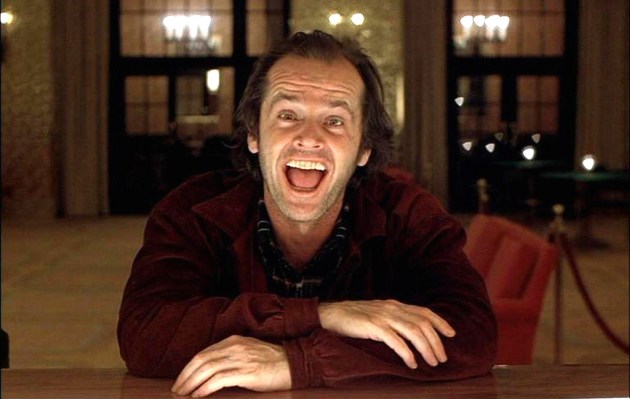
11. ‘The Shining’ (1980): The tide of terror that swept America is HERE.
A spine-tingler whose possible meaning is explored in excellent recent documentary ‘Room 237’.
10. ‘Ferris Bueller’s Day Off’ (1986): One man’s struggle to take it easy.
Does the job perfectly in just seven words.
9. ‘Scarecrows’ (1988): When it comes to terror, they’re in a field of their own.
8. ‘The Fog’ (1980): Bolt your doors. Lock your windows. There’s something in the fog!
Does what it says on the tin, but terrified me looking at the video cover in my local rental shop circa 1983.
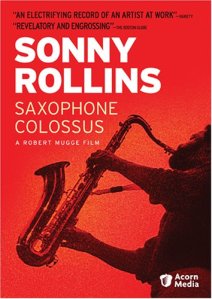
Every serious jazz fan seems to have a favourite Sonny Rollins story.
A good one is recited by musician Matt Glaser in Ken Burns’ ‘Jazz’ documentary. Sonny was playing a late-night Carnegie Hall gig on Easter Saturday during the 1990s. He embarked on a typically Herculean solo at around 11:30pm. This went on for quite a while. At EXACTLY ten seconds to midnight he quoted from Irving Berlin’s ‘Easter Parade’…
Truth or fiction, it’s the kind of story that has followed the brilliant Harlem-born saxophonist around throughout his career. It also speaks volumes about his intellectual and musical vigour.
Robert Mugge’s excellent 1987 documentary ‘Saxophone Colossus’ spawns yet more Sonny stories, inadvertently filming an extraordinary moment during an outdoor New York gig. Jumping off the stage mid-solo to join the audience, he misjudges the height and breaks his heel in the process. Lying stricken on the floor, alone and unaided though still holding his horn, there’s the briefest of pauses before he continues soloing as if nothing was amiss.
The film also features fascinating interviews with Sonny and his wife/manager/producer (and now sadly departed) Lucille. Writers Gary Giddins, Francis Davis and Ira Gitler contribute intelligent, revealing summations of Rollins’ career. There’s also some superb concert footage of Sonny’s ‘Concerto For Tenor Saxophone And Orchestra’ premiere in Japan.
Watching the film again has led to a period of Sonny woodshedding, and I’m unearthing some real gems. It’s exciting that he has continued to be an absolutely vital presence on the jazz scene, performing when possible and frequently contributing to media debates about the music.
He has also written obituaries for his long-time producer Orrin Keepnews and long-time bassist Bob Cranshaw in recent issues of JazzTimes magazine. More power to Mr Rollins. Here’s some of that woodshedding, in chronological order:
I never tire of ‘Sideways’, ‘Diner’, ‘Duel’, ‘Career Girls’, ‘Tape’, ‘This Is Spinal Tap’, ‘The Long Goodbye’, ‘The Apartment’, ‘Eyes Wide Shut’, and a few others too.
But ‘Withnail’, released 30 years ago this week, should probably go right at the top of that list. I first saw it around 1988 when my dad rented the video. I think he was a vague acquaintance of the movie’s writer/director Bruce Robinson at the time and had an inkling that it would float my boat.
How right he was. I was immediately smitten, drawn in by the superb swearing, anti-establishment mood, hilariously down-at-heel, self-important protagonists and low-key ending.
By the early ’90s, there was an outbreak of Withnails all over Britain – pasty, unshaven, rather insolent youths mooching around in leather overcoats and muttering about ‘wanting the finest wines available to humanity’…
Not a big hit on its original release, ‘Withnail’ has nonetheless become a classic cult movie, inspiring many devotees and even a notorious drinking game. But why has it endured? Here are seven reasons why it doesn’t seem to date as the years go by (swearing and spoiler alerts…).
7. No ‘Crap Bits’
Actor Ralph Brown – who plays Danny the Dealer – analysed ‘Withnail”s appeal thus. Almost every movie has a clunky change of pace/tone or a dodgy character beat – not this one, though Bruce Robinson has pinpointed an uncertain moment in the final reel when Danny embarks on his ‘They’re selling hippy wigs in Woolworths’ speech.
6. Lack Of Plot
Let’s face it, nothing much happens in ‘Withnail’. There are no ‘life lessons’. But that’s its main strength. Two out-of-work actors try to go on holiday, one of their uncles comes to stay, falls in love with and attempts to seduce the other one, then they come home. It’s two fingers up to the screenwriting template taught in most film schools. But, framed another way, it’s actually the classic plot: put your hero(es) up a tree, throw rocks at him and get him down, though poor Withnail seems destined to stay up the tree forever…
5. Endlessly Quotable Dialogue
This is probably the key to the film’s longevity. ‘Fork it!’… ‘Monty, you terrible c**t!’… ‘We’ve gone on holiday by mistake’, ‘I demand to have some booze!’ ‘My thumbs have gone weird…’ etc. But as the years go by, it’s the throwaway lines that now make me chuckle the most: ‘Out-vibe it’, ‘Jesus, you’re covered in sh*t,’ ‘I’ve waited an aeon for assistance’, ‘Drugs banned in sport…’ ‘We’ll be found dead in here next spring…’ etc., etc…
4. Memorable Minor Characters
The film is chock-a-block with them. There’s Ralph Brown’s classic turn, Noel Johnson’s delightfully-plastered pub landlord, Llewellyn Rees’s tea-shop proprietor, Michael Elphick’s psychotic poacher and Anthony Strong’s manic traffic cop. All perform as if their lives depended on it. Late, great casting director Mary Selway must take a lot of credit.
3. Outstanding Lead Performances
Has there ever been a better movie drunk than Richard E Grant? (How about Ray Milland in ‘The Lost Weekend’? Ed.) It’s a superb breakout performance, especially coming from a famous teetotaler. In a far less showy role, Paul McGann does a fine job of tethering the movie (Kenneth Branagh and Michael Maloney were apparently sniffing around his part, so to speak), even if his accent flies around a bit. And of course Richard Griffiths as Uncle Monty is a delight.
2. Lack Of A Remake/Sequel
Please, please, please may it stay this way. Hollywood: stay away from ‘Withnail’. ‘Edgy’ young Brit writer/directors: leave well alone. You can just imagine the horror of a remake – lots of touchy-feely moments about ‘friendship’, and Withnail going on a ‘journey’… Just NO.
1. Good Grammar
It’s not called ‘Withnail And Me’… (Enough reasons already… – Ed.)
In 1987, Mickey Rourke was fast becoming one of the most controversial movie stars of the era, the go-to guy (alongside Michael Douglas) for potentially commercial but decidedly ‘off-colour’ material.
Even David Bowie rated Rourke as one of the coolest people on the planet in ’87 – to my knowledge, only Mickey, Iggy Pop, Tina Turner and Al B Sure! ever shared ‘lead vocals’ on a Bowie solo album (though their collaboration was less than essential…).
‘Angel Heart’ turns 30 this week. I’ve been a Mickey fan since randomly renting the video circa 1988. If, as Marlon Brando attested, acting (or at least good acting) is essentially ‘behaviour’, Rourke delivers one of the great modern screen performances.
He mumbles lines, adds strange emphases (‘Yeah, I could be free‘) and quirky ad-libs, smirks inappropriately and generally shambles around in his filthy linen suit; Pauline Kael memorably wrote that ‘he has enough dirt on him to sprout mushrooms’. But also he carries off the action sequences with aplomb, looking like he could take care of himself in a bar fight.
Most importantly, Rourke tempers the increasingly hokey supernatural elements of the film with a believable, sympathetic, relatively down-at-heel protagonist: Harry Angel seems to be a regular knockaround guy in Brooklyn. ‘He likes the simple life, going for a beer, getting laid whenever he can. He minds his own business. He just gets by. He works, reads the comics, he takes a walk,’ Rourke told his biographer Christopher Heard.
William Hjortsberg’s screenplay for ‘Angel Heart’, based on his New York-set novel ‘Falling Angel’ (described by Stephen King ‘as if Raymond Chandler had written “The Exorcist”’), had been hanging around Hollywood for a while.
First it looked like Robert Redford would produce and star. Then ‘Midnight Express’/’Fame’ director Alan Parker came onboard, rewrote the script (with the questionable decision to relocate most of the action to New Orleans) and offered the lead role to naysayers Jack Nicholson, Al Pacino and Robert De Niro, the latter taking the role of Louis Cyphre (geddit?) instead.
Enter Mickey. Parker made it clear to Rourke that he was nowhere near his first choice, but was interested in what he could bring to the role. Rourke was disillusioned with acting in general and Hollywood in particular but desperately needed the part: ‘I was about to lose my big-assed house in California and needed a big paycheck fast…’ Parker warned Rourke that he wouldn’t put up with any funny business, also apparently giving him many a dressing-down on set.
But how does ‘Angel Heart’ stack up these days? It’s still very watchable, salvaged by the Rourke/De Niro scenes and Mickey’s eccentric ‘behaviour’. Bonet is a refreshingly natural presence and De Niro hams it up semi-convincingly.
Trevor Jones’ original soundtrack (recorded at the aptly-named Angel Studios in Islington, North London) still holds the attention alongside some great crooner and blues tunes. But Parker searches in vain for his inner Nicolas Roeg (or Ken Russell?), showing his background in advertising with a succession of beautiful, if clichéd, images of ‘evil’ (a glistening, freshly-extracted human heart, ceiling fans, lift shafts, writhing bodies, blood-stained walls), memorable crane shots and disorientating flashbacks, but it all feels way too slick.
Kael again: ‘There’s no way to separate the occult from the incomprehensible. Parker simply doesn’t have the gift of making evil seductive, and he edits like a flasher.’ There’s also a lack of memorable secondary characters – Charlotte Rampling and Brownie McGhee seem miscast and barely register.
‘Angel Heart’ just about broke even at the box office but has enjoyed a healthy cult following since. My brother tells me that it most definitely worked on the big screen, delivering a real sense of impending doom. I don’t doubt it, ably aided by some classic Mickey.
In the late summer of 1989, Madonna held a series of dance auditions for her Blond Ambition world tour, eventually choosing seven virtually unknown male artists: Luis Camacho, Oliver Crumes III, Salim Gauwloos, José Gutierez, Kevin Stea, Carlton Wilborn and Gabriel Trupin.
Camacho and Gutierez were possibly the best known of the group, members of the Harlem House Ball that became famous for ‘voguing’ (as seen in the ‘Paris Is Burning’ documentary and Madonna’s ‘Vogue’ video).
The heightened environment of the Blond Ambition tour forged a bond between Madonna and the dancers but also conjured up some demons. ‘In Bed With Madonna‘ (AKA ‘Madonna: Truth Or Dare’), Alex Keshishian’s hugely successful 1991 film of the tour, had ramifications for the dancers too – three filed a lawsuit against Madonna, claiming she had invaded their privacy.
A fine new documentary ‘Strike A Pose’ catches up with six of the dancers nearly 30 years on (Trupin sadly died of an AIDS-related illness in 1995), investigating the impact that instant fame had on their lives and unveiling the deep, personal traumas that haunted many of them before, during and after the tour.
Co-directed by Ester Gould and Reijer Zwaan, it’s a powerful, sometimes moving meditation on ageing, artistic integrity, celebrity and identity. I caught up with Gould to chat about the film.
MP: Where did the original idea for ‘Strike A Pose’ come from and was it easy getting the funding?
EG: The original idea was co-director Reijer Zwaan’s: he was 11 when he first saw ‘In Bed With Madonna’ and was immediately blown away by these seven dancers and the film’s bold, liberating message. For the first time in mainstream media, there was this wild, loud, fun-loving troupe of dancers who were being themselves – gay and happy. Over the years, Reijer wondered what had happened to those men. When he told me about the idea for the film, I immediately loved it. We did some online research and found out that there was an entire generation out there thanking these guys for helping them dare to be themselves. At the same time, it wasn’t till we met each of them separately in summer 2013 that we knew we had a film. Our premise was that these paragons of pride and self-expression had each, in their own way, struggled with shame and self-doubt. We always wanted ‘Strike A Pose’ to be more than a ‘where are they now?’ story. We were looking for a larger narrative. It took us about 18 months to finance the film mostly with Dutch government funds. There were questions about whether Madonna would be on board and how she’d be depicted; it’s strange that when there’s a celebrity in the picture there are always forces who want to attack or uncover some dirt. For us, it was never about that.
Was it difficult tracking down Luis, Oliver, Salim, Jose, Kevin and Carlton? And were they easily sold on the idea?
Thanks to social media it wasn’t that hard to find them, but it took some time to get some of them on board, specifically José and Luis. They were tired of people asking them to gossip about Madonna – how could they know we were any different? There was also some fear going back down memory lane perhaps because it had been so hard to move on with their lives after such an impactful experience. What persuaded them was our genuine interest in telling their stories.
The film is a powerful statement about the devastating physical and mental issues around HIV and AIDS, and also the social stigmas surrounding them. In that respect, ‘Strike A Pose’ feels just as relevant today as ‘In Bed With Madonna’ felt in 1991. Was it your intention to make a ‘statement’ or just tell an interesting story about these attractive, fascinating people?
We did want to make a statement, but for us that statement isn’t solely about HIV and AIDS. It was about the emotional consequences of hiding a part of yourself, of feeling unworthy of being loved. It’s really hard to dare to be yourself, to fully accept yourself, if you feel different for whatever reason. Because we all want to belong – it’s deeply engrained in human nature. Of course, gay rights and AIDS awareness have improved since the early ’90s. On another level, it’s one thing to be loud and provocative when you’re young, it’s another to accept yourself on a deeper level when you get older and reality kicks in.
Reijer Zwaan and Ester Gould at the ‘Strike A Pose’ premiere, Tribeca Film Festival, New York City, April 2016
At any point did you seek a contribution from Madonna for the film, and has she made any public or private comment?
We did successfully reach out to her management and lawyers to secure the rights to use fragments of the original film. We also thought a lot about asking her to be part of ‘Strike A Pose’ but always felt like her presence could overshadow the whole film. In a strange way, she was the elephant in the room, because even if she had turned up at the reunion dinner, wouldn’t that somehow ruin the point that these young dancers have moved on, matured and become grown men? We did have one specific scene in mind, almost a title sequence at the end, which was to see these men and Madonna performing ‘Vogue’ once more on stage. We wrote to her about the scene but never got a reply. We do know that she has seen the film and liked it.
What’s your favourite scene in the movie and why?
My favourite scene is the one with José, his mother and her disappointment that he never managed to buy her a house. It’s really hard-hitting and there’s something painfully beautiful about the fact that José is translating what his mum is saying in Spanish, and at the same time he’s moved by what she’s saying, by her sadness that he’s messed up his professional career. We see two broken people and it’s such an honest scene about shattered dreams.
I agree. Your film reminded me a little of ‘Anvil! The Story Of Anvil’ in its depiction of fast fame and then the return to ‘normal life’, but you don’t go into much detail about the dancers’ professional lives after the Blond Ambition tour – was that a conscious decision or one forced by time constraints?
I would say it was mostly forced by time constraints but also for us it was more about this larger narrative that the individual facts. We wanted the film to be cathartic but it was quite hard to interweave all these individual life stories into one film. Also, the reunion of the dancers kind of got in the way of shedding more light on their current lives. Hopefully you do understand that they all still dance or teach dance and have overcome their darker moments. We end with the power of dance rather than talk about their lives today.
‘Strike A Pose’ has enjoyed a limited but successful run at the Dochouse in London but what’s next for the film? Will there be a DVD release?
The film will very soon be released on digital platforms in the UK. And then later this year it’ll be on Netflix, so there are lots of chances to see it.
This is a golden era for documentaries and ‘Strike A Pose’ is a fitting addition. Have you got another project in the pipeline?
I’ve just finished a six-part documentary series for Dutch public television, co-directed by Sarah Sylbing, which was a great success. It’s about the debt problem. We set out to make it as exciting and compelling as fiction, looking at ‘The Wire’ for inspiration. I’m still busy with the impact of that series. I’m also cooking up new ideas but it’s too early to say anything concrete. What I can say is that I love documentary filmmaking and have a lot of faith in its narrative power to reach audiences, especially since there is much more freedom now with genre and form.
This is a golden age for documentaries, and, in its own way, ‘Command And Control’ may just be as powerful as 2012’s BAFTA-winning ‘The Act Of Killing’.
As nail-biting as any Hollywood thriller and carrying a terrifying message, it’s also a remarkably timely film given this week’s Theresa May Trident controversy.
Based on the book by acclaimed journalist and author Eric Schlosser (‘Fast Food Nation’, ‘Reefer Madness’), Robert Kenner’s documentary looks in detail at the notorious accident of September 1980 at the Damascus underground nuclear base in Arkansas, when the fuel tank of an idle Titan II missile was damaged – with disastrous consequences.
Meticulously researched and beautifully paced, the film expands into a shocking and riveting exposé of the US nuclear industry. Testimonies of the accident survivors are heartfelt, often surprising and occasionally moving, describing a world where human error can be catastrophic and is usually the result of an unreliable – and sometimes unjust – system.
Any event which leads to loss of life can hardly be classed as a ‘near miss’, but Damascus could easily have been a lot worse – we learn that Vice President Walter Mondale and Governor of Arkansas Bill Clinton were just 46 miles down the road at a Democratic convention in Little Rock when the accident happened.
They would have been pulverized if the warhead had exploded, along with thousands – if not millions – of other citizens.
The scary facts pile up: during the Cold War, it was believed that the US needed between 50 and 100 nuclear weapons to keep up with the Soviet Union – there are currently around 7,000 nuclear weapons on US soil and surrounding oceans, including approximately 500 primed and ready to go.
And some experts estimate that 1,000 similar accidents to the one at Damascus have occurred in the US since the advent of nuclear weaponry.
According to Schlosser, the fact that there hasn’t been more loss of life is down to the excellence of the weapons designers and bravery of the (mostly very young) site engineers.
But mostly it’s down to luck. And the thing about luck is that it eventually runs out, as ‘Command And Control’ so harrowingly depicts.

 There definitely seems to be something in the London air this summer.
 Whitney is seldom mentioned in the list of ’80s biggies (Prince, Bruce, Bon Jovi, Madonna, Jacko, Hall & Oates etc.) – strange considering her 1985 debut album sold 22 million copies, her second 25 million and she’s still the only artist in history to have seven consecutive US number one singles (one more than The Beatles).
 Reading obituaries of director Jonathan Demme, who has died from cancer aged 73, it struck me how many memorable scenes his films spawned.
  Movie taglines: you know the drill (actually the tagline for a dental-themed slasher pic whose name escapes me…). One, two or three sentences that sum up a film’s flavour or sometimes entire plot.


 Every serious jazz fan seems to have a favourite Sonny Rollins story.
 In 1987, Mickey Rourke was fast becoming one of the most controversial movie stars of the era, the go-to guy (alongside Michael Douglas) for potentially commercial but decidedly ‘off-colour’ material.

 This is a golden age for documentaries, and, in its own way, ‘Command And Control’ may just be as powerful as 2012’s BAFTA-winning ‘The Act Of Killing’.
  movingtheriver.com