Gig Review: Nik Kershaw @ Shepherds Bush Empire, 16 October 2024

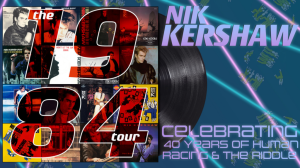
As the male solo artist with the most weeks on the UK singles chart during 1984, it’s not surprising Nik Kershaw is celebrating that year with a lengthy European tour, playing his two top 10 albums Human Racing and The Riddle in their entirety.

He’s still able to command big audiences for his solo gigs, and with good reason – his vocals are if anything much improved since his mid-‘80s heyday and his songs are built to last, with their bold melodies, crafty harmonies and intricate arrangements. But then regular readers already know movingtheriver is a big fan.

So Kershaw’s back catalogue is an embarrassment of riches but also presents some potential problems for a five–piece ‘rock’ band – for a start, how to recreate those dense textures and sequence-heavy arrangements? Thankfully he generally didn’t scrimp on any of that, mostly using the same audio stems and keyboard sounds from the 1980s. There was little or no ‘reimagining’ during this gig, hugely enjoyed by a packed house.

‘Roses’, whose lyrics are still relevant today, was the surprise but effective first song, the band (all middle-aged white guys dressed in black, but then you don’t go to a Kershaw gig expecting bells and whistles) arriving onstage to the opening percussion loop.

‘Know How’ and ‘Wild Horses’ (a favourite of Miles Davis) sounded fantastic, benefitting from bassist Paul Geary’s beefy tone and Kershaw’s fluid guitar lines.

He delivered a great vocal on ‘Wide Boy’, while ‘City Of Angels’ – written about ‘a city I’d never been to’ – featured a lovely laidback performance from drummer Bob Knight, though at times during the gig he lacked the dynamics and smooth grooves of original Human Racing/Riddle sticksman Charlie Morgan.

Geary had his work cut out aping Mark King on ‘Easy’, but he did a pretty good job if somewhat lacking the Level 42 man’s precise percussiveness and syncopated slides. Impressively, keys player Phil Peckett seemed to take care of all the track’s fast sixteenth-notes in real time rather than relying on a sequencer. The whole band did pretty much the same on ‘Don Quixote’.

Self-deprecating to the last (he’s always claimed he’s just a ‘muso’ who was thrust into the limelight), Kershaw played down his Green credentials before ‘Save The Whale’, claiming it had been written as a last-minute ‘rent-an-issue’ song for The Riddle.

The excellent ‘You Might’ featured ‘too many chords’, according to Kershaw, while the first set closed with the album’s perennially popular title track, featuring tasty duel lead guitars though with a rather stiff ‘rock’ feel compared to the slinky sixteenth-note groove of the original.

Set two featured Human Racing in its entirety, and this is where the now rather dated zaniness of Kershaw’s early stuff became apparent, the superbly sung title track and ‘Wouldn’t It Be Good’ aside, though the latter was played surprisingly early in the set.

There was a lengthy tribute to and applause for producer Peter Collins who passed away in June before Kershaw closed up Human Racing with ‘I Won’t Let The Sun Go Down On Me’, rescued by the frontman’s lengthy Holdsworth-like guitar solo.

He seemed genuinely delighted by the ecstatic crowd reaction, signing off with a breezy ‘You’ve made an old man very happy’, before encoring with mass singalongs ‘When A Heart Beats’ (complete with superb note-for-note solo from second guitarist Adam Evans), should-have-been-a-hit ‘The Sky’s The Limit’ and ‘The One And Only’.

A great night of classy music and enjoyable nostalgia. Who knows – maybe Nik will amaze us with Radio Musicola @ 40 in 2026.
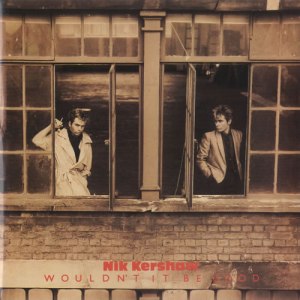
Nik Kershaw: Wouldn’t It Be Good @ 40

Bristol-born, Ipswich-raised Nik Kershaw had a spiffing 1984 – no other solo artist spent more time on the UK singles charts during the year.

‘Wouldn’t It Be Good’, released 40 years ago this weekend (on the same day as Echo & The Bunnymen’s ‘The Killing Moon’) and reaching #4, was his second single – ‘I Won’t Let The Sun Go Down On Me’ initially flopped in September 1983.

‘Wouldn’t It Be Good’ was predominantly recorded at Sarm East studios on Osborn Street, Aldgate (don’t look for it – it’s not there any more). Peter Collins produced soon after helming Musical Youth’s ‘Pass The Dutchie’ and Tracy Ullman’s solo output (he later worked with Rush, Alice Cooper and Queensryche). The song’s original title was ‘Wouldn’t It Be Nice’ – Collins demanded a better word than ‘nice’.

It’s a great single, the beginning of movingtheriver’s love affair with Kershaw’s music, and its ominous lyrics have the slight whiff of ‘In The Air Tonight’ about them, as well as a subtle social conscience. I also always liked the weird emphases he placed on some words/syllables – ‘You must be JOKING/You don’t know A thing about it/You got no probLEM‘ etc…

I distinctly remember watching him perform the song on ‘Top Of The Pops’ for the first time – who was this tramp on telly, with the snood and fingerless gloves? My parents liked the track too, which was a bit disarming.

The song’s overdriven guitars were layered/overdubbed, Brian May-style (best heard on the 12” remix), and their major-seventh chords create some strange timbres. Its structure is seriously weird too – the second chorus comes right at the end, after a lengthy guitar/horn solo. The delayed gratification is clever and totally outside the norm.

The video was directed by Storm Thorgersen, mostly filmed in a large, disused building opposite Buckingham Palace, apart from a bit at the Mullard Radio Astronomy Observatory in Cambridge. An extremely odd cover version features on the ‘Pretty In Pink’ movie soundtrack. Nik fluffed the words at Live Aid but hardly anyone noticed.

Happy birthday to another classic single from 1984.

The Essential Nik Kershaw

Universal’s Nik Kershaw CD re-release program seems to have stalled after Human Racing and The Riddle emerged around ten years ago, a pretty scant return considering he spent more weeks on the UK singles chart during 1984 and 1985 than any other solo artist.

And though all four of his MCA albums are now on streaming platforms, there’s still no sign of decent physical versions of Radio Musicola or The Works (and absolutely nothing on vinyl yet), so we’ll have to make do with Essential Nik Kershaw, a new budget 3-CD compilation which, confusingly, has the same title as a similar one-CD comp that came out in 2000.

Back when his four 1980s albums were basically unavailable, Kershaw fans had to make do with fairly crappy CD compilations, so it’s a relief to report that this one’s pretty good. It’s two discs of original album tracks/singles plus one of remixes.

The good stuff first: the remastering is absolutely first-rate. The tracks have punch and not too much bass, usually the first sign of an overzealous tinkerer. The design is attractive, and the digipack very light but very solid.

There are a few decent B-sides I’d never heard: ‘When I Grow Up’ circa The Works could easily have been a single, and certainly should have appeared on the album. Instrumental ‘One Of Our Fruit Machines Is Missing’ gives the Chick Corea Elektric Band a run for their money in terms of insanely technical jazz/fusion.

Now for the not-so-good stuff: the track order is random, certainly not chronological, and there are songs missing that most fans would say are among his greatest: ‘Easy’, ‘City Of Angels’, ‘Walkabout’, ‘Lady On The Phone’, ‘LABATYD’, ‘Violet To Blue’.

The disc of remixes is a slog to get through, but it’s worth hearing ‘One Step Ahead’, ‘Radio Musicola’ and ‘Don Quixote’. There are also zero musician/producer credits and no liner notes.

But Essential Nik Kershaw a very good entry-level compilation and a treat to acknowledge again just how high the quality threshold was with this guy. I’ve also developed a real penchant for some material from the first album which I’d earlier dismissed, especially ‘Bogart’.

In recent interviews, both his engineer/mixer Julian Mendelsohn and keyboard player Andy Richards rate Kershaw as top of the list in terms of musical talent, pretty special when you consider the two have worked with Trevor Horn, Yes, George Michael, Level 42, Prefab Sprout and Paul McCartney.

(Mendelsohn also revealed that, much to producer Peter Collins’ annoyance, he spent a whole WEEK mixing ‘Know How’, so highly did he rate the track. His work definitely paid off…)


Nik Kershaw: The Works 30 Years On

It was goodbye to Basildon and Braintree, hello to Bel Air and Beverly Hills.

Kershaw had always threatened the big-budget, US-recorded album, and in 1989 he delivered it. And, to no-one’s great surprise, it was an excellent collection, one of the best ‘Brit-Goes-Stateside’ pop records of the decade.

Recorded over four months in LA, The Works – released 30 years ago this week – saw Kershaw put together some of his best material to date with two top-notch drummers (Vinnie Colaiuta and Jeff Porcaro) in tow, the great Jerry Hey on horn arrangements, Paulinho Da Costa on percussion, ex-Zappa keyboardist Peter Wolf producing and backing vocals from Michael McDonald and Siedah Garrett.

And yet it was also the straw that broke the camel’s back, underselling drastically, cutting ties with MCA Records and leading Kershaw into decades of back-room writing and producing. But maybe he was happier that way (and he did write the enormo-hit ‘The One And Only’ for Chesney Hawkes a few years later).

But from August to December 1987, Kershaw was hob-nobbing with Rod Temperton, Quincy Jones and Toto, flirting with the kinds of scenes that he had mocked on ‘Radio Musicola’ and ‘City Of Angels’. Reportedly he didn’t get on very well with Wolf, virtually re-recording the entire album back in London alongside Australian producer Julian Mendelsohn (Level 42’s World Machine).

But hey, the hard work paid off. There’s nothing else in the ’80s pop canon quite like the techno/pop/fusion flash of ‘Don’t Ask Me’, ‘Wounded Knee’ and ‘Cowboys and Indians’, and Colaiuta’s extraordinary drum performances had players rushing to their practice rooms. In particular, the former track has that fill… If only Vinnie had played on a few of the other machine-driven tracks. And Kershaw coaxes Porcaro to play a classic half-time shuffle on the superb ‘Walkabout’.

It’s still hard to believe that ‘One Step Ahead’ and ‘Elisabeth’s Eyes’ (very influenced by Scritti) completely flopped as singles (though I would have gone with ‘Lady On The Phone’). They still sound great today, with brilliant choruses and nice grooves. ‘Burning At Both Ends’ may be the standout of the album, with its Middle-Eastern-flavoured hook and superb Siedah Garrett backup vox. Slightly less impressive are ‘Take My Place’ and ‘One World’; both could be Climie Fisher or Robbie Nevil.

The album disappeared without trace both in the UK and US. As far as solo pop success was concerned, the game was up. But it’s a shame that the kind of intelligent, superbly-played pop heard on The Works was unsustainable by the end of the ‘80s. As Nik so succinctly puts it on his website:

Los Angeles for four months with producer Peter Wolf. Get to record with some legends: Jerry Hey, Larry Williams, Paulinho Da Costa, Jeff Porcaro, Vinnie Colaiuta. House in Nichols Canyon; Rented Mustang; Earthquake. Constantly bumping heads with Peter. End up finishing album myself in London. More record company upheaval; another MD; another A&R person. Not looking good. European tour with Elton John. Goodbye MCA. Time for a break...”

Nik Kershaw: Radio Musicola 30 Years On

radio-musicola-527b885540974

The rather despairing NME headline during October 1986 said it all: ‘When The Little Girls Have All Grown Up…’

After releasing two albums in the space of barely six months, Kershaw took his time over the third. He settled in to North London’s Swanyard Studios for most of 1986 to work on the self-produced Radio Musicola, employing the cream of the English session scene (The Kick Horns, Charlie Morgan, Mark Brzezicki, Wix, Andy Richards, Simon Phillips etc).

Yes, Musicola was Kershaw’s chance to take on the Trevor Horns of this world and deliver a big-budget, endlessly-fussed-over studio ‘project’… Perhaps unsurprisingly, given his meteoric rise to fame, the main themes of the album are press intrusion and tabloid sensationalism.

And, in a neat irony, the rise of technology-led, assembly-line music was also in Kershaw’s sights, despite Musicola making liberal use of all the latest sampling and synthesizer technology. So let’s get Musicola‘s duff tracks out the way first – ‘What The Papers Say’, ‘Nobody Knows’ and ‘Running Scared’ are jarringly overproduced, though the latter had real potential.

But there are loads of treats elsewhere – ‘Life Goes On’ is a musically-rich, very pretty ballad with swooning chord changes and fine vocals from Kershaw. ‘LABATYD’ is pure class, a half-time shuffle with tasty Mark Brzezicki drums, an excellent Kick Horn arrangement and soaring synth by either Wix or Andy Richards.

The title track blew a lot of musicians’ minds back in 1986. It really was state-of-the art and still sounds pretty novel today, as striking as the title track of Level 42’s World Machine a year before. I remember eagerly tuning in to ‘The Tube’ to see Kershaw performing the song live. You can hear a lot of the ‘little girls’ turning off their TVs as he lays into the opening guitar solo…

‘Don’t Let Me Out Of My Cage’ is pretty damn ambitious fare for a pop album, a fast swing number featuring some cracking Phillips drums and effective close-harmony backing vox from Mrs Kershaw (Sheri). The excellent ‘James Cagney’ chugs along with a Level 42 groove (and features an interesting ‘New Man’ lyric) and it sounds uncannily like Mr King on bass (the bass is credited to ‘Felix Krish’ – a King pseudonym?).

‘When a Heart Beats’, an excellent, intricate slice of pop/prog in the It Bites mould, gave Kershaw his last top 40 chart appearance (peaking at a disappointing #27) when it was released in November 1985.

The closing ‘Violet To Blue’ is possibly Kershaw’s finest and most ambitious recording to date, featuring some rousing vocals from the London Community Gospel Choir and superb, driving drum work from Phillips (much imitated in my music room back in the day).

kershaw-tour

An interesting album which clearly fell between the stools of art and commerce, Radio Musicola reached a barely believable #46 in the UK album chart, just over a year after Kershaw had played Live Aid. It disappeared without trace in the US.

The little girls had definitely grown up. Or maybe it was the new haircut. But 18 months is a long time to leave between albums when you’re hot, though Kershaw didn’t seem bothered about his new ‘selective’ popularity; in fact, he seemed genuinely relieved, but wondered how MCA were going to sell him now that he was focused on being a musician rather than a pop star.

Despite the poor album sales, Kershaw embarked on a sold-out UK tour in early 1987 including three nights at London’s Town & Country Club. And he would be back once more before the ’80s were out to deliver perhaps his finest solo album to date.

Nik Kershaw: The Riddle

the-riddle-54d854ab5fe83After several years playing guitar in cover bands and fronting East Anglia blue-eyed-soulsters Fusion, Nik Kershaw wrote a few poppy-sounding tracks and suddenly found himself thrust into the solo spotlight.

But he didn’t fool anyone with the snood, fingerless gloves and mullet – it was obvious from the get-go that Nik was a superb musician and songwriter. He had a voice a bit like Stevie Wonder (though my dad rightly identified something Numanoid too), played guitar a bit like Allan Holdsworth and wrote clever, catchy pop songs with prog, metal and funk undercurrents.

He also had some very famous fans in the US including Miles Davis and Herbie Hancock. But his image, dreamed up by some wags in MCA’s marketing department, probably didn’t do him any favours – Smash Hits summed it up perfectly, calling him ‘the thinking man’s Limahl’!

The Riddle is probably his best album. It was recorded pretty quickly to cash in on the unexpected success of his debut Human Racing, though featured a fair amount of post-production courtesy of the excellent Peter Collins who later produced Rush’s Power Windows and had previously worked on Musical Youth’s ‘Pass The Duchie’.

It features a very solid but expressive rhythm section (Elton John sticksman Charlie Morgan and ex-Secret Affair bassist Dennis Smith plus a great guest appearance from Level 42’s Mark King on ‘Easy’). Kershaw’s use of synths was kind of revolutionary, with intriguing sequencer patterns and subtle, almost subliminal pads. He also had invaluable input and some ZTT flash from keyboardist Andy ‘Relax’/’Two Tribes’ Richards throughout the album.

Yes, The Riddle screams the mid-1980s, but every song on it is memorable and has a very distinct flavour. On a songwriting level, Kershaw always knows how to keep things interesting for the listener. ‘Know How’ is a case in point – initially coming across somewhere between Level 42 and Talking Heads, it veers into prog territory with its superb pair of instrumental breakdowns.

Miles apparently recorded a cover of the very pretty ‘Wild Horses’ which has never seen the light of day. Hollywood-baiting ‘City Of Angels’ and eco-themed ‘Roses’ have more than a hint of Steely Dan about them, partly due to the use of the famous Purdie Shuffle, nicely reformatted by Morgan.

‘Wide Boy’ and ‘Don Quixote’ have lots of interesting melodic modulations under their pop sheen. ‘Easy’ is a brilliant band performance and crafty composition with a nutty middle eight, while the closing ballad ‘Save The Whale’ is also musically rich. And though the title track divides opinion, to say the least, check out its two-chords-per-bar middle-eight for a great example of Kershaw’s craft.

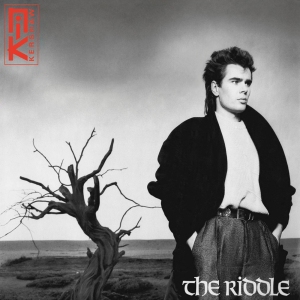
The cover photo was taken at Chesil Beach in Dorset. The Riddle peaked at #8 in the UK and went multi-platinum. The lead single was the title track which reached #3 in the UK. ‘Wide Boy’ peaked at #9, ‘Don Quixote’ #10. Three top 10 hits from a sophomore album – pretty damn good.

Nik was massive for approximately 18 months. He played Live Aid in July 1985 but then waited until autumn 1986 to follow up The Riddle – probably a mistake. The screaming girls were growing up fast or moving on to a-ha. He was developing as a musician and songwriter but gaining a much more ‘selective’ appeal, in the words of Spinal Tap’s manager Ian Faith.

Gig Review: Let’s Rock Exeter, Saturday 4th July 2015

let's rockThe ’80s nostalgia festivals are big business right now judging by the quality of acts and impressive turnout of punters at Let’s Rock Exeter.

Taking place in a large, picturesque estate next to Powderham Castle, this all-day festival will be repeated at various venues across the country over the summer and it was a great chance to see if the musicianship and songwriting of the decade stand up today.

And I’m pleased to say that, by and large, they do. Also it helped that there was no ubiquitous ‘house band’ – all the artists brought their own back line. This was no cost-cutting package deal.

We were too late to catch Altered Images or Nathan Moore from Brother Beyond – no great hardship – but heard most of The Real Thing’s impressive set while queuing. Nick Heyward followed with some fairly downbeat and strangely unmemorable near-hits bookended by still-effervescent Haircut One Hundred tracks ‘Love Plus One’ and ‘Fantastic Day’.

Five Star were the first big surprise of the day, featuring surprisingly strong lead vocals from Lorraine Pearson and a supertight, R’n’B-tinged band. ‘Rain Or Shine’ transcended its ‘guilty pleasure’ tag to become a true ‘80s pop classic.

Nik Kershaw

Nik Kershaw

Nik Kershaw brought some real muso cred to proceedings with some extended Allan Holdsworth-esque guitar solos, more excellent singing (a big improvement on his mid-’80s vocals) and some engagingly dry humour, preceding ‘The One And Only’ with a curt ‘If you know this, sing along. If you don’t, don’t!’

A quick look at Go West’s singles chart positions show that they were big in the States in the late ‘80s and early ‘90s; ‘Faithful’ and ‘King Of Wishful Thinking’ sounded tailor-made for that market.

Peter Cox’s vocals were superb, soulful and inventive, and they’d put a lot of thought into their arrangements with some tracks sounding almost like 12” remixes. Covers of ‘Sex On Fire’ and ‘Black And Gold’ initially seemed curious choices but went down very well with the crowd.

And the trio of great vocalists were concluded with the appearance of Martin Fry’s ABC who provided the classiest set of the day. A superb percussionist filled out the Lexicon Of Love material beautifully and Fry exuded charisma.

bananarama

Bananarama

I didn’t bother with much of Midge Ure or Howard Jones’ sets; Bananarama, now just a duo of Sara Dallin and Keren Woodward, looked good but unfortunately didn’t sound great or perform with much intensity – their vocals were harsh and there was apparently no love lost between them.

Early-’80s pure pop classics like ‘Cruel Summer’ and ‘Robert De Niro’s Waiting’ were also inexplicably mired in disco-lite arrangements and there was a bit too much emphasis on the Stock Aitken Waterman era for my liking.

We legged it before Billy Ocean and The Thompson Twins’ Tom Bailey – I quite regret not seeing the latter but wasn’t too bothered about the former. But, all in all, this was an impressive showing for some great 1980s singles acts. There’s life in them yet.