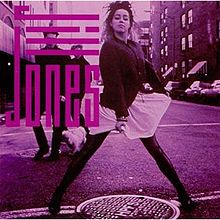
I first heard The Redskins’ ‘Bring It Down (This Insane Thing)’ circa 1985 on ‘The Max Headroom Show’ and was seriously impressed.
Listening back more than 35 years on, there are shades of early ’80s punk/funk: Gang Of Four, 23 Skidoo, A Certain Ratio, plus a bit of Dexys/Jo Boxers, courtesy of the spicey horn arrangements.
The lyrics seem fairly revelant in a post-Grenfell world and feature somewhat of a classic opening line, parodying Prime Minister Harold Macmillan’s famous 1957 speech: ‘You’ve never had it so good/The favourite phrase of those who’ve always had it better…’
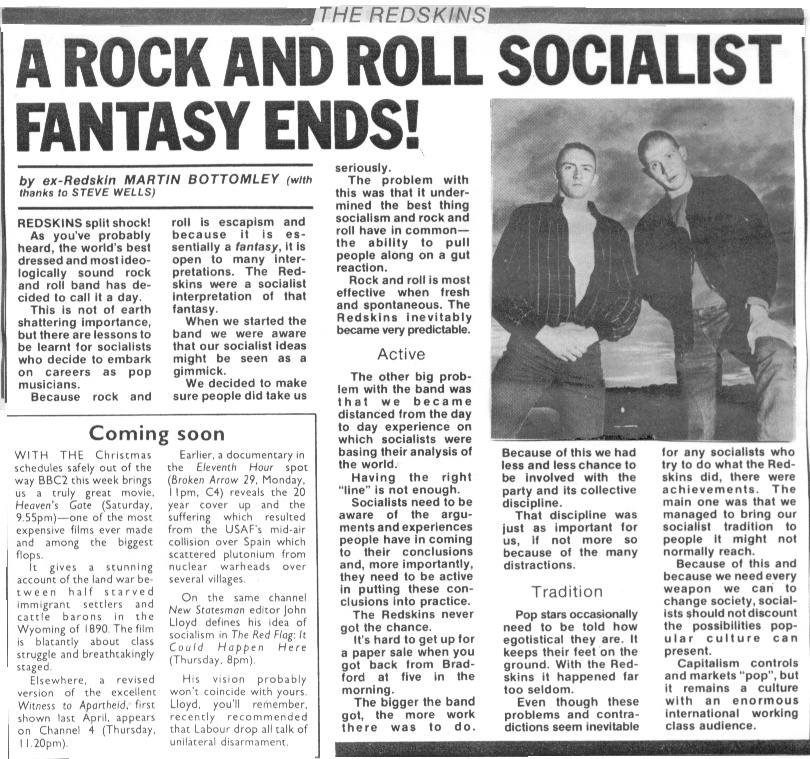
The band’s break-up as announced in the NME – click to enlarge
The band are a solid, funky little unit and I like singer Chris Dean’s chuckling Melle Mel homage and general swagger – it’s a classic ’80s vocal performance. His Afro-beat-flavoured rhythm guitar playing is pretty good too.
Their Wikipedia entry claims that The Style Council’s Steve White plays drums on this but it doesn’t particularly sound like him. The Redskins burned fairly brightly for four years, starting out as an NME-approved indie act and then graduating to a major-label deal in the classic ’80s style.
They split up after their Anti-Apartheid tour of 1986. ‘Bring It Down’ was their one and only UK top 40 single – a fairly poor return when such blue-eyed-soul inanities like The Blow Monkeys’ ‘It Doesn’t Have To Be This Way’ were just around the corner.
Where are they now? Who knows? No reunion. No sell-out. One near-hit.
Almost 30 years ago to the day, my brother arrived home from a Richmond shopping spree bearing strange cargo – a new Donald Fagen 12” single.
To say that this was a surprise would be an understatement. After all, it was six years since The Nightfly and the late ’80s were generally a Steely Dan wasteland apart from occasional guest spots (China Crisis, Rosie Vela, Love And Money, Yellowjackets).
‘I think we felt that a lot of the energy was missing so we kind of sat out the ’80s,’ Fagen once said.
But, in his book ‘Eminent Hipsters’, he went further, talking about ‘falling apart like a cheap suit’ towards the end of the decade, with panic attacks, antidepressants and shrinks abundant.
But at least he didn’t need the money – ‘What supported me was that when CDs came out at the beginning of the ’80s, people had to buy the albums again.’
Fagen’s movie-producing cousin Mark Rosenberg headhunted him to come up with some music for the film version of Jay McInerney’s celebrated yuppie-in-peril book ‘Bright Lights Big City’. Fagen was typically reluctant but apparently swayed by the quality of McInerney’s writing.
There was also something distinctly Steely-esque about this tale of a disillusioned twentysomething’s descent into a drug-addled, paranoid New York hell. So Fagen fashioned his version of the movie, co-writing the lyric with Timothy Meher.
There are touches of ‘Bonfire Of The Vanities’ and ‘Wall Street’ in there. AIDS too, and ‘American Psycho’ was of course just around the corner.
The opening scene finds our hungover hero lamenting the roar of the Monday-morning garbage trucks. Cut to the floor of the NY Stock Exchange, where our yuppie daydreams about a conquest of the female variety: ‘We cut to this blonde/Dancing on a mirror/There’s no disbelief to suspend….‘
The image brilliantly conjures up Marilyn Monroe on the subway grate. Madonna should also probably come to mind. ‘She’s the concept, more or less, of love in the city at century’s end…‘
Nothing and nobody is real – it’s all pose and high-concept. There’s no hope for redemption either: ‘Nobody’s holding out for heaven‘. Greed is good. But then the mystery blonde is using her ‘pirate radar’ to find a likely escort or – even better – a minor celebrity to latch onto.
But no-one materialises, so you’ll do, although you know you’re only the second choice. But still: ‘Let’s get to the love scene, my friend‘…
Musically, ‘Century’s End’ is yet another brilliant Fagen concoction, initially based around a typical minor vamp and groovy half-time shuffle groove shepherded by Yellowjackets’ ‘Jim’ Haslip on bass and drummer Leroy Clouden (submerged in one or two different bits of rhythm programming).
Michael Brecker and Lew Soloff lead the horn section, and the raft of uncredited backing vocalists sounds like it might include Patti Austin. Gary Katz co-produced the song at Chelsea Sound.
Fagen’s vocals have rarely been better – check out his phrasing in the chorus. The 12” and CD also came with ‘Shanghai Confidential’, a neat little fuzak instrumental starring Marcus Miller on bass and Steve Khan on guitar.
The movie, starring Michael J Fox, stiffed. The casting didn’t help. But ‘Century’s End’ seems to be a bit of a guilty secret in Fagen’s discography, ripe for rediscovery…
On first listen, ‘The Land Of Make Believe’ would seem to be a frothy, fairly harmless bit of fun built on one of the oldest chord sequences in the book.
But dig a little deeper and it’s a distinctly odd psych/pop classic and one of the weirdest number ones of the 1980s (hitting the top spot 36 years ago this week).
The main reason for that would seem to be the presence of Pete Sinfield on the songwriting credits. Most famous for providing lyrics for prog behemoths King Crimson and ELP, in his bizarre career he has also – thrillingly – co-written Celine Dion’s ‘Think Twice’ and Five Star’s ‘Rain Or Shine’!
In the book ‘1,000 UK Number Ones’, he recalled being tasked by Fizz producer/co-songwriter Andy Hill to come up with the words for ‘The Land Of Make Believe’:
It is 10 times more difficult to write a three-minute hit song with a veneer of integrity than it is to write anything for King Crimson or ELP. But I half-succeeded on “The Land Of Make Believe”. Beneath its ‘tra-la-laas’ is a virulent anti-Thatcher song. Oh yes it is. Something nasty in your garden, waiting, until it can steal your heart…
Portraying Thatcherism as a kind of creeping ‘Invasion Of the Body Snatchers’-style affliction… Well, maybe it’s just about discernible in the lyrics.
But more likely it’s a neat concept on which to hang a lot of disparate references, from Superman to Captain Kidd (apparently a Scottish sailor who was tried and executed for piracy after returning from a voyage to the Indian Ocean) and fairy tales of all kinds.
But I always think of that creepy scene in ‘Salem’s Lot’ when I hear those lines about ‘shadows tapping at your window/Ghostly voices whisper will you come and play’…
The fade-out features a cod nursery rhyme – also penned by Sinfield – which was narrated by Abby Kimber, future Minipop and 11-year-old daughter of Bill Kimber, an executive at RCA Records. Listening as a nine-year-old burgeoning pop fan in early 1982, it used to give me the creeps, and can still send a chill down my spine.
The video was filmed at White City swimming baths in West London. It references ‘The Wizard Of Oz’, ‘Cinderella’ and ‘The Lion, The Witch And The Wardrobe’ and foregrounds some fairly blatant swimwear shots of singer Jay Aston, whose unhappy tenure in Bucks Fizz was outlined in Simon Garfield’s excellent book ‘Expensive Habits’.
Aston also apparently chose the outfits for the video, the female costumes coming from Kahn & Bell on the King’s Road and the male costumes from Boy. Aston later remarked that her and Cheryl Baker’s costumes ‘were ten years ahead of Madonna, with the cone boobs…’
‘The Land Of Make Believe’ subsequently became Bucks Fizz’s biggest-selling single in the UK, outselling even their famous 1981 Eurovision winner ‘Making Your Mind Up’. Not bad for a song that apparently no-one in the group particularly liked.
Here we go again, then. Ducking the bombardment of crappy Christmas musical missives, and two years on from the first collection, we present a few more festive tracks that – hopefully – don’t require the services of a sickbag.
A very Merry Christmas to all.
6. Paul McCartney: Pipes Of Peace (1983)
Paul’s Christmas 1983 chart-topper is, surprisingly, his only UK solo number one single (no doubt helped by the impressive video). The melody maestro puts together a hook-laden mini-symphony that Brian Wilson would surely be proud of. Producer George Martin even conjures a bit of Pepper-stylesurrealism for the intro.
5. Chris Rea: Joys Of Christmas (1987)
It can’t be easy writing a ‘downer’ Christmas song. ‘Joys Of Christmas’ was a single but wasn’t a hit, reaching just 67 in the UK, but it still sounds like a minor classic, lyrically a harrowing portrait of the North East underclass and musically a kind of ZZ Top/Robert Palmer hybrid (what’s with that weird ‘Addicted To Love’ accordion?) with some scorching Telecaster work. And his voice has never sounded better – he hits some amazing low notes in the verses.
4. Joan Jett: Little Drummer Boy (1981)
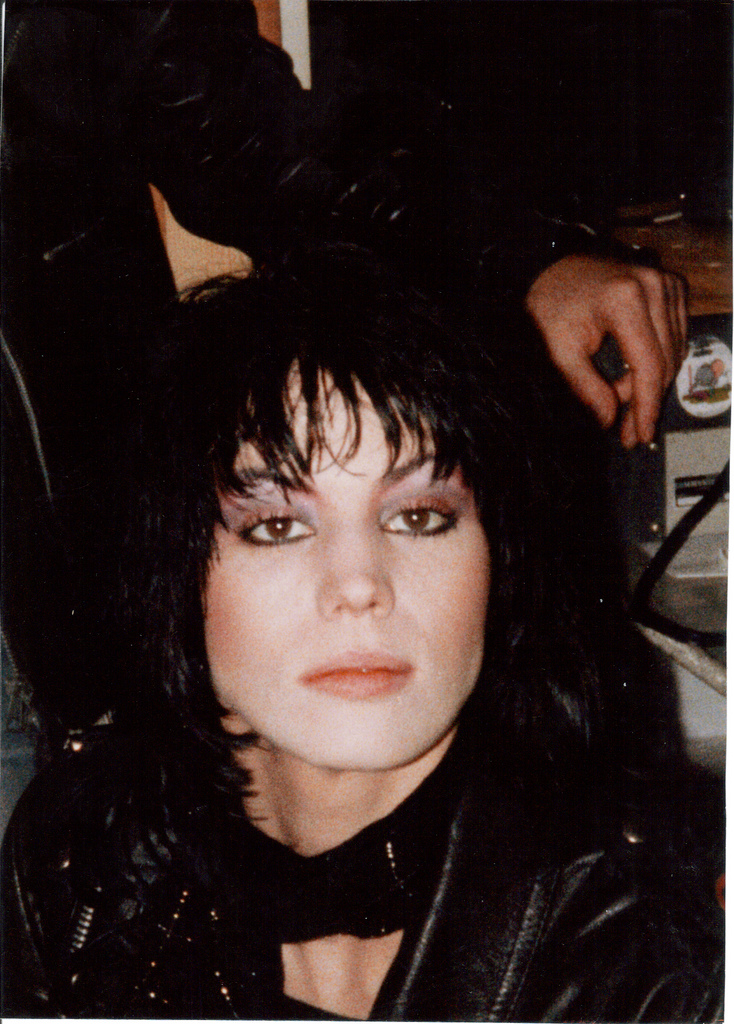
I first heard this on the soundtrack of the 1983 guilty-pleasure movie ‘Class’ and have had a soft spot for it ever since. It was never a single but appeared for a while on Jett’s breakthrough album I Love Rock’n’Roll until it was bumped off in favour of something less seasonal.
3. Wham!: Last Christmas (1984)
Recorded at London’s Advision studios in August 1984, George insisted on playing all instruments (including some very dodgy bass). But the bittersweet lyrics, twinkling synths, George’s gossamer vocals and the poignant memory of his death a year ago make it an indispensable seasonal hit. It was kept off the 1984 Christmas number one spot in the UK by Band Aid’s ‘Do They Know It’s Christmas’.
2. The Replacements: Beer For Breakfast (1983)
Is it a Christmas song? Dunno, but Paul Westerberg drawls ‘I’m dreaming of a white Christmas’ halfway through, and maybe it’s a portrait of his Christmas Day libations. Good effort (swearing alert).
1. Chris Rea: Driving Home For Christmas (1988)
Rea’s song was only a minor yuletide hit on its original UK release in 1988 (though written in 1984 and recorded in 1986) but it’s still played regularly and has made the top 100 every year it’s been re-released. Rea told Classic Rock magazine recently: ‘I do regret that I never got it to Van Morrison because that’s who I wrote it for. I thought he would have done a marvellous job. But I can’t knock it. I always think, if I don’t hear “Driving Home For Christmas”, it means I can no longer go on holiday…’
The lead-off track and third single (UK #19 in May 1985, not released in the US) from 1984’s Tonight album, ‘Loving The Alien’ was arguably Bowie’s most committed piece of writing since Scary Monsters‘ ‘Teenage Wildlife’ four years earlier.
Recorded at Quebec’s Le Studio in May 1984, the song was musically rich with a striking set of lyrics and a superb, soaring vocal performance. Like a good Kubrick movie, it distills down weeks of research to just the crucial components.
Bowie was apparently doing a lot of reading about Christianity and the Catholic Church, influenced particularly by Donovan Joyce’s notorious book ‘The Jesus Scroll’ which posited that Jesus died in Masada at the age of 80 and wrote a scroll currently in Russian hands. The wider implications of this led Bowie into further thoughts on organised religion in general and Christianity in particular. He told writer Charles Shaar Murray:
‘It was always more of a power tool than anything else, which was not very apparent to the majority of us. My father encouraged me to become interested in other religions. It’s extraordinary considering all the mistranslations in the Bible that our lives are being navigated by this misinformation, and that so many people have died because of it. That’s how the song started out: for some reason, I was very angry…’
Using the bloodshed of The Crusades as its central image, the lyric uses various effective ploys, one of which is an almost Pinteresque juxtaposition of the banal and portentous. While Bowie blithely stated ‘It’s just a song of images’ in the above interview, each line is ripe for analysis.
Watching them come and go The Templars and the Saracens They’re travelling the holy land Opening telegrams
Torture comes and torture goes Knights who’d give you anything They bear the cross of Coeur de Leon Salvation for the mirror-blind
But if you pray All your sins are hooked upon the sky Pray and the heathen lie will disappear
Prayers, they hide the saddest view (Believing the strangest things, loving the alien)
And your prayers they break the sky in two
And you’ll believe you’re loving the alien
Thinking of a different time Palestine a modern problem Bounty and your wealth in land Terror in a best-laid plan
Watching them come and go Tomorrows and the yesterdays Christians and the unbelievers Hanging by the cross and nail
Bananarama it ain’t. Both lyrically and musically, the song stands out a mile on Tonight. But despite Bowie’s fantastic vocal, it’s let down by an immense production with huge, gated drums (Omar Hakim’s entrée into rock drumming that arguably got him the gigs with Dire Straits and Sting), muddy bass, overwrought Arif Mardin string arrangement and a ponderous Carlos Alomar guitar solo.
More successful are Guy St Onge’s marimba and the sampled Bowie vocals at the top (apparently more influenced by Philip Glass’s ‘Einstein On The Beach’ than Laurie Anderson’s ‘O Superman’ – the kind of detail that was very important to Bowie!). Regular collaborator David Mallet directed the video, storyboarded – as usual – by Bowie. Though seemingly a fairly disparate series of arresting images, the clip was fairly successful as a surreal assault on religion’s materialistic symbols and commodification of women.
It also makes a fascinating companion piece to his ‘Blackstar’ video. Bowie’s cheery grin that accompanies the ‘Opening telegrams/Whoa-oh’ line is a thrillingly weird moment. Bowie performed ‘Loving The Alien’ throughout the ‘Glass Spider’ tour. Then, in 2002, DJ Scumfrog remixed the track to create a single called ‘The Scumfrog vs Bowie’, a top 10 hit in the UK Dance Chart.
A year later Bowie himself resurrected the song, cooking up a stripped-down version in duet with guitarist Gerry Leonard. They dropped the key from E-minor down to C-minor and dispensed with many of the original’s passing chords, arguably dissolving some of its power, but it’s certainly a unique reading.
According to Bowie, the best version of ‘Loving The Alien’ is his original home demo of the song, yet to see the light of day. Let’s hope we get to hear it sometime.
Steely Dan’s breakup was officially announced on 17 June 1981 when Donald Fagen gave a scoop to journalist and long-time fan Robert Palmer in the New York Times.
In the interview, Fagen didn’t rule out the possibility that he would one day reunite with Steely co-leader/co-songwriter Walter Becker, but neglected to mention that he had already returned to the studio as a solo artist.
Until a few years ago, I assumed The Nightfly was Fagen’s ’80s debut, but the one-off track ‘True Companion’ preceded it by a year. It was part of the ‘Heavy Metal’ soundtrack, an animated film based on the sex’n’slash fantasy comic book of the same name. Fagen used the song as an excuse to get back into the studio after a few years off.
‘True Companion’ was recorded at Automated Sound in New York and co-produced by Fagen and legendary engineer Elliot Scheiner (Dan helmer Gary Katz was busy producing Eye To Eye’s debut album).
Lyrically, the song seemed to be a ‘Dark Star’-esque meditation on the spiritually-bereft inhabitants of a spaceship, possibly narrated by God, or at least some kind of omniscient being…
Crewmen of the True Companion I can see you’re tired of action In this everlasting twilight Home is just a sad abstraction
Just beyond the troubled skyways Young men dream of fire and starshine I’ve been dreaming of my own green world Far across the reach of space time
Musically, the track showcased some exceptionally dense Fagen vocal harmonies (prefiguring a similar approach on The Nightfly‘s ‘Maxine’), and typically tasty Fender Rhodes playing by Steely regular Don Grolnick.
But the first half of the tune was almost a mini guitar symphony for Steve Khan. I asked Steve for his recollections of recording ‘True Companion’:
During those years, I think that Donald was trying to find the confidence to move forward with a solo career because, after Gaucho, it seemed that he and Walter were going to need a long, long break! “True Companion” was one of a few experiments Donald recorded just to test the waters, as it were. To be in the studio with old friends and bandmates like Don Grolnick, Will Lee and Steve Jordan and with Elliot Scheiner engineering, nothing could have felt more familiar. Actually, for working with Donald, things went really fast. I would imagine that I played the electric parts first, then overdubbed the solo, and thereafter the acoustic steel-string. With the Les Paul, I know that I was playing REALLY loud in the room, but I did that because I felt that this was the underlying attitude of the song. It was a blend of subtlety and power. So I tried to give it both…
On the ‘Heavy Metal’ soundtrack album, ‘True Companion’ sat incongruously alongside tracks by Black Sabbath, Grand Funk Railroad, Journey, Sammy Hagar and Stevie Nicks, a state of affairs that no doubt tickled Fagen.
But, most importantly, he had taken his first major steps back into the recording studio, and by late summer 1981 was recording The Nightfly. Almost 15 years later, a reunited Steely Dan also played ‘True Companion’ live on their second comeback tour.
For students of songwriting, there’s been an embarrassment of riches on the book front recently – in the last few years we’ve had the groundbreaking ‘Isle Of Noises’, entertaining ‘Complicated Game’, and lengthy autobiographies by the likes of Elvis Costello, Bruce Springsteen, Robbie Robertson, Chrissie Hynde, Neil Young, Brian Wilson and Phil Collins.
And now here comes Paul Zollo’s ‘More Songwriters On Songwriting’, the weighty sequel to his landmark 1991 volume, comprising new, indepth interviews with famous composers from the worlds of pop, rock, country, R’n’B and jazz.
When the book catches fire, tasty anecdotes come thick and fast: Kenny Gamble delivers a powerful statement on his hopes for America’s future; Joe Jackson discusses his love of Duke Ellington and Steely Dan; Bryan Ferry reveals that the lyrics for ‘Avalon’ (the song) were written in no less than four different countries.
Elvis Costello talks about trying (and failing) to collaborate with legendary lyricist Sammy Cahn; Rickie Lee Jones discusses how caring for her sick mother reignited her music mojo; Chrissie Hynde describes in visceral detail how her views on animal rights inform her songwriting.
Ringo talks about how George helped him write ‘Octopus’s Garden’; Dave Stewart recalls the thrill of writing ‘Sweet Dreams (Are Made Of This)’ with Annie Lennox in double-quick time; James Taylor waxes lyrical about Paul McCartney; Don McLean reveals the unusual inspiration behind ‘American Pie’.
And that’s just scratching the surface. Zollo always knows the right questions to ask and the conversations flow unpredictably. Highly recommended.
Musicians and writers have long puzzled over a definition of Harmolodics, the musical system invented by Ornette Coleman.
The man himself was famously coy on the subject, his brief liner note on the back of the Dancing In Your Head LP possibly the nearest he ever got to an outright definition: ‘Rhythms, harmonics and tempos are all equal in relationship’.
Of all the Ornette collaborators who developed their own take on Harmolodics, Ronald Shannon Jackson, who died in October 2013, probably came up with the most accessible version.
He had played with avant-garde pioneers Albert Ayler, Ornette, James Blood Ulmer and Cecil Taylor in the 1970s, but developed into a fine bandleader/composer in the ’80s, fronting a red-hot band featuring guitarist Vernon Reid (Living Colour), bassist Melvin Gibbs (Rollins Band), trombonist Robin Eubanks and saxophonist Zane Massey. (Shannon’s version of Harmolodics was so successful it possibly even influenced Ornette’s Virgin Beauty.)
My dad used to get sent a lot of music in his capacity as a programme consultant for Channel 4 TV’s music arm back in the mid-1980s. A surprising amount of it would come in home-compiled cassette format. One such tape was simply called ‘Dance Music’ – I’ve still got it somewhere.
Most of it was fairly standard Brazilian and Blue Note stuff but one track stood out a mile and became somewhat of an obsession for my brother and I: Shannon’s ‘Behind Plastic Faces’, from the 1985 album Decode Yourself. It was the beginning of my love affair with his music and drumming.
He lays down one of his patented military grooves on Simmons drums underneath slithering fretless bass, chattering Reid guitar and Onaje Allan Gumbs’ summery keyboards. But then the track suddenly changes gear halfway through and turns into a Afro-Funk/No-Wave rave-up, with Shannon moving over to the acoustic drums and Eric Person rhapsodising on alto sax.
The track and attendant album were recorded at Electric Lady Studios in New York and produced by Bill Laswell. Decode Yourself seems very difficult to find on physical formats these days, like many of Shannon’s numerous other ’80s albums, but thankfully it is on streaming platforms.
Shannon Jackson was born and brought up in Forth Worth, Texas, just like Ornette. His father’s jukebox introduced him to BB King, Howlin’ Wolf, Charlie Parker and Dave Brubeck, but there were many other influences in the mix too, as he told writer Gary Giddins in 1985:
‘You’d wake up and hear hillbilly music on the radio. In school, we’d play (Wagner’s) “Lohengin”, at night we’d hear Bo Diddley or Bobby “Blue” Bland. On Sunday, we’d hear gospel. It was a total black community, and music wasn’t categorised as jazz or pop – nobody told you you weren’t supposed to like something.’
Jeff Porcaro laid down one of the greatest recorded drum performances of all time on the Toto song ‘Rosanna’, recorded at Sunset Sound in Los Angeles in December 1981.
He had been in the music business for less than a decade but was already being talked up as one of the finest drummers in the world. He was a disciple of Bernard Purdie and John Bonham, those kings of the half-time shuffle, as well as legendary ghost-note masters Jim Gordon and Jim Keltner.
But it’s the way Porcaro brought together all these influences to come up with something totally his own. Recorded by engineer Al Schmitt, ‘Rosanna’ may be the most analysed groove of all time, though Porcaro was always extremely humble about its genesis and execution.
Listening to it in its entirety, raw and uncut without any other accompanying instruments, the performance takes on a whole new meaning. Porcaro’s mastery of time and groove are impeccable. It’s the attention to detail, beyond ‘just’ the placing of the ghost notes and doubles.
Keep in mind also that he had to navigate the band through a tricky, mid-paced track with lots of ‘holes’ – a one-bar rest here, half-a-bar rest there – as well as apeing Jerry Hey’s horn arrangements, first heard at 1:08. It’s fascinating to hear how Porcaro navigates those holes, putting in an extra hi-hat or kick-drum beat to dictate the time to the band (and himself):
According to Schmitt (who deserves much credit for a beautiful sounding kit), ‘Rosanna’ was the first song recorded for Toto IV. Jeff’s part was laid down live with the rhythm section – bass, guitar, two keyboards – and it was the second and final take.
Written by David Paich and released as a single on 1 April 1982, it reached #14 on the Billboard Hot 100 and sold over a million copies. RIP Jeff.
‘Undercover’ is essentially a one-chord groove with powerful lyrics, stinging guitar licks, a memorable hook and notable video.
Though Mick and Keef share a writing credit, the song was apparently largely a Jagger composition, with Richards later saying: ‘Mick had this one all mapped out. I just played on it. There was a lot more separation in the way we were recording at that time. Mick and I were starting to come to loggerheads…’
Guitarist Ronnie Wood concurred but also had reservations: ‘There was a great acoustic version which is the kind of song it should be. The final, polished version may have been Mick’s vision of the song…’
Reading between the lines, Jagger was clearly keen to bring outside players into an increasingly dysfunctional band situation. Recording took place during the summer of 1983 at Compass Point Studios in Nassau, giving Jagger the opportunity of using some great local players, many of whom light up ‘Undercover Of The Night’.
A raft of percussionists including Sly Dunbar, Martin Ditcham, Moustapha Cisse and Brahms Coundoul accompany drummer Charlie Watts on various instruments including bongos, Simmons drum and even a timpani (there are rumours that a complete different version of the song exists featuring a rhythm section of Sly and Robbie). Producer Chris Kimsey also enters into the spirit of things with an ingenious ‘dub’-style arrangement (or is that the work of Brian McGee, credited as ‘editor’ on the vinyl label?).
Jagger claimed that his lyric was heavily influenced by William Burroughs’ 1981 novel ‘Cities Of The Red Night’. The song is a disturbing vision of Latin America’s Dirty War. This was, after all, an era in which thousands of ‘political prisoners’ were tortured and killed in the ESMA detention camp in Buenos Aires, less than a mile from the stadium where the 1978 football World Cup Final was taking place (according to many reports, the cheers of the fans obscured the screams of suffering prisoners).
Excellent documentary ‘The Shock Doctrine’ claims that many torture techniques used by the Chilean and Argentinian junta (including rape and genital mutilation) may have been ‘learned’ in the US-run School Of The Americas. Jagger manages to crystallise many of these disturbing aspects in a powerful lyric:
Hear the screams of Centre 42 Loud enough to bust your brains out The opposition’s tongue is cut in two Keep off the street cos you’re in danger One hundred thousand disparos Lost in the jails in South America
Cuddle up baby, cuddle up tight Cuddle up baby, keep it all out of sight Undercover of the night
The sex police are out there on the streets Make sure the pass laws are not broken The race militia has got itchy fingers All the way from New York back to Africa
All the young men, they’ve been rounded up And sent to camps back in the jungle And people whisper, people double-talk And once-proud fathers act so humble All the young girls they have got the blues They’re heading on back to Centre 42
Down in the bars, the girls are painted blue Done up in lace, done up in rubber The johns are jerky little GI Joes On R&R from Cuba and Russia The smell of sex, the smell of suicide All these sweet things I can’t keep inside
Undercover, all out of sight Undercover of the night
Julien Temple directed the controversial video, shot in Mexico City. As he relayed in the book ‘I Want My MTV’, his dealings with Jagger and Richards gave him a pretty stark insight into the state of their relationship:
‘I wrote an extreme treatment about being in the middle of an urban revolution, and dramatised the notion of Keith and Mick really not liking each other by having Keith kill Mick in the video. I never thought they would do it. Of course they loved it. I went to Paris to meet with the band. Keith was looking particularly unhappy. He was glowering with menace and eventually said, “Come downstairs with me.” My producer and I went down to the men’s room. Keith had a walking stick and suddenly he pulled it apart. The next thing I know he’s holding a swordstick to my throat. He said, “I want to be in the video more than I am.” So we wrote up his part a bit more. That was Keith’s idea of collaboration!’
The video was initially considered too violent for MTV (though they did eventually air an edited version after 9pm) and it was heavily censored when shown on British television, leading to a fractious interview on ‘The Tube’ during which presenter Muriel Gray questioned Jagger and Temple about the extreme content and their motives for making the video.
‘Undercover Of The Night’ was released as the first single from the accompanying Undercover album on 1 November 1983. It got to #9 in the US and #11 in the UK. Not bad. It was their highest chart placing to date.