Rosie Vela: Zazu @ 40 (And Being A Steely Dan Fan In The 1980s)

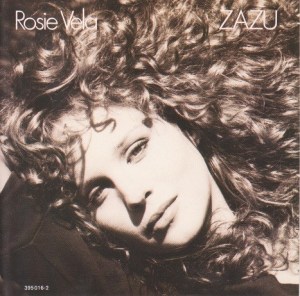
‘Models who make records usually should not but I’ll make an exception for Rosie Vela’, began Max Bell’s four-star review of Zazu in the January 1987 edition of Q magazine.

In general, us Brits liked Zazu (peaking at #20 and going silver), the album released 40 years ago this month which reunited the Steely Dan troika of Donald Fagen, Walter Becker and Gary Katz for the first time in nearly six years.

It was weird being a Steely Dan fan during the 1980s. Your correspondent got in around 1984, obsessed with his dad’s Steely Dan Greatest Hits cassette and Aja vinyl, and by 1986 was a megafan who’d only just twigged that Gaucho had been released a full six years earlier.

We were excited when Becker produced China Crisis, but apart from The Nightfly, Fagen seemed to have gone AWOL (he later admitted that he ‘came apart like a cheap suit’ during the decade).

But imagine our surprise when Zazu was advertised in the first issue of Q magazine, and then Rosie was interviewed in issue four.

I probably bought Zazu on the strength of the ‘Magic Smile’ single around January 1987 (but have just checked and no longer own it on any format…).

Texas-born Roseanne Vela had been a first-call model in the late ‘70s and briefly appeared in Michael Cimino’s ‘Heaven’s Gate’, all the while working on her own demos. Jerry Moss at A&M loved them and enlisted Joe Jackson to produce her debut album (he subsequently pulled out).

You can read more about Vela and the background to Zazu in Anthony Robustelli’s book ‘Steely Dan FAQ’, but for our purposes: is it easy to hear why Fagen, Katz and Becker was so drawn to the project?

Not really. But the positive things first:

With her husky voice and sometimes through-composed songs with odd chord movement, she offered something completely different to other mid-‘80s female singer/songwriters.

‘Magic Smile’ still sounds great (#27 in the UK) and ‘Boxs’ is good too. It’s very surprising that ‘Fool’s Paradise’ wasn’t a single though. It sounds like the nearest thing to a hit with its synth lick reminiscent of ‘A Hazy Shade of Winter’.

Fagen plays a nice little intro to ‘Interlude’, and Becker doubles his solo on guitar, a cool touch (Becker also plays the weird little synth additions to ‘Tonto’).

But there’s lots of bad too.

Katz helms a surprisingly cold album which leads a little too heavily on Rick Derringer’s lead guitar, some non-more-‘80s snare drum sounds and way too much DX7 from Fagen. With hindsight, maybe Jackson’s more organic approach would have worked better (Becker’s better still).

‘Sunday’, ‘Taxi’, ‘2nd Emotion’ and ‘Tonto’ are totally unmemorable songs. The closing, almost-gothic title track could have been good though with some more real instruments.

In general Katz renders some superb musicians – Tony Levin, Jimmy Haslip, Jim Keltner – pretty anonymous. In some ways Zazu is the ultimate 1986 album (Robustelli compares it to Gaucho and Aja in ‘Steely Dan FAQ’ – it’s impossible to hear that).

The cover art and photo are poor too – whose idea was it to portray this gorgeous woman in black and white?

Vela did ‘Magic Smile’ on Letterman – a brave performance that didn’t quite work. The album and single completely flopped in the USA.

But of course the main thing about Zazu is that it got Becker and Fagen back together again. Next up for Fagen was the ‘Century’s End’ single and The New York Rock and Soul Revue, both interesting. Kamikiriad was just around the corner.
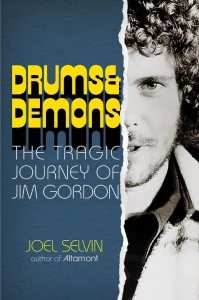
Book Review: Drums & Demons (The Tragic Journey Of Jim Gordon) by Joel Selvin

Pop quiz: what do the following tracks have in common? Beach Boys’ ‘Good Vibrations’, Derek and the Dominos’ ‘Layla’, Steely Dan’s ‘Rikki Don’t Lose That Number’, Frank Zappa’s ‘Apostrophe’, Minnie Riperton’s ‘Inside My Love’, The Incredible Bongo Band’s ‘Apache’ and Carly Simon’s ‘You’re So Vain’.

They all feature drummer/percussionist Jim Gordon, who between the mid-‘60s and mid-‘70s was probably the most recorded and celebrated studio drummer in the world (declaring an interest here too: movingtheriver basically learned how to play drums by copying Gordon’s playing on Steely’s Pretzel Logic).

He brought pinpoint time-keeping, smooth grooves, razor-sharp song sense and technical mastery to the kit, but was also a deeply troubled individual whose schizophrenia – exacerbated by drug and alcohol issues – ultimately led to a tragic and shocking crime. He was incarcerated for murdering his mother on 3 June 1983, and died in prison during 2023.

But how did this good-looking, popular, all-American kid end this way? As experienced rock journo and author of ‘Altamont’, ‘Monterey Pop’ and ‘Sly and the Family Stone: The Oral History’, Joel Selvin is perfectly placed to tell this dark tale, and he honours both Gordon’s victim(s) and the drummer himself with a sober, unflinching account.

With the counsel of Gordon’s friends, family members and associates, Slavin outlines his meteoric rise to the top of the music business, the first half of the book featuring entertaining, detailed accounts of work with various Beatles, the Everly Brothers, Joe Cocker, Frank Zappa, Brian Wilson, Jackson Browne and Carly Simon. (The section on Gordon’s tenure with Eric Clapton is particularly illuminating and shocking – the guitarist does not come out well at all…)

The second half descends into very murky waters. There’s shocking evidence of Gordon’s physical abuse of singer/songwriter Rita Coolidge (and his and Clapton’s refusal to give her songwriter credit for ‘Layla’) and great detail about his struggles to get help for schizophrenia and addiction problems.

In fact ‘Drums & Demons’ is an absolute eye-opener with regard to schizophrenia, the voices inside Gordon’s head (tragically, mostly his mother’s) apparently denying him food, amongst other things, and moderating all aspects of his lifestyle.

And if Selvin never quite technically explains why Gordon was such a drum hero (Jim Keltner, Andy Newmark and Jeff Porcaro were huge fans/advocates), the passion for his subject and respect for the drum community as a whole come through loud and clear.

‘Drums & Demons’ joins Bill Milkowski’s ‘Jaco’ and Rob Chapman’s ‘Syd Barrett: A Very Irregular Head’ in the upper echelons of books about gifted, unwell musicians finding themselves alone when the circus has left town. It also perfectly outlines the boom and bust of the studio session scene.

Although at times a difficult, disturbing read, it’s gripping and slickly-written, and highly recommended.

Ry Cooder: The Slide Area 35 Years Old Today

Gavin Lambert’s 1959 book ‘The Slide Area’ was a collection of inter-related stories about a group of Hollywood’s lonely losers.

His theme was that California’s natural phenomena made ‘normal’ behaviour virtually impossible.

‘The Slide Area’ obviously rang a bell with Ry. His 1982 album of the same name also featured an array of characters not exactly thriving in the Dream Factory.

But it also turned out to be almost the complete opposite of Cooder’s commercial breakthrough, 1979’s slick, sparkling, digitally-recorded Bop Til You Drop.

The Slide Area sounds like what it is – a rough-and-ready band, often audibly cued by Cooder, playing songs of varying quality live in the studio with minimal, if any, overdubs.

‘Which Come First’, ‘Yes It’s Me And I’m Drinking Again’ and ‘Mama Don’t You Treat Your Daughter Mean’ are incredibly loose, with some bum notes and tentative moments left in. Ry’s vocals are similarly raw but full of passion. On ‘Mama…’ he sounds a bit like Bobby ‘Blue’ Bland.

Drummer Jim Keltner is uncharacteristically hyperactive, speeding up drastically on almost every song (definitely no click tracks involved with this album), but full of creativity on what sounds like a homemade kit with timbale, double kick drums, a trash can and a few different snares.

Cooder composes a lot more than on recent albums and even co-writes an ’80s classic with Keltner, ‘UFO Has Landed In The Ghetto’, which finds time to gently lampoon disco, rap and funk with references to the Bee Gees and George Benson.

But perhaps predictably the three cover tunes are the standouts: a Tex-Mex version of Curtis Mayfield’s ‘Gypsy Woman’, funky take on Dylan’s ‘I Need A Woman’ and a gloriously arse-over-tit ‘Blue Suede Shoes’.

But The Slide Area also marked the end of an era. Americana, roots music and blues were out, synths and drum machines were in.

It was the end of the sort of albums Little Feat, Van Dyke Parks, the Doobie Brothers, Bonnie Raitt, Randy Newman and Ry made with Warner Bros and the beginning of the sort of albums Madonna, Pat Benatar and Laura Branigan were making.

Live, it was a different matter – Ry was still a big draw in 1982, playing legendary gigs at the Hammersmith Odeon (my dad took me to one night, maybe my first ever major gig) and big shows all over Europe. But that too proved a false economy.

‘Someone yelled “Think of the money!” from the audience (during a 1977 Hammersmith Odeon gig). I’d like to show him my bank balance. I could never make a dime doing anything. I came back to California in debt. I’d make a record and I’m broke cos they’re not making any money, they don’t sell. I said, to hell with it,’ Ry told Q Magazine in 1987.

It was back to the movie soundtracks. For a while…

Jeff Porcaro: ‘Rosanna’ Exposed

Jeff_Porcaro_Toto_Fahrenheit_World_Tour_1986Jeff Porcaro laid down one of the greatest recorded drum performances of all time on the Toto song ‘Rosanna’, recorded at Sunset Sound in Los Angeles in December 1981.

He had been in the music business for less than a decade but was already being talked up as one of the finest drummers in the world. He was a disciple of Bernard Purdie and John Bonham, those kings of the half-time shuffle, as well as legendary ghost-note masters Jim Gordon and Jim Keltner.

But it’s the way Porcaro brought together all these influences to come up with something totally his own. Recorded by engineer Al Schmitt, ‘Rosanna’ may be the most analysed groove of all time, though Porcaro was always extremely humble about its genesis and execution.

Listening to it in its entirety, raw and uncut without any other accompanying instruments, the performance takes on a whole new meaning. Porcaro’s mastery of time and groove are impeccable. It’s the attention to detail, beyond ‘just’ the placing of the ghost notes and doubles.

Keep in mind also that he had to navigate the band through a tricky, mid-paced track with lots of ‘holes’ – a one-bar rest here, half-a-bar rest there – as well as apeing Jerry Hey’s horn arrangements, first heard at 1:08. It’s fascinating to hear how Porcaro navigates those holes, putting in an extra hi-hat or kick-drum beat to dictate the time to the band (and himself):

According to Schmitt (who deserves much credit for a beautiful sounding kit), ‘Rosanna’ was the first song recorded for Toto IV. Jeff’s part was laid down live with the rhythm section – bass, guitar, two keyboards – and it was the second and final take.

Written by David Paich and released as a single on 1 April 1982, it reached #14 on the Billboard Hot 100 and sold over a million copies. RIP Jeff.