I don’t recall seeing this excellent band on TV or hearing them on the radio back in 1989/1990.
To this day, I don’t really know what they look like and don’t want to know. Though their debut single ‘Can’t Be Sure’ was released in January 1989 and reached just #45 in the singles charts, it ended the year as number one in John Peel’s Festive Fifty. The track also has a weird prog connection – it was (excellently) co-produced by Ray Shulman, a founding member of Gentle Giant.
‘Can’t Be Sure’ and its attendant classic album Reading, Writing And Arithmeticnow seem redolent of a far gentler time, an era of hope and innocence, pre-Grunge and Britpop. For that reason, along with the Cocteaus’ Heaven Or Las Vegas, they’re quite hard to listen to now but no less powerful. The Sundays were also arguably a very influential band on many inferior acts (The Cranberries, The Corrs etc etc).
Andy Beckett’s excellent new book ‘Promised You A Miracle UK80-82’ has got me thinking about the early ’80s a lot.
It was in many ways a bleak time in the UK (temporarily lightened by the Royal Wedding and Ian Botham’s cricket heroics against the Aussies), mainly defined by Thatcher’s deeply unpopular government, the Yorkshire Ripper murders, various terrorist attacks and fears of a nuclear war that were hardly appeased by the terrifying ‘Protect And Survive’ public information films.
Contemporary pop generally railed against this attitude, wresting some much-needed fun and glamour from the gloom.
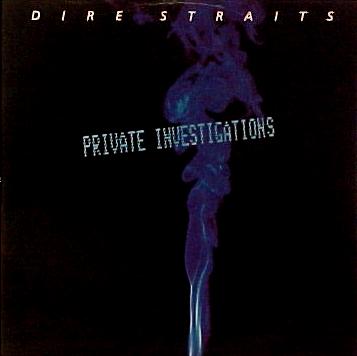
Although ‘Private Investigations’ shares almost nothing with prevailing musical trends of the period (and Mark Knopfler saved his reaction to the Falklands War for Brothers In Arms‘ title track), it continues to hold my fascination.
These days it’s hard to read the song as anything other than a portrait of a love affair gone wrong, emphasised by the slightly dodgy video.
The song’s protagonist is fixated on looking for clues of his paramour’s infidelities, so he goes ‘checking out the reports’ and ‘digging up the dirt’, finding some ‘confidential information in the diary’.
We never found out exactly what he finds but it definitely ain’t good; in this song, to discover the truth of a relationship is a fate worse than death, leaving one ‘scarred for life’ with ‘no compensation’.
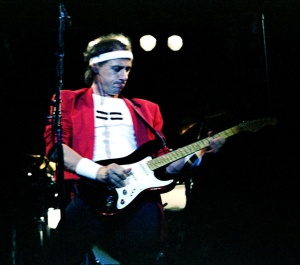
Love Over Gold Tour, Zagreb, 1983
I love the track’s sonic detail. The sense of drama and use of dynamics leaves other contemporary pop for dust.
The stereo spectrum is used as a kind of panaromic field across which various sonic events are ‘placed’ to fit the narrative, including Mike Mainieri’s intricate marimba and subtle bits of percussion.
The result is a kind of mini-movie set to music, best listened to with headphones. Ennio Morricone couldn’t have done it better. You could argue that ‘Private Investigations’ was the catalyst for all Knopfler’s film soundtrack work.
He also demonstrates a mastery of many guitar styles on the track, from the nylon-string acoustic main theme/mini-solos through to the power-chorded interjections towards the end, the latter frequently inspiring some of my uncle’s most spirited air guitar-playing back in the ’80s.
Then Knopfler’s volume-pedal swell perfectly imitates a cat’s nocturnal howl. The last section, with its picked-bass/kick-drum heartbeat and Alan Clark’s chiming piano chords, seems very influenced by the title track of Steely Dan’s ‘Royal Scam‘.
I love that glass (window?) breaking and the click of a suitcase opening, or is it the latch of a door being tampered with? The space in the track forces you to focus on these details. It all adds up to something akin to Knopfler’s version of Peter Gabriel’s ‘Intruder’.
Astonishingly, in a slightly edited form, ‘Private Investigations’ reached UK number 2 in September 1982 (sitting incongruously in the top 10 alongside ABC, Duran Duran, Dexys, Shalamar and The Kids From Fame!), a sure signifier as to just how much better the charts were back then.
The track’s accompanying album, Love Over Gold, is seen as somewhat of a disappointment in Dire Straits’ discography, and I can’t say that any of its other tracks have had much effect on me.
But now that the nights are drawing in and the blinds are being shut, it’s always fun to dim the lights and give ‘Private Investigations’ a spin. The game commences…
After a chastening period in the late-’60s and ’70s when rock pretty much swept all before it, major labels took a renewed interest in established jazz acts and underground movements flourished (no wave, acid jazz, harmolodic funk, neo-bop). Wynton Marsalis, Miles, Courtney Pine and Loose Tubes even put jazz back on primetime TV.
But when Chaka Khan recorded ‘And The Melody Still Lingers On (Night In Tunisia)’, the dramatic centrepiece of her What Cha’Gonna Do For Me album, she arguably set the whole revival in motion.
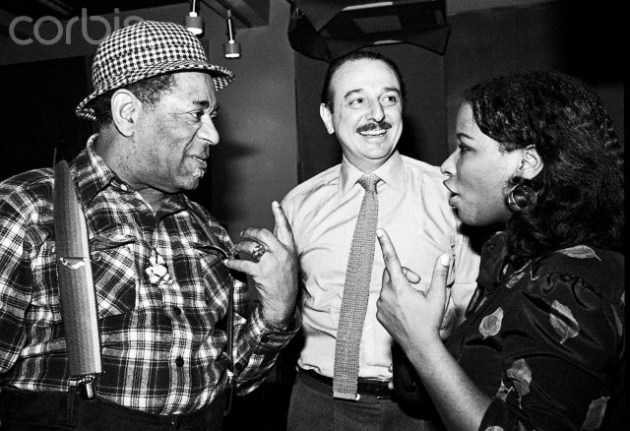
Dizzy Gillespie, Arif Mardin and Chaka Khan, Atlantic Studios 1981
It was producer Arif Mardin’s idea, his mind wandering during a flight between New York and LA. The album was one song short – so how about a tribute to the bebop masters of the ’40s using the crème de la crème of the early ’80s soul/R’n’B/jazz session players? They could use Dizzy Gillespie and Frank Paparelli’s 1942 bebop classic ‘A Night In Tunisia’ as a template.
Chaka loved the idea. Mardin hoped to find a lyricist but deadlines were pending so he tackled it himself with Chaka adding the final touches. Mardin made a demo of the arrangement which cheekily inserted Charlie Parker’s famous 1946 alto break.
Charlie Parker in 1946
A lengthy chart was quickly made up (resembling a ‘Chinese laundry list written in cuneiform’, according to Mardin) which included eight spare bars for the insertion of the Parker lick.
The musicians – Casey Scheuerell on drums, David Foster and Ronnie Foster (no relation) on keys, Abe Laboriel on bass and Paulinho Da Costa on percussion (mostly heard on shaker in the first verse and congas in the second) – were booked and smashed the tune in one take.
Herbie Hancock later contributed a brilliant synth solo. Chaka then added her sublime vocals. Her four-part big-band harmonies and spine-tingling ad-libs bring the song right up to date.
But there was still space for an opening head melody and a solo in the final verse. Dizzy had been sent the demo by Mardin with a note asking him to contribute.
But the bebop legend replied that he would be on tour and so couldn’t make the recording session – but he suddenly arrived two days before the album’s mastering date at New York’s Atlantic Studios to add his part. The track was complete.
Chaka and Mardin attempted to repeat the trick a few years later with ‘Bebop Medley’ but it lacked the finesse of this timeless classic.



 movingtheriver.com