Steely Dan’s breakup was officially announced on 17 June 1981 when Donald Fagen gave a scoop to journalist and long-time fan Robert Palmer in the New York Times.
In the interview, Fagen didn’t rule out the possibility that he would one day reunite with Steely co-leader/co-songwriter Walter Becker, but neglected to mention that he had already returned to the studio as a solo artist.
Until a few years ago, I assumed The Nightfly was Fagen’s ’80s debut, but the one-off track ‘True Companion’ preceded it by a year. It was part of the ‘Heavy Metal’ soundtrack, an animated film based on the sex’n’slash fantasy comic book of the same name. Fagen used the song as an excuse to get back into the studio after a few years off.
‘True Companion’ was recorded at Automated Sound in New York and co-produced by Fagen and legendary engineer Elliot Scheiner (Dan helmer Gary Katz was busy producing Eye To Eye’s debut album).
Lyrically, the song seemed to be a ‘Dark Star’-esque meditation on the spiritually-bereft inhabitants of a spaceship, possibly narrated by God, or at least some kind of omniscient being…
Crewmen of the True Companion I can see you’re tired of action In this everlasting twilight Home is just a sad abstraction
Just beyond the troubled skyways Young men dream of fire and starshine I’ve been dreaming of my own green world Far across the reach of space time
Musically, the track showcased some exceptionally dense Fagen vocal harmonies (prefiguring a similar approach on The Nightfly‘s ‘Maxine’), and typically tasty Fender Rhodes playing by Steely regular Don Grolnick.
But the first half of the tune was almost a mini guitar symphony for Steve Khan. I asked Steve for his recollections of recording ‘True Companion’:
During those years, I think that Donald was trying to find the confidence to move forward with a solo career because, after Gaucho, it seemed that he and Walter were going to need a long, long break! “True Companion” was one of a few experiments Donald recorded just to test the waters, as it were. To be in the studio with old friends and bandmates like Don Grolnick, Will Lee and Steve Jordan and with Elliot Scheiner engineering, nothing could have felt more familiar. Actually, for working with Donald, things went really fast. I would imagine that I played the electric parts first, then overdubbed the solo, and thereafter the acoustic steel-string. With the Les Paul, I know that I was playing REALLY loud in the room, but I did that because I felt that this was the underlying attitude of the song. It was a blend of subtlety and power. So I tried to give it both…
On the ‘Heavy Metal’ soundtrack album, ‘True Companion’ sat incongruously alongside tracks by Black Sabbath, Grand Funk Railroad, Journey, Sammy Hagar and Stevie Nicks, a state of affairs that no doubt tickled Fagen.
But, most importantly, he had taken his first major steps back into the recording studio, and by late summer 1981 was recording The Nightfly. Almost 15 years later, a reunited Steely Dan also played ‘True Companion’ live on their second comeback tour.
No less a pop personage than Brian Eno called the early 1980s ‘the most exciting era of New York music’, and he should know a thing or two about the subject.
Tim Lawrence’s excellent ‘Life And Death On The New York Dance Floor 1980-1983’ backs up Eno’s claim.
The book traces the many musical and cultural strands of the early ’80s NYC scene, from the ‘Disco Sucks’ movement which briefly blossomed at the beginning of the decade through to the end-of-an-era AIDS panic of late ’83.
Lawrence vividly brings to life a scene where musicians, DJs, dancers, artists and club owners fused new-wave, no-wave, punk, dub, pop-art, Afro-funk, kitsch, S&M, psychedelia, disco, gospel, electro and hip-hop to create an exciting, vibrant, anything-goes aesthetic.
Along the way, the book also looks at the making of some of the key NYC records of the era – ‘The Message’, ‘Rapture’, ‘Moody’, ‘Blue Monday’, ‘Planet Rock’.
Pretty much all the key players of the scene make memorable appearances, a fascinating roll call including Larry Levan, David Byrne, Madonna, Afrika Bambaataa, Fab 5 Freddy, Sylvia Robinson, Keith Haring, Jean-Michel Basquiat, Kool Herc, Arthur Baker, Melle Mel, Grandmaster Flash, Francois Kevorkian, Don Was and James Chance.
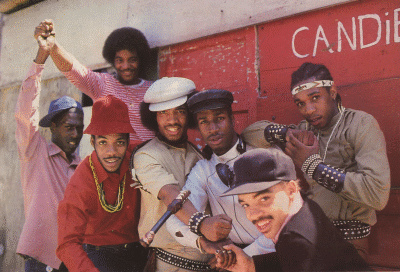
Grandmaster Flash and the Furious Five
Lawrence also paints a vivid picture of the diverse dancefloors of The Roxy, Danceteria, Paradise Garage, Mudd Club and Canal Zone, where on any given night you could see people doing martial arts moves, magic tricks or even aerobics (yes, apparently early ’80s NY also foresaw that cultural boom which hit big later in the decade).
Many rare and previously unpublished photos are included, and Lawrence also gets his hands on many interesting artefacts from the era such as Kraftwerk and Bambaataa full DJ setlists from The Ritz in 1981.
But all good things must come to an end, and ‘Life And Death On The New York Dance Floor’ doesn’t scrimp on the full details of how Reaganomics, gentrification, corporate intrusion and the spread of AIDS decimated the scene.
The book is a great achievement by Lawrence, with a level of detail and seriousness befitting a Professor of Cultural Studies but also large doses of fun and gossip befitting a good-time era and its fascinating protagonists.
‘Life And Death On The New York Dance Floor 1980-1983’ is published by Duke University Press.
On 17 July 1986, Tampa-born sax great David Sanborn broke off from a European tour to guest with Miles Davis and band at the Montreux Jazz Festival.
Though obviously nervous, Sanborn acquitted himself well, getting stuck in with some tasty modal solos and prompting many Miles smiles. Hopefully the performance would bode well for Sanborn’s next studio recording.
Unfortunately not. Sanborn made some fine albums during the 1980s – Hideaway, Voyeur, As We Speak, Straight To The Heart – but A Change Of Heart was not one of them. It was the kind of over-produced, under-composed, unfunky ‘fusion’ record that Tutu should have killed off once and for all.
I bought it on cassette when it came out, proudly showing it off to a cool family friend who had previously introduced me to loads of great music. I hoped he would be impressed by my purchase. He turned his nose up, mumbling something about ‘Bloody muzak…’ Harsh but fair, at least when it comes to most of A Change Of Heart.
The opening two Marcus-written-and-produced tracks – ‘Chicago Song’ and ‘Imogene’ – deliver a quality that the rest of the album never even remotely approaches. Miller was in constant demand around this time and presumably couldn’t commit to the whole album. ‘Imogene’ is a classic ballad with a haunting fretless bass melody and beguiling bridge, while ‘Chicago Song’ transcends its simple melody with an irresistibly funky rhythm section and biting Hiram Bullock guitar bridge.
The rest of A Change Of Heart seems designed for the latest Don Simpson movie or an episode of ‘Miami Vice’. Syndrum overdubs and unsubtle Fairlight samples prevail alongside ugly synth sounds and flimsy melodic motifs, without a whiff of jazz or R’n’B. Producer/synth players/writers Ronnie Foster, Philippe Saisse and Michael Colina toil away fruitlessly and even Sanborn’s licks don’t stick.
Sanborn toured A Change Of Heart extensively with a great band featuring Bullock and Dennis Chambers on drums, even popping up on primetime UK music show ‘The Tube’ playing Michael Sembello’s smooth-jazz ballad ‘The Dream’. He was clearly at his commercial peak (the album made the top 100 in the US and UK) but the creative rot would prevail to the end of the ’80s. He got back on track with the release of 1991’s Another Hand.
In 1987, Mickey Rourke was fast becoming one of the most controversial movie stars of the era, the go-to guy (alongside Michael Douglas) for potentially commercial but decidedly ‘off-colour’ material.
Even David Bowie rated Rourke as one of the coolest people on the planet in ’87 – to my knowledge, only Mickey, Iggy Pop, Tina Turner and Al B Sure! ever shared ‘lead vocals’ on a Bowie solo album (though their collaboration was less than essential…).
‘Angel Heart’ turns 30 this week. I’ve been a Mickey fan since randomly renting the video circa 1988. If, as Marlon Brando attested, acting (or at least good acting) is essentially ‘behaviour’, Rourke delivers one of the great modern screen performances.
He mumbles lines, adds strange emphases (‘Yeah, I could be free‘) and quirky ad-libs, smirks inappropriately and generally shambles around in his filthy linen suit; Pauline Kael memorably wrote that ‘he has enough dirt on him to sprout mushrooms’. But also he carries off the action sequences with aplomb, looking like he could take care of himself in a bar fight.
Most importantly, Rourke tempers the increasingly hokey supernatural elements of the film with a believable, sympathetic, relatively down-at-heel protagonist: Harry Angel seems to be a regular knockaround guy in Brooklyn. ‘He likes the simple life, going for a beer, getting laid whenever he can. He minds his own business. He just gets by. He works, reads the comics, he takes a walk,’ Rourke told his biographer Christopher Heard.
William Hjortsberg’s screenplay for ‘Angel Heart’, based on his New York-set novel ‘Falling Angel’ (described by Stephen King ‘as if Raymond Chandler had written “The Exorcist”’), had been hanging around Hollywood for a while.
First it looked like Robert Redford would produce and star. Then ‘Midnight Express’/’Fame’ director Alan Parker came onboard, rewrote the script (with the questionable decision to relocate most of the action to New Orleans) and offered the lead role to naysayers Jack Nicholson, Al Pacino and Robert De Niro, the latter taking the role of Louis Cyphre (geddit?) instead.
Enter Mickey. Parker made it clear to Rourke that he was nowhere near his first choice, but was interested in what he could bring to the role. Rourke was disillusioned with acting in general and Hollywood in particular but desperately needed the part: ‘I was about to lose my big-assed house in California and needed a big paycheck fast…’ Parker warned Rourke that he wouldn’t put up with any funny business, also apparently giving him many a dressing-down on set.
But how does ‘Angel Heart’ stack up these days? It’s still very watchable, salvaged by the Rourke/De Niro scenes and Mickey’s eccentric ‘behaviour’. Bonet is a refreshingly natural presence and De Niro hams it up semi-convincingly.
Trevor Jones’ original soundtrack (recorded at the aptly-named Angel Studios in Islington, North London) still holds the attention alongside some great crooner and blues tunes. But Parker searches in vain for his inner Nicolas Roeg (or Ken Russell?), showing his background in advertising with a succession of beautiful, if clichéd, images of ‘evil’ (a glistening, freshly-extracted human heart, ceiling fans, lift shafts, writhing bodies, blood-stained walls), memorable crane shots and disorientating flashbacks, but it all feels way too slick.
Kael again: ‘There’s no way to separate the occult from the incomprehensible. Parker simply doesn’t have the gift of making evil seductive, and he edits like a flasher.’ There’s also a lack of memorable secondary characters – Charlotte Rampling and Brownie McGhee seem miscast and barely register.
‘Angel Heart’ just about broke even at the box office but has enjoyed a healthy cult following since. My brother tells me that it most definitely worked on the big screen, delivering a real sense of impending doom. I don’t doubt it, ably aided by some classic Mickey.
Steve Khan, one of jazz’s most underrated and distinctive guitarists, made two fine fusion albums during the 1980s: Eyewitness and Casa Loco.
His unique chord voicings, intriguing melodic sense and subtle use of effects have also illuminated work by The Brecker Brothers, Steely Dan, Billy Cobham and Joe Zawinul.
Khan’s other solo albums across a 40-year career showcase his enormous versatility, from overdubbed guitar tributes to Thelonious Monk (Evidence) and jazz trios (Headline, Let’s Call This) to large fusion ensembles featuring the likes of Steve Gadd, Don Grolnick, Michael Brecker and David Sanborn (The Blue Man, Arrows).
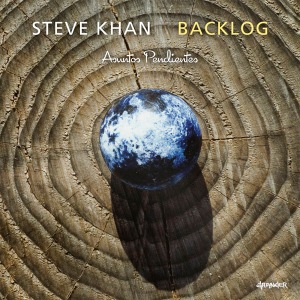
Khan has also become well known as a master-interpreter and reharmoniser of non-guitar jazz compositions by the likes of Andrew Hill, Herbie Hancock, Wayne Shorter, Ornette Coleman, Lee Morgan and Randy Brecker. His new collection Backlog, the third in a Latin Jazz triptych following Parting Shot (2011) and Subtext (2014), continues to plunder the songbooks of his favourite composers.
The album kicks off with the killer one-two of Monk’s ‘Criss Cross’ and Greg Osby’s ‘Concepticus In C’. The former is inspired by the late great pianist Kenny Kirkland’s Latin version which first appeared on his fine 1991 debut album.
Says Khan, ‘It’s a wonderful arrangement and so good that it’s hard to escape its influence. It took me years to find a way to do the tune in a way where I could put my own stamp on it. As everyone already knows, I love Monk’s compositions and have recorded many of them. I happen to feel that Monk’s tunes have a way of fitting into a Latin context, as if they were made to be interpreted in that style.’
The Osby tune was played by Khan during their tenure together in the New Sound Collective band; the guitarist clearly relishes arranging his version of ‘Concepticus’ on Backlog, adding a funky Joe Zawinul flavour to the tasty harmonies and quirky rhythmic concept.
‘Latin Genetics’, composed by Ornette Coleman and first appearing on his In All Languages album, features a fine guest spot from Randy Brecker on trumpet.
On first listening, it seems a light, almost joyous piece of music, but Khan has a different take on it: ‘It’s funny to me that people see this tune as being so happy – I actually see it as a rather dark piece of music, one with many sinister and even humorous qualities.’
Backlog‘s other Coleman cover version is ‘Invisible’, featuring Bob Mintzer on sax, originally recorded in 1958: ‘It comes from one of his earliest albums, Something Else!!!!, featuring an acoustic piano,’ says Khan. ‘Every time I hear this tune, I feel that Ornette’s playing and improvisational concepts are a bit constricted by having the chord changes applied so literally. There seems to be an absence of space. So, in my interpretation, though there are chord changes, both Bob and I play pretty much unaccompanied, and that’s really how I like it.’
Elsewhere on Backlog, Khan reimagines the music of Stevie Wonder, his father Sammy Cahn, Johnny Mandel, Bobby Hutcherson and Andrew Hill.
Clearly a labour of love, Khan wonders whether it will be his final album: ‘When I recorded Parting Shot, for reasons of the health and condition of my left hand, I thought that was going to be the final album. Then when I decided that I felt well enough to record Subtext, I was even more certain that that would be the final album. But, as 2015 unfolded, I came to the simple conclusion that I just do not feel alive unless I am creatively involved in the formation of new music. So, while I can still do it, I had to do everything possible to record. Can I foresee ever being able to self-finance another recording of my own again? I don’t want to utter the word “never” in conjunction with such a thought, but honestly, I really don’t know. With the release of any new piece of work, there is always hope for better days and better times, but this remains to be seen…’
Humour: it’s not something often associated with Lou Reed, even though he filled up much of 1978’s Live: Take No Prisoners with breakneck Lenny Bruce-style banter.
But a listen to ‘The Gun’, ‘Underneath The Bottle’ or ‘Waves Of Fear’ from The Blue Mask – released 35 years ago today – always cheers me up; there’s just something so uncensored, unapologetic and even cathartic about his worldview, and of course an element of ‘there but for the grace of God…’
Newly married to Sylvia Morales (who also designed the striking album cover), recently clean and apparently the happiest he’d ever been, the more extreme cuts from the album seem to point towards some of the sacrifices Reed had made for this new life, and/or the fears that it could all go pear-shaped at any moment. Maybe falling in love just scared the hell out of him.
He had put together possibly the finest band of his career (Robert Quine on guitar, Fernando Sanders on bass, Doane Perry on drums). Gone were the perky, ‘funky’ tones of 1980’s Growing Up In Public – now it was time to return to two guitars, panned hard-left and hard-right, voice, bass and drums. The whole album has a gorgeous, ambient mix – Rudy Van Gelder would have approved.
‘Women’ is magnificent – Sanders plays some charming countermelodies on fretless while Lou eulogises: ‘A woman’s love can lift you up/And women can inspire/I feel like buying flowers and hiring a celestial choir/A choir of castratis to serenade my love/They’d sing a little Bach for us and then we’d make love.’
‘Waves Of Fear’, a coruscating portrait of alcohol DTs, plays out like a deleted scene from ‘The Lost Weekend’. In the extended outro, as Reed riffs viciously, Quine’s manic solo flaps around like a dying fish. ‘Underneath The Bottle’ also focuses on the booze to gripping and sometimes amusing effect: ‘Things are never good/Things go from bad to weird/Hey, gimme another scotch with my beer.’
The title track is a Burroughsian jaunt through torture, pain and self-loathing, while ‘The Gun’ seems to represent the worst possible situation between a man and woman: ‘A man…carrying a gun/And he knows how to use it/Nine millimetre Browning/Let’s see what it can do/Tell the lady to lie down/I want you to be sure to see this,’ croaks Lou over a gentle two-chord vamp and superb Sanders bass.
‘Average Guy’ brings back the lightness, a mock-heroic look at Lou’s new life: ‘Average in everything I do/My temperature is 98.2.’ ‘The Day John Kennedy Died’ is a classic piece of modern Americana, a fable of lost innocence: ‘I dreamed I was young and smart and it was not a waste/I dreamed that there was a point to life and to the human race.’
‘No redemption, no salvation… My characters just squeeze by’, Reed told the NME in 1983. Dylan rates him as one of the great lyricists and The Blue Mask offers many reasons why. The band sounds pretty damn great too but was sadly short-lived – apparently Lou couldn’t stand Perry who fled to Jethro Tull pretty soon after the recording. Quine lasted a little longer but was also soon on his way.
The Blue Mask only reached number 167 on the US album chart and didn’t even register in the UK – a pretty dire state of affairs for such an influential artist. The ’80s were not going to be easy on Lou.
In the late summer of 1989, Madonna held a series of dance auditions for her Blond Ambition world tour, eventually choosing seven virtually unknown male artists: Luis Camacho, Oliver Crumes III, Salim Gauwloos, José Gutierez, Kevin Stea, Carlton Wilborn and Gabriel Trupin.
Camacho and Gutierez were possibly the best known of the group, members of the Harlem House Ball that became famous for ‘voguing’ (as seen in the ‘Paris Is Burning’ documentary and Madonna’s ‘Vogue’ video).
The heightened environment of the Blond Ambition tour forged a bond between Madonna and the dancers but also conjured up some demons. ‘In Bed With Madonna‘ (AKA ‘Madonna: Truth Or Dare’), Alex Keshishian’s hugely successful 1991 film of the tour, had ramifications for the dancers too – three filed a lawsuit against Madonna, claiming she had invaded their privacy.
A fine new documentary ‘Strike A Pose’ catches up with six of the dancers nearly 30 years on (Trupin sadly died of an AIDS-related illness in 1995), investigating the impact that instant fame had on their lives and unveiling the deep, personal traumas that haunted many of them before, during and after the tour.
Co-directed by Ester Gould and Reijer Zwaan, it’s a powerful, sometimes moving meditation on ageing, artistic integrity, celebrity and identity. I caught up with Gould to chat about the film.
MP: Where did the original idea for ‘Strike A Pose’ come from and was it easy getting the funding?
EG: The original idea was co-director Reijer Zwaan’s: he was 11 when he first saw ‘In Bed With Madonna’ and was immediately blown away by these seven dancers and the film’s bold, liberating message. For the first time in mainstream media, there was this wild, loud, fun-loving troupe of dancers who were being themselves – gay and happy. Over the years, Reijer wondered what had happened to those men. When he told me about the idea for the film, I immediately loved it. We did some online research and found out that there was an entire generation out there thanking these guys for helping them dare to be themselves. At the same time, it wasn’t till we met each of them separately in summer 2013 that we knew we had a film. Our premise was that these paragons of pride and self-expression had each, in their own way, struggled with shame and self-doubt. We always wanted ‘Strike A Pose’ to be more than a ‘where are they now?’ story. We were looking for a larger narrative. It took us about 18 months to finance the film mostly with Dutch government funds. There were questions about whether Madonna would be on board and how she’d be depicted; it’s strange that when there’s a celebrity in the picture there are always forces who want to attack or uncover some dirt. For us, it was never about that.
Was it difficult tracking down Luis, Oliver, Salim, Jose, Kevin and Carlton? And were they easily sold on the idea?
Thanks to social media it wasn’t that hard to find them, but it took some time to get some of them on board, specifically José and Luis. They were tired of people asking them to gossip about Madonna – how could they know we were any different? There was also some fear going back down memory lane perhaps because it had been so hard to move on with their lives after such an impactful experience. What persuaded them was our genuine interest in telling their stories.
The film is a powerful statement about the devastating physical and mental issues around HIV and AIDS, and also the social stigmas surrounding them. In that respect, ‘Strike A Pose’ feels just as relevant today as ‘In Bed With Madonna’ felt in 1991. Was it your intention to make a ‘statement’ or just tell an interesting story about these attractive, fascinating people?
We did want to make a statement, but for us that statement isn’t solely about HIV and AIDS. It was about the emotional consequences of hiding a part of yourself, of feeling unworthy of being loved. It’s really hard to dare to be yourself, to fully accept yourself, if you feel different for whatever reason. Because we all want to belong – it’s deeply engrained in human nature. Of course, gay rights and AIDS awareness have improved since the early ’90s. On another level, it’s one thing to be loud and provocative when you’re young, it’s another to accept yourself on a deeper level when you get older and reality kicks in.
Reijer Zwaan and Ester Gould at the ‘Strike A Pose’ premiere, Tribeca Film Festival, New York City, April 2016
At any point did you seek a contribution from Madonna for the film, and has she made any public or private comment?
We did successfully reach out to her management and lawyers to secure the rights to use fragments of the original film. We also thought a lot about asking her to be part of ‘Strike A Pose’ but always felt like her presence could overshadow the whole film. In a strange way, she was the elephant in the room, because even if she had turned up at the reunion dinner, wouldn’t that somehow ruin the point that these young dancers have moved on, matured and become grown men? We did have one specific scene in mind, almost a title sequence at the end, which was to see these men and Madonna performing ‘Vogue’ once more on stage. We wrote to her about the scene but never got a reply. We do know that she has seen the film and liked it.
What’s your favourite scene in the movie and why?
My favourite scene is the one with José, his mother and her disappointment that he never managed to buy her a house. It’s really hard-hitting and there’s something painfully beautiful about the fact that José is translating what his mum is saying in Spanish, and at the same time he’s moved by what she’s saying, by her sadness that he’s messed up his professional career. We see two broken people and it’s such an honest scene about shattered dreams.
I agree. Your film reminded me a little of ‘Anvil! The Story Of Anvil’ in its depiction of fast fame and then the return to ‘normal life’, but you don’t go into much detail about the dancers’ professional lives after the Blond Ambition tour – was that a conscious decision or one forced by time constraints?
I would say it was mostly forced by time constraints but also for us it was more about this larger narrative that the individual facts. We wanted the film to be cathartic but it was quite hard to interweave all these individual life stories into one film. Also, the reunion of the dancers kind of got in the way of shedding more light on their current lives. Hopefully you do understand that they all still dance or teach dance and have overcome their darker moments. We end with the power of dance rather than talk about their lives today.
‘Strike A Pose’ has enjoyed a limited but successful run at the Dochouse in London but what’s next for the film? Will there be a DVD release?
The film will very soon be released on digital platforms in the UK. And then later this year it’ll be on Netflix, so there are lots of chances to see it.
This is a golden era for documentaries and ‘Strike A Pose’ is a fitting addition. Have you got another project in the pipeline?
I’ve just finished a six-part documentary series for Dutch public television, co-directed by Sarah Sylbing, which was a great success. It’s about the debt problem. We set out to make it as exciting and compelling as fiction, looking at ‘The Wire’ for inspiration. I’m still busy with the impact of that series. I’m also cooking up new ideas but it’s too early to say anything concrete. What I can say is that I love documentary filmmaking and have a lot of faith in its narrative power to reach audiences, especially since there is much more freedom now with genre and form.
Occasionally a musician appears out of nowhere, ‘fully-formed’, or at least it can seem that way during one’s formative years.
In my lifetime, there have been a few: Lewis Taylor, Omar Hakim, Trilok Gurtu, and probably a few more. Drummer Dennis Chambers, who plays brilliantly throughout Blue Matter, would definitely be one too.
My muso schoolmate Jem Godfrey had lent me John Scofield’s superb Still Warm album sometime around 1986. Before then, I knew John’s playing mainly from Miles Davis’s Star People, one of my mid-’80s favourites.
So when the Steve Swallow-produced Blue Matter dropped in early ’87, I was primed and ready – and instantly gripped.
The presence of Hiram Bullock’s rhythm guitar on three tracks gives a good indication of Scofield’s approach on this album – it’s R’n’B/funk-based jazz/rock, with great grooves, neat chord changes and no gratuitious displays of instrumental technique for technique’s sake – though Scofield and Chambers were of course quite capable of some serious chops, evident on the killin’ ‘Trim’.
The dynamic title track is clearly influenced by Miles/Marcus Miller’s ‘Tutu’ with its half-time groove, walking synth bass and enigmatic chords, but Chambers’ brilliant contribution (closely monitored by the excellent Gary Grainger on bass) transforms it into something totally new.
In the first minute of the tune, he achieves a novel ‘bouncing ball’ snare drum effect and then unleashes some of the most kick-ass kick-drum playing in music history.
Chambers had already turned some heads playing with George Clinton, but, even if he had never picked up the sticks again after 1987, ‘Blue Matter’ would probably have put him right up in the drum pantheon.
‘Heaven Hill’ – named for Sco’s favourite brand of bourbon – a slow blues with surprising chord changes and tasty gospel-tinged piano playing by Mitch Forman, influenced a whole host of ‘fusion’ guitarist/composers such as Robben Ford, Scott Henderson and Frank Gambale (compare it to Henderson’s ‘Slidin’ Into Charlisa’).
‘Now She’s Blonde’, ‘Time Marches On’, ‘The Nag’ and ‘So You Say’ manage to be both funky and catchy while retaining enough harmonic interest and ‘dirt’ to go way beyond the smooth jazz tag.
The Blue Matter band got quite a live following around this time, with good reason. They were somewhat of an antidote to the Chick Corea Elektric Bands and Al Di Meolas of this world, as musically jaw-dropping as those artists were/are. Scofield himself acknowledged as much during an interview with Howard Mandel in 1988:
‘What I hate about fusion music is the gymnastics. We are often playing to audiences who want to hear fast and loud and I have to watch myself. I’ve never been that good at doing fast stuff. Luckily, it doesn’t come easy to me. Now, Dennis Chambers is a chops phenomenon. On his solos, he destroys the drums. But he also has inbred musicianship, so it’s exciting and not so calculated…’
Recorded at The Manor, Oxfordshire, October/November 1981
Working titles: Rogue Soup, Motorcyle Landscape, World Colour Banner, Explosion Of Flowers, Knights On Fire
Album Chart position: #5 (UK), #48 (US)
Singles released: ‘Senses Working Overtime’ (UK #10)
‘Ball And Chain’ (UK #58)
‘No Thugs In Our House’ (did not chart)
Andy Partridge (vocals, guitar, keyboards, percussion, co-composer): ‘We spent the summer of 1981 rehearsing at Terry “Fatty” Alderton’s Tudor Rehearsal Studio and it was very sweaty. All the Swindon heavy rock bands would rehearse there, drink cider and piss in the corner. Terry (Chambers) had forgotten how to drum. He had spent the early summer working on a building site and when he set up his drum kit it was more like scaffolding. He was just useless (but apparently improved pretty quickly… Ed.). I forced him to buy a new snare drum and timbale. I bought a Yamaha acoustic. It opened up possibilities for new sounds where the live arrangements mattered less. I’d become unhinged a couple of times on tour and wanted a break. The album cover (by Ken Ansell)? I think it was just that we were fascinated with the Uffington Horse. The Americans thought it was a duck…’
Dave Gregory (guitar, keyboards, backing vocals): ‘I’d always dreamed about owning a 12-string Rickenbacker but it had seemed like a frivolous folly until now. I fell totally in love with the sound. English Settlement was a watershed record for us. We’d made a couple of guitar records and then the acoustic side came out. It was definitely a progression. There weren’t too many songs, just not enough time…’
Colin Moulding: (vocals, bass, keyboards, percussion, co-composer): ‘I bought a fretless bass. I thought it would fit in with the acoustic stuff we were doing but it was impossible on tour. You have to have a flair for playing something without frets and I haven’t. As soon as the lights went out…the rest is history…’
For much more info on English Settlement, check out Neville Farmer’s book ‘XTC Song Stories’.