Strike A Pose (2016): An Interview With Co-Director Ester Gould

71e6e7c242045b1aefaf0a5aa90969f0In the late summer of 1989, Madonna held a series of dance auditions for her Blond Ambition world tour, eventually choosing seven virtually unknown male artists: Luis Camacho, Oliver Crumes III, Salim Gauwloos, José Gutierez, Kevin Stea, Carlton Wilborn and Gabriel Trupin. 

Camacho and Gutierez were possibly the best known of the group, members of the Harlem House Ball that became famous for ‘voguing’ (as seen in the ‘Paris Is Burning’ documentary and Madonna’s ‘Vogue’ video).

The heightened environment of the Blond Ambition tour forged a bond between Madonna and the dancers but also conjured up some demons. ‘In Bed With Madonna‘ (AKA ‘Madonna: Truth Or Dare’), Alex Keshishian’s hugely successful 1991 film of the tour, had ramifications for the dancers too – three filed a lawsuit against Madonna, claiming she had invaded their privacy.

A fine new documentary ‘Strike A Pose’ catches up with six of the dancers nearly 30 years on (Trupin sadly died of an AIDS-related illness in 1995), investigating the impact that instant fame had on their lives and unveiling the deep, personal traumas that haunted many of them before, during and after the tour.

Co-directed by Ester Gould and Reijer Zwaan, it’s a powerful, sometimes moving meditation on ageing, artistic integrity, celebrity and identity. I caught up with Gould to chat about the film.

MP: Where did the original idea for ‘Strike A Pose’ come from and was it easy getting the funding?

EG: The original idea was co-director Reijer Zwaan’s: he was 11 when he first saw ‘In Bed With Madonna’ and was immediately blown away by these seven dancers and the film’s bold, liberating message. For the first time in mainstream media, there was this wild, loud, fun-loving troupe of dancers who were being themselves – gay and happy. Over the years, Reijer wondered what had happened to those men. When he told me about the idea for the film, I immediately loved it. We did some online research and found out that there was an entire generation out there thanking these guys for helping them dare to be themselves. At the same time, it wasn’t till we met each of them separately in summer 2013 that we knew we had a film. Our premise was that these paragons of pride and self-expression had each, in their own way, struggled with shame and self-doubt. We always wanted ‘Strike A Pose’ to be more than a ‘where are they now?’ story. We were looking for a larger narrative. It took us about 18 months to finance the film mostly with Dutch government funds. There were questions about whether Madonna would be on board and how she’d be depicted; it’s strange that when there’s a celebrity in the picture there are always forces who want to attack or uncover some dirt. For us, it was never about that.

Was it difficult tracking down Luis, Oliver, Salim, Jose, Kevin and Carlton? And were they easily sold on the idea?

Thanks to social media it wasn’t that hard to find them, but it took some time to get some of them on board, specifically José and Luis. They were tired of people asking them to gossip about Madonna – how could they know we were any different? There was also some fear going back down memory lane perhaps because it had been so hard to move on with their lives after such an impactful experience. What persuaded them was our genuine interest in telling their stories.

The film is a powerful statement about the devastating physical and mental issues around HIV and AIDS, and also the social stigmas surrounding them. In that respect, ‘Strike A Pose’ feels just as relevant today as ‘In Bed With Madonna’ felt in 1991. Was it your intention to make a ‘statement’ or just tell an interesting story about these attractive, fascinating people?

We did want to make a statement, but for us that statement isn’t solely about HIV and AIDS. It was about the emotional consequences of hiding a part of yourself, of feeling unworthy of being loved. It’s really hard to dare to be yourself, to fully accept yourself, if you feel different for whatever reason. Because we all want to belong – it’s deeply engrained in human nature. Of course, gay rights and AIDS awareness have improved since the early ’90s. On another level, it’s one thing to be loud and provocative when you’re young, it’s another to accept yourself on a deeper level when you get older and reality kicks in.

Reijer Zwaan and Ester Gould at the 'Strike A Pose' premiere, Tribeca Film Festival, New York City, April 2016

Reijer Zwaan and Ester Gould at the ‘Strike A Pose’ premiere, Tribeca Film Festival, New York City, April 2016

At any point did you seek a contribution from Madonna for the film, and has she made any public or private comment?

We did successfully reach out to her management and lawyers to secure the rights to use fragments of the original film. We also thought a lot about asking her to be part of ‘Strike A Pose’ but always felt like her presence could overshadow the whole film. In a strange way, she was the elephant in the room, because even if she had turned up at the reunion dinner, wouldn’t that somehow ruin the point that these young dancers have moved on, matured and become grown men? We did have one specific scene in mind, almost a title sequence at the end, which was to see these men and Madonna performing ‘Vogue’ once more on stage. We wrote to her about the scene but never got a reply. We do know that she has seen the film and liked it.

What’s your favourite scene in the movie and why?

My favourite scene is the one with José, his mother and her disappointment that he never managed to buy her a house. It’s really hard-hitting and there’s something painfully beautiful about the fact that José is translating what his mum is saying in Spanish, and at the same time he’s moved by what she’s saying, by her sadness that he’s messed up his professional career. We see two broken people and it’s such an honest scene about shattered dreams.

I agree. Your film reminded me a little of ‘Anvil! The Story Of Anvil’ in its depiction of fast fame and then the return to ‘normal life’, but you don’t go into much detail about the dancers’ professional lives after the Blond Ambition tour – was that a conscious decision or one forced by time constraints?

I would say it was mostly forced by time constraints but also for us it was more about this larger narrative that the individual facts. We wanted the film to be cathartic but it was quite hard to interweave all these individual life stories into one film. Also, the reunion of the dancers kind of got in the way of shedding more light on their current lives. Hopefully you do understand that they all still dance or teach dance and have overcome their darker moments. We end with the power of dance rather than talk about their lives today.

‘Strike A Pose’ has enjoyed a limited but successful run at the Dochouse in London but what’s next for the film? Will there be a DVD release?

The film will very soon be released on digital platforms in the UK. And then later this year it’ll be on Netflix, so there are lots of chances to see it.

This is a golden era for documentaries and ‘Strike A Pose’ is a fitting addition. Have you got another project in the pipeline?

I’ve just finished a six-part documentary series for Dutch public television, co-directed by Sarah Sylbing, which was a great success. It’s about the debt problem. We set out to make it as exciting and compelling as fiction, looking at ‘The Wire’ for inspiration. I’m still busy with the impact of that series. I’m also cooking up new ideas but it’s too early to say anything concrete. What I can say is that I love documentary filmmaking and have a lot of faith in its narrative power to reach audiences, especially since there is much more freedom now with genre and form.

John Scofield: Blue Matter 30 Years On

scofield

Occasionally a musician appears out of nowhere, ‘fully-formed’, or at least it can seem that way during one’s formative years.

In my lifetime, there have been a few: Lewis Taylor, Omar Hakim, Trilok Gurtu, and probably a few more. Drummer Dennis Chambers, who plays brilliantly throughout Blue Matter, would definitely be one too.

My muso schoolmate Jem Godfrey had lent me John Scofield’s superb Still Warm album sometime around 1986. Before then, I knew John’s playing mainly from Miles Davis’s Star People, one of my mid-’80s favourites.

So when the Steve Swallow-produced Blue Matter dropped in early ’87, I was primed and ready – and instantly gripped.

The presence of Hiram Bullock’s rhythm guitar on three tracks gives a good indication of Scofield’s approach on this album – it’s R’n’B/funk-based jazz/rock, with great grooves, neat chord changes and no gratuitious displays of instrumental technique for technique’s sake – though Scofield and Chambers were of course quite capable of some serious chops, evident on the killin’ ‘Trim’.

The dynamic title track is clearly influenced by Miles/Marcus Miller’s ‘Tutu’ with its half-time groove, walking synth bass and enigmatic chords, but Chambers’ brilliant contribution (closely monitored by the excellent Gary Grainger on bass) transforms it into something totally new.

In the first minute of the tune, he achieves a novel ‘bouncing ball’ snare drum effect and then unleashes some of the most kick-ass kick-drum playing in music history.

Chambers had already turned some heads playing with George Clinton, but, even if he had never picked up the sticks again after 1987, ‘Blue Matter’ would probably have put him right up in the drum pantheon.

‘Heaven Hill’ – named for Sco’s favourite brand of bourbon – a slow blues with surprising chord changes and tasty gospel-tinged piano playing by Mitch Forman, influenced a whole host of ‘fusion’ guitarist/composers such as Robben Ford, Scott Henderson and Frank Gambale (compare it to Henderson’s ‘Slidin’ Into Charlisa’).

‘Now She’s Blonde’, ‘Time Marches On’, ‘The Nag’ and ‘So You Say’ manage to be both funky and catchy while retaining enough harmonic interest and ‘dirt’ to go way beyond the smooth jazz tag.

The Blue Matter band got quite a live following around this time, with good reason. They were somewhat of an antidote to the Chick Corea Elektric Bands and Al Di Meolas of this world, as musically jaw-dropping as those artists were/are. Scofield himself acknowledged as much during an interview with Howard Mandel in 1988:

‘What I hate about fusion music is the gymnastics. We are often playing to audiences who want to hear fast and loud and I have to watch myself. I’ve never been that good at doing fast stuff. Luckily, it doesn’t come easy to me. Now, Dennis Chambers is a chops phenomenon. On his solos, he destroys the drums. But he also has inbred musicianship, so it’s exciting and not so calculated…’

XTC: English Settlement 35 Years Old Today

r-1455277-1313625163-jpegVirgin Records, released 12 February 1982

Produced by Hugh Padgham and XTC

Recorded at The Manor, Oxfordshire, October/November 1981

Working titles: Rogue Soup, Motorcyle Landscape, World Colour Banner, Explosion Of Flowers, Knights On Fire

Album Chart position: #5 (UK), #48 (US)

Singles released: ‘Senses Working Overtime’ (UK #10)
‘Ball And Chain’ (UK #58)
‘No Thugs In Our House’ (did not chart)

Andy Partridge (vocals, guitar, keyboards, percussion, co-composer): ‘We spent the summer of 1981 rehearsing at Terry “Fatty” Alderton’s Tudor Rehearsal Studio and it was very sweaty. All the Swindon heavy rock bands would rehearse there, drink cider and piss in the corner. Terry (Chambers) had forgotten how to drum. He had spent the early summer working on a building site and when he set up his drum kit it was more like scaffolding. He was just useless (but apparently improved pretty quickly… Ed.). I forced him to buy a new snare drum and timbale. I bought a Yamaha acoustic. It opened up possibilities for new sounds where the live arrangements mattered less. I’d become unhinged a couple of times on tour and wanted a break. The album cover (by Ken Ansell)? I think it was just that we were fascinated with the Uffington Horse. The Americans thought it was a duck…’

Dave Gregory (guitar, keyboards, backing vocals): ‘I’d always dreamed about owning a 12-string Rickenbacker but it had seemed like a frivolous folly until now. I fell totally in love with the sound. English Settlement was a watershed record for us. We’d made a couple of guitar records and then the acoustic side came out. It was definitely a progression. There weren’t too many songs, just not enough time…’

Colin Moulding: (vocals, bass, keyboards, percussion, co-composer): ‘I bought a fretless bass. I thought it would fit in with the acoustic stuff we were doing but it was impossible on tour. You have to have a flair for playing something without frets and I haven’t. As soon as the lights went out…the rest is history…’

For much more info on English Settlement, check out Neville Farmer’s book ‘XTC Song Stories’.

Wayne Shorter: Phantom Navigator 30 Years Old Today

wayne sh

In the late-’80s, Wayne was seemingly about as far away from ‘jazz’ as it’s possible for a jazz legend to get.

His music hadn’t featured any tinging ride cymbals or walking acoustic basses for decades. Even Miles thought Wayne was getting a bit too ‘far-out’ – he reportedly told the saxophonist as much when they met backstage during Miles’s Paris tribute show in July 1991.

Which must have come as quite a shock to Wayne – after all, his ’80s music featured strong, ‘funky’ grooves and attractive, happy melodies. On the face of it, albums like ’87’s Phantom Navigator (apparently inspired by the ‘Other Worlds’ sci-fi comic series he drew in his teenage years) weren’t that different from Miles’s Tutu and Amandla.

But of course they were completely different, and Phantom Navigator is probably the most ‘far-out’ collection of Wayne’s solo career.


Many critics couldn’t see beyond the drum machines, bass vamps and synths, missing the complexity of the arrangements and incredible care and attention that went into making the album, though maybe Wayne was asking for trouble by recruiting legendary NY beat-maker Jimmy Bralower, who had recently featured on Steve Winwood’s ‘Higher Love’ and Nile Rodgers’ B Movie Matinee.

wayne-shorter_in_amsterdam_1980

But these elements were just ‘sweeteners’ – Phantom Navigator was designed to be lived with, devoured in long stretches as one would a classical piece.

There were so many good melodic ideas packed into every tune but it wasn’t an album for short attention spans – not ideal in the MTV-flavoured, thrill-a-minute late-’80s.

‘Condition Red’ fairly bursts out of the speakers, with Wayne’s hair-raising soprano (I’d posit that Phantom Navigator features the best soprano tone of his career), sublime harmonies and witty scat vocals.

Chick Corea’s crystalline piano features strongly on the intricate, beguiling ‘Mahogany Bird’, while ‘Remote Control’ taps into a go-go groove (though Bralower’s snare is way too big – where was Ricky Wellman when Wayne needed him?) underpinning rich, endlessly-flowing soprano harmonies.

Side two’s triptych of ‘Yamanja’ (named for a sea goddess of Brazilian legend), ‘Forbidden – Plan-It!’ and ‘Flagships’ are nothing less than mini concertos for soprano sax, electric bass and synths. All would work fine with a symphony orchestra with their endlessly intertwining lines and countermelodies.

Wayne toured a lot during this period (I think I saw him three times in London between ’85 and ’88) and to a certain extent the music was a hard sell, both for audiences and the musicians. His sci-fi fusion stuck out like a sore thumb during the late-’80s London jazz/rare-groove revival when he was sometimes put on the same bill as people like The James Taylor Quartet and Gilles Peterson! I remember a really weird such gig at the old Town & Country Club in the late ’80s.

It’s the same old story – the problem of marketing music that goes way beyond category. But, in the final analysis, Wayne doesn’t play jazz, rock, go-go, funk or soul on Phantom Navigator – he plays life.

Book Review: More Songwriters On Songwriting by Paul Zollo

51o7o-ad4l-_sx329_bo1204203200_For students of songwriting, there’s been an embarrassment of riches on the book front recently – in the last few years we’ve had the groundbreaking ‘Isle Of Noises’, entertaining ‘Complicated Game’, and lengthy autobiographies by the likes of Elvis Costello, Bruce Springsteen, Robbie Robertson, Chrissie Hynde, Neil Young, Brian Wilson and Phil Collins.

And now here comes Paul Zollo’s ‘More Songwriters On Songwriting’, the weighty sequel to his landmark 1991 volume, comprising new, indepth interviews with famous composers from the worlds of pop, rock, country, R’n’B and jazz.

When the book catches fire, tasty anecdotes come thick and fast: Kenny Gamble delivers a powerful statement on his hopes for America’s future; Joe Jackson discusses his love of Duke Ellington and Steely Dan; Bryan Ferry reveals that the lyrics for ‘Avalon’ (the song) were written in no less than four different countries.

Elvis Costello talks about trying (and failing) to collaborate with legendary lyricist Sammy Cahn; Rickie Lee Jones discusses how caring for her sick mother reignited her music mojo; Chrissie Hynde describes in visceral detail how her views on animal rights inform her songwriting.

Ringo talks about how George helped him write ‘Octopus’s Garden’; Dave Stewart recalls the thrill of writing ‘Sweet Dreams (Are Made Of This)’ with Annie Lennox in double-quick time; James Taylor waxes lyrical about Paul McCartney; Don McLean reveals the unusual inspiration behind ‘American Pie’.

And that’s just scratching the surface. Zollo always knows the right questions to ask and the conversations flow unpredictably. Highly recommended.

‘More Songwriters On Songwriting’ is published by Da Capo Press.

Bill Bruford’s Earthworks: 30 Years On

earthworks

Some musicians have a unique touch – you can identify them within a few notes.

In Bill Bruford’s case, his snare drum is his main audio imprint. But he also always had a highly-original composing style before his retirement in 2009, and both are very much in evidence on the excellent Earthworks album.

Bruford had spent the mid-’80s winding down Crimson and duetting with ex-Yes keyboardist Patrick Moraz, mostly in spontaneous improvisation mode, but now a new musical approach was called for.

He had based his career on defying expectations and he did it again in 1986, forming a quartet made up two young jazz tyros best known for their work in big-band-extraordinaire Loose Tubes (keys man Django Bates and saxist Iain Ballamy) plus acoustic bassist Mick Hutton.

bruford-inside

Bruford chose well: Bates and Ballamy were excellent and prolific composers too. Also key to this new band was Bruford’s development of a very advanced electric/acoustic kit whereby he could play chords and melodic ideas alongside a ‘standard’ jazz setup.

This approach also chimed well with Bates’ propensity on both acoustic piano and synth. On the latter instrument, he was fast becoming almost as recognisable as Jan Hammer, Joe Zawinul, Chick Corea or George Duke.

All the ingredients add up to one of the key British jazz albums of the ’80s, showcasing a band equally at home playing Weather Report-style fusion, Eastern themes and odd-time prog as they were with ECM-flavoured chamber jazz of the type played by obvious heroes Kenny Wheeler and John Taylor.

Ballamy’s opener ‘Thud’ (inspired by the Rosenhan psychology experiment?) almost has a ska feel – if Madness had tried their hand at quirky instrumental jazz/rock, they might come up with something like this. ‘Pressure’ is possibly the album’s standout, a superb mini-suite featuring some classic odd-time Bruford mischief and lyrical piano playing from Bates.

Ballamy’s ballad ‘It Needn’t End In Tears’ still sounds like a jazz-standard-in-waiting to this writer, though its possibly a bit saccharine for some. Bruford unleashes a fine drum solo on ‘My Heart Declares a Holiday’ while Bates’ ‘Emotional Shirt’ veers humourously between an early hip-hop groove and free-jazz freakout. ‘Bridge Of Inhibition’ fuses Turkish modes with high-speed bebop.

Buoyed by state-of-the-art production (maybe a bit too state-of-the-art) and stylish packaging, Earthworks was a palpable hit by ‘jazz’ standards, selling well and turning up in several ‘best of 1987’ lists. Some critics were of course suspicious of Bruford’s jazz credentials, but he probably couldn’t have cared less; he had always considered himself a jazz drummer anyway and knew he was onto a winner with Bates, Ballamy and Hutton.

The latter wouldn’t last beyond this first album, but Earthworks (the band) would continue to make some excellent music throughout the rest of the ’80s and for two decades beyond that. Bruford had successfully defied expectations yet again.

Movie Review: Command And Control (2016)

cmd-ctl-movieThis is a golden age for documentaries, and, in its own way, ‘Command And Control’ may just be as powerful as 2012’s BAFTA-winning ‘The Act Of Killing’.

As nail-biting as any Hollywood thriller and carrying a terrifying message, it’s also a remarkably timely film given this week’s Theresa May Trident controversy.

Based on the book by acclaimed journalist and author Eric Schlosser (‘Fast Food Nation’, ‘Reefer Madness’), Robert Kenner’s documentary looks in detail at the notorious accident of September 1980 at the Damascus underground nuclear base in Arkansas, when the fuel tank of an idle Titan II missile was damaged – with disastrous consequences.

Meticulously researched and beautifully paced, the film expands into a shocking and riveting exposé of the US nuclear industry. Testimonies of the accident survivors are heartfelt, often surprising and occasionally moving, describing a world where human error can be catastrophic and is usually the result of an unreliable – and sometimes unjust – system.

Any event which leads to loss of life can hardly be classed as a ‘near miss’, but Damascus could easily have been a lot worse – we learn that Vice President Walter Mondale and Governor of Arkansas Bill Clinton were just 46 miles down the road at a Democratic convention in Little Rock when the accident happened.

They would have been pulverized if the warhead had exploded, along with thousands – if not millions – of other citizens.

The scary facts pile up: during the Cold War, it was believed that the US needed between 50 and 100 nuclear weapons to keep up with the Soviet Union – there are currently around 7,000 nuclear weapons on US soil and surrounding oceans, including approximately 500 primed and ready to go.

And some experts estimate that 1,000 similar accidents to the one at Damascus have occurred in the US since the advent of nuclear weaponry.

According to Schlosser, the fact that there hasn’t been more loss of life is down to the excellence of the weapons designers and bravery of the (mostly very young) site engineers.

But mostly it’s down to luck. And the thing about luck is that it eventually runs out, as ‘Command And Control’ so harrowingly depicts.

Ronald Shannon Jackson: Behind Plastic Faces

ronald_shannon_jackson_06n5970

Shannon Jackson in 2012

Musicians and writers have long puzzled over a definition of Harmolodics, the musical system invented by Ornette Coleman.

The man himself was famously coy on the subject, his brief liner note on the back of the Dancing In Your Head LP possibly the nearest he ever got to an outright definition: ‘Rhythms, harmonics and tempos are all equal in relationship’.

Of all the Ornette collaborators who developed their own take on Harmolodics, Ronald Shannon Jackson, who died in October 2013, probably came up with the most accessible version.

He had played with avant-garde pioneers Albert Ayler, Ornette, James Blood Ulmer and Cecil Taylor in the 1970s, but developed into a fine bandleader/composer in the ’80s, fronting a red-hot band featuring guitarist Vernon Reid (Living Colour), bassist Melvin Gibbs (Rollins Band), trombonist Robin Eubanks and saxophonist Zane Massey. (Shannon’s version of Harmolodics was so successful it possibly even influenced Ornette’s Virgin Beauty.)

r-1084782-1190894488-jpeg

My dad used to get sent a lot of music in his capacity as a programme consultant for Channel 4 TV’s music arm back in the mid-1980s. A surprising amount of it would come in home-compiled cassette format. One such tape was simply called ‘Dance Music’ – I’ve still got it somewhere.

Most of it was fairly standard Brazilian and Blue Note stuff but one track stood out a mile and became somewhat of an obsession for my brother and I: Shannon’s ‘Behind Plastic Faces’, from the 1985 album Decode YourselfIt was the beginning of my love affair with his music and drumming.

He lays down one of his patented military grooves on Simmons drums underneath slithering fretless bass, chattering Reid guitar and Onaje Allan Gumbs’ summery keyboards. But then the track suddenly changes gear halfway through and turns into a Afro-Funk/No-Wave rave-up, with Shannon moving over to the acoustic drums and Eric Person rhapsodising on alto sax.

The track and attendant album were recorded at Electric Lady Studios in New York and produced by Bill Laswell. Decode Yourself seems very difficult to find on physical formats these days, like many of Shannon’s numerous other ’80s albums, but thankfully it is on streaming platforms.

Shannon Jackson was born and brought up in Forth Worth, Texas, just like Ornette. His father’s jukebox introduced him to BB King, Howlin’ Wolf, Charlie Parker and Dave Brubeck, but there were many other influences in the mix too, as he told writer Gary Giddins in 1985:

‘You’d wake up and hear hillbilly music on the radio. In school, we’d play (Wagner’s) “Lohengin”, at night we’d hear Bo Diddley or Bobby “Blue” Bland. On Sunday, we’d hear gospel. It was a total black community, and music wasn’t categorised as jazz or pop – nobody told you you weren’t supposed to like something.’

Book Review: Walls Come Tumbling Down by Daniel Rachel

walls come tumblingDaniel Rachel’s excellent new book focuses on the links between music and politics in the 1980s.

Ostensibly an oral history of three epochal movements of the era – Rock Against Racism, 2 Tone and Red Wedge – ‘Walls Come Tumbling Down’ shows how these campaigns politicised a whole generation.

Fresh from his fine ‘Isle Of Noises’ tome which interviewed key British songwriters, Rachel opens his contacts book again to get telling contributions from Pauline Black, Dennis Bovell, Billy Bragg, Lloyd Cole, Elvis Costello, Jerry Dammers, Andy Gill, Junior Giscombe, Paul Heaton, Linton Kwesi Johnson, Tracey Thorn, Tom Robinson, Paul Simonon, Paul Weller and many more. There are also rare or never-before-published photos of the era by the likes of Pennie Smith, Jill Furmanovsky and Kevin Cummins.

The story starts on 5 August 1976 when Eric Clapton used a notorious Birmingham Odeon gig to lambast the audience, calling for ‘w*gs’ and ‘P*kis’ to ‘leave the country’ and pledging his support for Enoch Powell, the Conservative MP who eight years earlier had made the infamous ‘Rivers Of Blood’ speech.

Clapton’s shocking proclamations sparked the Rock Against Racism movement, a campaign also inflamed by David Bowie’s comments to Playboy magazine concerning Hitler and the rise of fascism.

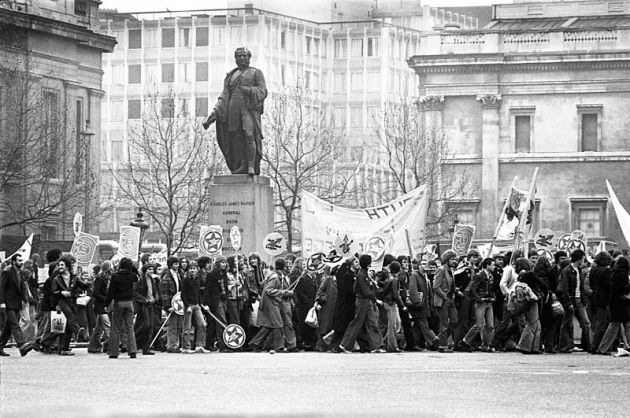
Rock Against Racism march, Trafalgar Square, April 1978

Rock Against Racism march, Trafalgar Square, April 1978

This troubling era is picked over in immense detail, with various jaw-dropping artefacts: Clapton’s handwritten ‘apology’ letter to Sounds magazine is printed in full, and there’s also an extremely rare photo of Bowie’s ‘Nazi salute’ at Victoria station in May 1976 (as well as a new-to-this-writer explanation/apology from Bowie). Black musicians and music-biz legends also comment with great candour about life in the UK during this period.

3-september-20162c-walls-come-tumbling-down-billy-bragg-in-conversation-with-author2c-daniel-rachel-40-people27s-history-museum-image-red-wedge5b45d

The 2 Tone movement attacked racism at its source while many artists under that umbrella also supported the Campaign For Nuclear Disarmament and Rock Against Sexism.

When Margaret Thatcher swept to a second term of office in 1983, bolstered by the Falklands War, a new pacifism emerged, typified by tracks like Elvis Costello’s ‘Shipbuilding’ and Heaven 17’s ‘(We Don’t Need This) Fascist Groove Thang’.

Later, as the miners’ strike took hold and Thatcher’s assault on socialism gathered pace, Paul Weller and Billy Bragg formed the Red Wedge movement which focused its attentions on ousting her in the 1987 General Election. It wasn’t to be, of course – although she did resign in December 1990.

The final section of ‘Walls Come Tumbling Down’ focuses on Dammers and various accomplices’ efforts to raise public awareness about the banned ANC, with high-profile singles and the famous 1988 Nelson Mandela 70th birthday tribute at Wembley Stadium, followed by his eventual freeing from jail on 11 February 1990.

Full of juicy details, potent memories of a far more passionate and politically-engaged era of pop music, and gripping, sometimes moving testimonies, this fascinating book outlines a period when youth culture demanded a voice.

‘Walls Come Tumbling Down’ is published by Picador.

Classic Rock’s 100 Greatest Albums Of The ’80s: First Impressions

_57I’m a sucker for a ‘best albums of the 1980s’ list.

Classic Rock magazine have just published their ‘real’ top 100, focusing on under-the-radar records by both well-established and cult artists.

The countdown features a fair few critics’ favourites – Peter Gabriel 3, Lou Reed’s New York, David Bowie’s Scary Monsters (And Super Creeps), Talking Heads’ Remain In Light, The Police’s Synchronicity, Roxy Music’s Avalon. No major surprises there.

Then there are the slightly left-field choices that would possibly scrape into my top 100 too (Living Colour’s Vivid, PiL’s Album, Brian Wilson’s self-titled debut, Billy Idol’s Rebel Yell, Genesis’s Duke, Neil Young’s Freedom, Robbie Robertson’s self-titled debut, David Lee Roth’s Skyscraper).

There are the slightly puzzling choices from established artists – Tom Waits’ Frank’s Wild Years, Yes’s Drama, Red Hot Chili Peppers’ Uplift Mofo Party Plan, Rolling Stones’ Tattoo You, Van Halen’s Women And Children First, Faith No More’s Introduce Yourself and Aerosmith’s Done With Mirrors.

And then there’s a whole raft of albums by artists I’ve long meant to check out. So I gave them a spin. I didn’t make much headway with Dead Kennedys, Billy Squier, Zodiac Mindwarp, John Mellencamp, Gun, Sea Hags, Green On Red, Queensryche, Georgia Satellites, Enuff Z’Nuff and King’s X, but here’s some stuff that did make an impression – very surprisingly, in most cases:

#86: Steve Perry’s Street Talk (1985)
I’ve always respected the Journey man’s voice but was unaware of his solo career until I heard this super-catchy single (whose video even throws in a bit of ‘Spinal Tap’ self-parody).

#84: Michael Bolton’s Everybody’s Crazy (1985)
The sound of Michael McDonald fronting ZZ Top.

#55: Gary Moore’s Corridors Of Power (1984)
Included for the extraordinary first two minutes: scary chops from a guitar great.

#38: Pink Floyd’s The Final Cut (1983)
You’d be hard pressed to call it a great voice and the casual racism grates but Waters emotes effectively on this beautifully-produced, evocative album opener.

#3: Def Leppard’s High ‘N’ Dry (1981)
One for audiophiles everywhere: producer ‘Mutt’ Lange works his magic again.

I won’t give away the number one…but you can check out the full top 100 albums here.