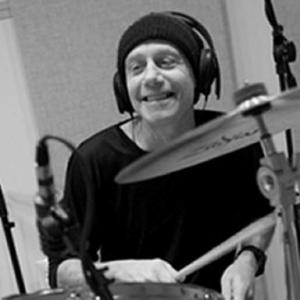
Keith LeBlanc (1954-2024)

‘No crap beats’ – if that wasn’t on Keith Leblanc’s business card, it should have been.

The man could just sit down at any kit – or program any drum machine – and make it sound rich and swinging, whether he was playing with Tackhead, Seal, Tina Turner, Nine Inch Nails, Depeche Mode, Bomb The Bass, ABC, Sugarhill Gang, Annie Lennox, Mark Stewart or Little Axe.

LeBlanc – who died in April – has to go down as a true beat innovator, embracing and developing drum technology and particularly developing a human/machine interface which always grooved beautifully and didn’t distract from the music. Along with other key ’80s/’90s drummers Dennis Chambers, Jonathan Moffett, Ricky Wellman and Lenny White, he also had a killer right foot.

He grew up in Bristol, Connecticut, and was inspired to pick up the drum sticks after seeing The Beatles on TV. He was later influenced by what he called ‘pop’ music – James Brown, Cameo, Muscle Shoals, Gap Band, Parliament/Funkadelic – and became the house drummer for Sugar Hill Records in late 1979 and co-founder of grounbreaking funk/industrial/dub/rock outfit Tackhead alongside Skip McDonald, Doug Wimbish and Adrian Sherwood.

LeBlanc also recorded many solo albums, the best of which is probably Time Traveller, and played excellent live jazz/rock with Nikki Yeoh, Jonas Hellborg and Mano Ventura.

It’s sad to think one will never hear that amazing LeBlanc/Wimbish bass and drums hook-up. Anyone who saw Mark Stewart, Little Axe or Tackhead live will remember how the first few minutes of every gig was usually just the two of them playing together. That lasted right through to the 2021 On-U Records anniversary shindig, though a masked Keith looked very frail.

movingtheriver had the pleasure of interviewing LeBlanc in 2010 for Jazz FM, and revisiting my notebook I found lots of interesting quotes I didn’t use in my original article:

On Sugarhill Records/co-owner Sylvia Robinson:
Sylvia was looking for Skip and Doug but they initially said no because they’d had a bad experience before. I was new to the band but I heard the words ‘recording studio’ and ‘money’ and bugged them until they said yes. The first Sugarhill Gang album was recorded in the Robinsons’ studio (H&L in Englewood Cliffs, New Jersey, down the road from Rudy Van Gelder’s famous studio) which was falling to bits! We’d cut a track on the Friday, drive home to Connecticut and hear it on the radio on the Monday. The whole industry was shaken up when rap started. It took them four years to catch up. But if the Robinsons had done 25% of the right thing, Sugar Hill Records would still be going. They screwed up. It was hard to watch the artists get ripped off and then watch those people flaunt money in front of them. We tried not to write anything because we knew how they were.

On playing live in the studio:
The first rap drummer was a white guy! Back then, playing live in the studio was normal. The arranger Jiggs Chase would get with the rappers, do an arrangement based on what they wanted to use and then give us charts. And then we’d add things. The musical ethic was really good at that time. You had to get it right or there’d be someone else in there recording the next day.

On hip-hop and drum machines:
After ‘Planet Rock’, anyone could make a rap record in their bedroom. When drum machines came out, I saw my job opportunities flying out of the window. They opened the door for everybody to do it. Then it dawned on me what I could program one of those better than any engineer. I did ‘No Sell Out’ just to see what I could do with drum machines.

On George Clinton/P-Funk:
I was offered the gig with Parliament – I asked Bernie Worrell if I should do it and he said, ‘Only if you want to chase the money all night!’

On his imitators:
The Red Hot Chili Peppers ripped us off, especially in the beat department. The drummer was checkin’ me hard!

On Prince:
Prince sabotaged my drum machine at First Avenue in Minneapolis. I was playing along and then the machine stopped and I heard this voice hissing through the monitor: ‘What’s the matter, can’t you keep time?’!

Mark Stewart (1960-2023)

‘I think a paranoid is someone who’s in possession of all the facts.’ Mark Stewart, 1996

In another terrible year for musician deaths, one of 2023’s most surprising and least welcome was the passing of post-punk pioneer Mark Stewart in April, of undisclosed causes.

Indeed it is almost uncanny, considering how full of life he seemed onstage last year during On-U Sound Records’ 40th anniversary rave-up at London’s Forum. And the fact that 2022 also saw one of his best ever collaborations, with KK Null.

His music and friendship helped pave the way for his Bristol mates Tricky, Gary Clail and Massive Attack, and his influence is detectable in such acts as Sleaford Mods and LCD Soundsystem.

I saw Mark live five or six times. His presentation was sometimes hilarious, sometimes disturbing, always thrilling. He would shamble onstage, often with a shopping bag of beers in tow, before exploding into action, a man with a lot on his mind. The fact that he was often playing with one of the slickest/funkiest American rhythm sections in history (Skip McDonald/Doug Wimbish/Keith LeBlanc) was a brilliant dichotomy.

He was interested in everything from the Dead Sea Scrolls to CIA Mind Control to the Gemstone Files and Operation Gladio. His thing was information – who controls it and how/why they conceal it.

The teenage, beanpole, 6’6” Mark – resplendent in zoot suit and brothel creepers – was a regular sight at clubs and gigs in mid-1970s Bristol as part of the Funk Army. After his first band The Pop Group split up, he pursued mad mash-ups of sound, sometimes using Walkmans to create his collages, plundering scary ‘50s sci-fi voices and even TV ads.

He gave good album title: Learning To Cope With Cowardice. As The Veneer Of Democracy Starts To Fade. He was never interested in slick, ‘funky’ beats – even his ‘band’ album, 1990’s Metatron, with Wimbish, McDonald and LeBlanc, is distinctly uneasy listening.

By 1996’s Control Data, the music world had finally caught up with him, the album’s mix of techno, dub and house more commercial than usual. But the extraordinary ‘Simulacra’, ‘Red Zone’ and ‘Digital Justice’ to this day sound unlike anything else. This trend continued through his occasional records of the noughties, particularly the excellent Edit (2009).

His vocals were generally low in the mix. You had to strain to hear his lyrics. Why? He claimed it was the influence of dub and funk. ‘So it’s not like making a f**king speech’, he told Simon Reynolds. But his words were often brilliant, as funny and peculiar as Mark E Smith or Morrissey. Check out ‘The Lunatics Have Taken Over The Asylum’, ‘Low Life, High Places’ or The Pop Group’s ‘Citizen Zombie’ (You’ve got that brainwashed look of an alien abductee/Maybe your mind has been wiped clean’).

Mark also made a lot of impact writing for other acts – Tackhead, Gary Clail, Living Colour (‘Sacred Ground’), Audio Active (‘Happy Shopper’). But I’ll always remember him passing the time of day with my brother in the audience immediately after the Forum gig last April. He always said his fans were just as interesting as the musicians onstage – another legacy of punk.

Farewell to a brilliant one-off.

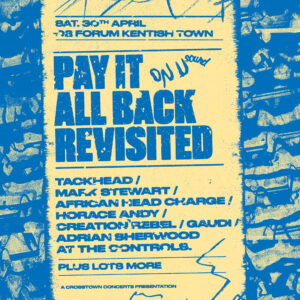
Gig Review: Mark Stewart & The Maffia/Tackhead @ The Forum, 30 April 2022

This was a twice-rescheduled London gig, initially designed to celebrate the 40th anniversary of On-U Sound Records.

And what a line-up was brought together to celebrate mixmaster general (and birthday boy) Adrian Sherwood’s iconic dub/funk/post-punk/industrial indie label (motto: ‘disturbing the comfortable, comforting the disturbed’): Creation Rebel, African Head Charge, Tackhead and Mark Stewart & The Maffia.

And what a pleasure to hear this music in a big hall, in front of a near-sell-out crowd. There were no half-measures here – this was an ageless performance from all the artists, and, refreshingly, also bone-crunchingly loud. Club gigs are all well and good but sometimes you need to hear this stuff in full effect.

Augmented by a striking set of projected visuals, taking in everything from Malcolm X to 1980s CND marches (On-U always championed agents of protest), Creation Rebel and Head Charge fused slow dubs and occasional bursts of metal guitar.

But the real draw was the return of Tackhead, their first London date for 14 years, and they didn’t disappoint – drummer Keith LeBlanc always swings even when tied to drum machines and loops, playing with dynamics and a killer right foot.

If there’s a greater contemporary rhythm section than him, bassist Doug Wimbish and guitarist Skip McDonald, I haven’t heard it – and these guys are not young any more. Joined by sermonising vocalist Bernard Fowler, they unleashed tracks taken mainly from their 1989 Friendly As A Hand Grenade album, excellent versions of ‘Stealing’, ‘Tell Me The Hurt’, ‘Mind At The End Of The Tether’, ‘Ticking Time Bomb’, and a brilliant take on ‘White Lines (Don’t Do It)’.

Mark Stewart, skulking around at the back of the stage for most of the Tackhead set, then took the mic, seriously pissed off with the state of the world – and who can blame him? He laid into ‘Hysteria’, ‘Liberty City’, ‘Passcivecation Program’ and ‘Resistance Of The Cell’ with the intensity of a man who knows everything he predicted 40 years ago has come to pass, but also found time to lead the crowd in a verse of ‘Happy Birthday’ for Sherwood.

Then, gig over and job done, Stewart was soon spotted in the stalls, chinwagging with fellow travellers. As he once said, the On-U audience is just as interesting as those on stage. Great gig.

TACK>>HEAD: Friendly As A Hand Grenade 30 Years On

Tackhead have always been ahead of their time, but no one could have predicted quite how prescient their 1989 album Friendly As A Hand Grenade would prove.

When Trump became president in 2016, Gee Vaucher’s brilliant cover artwork went viral, though one wonders how many people knew the image’s origins.

In a way that’s a good metaphor for the band’s career. A supergroup of session players, and arguably the ultimate post-punk band in their effortless fusion of hip-hop, P-funk, agit-prop, dub, house, gospel, blues and industrial, Tackhead have never quite hit the mainstream, even while their respective careers flourished with other artists.

And that’s probably exactly how they like it. Tackhead has always been a kind of musical petri dish for each member’s explorations, kind of a funk version of 1980s King Crimson.

Bassist Doug Wimbish, drummer Keith LeBlanc and guitarist Skip McDonald had of course hooked up during their legendary sessions for Sugarhill Records, and vocalist Bernard Fowler was one of the great singers on the ’80s New York scene.

Add London-based mixologist/dub innovator Adrian Sherwood and it was a whole new thang, mixing the latest sampling technology with classic funk-rhythm-section smarts.

And if their second album Friendly, released 30 years ago this weekend, hasn’t dated as well as hoped, that’s more down to its mastering limitations (not enough bottom end) and occasional dearth of quality original material.

But when it works it really works, a thrilling mix of heavy guitar, funk basslines, tasty grooves, soulful vocals and scary samples, usually with a political element.

‘Mind And Movement’ steals a march on Heaven 17’s ‘We Don’t Need This Fascist Groove Thang’, a funky missive against Margaret Thatcher’s late-’80s policing policies. ‘Stealing’ is a grinding, gospel-tinged rail against TV evangelists.

The two ska cameos are pure filler, but side two is much better, kicking off with the classic Tackhead theme tune ‘Airborne Ranger’, and gradually adding in elements of old-school hip-hop and early house.

Friendly was a hit, reaching #3 on the UK Indie album chart and reportedly selling over 100,000 worldwide. The majors smelt a hit; EMI subsidiary SBK came calling with a big advance and huge recording budget (LeBlanc puts it at around £250,000), resulting in the 1990 major-label debut Strange Things, which had some brilliant moments but has been been described by a few band members since as ‘crap’.

Arguably the better follow-up to Friendly was the 1994 Strange Parcels album Disconnection, credited as a ‘A Tackhead Re-Duction’.

Elsewhere, Wimbish went on to great things with Living Colour, McDonald formed the potent Little Axe and Fowler became a key member of the Rolling Stones touring entourage. And they all continued to work with fascinating On-U Sound outliers Mark Stewart and Gary Clail.

But the ‘real’ Tackhead sound has probably never adequately been captured on record  – the gigs were (and are) where it’s at (and highly recommended is their live anthology Power Inc. Volume Three).

There was a memorable March 1989 show at London’s Town & Country Club, and I went to many great gigs in the capital during the early 1990s and beyond. The band’s fans were (and are) an incredibly disparate bunch, from Whirl-Y-Gig crusties to B-boys and musos.

And they’re still with us. Don’t miss them if they come to your town – they’re still doing some of the best stuff out there.

Gig Review: Little Axe @ The Jazz Cafe, 18th November 2017

The 1980s featured a smorgasbord of great guitarists and Skip McDonald was right in the thick of it.

He started the decade playing on many classic Sugar Hill Records sides and ended it as a member of futuristic funk/rock titans Tackhead.

Since then blues-dub solo project Little Axe has been his chief musical outlet, a collaboration with legendary mixologist Adrian Sherwood and Sugar Hill cohorts Doug Wimbish on bass and Keith Leblanc on drums.

1994 debut The Wolf That House Built was a big critical success, but, after a run of middling albums through the noughties, Little Axe’s time somehow seemed to have come and gone.

Until now. It’s unclear whether the state of the world (and the White House) has given him a new lease of life but McDonald’s bittersweet missives seem tailor-made for these times. T

his packed one-off London gig – promoting impressive, surprisingly upbeat new album London Blues – saw McDonald joined onstage by Wimbish, Sherwood and drummer Andy Gangadeen.

Observing Sherwood was like watching a master cocktail-maker at work, adding his trademark delays and feedback loops with deft sleights of hand. The ageless Wimbish was in typically fine form too, creating mind-bending dub tones with some very nifty footwork – not for nothing has he occasionally referred to himself as the ‘Bruce Lee of bass’.

But McDonald’s impressive vocals were the star of the show, and he also seems to have found his electric guitar mojo again. Old favourite ‘If I Had My Way’ has never sounded so apt (‘These are demon days/It’s a time of chaos, rage and anxiety/Where you gonna be when two worlds collide?’) while new songs ‘Snake Oil’, ‘Factory Girl’ and ‘London Blues’ were instant earworms.

The latter could even make for a leftfield choice of single. Best of all though was chilling closer ‘Deep River’, an eerie death-dub with a central image of ‘a flower blooming in hell’, sounding a bit like an unlikely collaboration between Gregory Isaacs and Sarah Kane.

There was a slightly valedictory feeling to the end of the gig; Wimbish, Sherwood and McDonald’s farewells were possibly more heartfelt than usual.

It would be a great shame if this was the last we see of Skip’s Axe – the state of the world and a fine new album demand that he continue.