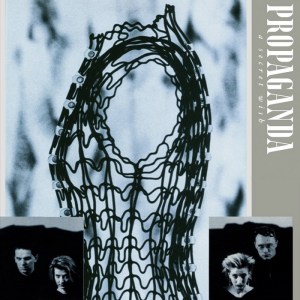
Propaganda: A Secret Wish 30 Years Old Today

propagandaTo many fans, A Secret Wish represents the peak of ’80s pop.

The glamorous though mysterious project was a flawed masterpiece but also the beginning of the end for big-budget, endlessly-fussed-over ‘concept’ albums.

It doesn’t really sound much like much else around in mid-’85 (though Pet Shop Boys and a-Ha were definitely listening), nor is it particularly similar to other ZTT releases or Propaganda’s subsequent albums.

A large part of the mystique is provided by Stephen Lipson’s pristine, widescreen production (Trevor Horn only produced ‘Dr Mabuse’), as well as his formidable mixing and guitar work (check out the extended mix of ‘Duel’). Claudia Brucken’s lead vocals are original and Suzanne Freytag’s spoken-word interludes carry unmistakable echoes of Nico (emphasised by their seriously weird ‘Femme Fatale‘ cover from the album sessions).

Yes guitarist Steve Howe contributes a nifty solo to ‘The Murder Of Love’ and David Sylvian has a hand in writing the gripping ‘p:Machinery’. But man of the match is ZTT house keyboardist Peter-John Vettese, purveyor of doomy soundscapes and intriguing chord voicings. Josef K’s post-punk classic ‘Sorry For Laughing’ is reinvented as a Wagnerian synth-pop anthem and there aren’t many more epic album openers than the majestic ‘Dream Within A Dream’.

Paul Morley, ZTT marketing/content man and former husband of Claudia Brucken, has talked about Trevor Horn and David Sylvian’s involvement in A Secret Wish:

Propaganda

‘When Trevor pulled out of producing them, I actually asked David Sylvian. While he was thinking about it, he came up with the ghostly top line of ‘P:Machinery’ – the music, if you like – and a gorgeous watery slowed down version of ‘Duel’, but he decided against producing them, and it stayed within the Sarm (London recording studio owned by ZTT label owners Trevor Horn and Jill Sinclair) pop factory. Actually, another sign of the split between sensibilities at the label: I asked David Sylvian to produce Propaganda and Jill approached Stock Aitken and Waterman!’

A Secret Wish wasn’t a huge hit and surely didn’t make back its sizeable recording costs, reaching just 16 in the UK album chart, but the singles ‘Duel’ and ‘p:Machinery’ both made the top 30.

The band picked up the first-class rhythm section of ex-Simple Minds pair Derek Forbes on bass and Brian McGee on drums (as well as Bowie/Dolby guitarist Kevin Armstrong) and toured the album extensively. I very clearly remember this performance on the BBC music show ‘Whistle Test’ in late 1985. Happy days:

Japan: Oil On Canvas 32 Years On

japan

First of all: the cover. As a teenager, I was instantly intrigued by Frank Auerbach’s artwork, and then the music very definitely lived up to the packaging.

But, though billed as such, it could hardly be called a ‘live’ album. In the recent band biography ‘A Foreign Place’, Jansen reports that the only ‘live’ elements on the album are his drums – everything else was replayed in the studio. Three excellent new all-studio tracks were added too. But Oil On Canvas was released six months after the band’s break-up and proved a near-perfect farewell from one of the key groups of the early ’80s.

The fact that it ended up as Japan’s highest-selling album (shifting over 100,000 in the UK and hitting #5) must have really irked manager Simon Napier-Bell – after year of toil, the band were calling it a day just as they were getting some commercial success (read ‘A Foreign Place’ for a full explanation of the split).

Tin Drum was great but who knows what they might have come up with as a follow-up given the giant strides they had made as musicians, songwriters and arrangers since ’81. Sure enough, within a few months of their split, Duran Duran were taking their sound and image to the bank.

The Oil On Canvas line-up, December 1982: Masami Tsuchiya, Richard Barbieri, David Sylvian, Steve Jansen, Mick Karn. (Photo by Fin Costello/Redferns)

The Oil On Canvas line-up, December 1982: Masami Tsuchiya, Richard Barbieri, David Sylvian, Steve Jansen, Mick Karn. (Photo by Fin Costello/Redferns)

There is so much to enjoy on Oil On Canvas. The Tin Drum tracks have added heft and a bit more air. David Sylvian’s vocals are warmer and more expressive than on the studio albums (though he has since virtually disowned this early singing style), and his Satie-esque title track prefigures the triumphs of his solo career.

‘Ghosts’ is extended with a superb Stockhausen-meets-serialism intro/interlude thrown in while ‘Canton’ becomes a mighty parade of musical colours, with clanging synths, whip-lashing china cymbals and the late great Mick Karn’s increasingly insane bass embellishments.

There has never been a rhythm section quite like Karn and Steve Jansen (drums) and probably never will be again. They revel in open spaces and ‘non-rock’ textures, typified by the deceptively simple and downright spooky ‘Sons Of Pioneers’.

Karn sounded like no one else on fretless bass, exploring Middle Eastern concepts and weird intervals to produce a sound both complex and hilarious. Jansen came up with several of the most ingenious backbeats in pop history while always making them danceable.

Together, they produced classic grooves like ‘Visions Of China’, ‘Cantonese Boy’ and ‘Still Life In Mobile Homes’, and Richard Barbieri’s creative keys playing always emphasises texture and mood over technique. His closing instrumental ‘Temple Of Dawn’ bids a fantastic album farewell first with a chill and then with a brief shot at redemption.

Sylvian escaped to a successful, innovative solo career, Karn also went solo and hooked up with collaborators including Midge Ure, Peter Murphy and, most memorably, Kate Bush. Barbieri and Jansen teamed up regularly in various projects and recorded together as The Dolphin Brothers in 1987 but didn’t enjoy much commercial success. Against all odds, they all got together again at the end of the ’80s for the intriguing Rain Tree Crow project.