Brit writer/director/auteur Mike Leigh is partly famous for his method of creating shooting scripts: he works with each actor in turn to develop a character, then formulates a story based on improvisations between the various characters.
But he wasn’t the only notable figure to work in that way. Les Blair, a Manchester college friend of his, was another. Blair devised and directed two superb Play For Todays for the BBC, ‘Blooming Youth’ (1973) and ‘Bet Your Life’ (1976), before embarking on a varied career including a few feature films.
But two of his most intriguing TV plays were made during the 1980s: ‘Honest, Decent & True’ (1986) and ‘News Hounds’ (1990). They make for fascinating viewing today, shining a light on two of the decade’s most lucrative and controversial industries: advertising and tabloid journalism.
Both star ‘Comic Strip’/’Young Ones’ comedy hero Adrian Edmondson, and he plays a blinder in both. In ‘Honest, Decent’ he’s a hapless, ethically-challenged ad man, in ‘News Hounds’ he’s a tabloid hack with the morals of a sewer rat. He brilliantly subverts his madcap image to play nuanced, troubling characters, and he’s clearly fond of these two films, focusing on them in some detail in his recent autobiography. It’s a shame he hasn’t been called on to play more serious roles in his career.
‘Honest, Decent’, which won a major award at the San Francisco Film Festival of 1986, also features a great cast including Arabella Weir, Gary Oldman and Richard E Grant in his first screen role and only credit before ‘Withnail’. Grant nicely embodies the kind of ‘liberated’, louche, humourless ad man you’d come across in the 1980s, into Asian architecture, yoga and new-age music, probably driving an Audi Quattro too.
Elsewhere Leigh veteran/ex-wife Alison Steadman shows up in ‘News Hounds’ to brilliantly portray a celebrity interviewer, pitched somewhere between Nina Myskow and Lynn Barber. It’s another classic performance, and reportedly one of her favourite roles.
It’s nice to revisit these amusing, almost-forgotten movies on some hot-button topics of the ’80s (and ‘News Hounds’ is still extremely relevant courtesy of the Leveson Enquiry and its reverberations). As for Les Blair, apparently he’s still teaching at the London Film School, an alumnus of which is one M. Leigh…
London-born filmmaker Nicolas Roeg, who has died aged 90, will surely be remembered as one of the all-time greats.
He began his career as either lighting cameraman or director of photography on some key films of the 1960s: ‘The Caretaker’, ‘Doctor Zhivago’, ‘Lawrence Of Arabia’, ‘The Masque Of The Red Death’, ‘Far From The Madding Crowd’, ‘Fahrenheit 451’. He then of course co-directed (alongside Donald Cammell) the astonishing Mick Jagger vehicle ‘Performance’.
Roeg went to to make some of the finest films of the 1970s – ‘Walkabout’, ‘Don’t Look Now’ and ‘The Man Who Fell To Earth’, and began the 1980s staking a claim to being England’s greatest living director.
And that was when his films really came alive for me. Many of the above were shown regularly on terrestrial TV during the decade. Then came a series of always-surprising new works, some of which also transferred quickly onto the small screen.
‘Bad Timing’ (1980) was a brutally candid portrayal of a love affair gone wrong, starring Art Gartfunkel and Theresa Russell in the first of her memorable lead roles for then-husband Roeg (a role that was apparently first intended for Sissy Spacek).
‘Eureka’ (1983) is little seen these days and almost totally forgotten, but it’s unpredictable and brilliant. Gene Hackman heads up a superb cast including Mickey Rourke, Joe Pesci, Russell and Rutger Hauer. ‘Insignificance’ (1985) was a film to match the best of Roeg’s ’70s output, a what-if tale based on Terry Johnson’s play about a meeting between Marilyn Monroe, Joe DiMaggio, Joseph McCarthy and Albert Einstein.
‘Castaway’ (1986), a desert-island survival tale starring Oliver Reed and based on Lucy Irving’s bestselling book, was given a critical mauling but these days still looks like an incredibly vital film. ‘Track 29’ (1987) was, if anything, even stranger, a Dennis Potter-penned story about a demented manchild, with Gary Oldman and Russell the memorable leads.
And Roeg finished off the decade with a fine adaptation of Roald Dahl’s ‘The Witches’ (1990), well worth digging out for the kids this Christmas if you’re after some mildly-menacing, icky fun. Farewell to a bona fide Brit movie hero.
Nicolas Jack Roeg, 15 August 1928 – 23 November 2018
There definitely seems to be something in the London air this summer.
The Grenfell Tower tragedy and various other events have brought some deeply unpleasant issues to light (again).
Revisiting Mike Leigh’s 1983 TV film ‘Meantime’ recently, it seemed eerily relevant. A withering portrait of Thatcher’s Britain featuring a brilliant cast, it’s still a striking piece of work, at times difficult to watch but finally offering cause for hope.
Its essential Englishness also echoes through the work of Suede and Blur; an alternative soundtrack might include ‘My Insatiable One’ or ‘Bank Holiday’.
Mainly set and shot in Haggerston, East London, ‘Meantime’ focuses on two generations of the Pollock family: parents Frank (Jeffrey Robert) and Mavis (Pam Ferris); their sons Colin (Tim Roth) and Mark (Phil Daniels); Mavis’s sister Barbara (Marion Bailey) and her husband John (Alfred Molina).
Frank, Mavis, Colin and Mark live in a rundown council high-rise (Bryant Court in Whiston Road, where a two-bedroom flat now goes for £330,000) while Barbara and John have escaped to middle-class respectability in Chigwell, Essex.
From Uncle John’s condescending opening line – ‘Barbara, the boys can take their shoes off and leave them in the kitchen, all right?’ (note that he doesn’t tell Colin and Mark himself) – we know we’re deep in Leighland. The performances are uniformly superb, with Roth, Daniels and Bailey possibly never better.
Oldman delivers a remarkable turn as the skinhead Coxy, smashed on the Special Brew, looking for trouble but also deeply vulnerable, while Peter Wight is excellent as the insouciant, blithely idealistic estate manager.
Gary Oldman as Coxy
Mark, Colin, Coxy and Frank are stuck in a grim, sometimes demeaning cycle of unemployment, but there seems to be glimmer of hope when Auntie Barbara offers Colin a painting job in her home. Mark has other ideas. Anyone growing up in London during the early 1980s knew kids like Colin, Mark and Coxy. The latter two are quick-witted and sharp but totally wasted, with no structure in place for them to thrive.
Andrew Dickson’s soundtrack – a duet for tack piano and soprano sax – is unforgettable. And, for a director known more for his characters and situations than a visual sense, Leigh comes up with many striking images: Mark and Coxy dodging the falling detritus from a freshly-bulldozed block of flats; Colin wandering uncertainly in front of the Winston Churchill statue at Woodford Green; Coxy rolling around a giant, hollow metal canister, attacking its insides impotently with a stick.
I asked legendary TV producer Graham Benson about his memories of working on ‘Meantime’ (which you can watch in HD below, at least until it’s taken down…).
MP: How did you come to the project and what was its genesis? I gather it was your first (and only) experience working with Mike Leigh.
GB: Yes, it was my one and only time working with Mike and a very enjoyable, rewarding time. The producer’s job is very much one of support, encouragement and of being there when needed in various aspects of the films progress. We initially wanted to make a feature film when I was running Robert Stigwood’s European film and TV company. We nearly got a deal with Warner Bros but the lack of script (Leigh famously develops his scripts through intensive improvisations in collaboration with the actors – Ed) scared the moguls. Eventually a combination of Channel 4 and David Rose together with Central Productions and Margaret Matheson delivered the commitment and budget. I am pleased and proud to have been a part of Mike’s journey and have to say that producing a Mike Leigh film was an example in my career of working with a supremely professional, responsible, collegiate and multi-talented film-maker, and a good-humoured, decent bloke to boot!
‘Meantime’ was made for Channel 4. It’s hard to imagine such a hard-hitting feature-length film getting shown on a terrestrial station today. Do you see that period as a golden age for British TV?
Well, Channel 4 were Mike Leigh enthusiasts as they remain now. He’s always had them and the BBC. I don’t see why it couldn’t be made now really. These days he has other places in Europe to go and get additional monies – for now, anyway…
The film showcases an incredible array of Brit acting talent: Marion Bailey, Gary Oldman, Tim Roth, Peter Wight, Pam Ferris, Alfred Molina, etc etc. Did you have any casting input?
We discussed the casting as we went along. It was a stunning cast but they were all much less well-known then. Like so many others, they were cutting their teeth on hard-hitting UK dramas.
Though often a difficult watch, the ending arguably shows chinks of light – Barbara finally stands up to John and the two brothers seem to come to a new understanding. Is that how you see it?
Yes. Though it’s a bleak and critical view of Thatcher’s Britain, it is a hopeful film. The human spririt will win through. But we must be watchful, as we see today.
What do you think is the legacy of the film, if there is one?
Oh, it proved Mike could handle a wider canvas and could deal with a slightly bigger budget. It solidified his method of working as a successful one and a genre all of its own. Soon afterwards he’d get his opportunity on the bigger screen.

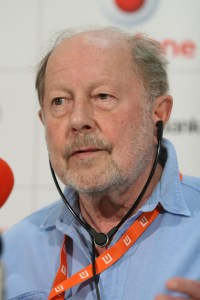 London-born filmmaker Nicolas Roeg, who has died aged 90, will surely be remembered as one of the all-time greats.
 There definitely seems to be something in the London air this summer.
 movingtheriver.com