
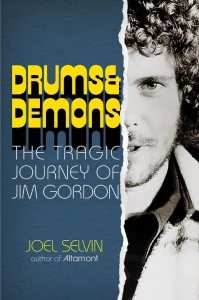
 Pop quiz: what do the following tracks have in common? Beach Boys’ ‘Good Vibrations’, Derek and the Dominos’ ‘Layla’, Steely Dan’s ‘Rikki Don’t Lose That Number’, Frank Zappa’s ‘Apostrophe’, Minnie Riperton’s ‘Inside My Love’, The Incredible Bongo Band’s ‘Apache’ and Carly Simon’s ‘You’re So Vain’.
They all feature drummer/percussionist Jim Gordon, who between the mid-‘60s and mid-‘70s was probably the most recorded and celebrated studio drummer in the world (declaring an interest here too: movingtheriver basically learned how to play drums by copying Gordon’s playing on Steely’s Pretzel Logic).
He brought pinpoint time-keeping, smooth grooves, razor-sharp song sense and technical mastery to the kit, but was also a deeply troubled individual whose schizophrenia – exacerbated by drug and alcohol issues – ultimately led to a tragic and shocking crime. He was incarcerated for murdering his mother on 3 June 1983, and died in prison during 2023.
But how did this good-looking, popular, all-American kid end this way? As experienced rock journo and author of ‘Altamont’, ‘Monterey Pop’ and ‘Sly and the Family Stone: The Oral History’, Joel Selvin is perfectly placed to tell this dark tale, and he honours both Gordon’s victim(s) and the drummer himself with a sober, unflinching account.
With the counsel of Gordon’s friends, family members and associates, Slavin outlines his meteoric rise to the top of the music business, the first half of the book featuring entertaining, detailed accounts of work with various Beatles, the Everly Brothers, Joe Cocker, Frank Zappa, Brian Wilson, Jackson Browne and Carly Simon. (The section on Gordon’s tenure with Eric Clapton is particularly illuminating and shocking – the guitarist does not come out well at all…)
The second half descends into very murky waters. There’s shocking evidence of Gordon’s physical abuse of singer/songwriter Rita Coolidge (and his and Clapton’s refusal to give her songwriter credit for ‘Layla’) and great detail about his struggles to get help for schizophrenia and addiction problems.
In fact ‘Drums & Demons’ is an absolute eye-opener with regard to schizophrenia, the voices inside Gordon’s head (tragically, mostly his mother’s) apparently denying him food, amongst other things, and moderating all aspects of his lifestyle.
And if Selvin never quite technically explains why Gordon was such a drum hero (Jim Keltner, Andy Newmark and Jeff Porcaro were huge fans/advocates), the passion for his subject and respect for the drum community as a whole come through loud and clear.
‘Drums & Demons’ joins Bill Milkowski’s ‘Jaco’ and Rob Chapman’s ‘Syd Barrett: A Very Irregular Head’ in the upper echelons of books about gifted, unwell musicians finding themselves alone when the circus has left town. It also perfectly outlines the boom and bust of the studio session scene.
Although at times a difficult, disturbing read, it’s gripping and slickly-written, and highly recommended.
 Jeff Porcaro laid down one of the greatest recorded drum performances of all time on the Toto song ‘Rosanna’, recorded at Sunset Sound in Los Angeles in December 1981.
 movingtheriver.com