Protest Songs @ 40: Prefab Sprout’s Best Album?

Speedily recorded 40 years ago this autumn at Newcastle’s Lynx Studios, Protest Songs was intended to be the no-frills, lo-fi, rush-released, ‘answer’ album to Prefab’s Steve McQueen.

Fans who attended the Two Wheels Good UK tour of October and November 1985 were given leaflets advertising its release on 2 December for one week only.

But then ‘When Love Breaks Down’ reached #25 at the third attempt, earning the band spots on ‘Top Of The Pops’ and ‘Wogan’, and the album was shelved (though apparently a few hundred white labels ‘escaped’ from CBS and are out there somewhere…)

Protest Songs was eventually held back until June 1989, but proved well worth the wait and reached a respectable #18 on the UK chart. This writer would put it right up there with Steve, From Langley Park To Memphis and Jordan, maybe even above them…

The album was produced by the band and – apart from the last-minute addition ‘Life Of Surprises’ – mixed by Richard Digby Smith, once a staff engineer at Island Records who served his apprenticeship under the likes of Arif Mardin, Phil Spector, Muff Winwood and Chris Blackwell.

Protest also showed that Patrick Joseph McAloon was turning into a really decent keyboard player (he later claimed that every song on Langley Park was written on keyboards) and that – massively helped by drummer Neil Conti – Prefab were becoming a really good live band.

But most importantly Protest is a moving, razor-sharp suite of songs. Paddy was operating at the absolute top of his game, with some of the anger which had initially been so attractive to Thomas Dolby (also detectable in this recently discovered interview).

The only thing tongue-in-cheek about it is its title. These were not protests against nuclear power or war, but rather against deprivation and, just six months on from the miners’ strike, the general media condescension about provincial English life (particularly in the McAloon brothers’ native North East) under Thatcher.

‘Til The Cows Come Home’ may be the killer track. If you’re in the mood, it can be a real heartbreaker. The superb lyrics deftly change perspective mid-thought and allude to how unemployment affects generations:

Aren’t you a skinny kid?
Just like his poppa
Where’s he workin’?
He’s not workin’…

Why’re you laughin’?
You call that laughin’?
Wearing your death head grin
Even the fishes are thin…

He can’t have his coffee with cream

Meanwhile ‘Diana’ was revamped from the ‘When Love Breaks Down’ B-side (Deacon Blue definitely listened to THAT), slowed down and with a few new chords added. Conti expertly marshals proceedings with his tasty Richie Hayward-style half-time groove.

‘Dublin’ showcases Paddy’s lovely sense of chord movement, with a little influence from bossa nova (here’s Paddy playing a different studio take). ‘Life Of Surprises’ and ‘The World Awake’ are shiny, synth-laden, mid-period 4/4 Prefab but with stings in their tails:

Never say you’re bitter, Jack
Bitter makes the worst things come back

You don’t have to pretend you’re not cryin’
When it’s even in the way that you’re walkin’…

The hilarious ‘Horsechimes’ investigates school-day piss-taking, with a large dollop of Salingeresque satire. Meanwhile it’s hard to think of a more perfect marriage of words and melody than ‘Talking Scarlet’ (also drastically slowed down from the early demo), while ‘Pearly Gates’ closes out the album in moving style, like a dimly-remembered hymn from school days, a rare 1980s ‘death disc’.

The only partial misfire is the jaunty ‘Tiffany’s’, with its comically poor guitar solos, but its inclusion was totally understandable. Happy birthday to a classic.
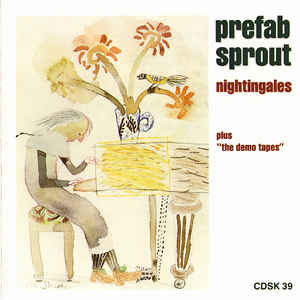
Story Of A Song: Prefab Sprout’s ‘Nightingales’ (1988)

Prefab Sprout’s 1988 album From Langley Park To Memphis was their pop breakthrough, reaching #5 in the UK charts, and is probably most casual fans’ favourite.

But let’s take a close look at the fifth track, the epic ‘Nightingales’. Featuring Stevie Wonder on harmonica and released as the fourth single from From Langley Park in November 1988, it remains one of Prefab’s most beguiling songs.

Written by Paddy McAloon under the influence of Barbra Streisand’s Broadway Album, it’s a stellar piece of work by any standards; melody, harmony and lyric are inextricably linked, as if the song had always existed and was just plucked out of the air.

Thought follows thought, musical idea follows musical idea completely naturally, without any songwriter ‘tricks’ such as looped chord sequences or vamps.

It’s fair to say that by the time of From Langley Park’s recording, McAloon was becoming a proficient pianist; eight of ten songs on the album were written on keyboards, including ‘Nightingales’.

Its harmonic concept, with an emphasis on major-seventh chords (including an audacious jump from F#m7 to Cmaj7 in bars four and five of the chorus) and triads superimposed over apparently unrelated root notes, possibly reveals a Brian Wilson influence, but the final effect is more Stephen Sondheim than ‘Surf’s Up’.

‘Nightingales’ also has no apparent antecedents in the 1980s pop firmament, though, at a stretch, approaches one of Green Gartside and David Gamson’s gossamer Scritti Politti ballads.

In a year when Acid House and the ‘Madchester’ sound were gestating and Stock Aitken Waterman ruled the charts, McAloon delivered something unabashedly romantic and somewhat old-fashioned; the opening line (‘Tell me do, something true‘) and general tenor of the lyric are more akin to ‘Daisy Bell’ than anything by the Stone Roses (and Paddy made no secret of his general distaste for late-’80s pop).

The song’s protagonist analyses his love affair, asking his paramour whether their love is fleeting like a ‘firework show’ or whether it’s a lasting, valuable entity. They agree that such questions are unhelpful and/or irrelevant – the key is to live in the moment.

‘Nightingales’ was co-produced by Jon Kelly and McAloon. By 1987, London-born Kelly was an experienced, highly-regarded producer and engineer, probably best known as one of Kate Bush’s key early collaborators on the classic 1980 album Never For Ever.

He had also worked on successful albums by Chris Rea (Dancing With Strangers) and Paul McCartney (Ram) and just produced Deacon Blue’s debut album Raintown, the latter definitely influenced by Prefab.

Double and triple-tracked keyboard parts dominate ‘Nightingales’, played by McAloon and legendary British session player Wix, AKA Paul Wickens. They closely follow the chord voicings of McAloon’s original acoustic piano demo, echoed on this lovely live version from 2000:

By the time of the first chorus, sampled sleigh bells and silky Synclavier drums are added to the mix alongside McAloon’s rather incongruous but effective (sampled?) banjo. Robin Smith’s widescreen string arrangement becomes increasingly prominent throughout the track; particularly notable is a flurry of ascending, almost celestial notes in three distinct phases beginning at 2:14 (and check out the rustle of fake locusts at 4:26!).

Stevie Wonder had long been a hero of McAloon’s, the album Journey Through The Secret Life Of Plants being a particular favourite. Mentioning as much to Prefab manager Keith Armstrong one day, Paddy half-joked that a Stevie harmonica solo on ‘Nightingales’ would really bring the track to life.

Armstrong stunned McAloon by informing him that he was a good friend of Wonder’s operations manager Keith Harris and would put in a good word for the band (it’s also worth noting that Wonder played some sublime harmonica on Thomas Dolby’s ‘Don’t Turn Away’ a year before the recording of ‘Nightingales’ – perhaps Thomas gave the band a good reference…).

Wonder’s harmonica solo for ‘Nightingales’ was recorded in a very rushed session during September 1987 at Westside Studios in Notting Hill, West London. He apparently learnt the song quickly, disappearing into a corner of the studio with a rough mix on his Walkman, and then recorded two takes in the lower octave and two in the higher. The released solo is a composite of the four.

Richard Moakes was the young engineer tasked with capturing Wonder’s solo on tape. According to McAloon:

He (Moakes) looked at me and said, ‘Oh God, I’m a bit worried I won’t know how to get his sound’. I said, ‘Well, look, we’ll just see what happens’. And of course you put the microphone on him and you turn the fader up and he sounds like Stevie Wonder. You don’t do anything. Unless you’re doing something really silly, you’ll get it and it will be identifiable. So I thought, OK, when you play a guitar, don’t blame an engineer if you don’t know what you’re doing…

New York mix engineer Michael Brauer cooked up the 12” version of ‘Nightingales’. He made some drastic changes from the 7” single, placing the sleigh bells right at the front of the mix, reinstating some of Wendy Smith’s stacked backing vocals originally left on the cutting room floor, stripping McAloon’s lead vocal of its reverb (though adding a lot more to the snare drum) and leaving more space for Smith’s string arrangement and McAloon’s banjo.

A video was also made, though it’s almost impossible to track down these days.