Movie Review: Killers Of The Flower Moon (2023)

Based on David Grann’s non-fiction book about series of mysterious deaths among the Osage Native American tribe in 1920s Oklahoma, Martin Scorsese’s new three-and-a-half hour movie is currently in the middle of a brief cinema run before showing on Paramount + (who also co-financed alongside Apple TV).

A new Scorsese movie is always an event. Co-starring Leonard DiCaprio, Robert De Niro and Lily Gladstone, ‘Killers Of The Flower Moon’ is another epic ‘creation of modern America’ movie, the flipside of ‘Goodfellas’, ‘Casino’, ‘The Irishman’, ‘Once Upon A Time In America’ and ‘The Godfather’, whilst also nodding to the oil boom of the 1920s and development of the FBI (‘Killers’ was reportedly reformatted during the Covid era to focus less on the FBI and more on the Osage).

The first thing to address is the giant running time. It’s quite extraordinary – and sometimes quite a challenge – watching a three-and-a-half-hour movie in 2023. And if, at times, it feels very much like an elongated TV show, its huge budget is all up there on the screen, with peerless attention to detail, meticulous mise en scene and truly hefty star performances.

You’re in the hands of a master, though Scorsese fans wanting elaborate camera movements and zippy set pieces will be disappointed – this is a sober, slow film, gaining its power from an accumulation of moods and images.

But ‘Killers’ is a true story of such simple, unremitting horror that you may also question why you are sitting so passively watching an exceptionally unpleasant, shameful episode in American history – all very apt in a long, non-fiction book or article, less so in a feature film of such extreme length.

One generally wants to look away from the casual, regular violence, unpleasantly forensic detail and focus on sometimes passive, unwell women. There’s exposure of intense anxiety and physical threat to child actors. There are also many longeurs, often undercut by Robbie Robertson’s pretty much wall-to-wall music (influenced by Kubrick’s ‘Barry Lyndon’ and ‘The Shining’?) with occasional Daniel Lanois-esque ‘funky’ breakdowns and slightly disconcerting inserts of blues and bluegrass.

But it’s the performances that linger longest in the mind after viewing. It’s thrilling watching intimate ‘behaviour’, as per Scorsese’s assessment of Marlon Brando in ‘On The Waterfront’, played out in the midst of such an epic, sprawling movie.

There are two key De Niro/DiCaprio stand-offs – it’s an absolute treat to see these two actors sparring on the big screen at such close quarters (and remember De Niro gave Leo his first big break in ‘This Boy’s Life’).

For his part, DiCaprio channels Brando, jutting out his bottom jaw, desperate to dial down the joie de vivre, excellently portraying a weak man who just wants to be left alone to enjoy money and gambling but is drawn into evil deeds. De Niro, in the meantime, seems to channel Trump. Gladstone burns very brightly during the first hour of the picture but fades fast, through no fault of her own, despite regrouping for a powerful final scene with DiCaprio.

There are shades of ‘Goodfellas’ and ‘The King Of Comedy’ in the film’s finale which summarises the hideous plot via a trite, ‘comic’ supper-theatre show, enjoyed by a middle-class audience and featuring a weird, uncharacteristically emotional cameo from the director.

So ‘Killers’ is not exactly Marty’s ‘Heaven’s Gate’ but a disappointment after ‘The Irishman’. Movingtheriver would put it alongside ‘Gangs Of New York’, ‘The Aviator’ and a few others in the ‘heroic failures’ camp. But is it worth seeing on the big screen? Of course. And Scorsese turns 81 on 17 November.

The Cult Movie Club: Great Swearing From The 1980s

We all know good movie swearing when we hear it.
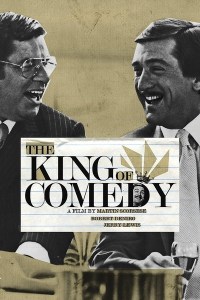
From Richard E Grant’s gloriously-English ‘Monty, you terrible c*nt!’ (‘Withnail & I’) to Harvey Keitel’s epochal ‘You rat-f*ck!’ (‘Bad Lieutenant’), modern cinema was made for despicable language.

Your mum told you that cursing was a sure sign of a limited vocabulary, but try telling that to writer/directors David Mamet, John Hughes, Bruce Robinson and Oliver Stone, who consistently broke out the memorable humdingers.

To celebrate the cinematic four-letter word, we proudly present some of the best swear scenes of the 1980s, in no particular order. A few rules: no cartoons, because…I hate them. And it has to be dialogue, not a stand-up routine or monologue. And yes, a few of these movies were released in 1990 but surely shot in ’89 (and I need them in the list…).

WARNING: this piece is rated X, not suitable for minors or those easily offended…

7. ‘Casualties Of War’ (1989)
We start with the only ‘serious’ item in the list, a well-placed profanity during one of the more poetic dialogue scenes in this underrated David Rabe-penned, Brian De Palma-directed drama.

6. ‘Planes, Trains And Automobiles’ (1987)
Steve Martin’s ’70s stand-up act wasn’t particularly known for the four-letter tirades, but he had his moments (including the memorable skit on The Steve Martin Brothers album that begins: ‘Well, good evening, motherf*ckers…’). But this endlessly-watchable John Hughes-penned blowout had even Steve’s hardcore fans hiding behind the sofa. The scene is also notable for featuring the brilliant Edie McLurg.

5. ‘Scarface’ (1983)
De Palma’s drama is surely the doyenne of swear movies, so we won’t pick out a single Oliver Stone-penned humdinger but rather itemise the entire film’s swearing thus. Thank you, YouTube (according to an urban myth, the band Blink-182 were named after the amount of f-words Pacino drops in ‘Scarface’).

4.Withnail & I’ (1987)
Impossible to leave out Bruce Robinson’s sweary masterpiece, a killer in almost every line of dialogue. But every profanity in the film earns its keep, none more so than this panic-stricken classic.

3.This Is Spinal Tap’ (1983)
Apparently performed very much under the influence of the notorious Troggs Tapes, this beautifully conjured the annoyances of a duff recording session. I particularly like David St Hubbins’ (Michael McKean) moment of total exasperation, when words begin to fail him. Here’s the full uncut version:

2. ‘The Godfather Part 3’ (1990)
Pacino again, and why not? When Shouty Al gets going, there’s always a good chance he’s going to deliver some quality swearing. In this unsung sequel, he remains fairly buttoned up until basically going ballistic…

1. ‘Goodfellas’ (1990)
Tommy (Joe Pesci) meets ‘old friend’ Billy Batts (Frank Vincent) who is none too complimentary about the days when Tommy used to shine shoes…

BONUS! Let’s extend our look at great swear scenes into the 1990s. Because we can…

4. Bad Lieutenant (1992)
The Bad Lieutenant (Harvey Keitel) is driving his two young sons to school.

Boy 1: Aunt Wendy hogged the bathroom… All morning we couldn’t get in… So how are we supposed to be on time?
The BL: Hey, listen to me. I’m the boss, not Aunt Wendy. When it’s your turn to use the bathroom, tell Aunt Wendy to get the f*ck out. What are you, men or mice? If she’s hogging the bathroom, call me, I’ll throw her the f*ck out…

3. One False Move (1992)
Pluto (Michael Beach) and Ray (Billy Bob Thornton) drive along having a row about the money they’ve stolen, which Ray may have given to his girlfriend…

Pluto: Where’s my f*cking money, Ray?
Ray: I said I ain’t got any money. She took the f*cking money, all right? I’ve got 56 f*cking dollars, she took it, now let me go.
Pluto: You’re a pussy-whipped motherf*cker!
Ray: Don’t throw that sh*t at me, man. They’re your f*cking buddies back there that don’t have any money. That good friend of yours, Billy.
Pluto: I don’t know what the f*ck I’m doing with you, man! You’re a pussy-whipped, sorry-assed motherf*cker!

2. Glengarry Glen Ross (1992)
Blake (Alec Baldwin) turns up at a real estate office and makes his presence felt amongst the salesmen…

1. Fargo (1996)
Carl (Steve Buscemi) wants to leave a car park but the Attendant (Don William Skahill) isn’t making it easy…


The Cult Movie Club: The King Of Comedy (1982)

Looking at the trailer and publicity for James Franco’s Tommy Wiseau biopic ‘The Disaster Artist’, it’s hard to ignore the ‘King Of Comedy’ comparisons. 
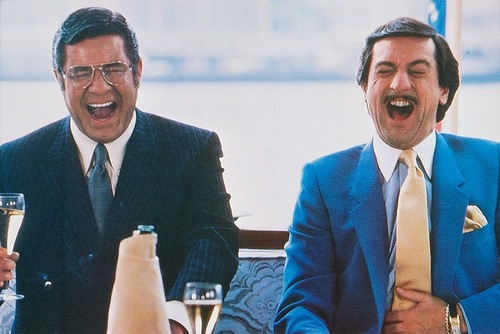
Featuring Robert De Niro’s fascinating and detailed turn as anti-hero Rupert Pupkin, Martin Scorsese’s classic black comedy was released 35 years ago today.

If Wiseau didn’t actually exist, Hollywood would probably have to invent him. Recent American cinema is full of Wiseaus and Pupkins – desperate characters, probably a few cards short of a full deck, who will do almost anything to make it.

Pupkin passive-aggressively stalks celebrities for their autographs, but then comes to believe that he is owed a shot at fame. Talk-show host Jerry Langford (Jerry Lewis) is his passport to success – Pupkin and disturbed rich-girl Masha, brilliant played by Sandra Bernhard, kidnap him. Pupkin then demands the opening monologue on Langford’s nightly TV show.

Jerry Lewis and Robert De Niro in character

If ‘The King Of Comedy’ had been made today, it would probably be hailed as a modern classic, a fable for our times, a coruscating attack on narcissism, celebrity culture and unchecked ambition.

It’s ‘Nightcrawler’ meets ‘Curb Your Enthusiasm’. But it stiffed on its original release (not helped by a substandard trailer – see below), grossing barely $3 million against a $19 million budget.

The studio didn’t know how to market it, trying to sell it as a knockabout comedy. Scorsese sensed the bad vibes gathering around the film long before it was released, telling writer Peter Biskind, ‘A close friend of mine told me “The buzz is bad.” I hate that. When the buzz is bad, people don’t want to be associated with the picture. But they were right – the film was a bomb. It’s called “The King Of Comedy”, it’s Jerry Lewis, and it’s not a comedy. Already it’s a problem…’

Yes, it sometimes feels like a succession of skits strung together, almost in the style of Brian De Palma’s early films ‘Greetings’ and ‘Hi Mom’. And it would be nice to get a bit more access to Pupkin and Masha’s backgrounds.

But Scorsese, Lewis, De Niro and Bernhard, working instinctively from ex-Newsweek film critic’s Paul D Zimmerman’s slight but intriguing story, create something toxic and completely memorable.

Scorsese fills the screen with significant minor characters, mainly playing themselves and recruited from the ‘real’ TV world, and he obviously has deep respect for Lewis and all he stands for (though has less respect for the all-pervading, gossipy influence of TV culture).

Bernhard, prodded by De Niro, is superb, given free rein by Scorsese to improvise freely: ‘I cover the waterfront, remember that!’ she bawls at Pupkin, just before one of the director’s typically bracing cuts.

There are many excruciating moments: Pupkin’s arrival at the Langford house (De Niro apparently screamed antisemitic abuse at Lewis to elicit the correct level of outrage in his response to having his golf game interrupted) and Masha’s ‘seduction’ of Langford. Is his violence towards her ‘justified’?

And then there’s Pupkin’s monologue, shown in one long take with no cutaways – Scorsese and De Niro dare us to laugh at this schmuck, and it’s unsettling when one or two of his gags hit the spot.

‘The King Of Comedy’ is the De Niro/Scorsese collaboration I return to the most. Nobody gets killed, but a lot of people get hurt. Very hurt indeed.

And it bears repeated viewings: recently I noticed an intruder in the restaurant scene where Pupkin tries to persuade his ‘girlfriend’ Rita to accompany him to Langford’s. Check him out. He’s behind Pupkin, mocking him throughout. I take it he’s supposed to stand in for the entire film-going audience.

Robbie Robertson (1987): 30 Years Old Today

robbie robertson

Robbie had a strange old ’80s.

He began the decade acting alongside Jodie Foster in weirdo circus movie ‘Carny‘ before becoming Martin Scorsese’s best buddy and music consultant on ‘The King Of Comedy’ and ‘The Colour Of Money’.

He ended it by making one of the best debut albums of the era – at 44 years old.

I didn’t have a clue about Robertson’s ‘mythical’ past as a founder member of counterculture heroes The Band when I first heard his superb ‘Somewhere Down The Crazy River’ single (which made #15 in the UK singles chart) in autumn 1987.

But I was sold immediately. I think it was Robbie’s beguiling film-noir vocal, the delicious Manu Katche/Tony Levin rhythm section (check out Levin’s little countermelody in the song’s opening minute) and swirling Daniel Lanois ‘gaseous effect’ (as Q magazine memorably dubbed the Canadian’s production style). Certainly there were echoes of Peter Gabriel’s So.

Everywhere you look on Robbie Robertson there are modern classics. Gabriel himself supplies synth and vocals to the majestic opener ‘Fallen Angel’ (dedicated to Robertson’s former Band-mate Richard Manuel) and trademark Yamaha CP-300 piano to the anthemic ‘Broken Arrow’ (later covered – rather disastrously – by Rod Stewart).

The superb ‘Sonny Got Caught In The Moonlight’ features yearning backing vocals from Band-mate Rick Danko. ‘American Roulette’ is a coruscating portrait of US celebrity culture; the first verse concerns James Dean, the second Elvis and the third Marilyn. There’s some top-class rhythm section work from Levin and drummer Terry Bozzio and intriguing keyboard playing from another ex-Bandmate Garth Hudson.

‘Showdown at Big Sky’ and harrowing, Vietnam-themed, almost Clash-like ‘Hell’s Half Acre’ rock hard but with enormous finesse, mainly thanks to Katche.

Robertson’s voice has power and presence. In the main, synths are eschewed in favour of Lanois’s ambient textures and Bill Dillon’s ethereal guitars. Robbie himself supplies some biting, Roy Buchanan-ish Tele leads here and there. Bob Clearmountain works his magic on the mix. We’ll pass swiftly over the two U2 collaborations.

But Robbie Robertson is a corking debut and fascinating companion piece to Joni Mitchell’s Chalk Mark In a Rainstorm, Steve Winwood’s Back In The High Life, Neil Young’s Freedom and Bob Dylan’s Oh Mercy (and possibly trumps all of ’em). 

This was a really interesting era for the heroes of the ’60s and ’70s. Live Aid – featuring such strong showings by Jagger, The Who, Queen and Bowie – had given the older guys a new lease of life and reason to get back out there.

However, Robbie Robertson was surprisingly somewhat of a disappointment sales-wise, only reaching #38 in the US and #23 in the UK.