Gig Review: Mel Gaynor @ 606 Club, 25 September 2025

Mel Gaynor spent almost 30 years playing superb drums with Simple Minds in studios, stadiums and sports halls across the globe.

But it’s also oft-forgotten that he was also one of the key British session drummers of the 1980s, working with Joan Armatrading, Elton John, Heaven 17, Pretenders, Kirsty MacColl and others (and, in a 1992 Sunday Times poll, was named the world’s best rock drummer by Stewart Copeland, no less).

So it’s always interesting seeing such behemoths of the drums in tiny venues, often un-mic’d and playing small kits. And they don’t come much more intimate or friendlier than the 606 – though the club always has excellent acoustics.

Gaynor’s latest live project eschews the heavy rock of last year’s Come With Me album and returns him to the fusion and jazz/funk of his youth (he started his career playing with Britfunk legends Central Line), alongside pianist John Watson, who has also worked with Sister Sledge, Imagination and Mica Paris, and impressive young bassist Issy Brown. On this gig, they were also joined by MOBO and Mercury-winning saxophonist Denys Baptiste – a real coup.

A fit, healthy and happy-looking Gaynor settled behind the kit with no fuss and counted off ‘Got The Message’, a Crusaders-style, medium-tempo slow-burner, with Baptiste outlining a pretty melody and Brown digging in with excellent tone and judicious use of his low B string. Gaynor was the epitome of taste and groove here, but still found time for one explosive ‘Alive And Kicking’-style snare fill towards the end.
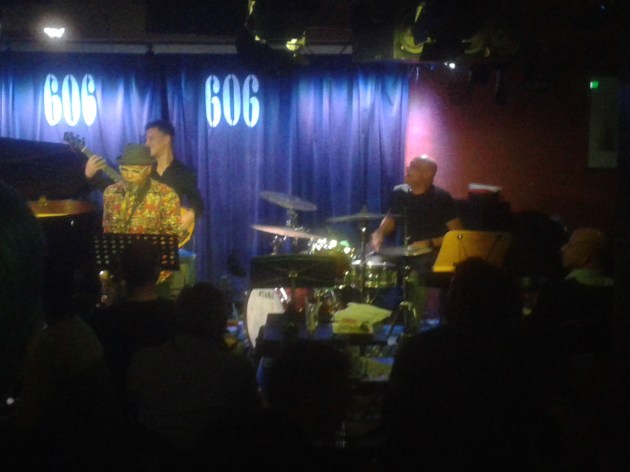
Denys Baptiste, Issy Brown and Mel Gaynor @ the 606

‘Beyond The Stars’, touchingly dedicated by Gaynor to his late father, started with an African-tinged 6/4 drum loop, before settling into another pretty, gentle tune with a touch of Jason Rebello’s writing about it.

‘Preludio’, written by Watson, chugged along with a nice Morrissey-Mullen-style samba groove, and became a feature for Baptiste’s tenor, wittily quoting Dennis Edwards’ ‘Don’t Look Any Further’, with which it shared a chord sequence.

Baptiste also elevated ‘Zeta’ – apparently Gaynor’s manager’s favourite tune. The saxophonist can do it all, from Grover Washington Jr. soul to sixteenth-note meltdown, Michael Brecker-style. It was nice to hear Watson lay out for a while too, then return to trade spicy fours with Baptiste. Gaynor also raised the volume level by about 25%, suddenly shifting into fifth gear with some terrific Tony Williams-style fills around the toms.

This was not an evening of cutting-edge jazz/rock, with not a broken beat nor drum-and-bass groove in sight, nor was it volatile fusion in the Mahavishnu or Lifetime mold. But if Mel’s music leans more towards the softer style of the late 1970s/early 1980s, from Average White Band to The Crusaders via Incognito and Morrissey-Mullen, it’s no worse for that.

And the set showed Gaynor to be an excellent ‘pocket’ drummer, with much power in reserve. But then you already knew that from his work with Simple Minds.

Book Review: Backtrack by Tessa Niles

Excellent recent documentary ’20 Feet From Stardom’ busted the myth once and for all that backing singers aren’t ‘good’ enough to be solo artists.

In fact, the contrary is often true: they make the artist sound and look better, and there are often a myriad of reasons both professional and personal why they haven’t become headliners in their own right.

Tessa Niles is probably the UK’s most celebrated backing vocalist of the last 35 years, and her excellent new memoir lifts the lid on a distinguished career singing with David Bowie, George Harrison, Elton John, Kylie, Eric Clapton, Steve Winwood, Tina Turner, Pet Shop Boys, Annie Lennox, Gary Numan, The Police, Duran Duran, ABC, Tears For Fears and Robbie Williams.

It’s a real page-turner and ’80s guilty pleasure, a voyage through all the pop fads of the decade (and decades since) and a search for a fruitful work/life balance in the face of demanding touring schedules and family commitments.

We follow Niles’ career from her early days as factory worker, cabaret entertainer and ‘Benny Hill Show’-auditioner to the late-’70s/early-’80s London live music scene, where good, young female singers could make a decent living at the city’s many nightclubs.

She is excellent at painting a picture of this somewhat dodgy state of affairs, when a pre-New Romantic London was anything but swinging and ‘Page 3’ culture was at its peak.

But a shrewd volte face leads Tessa into the burgeoning jazz/funk scene and decent, reliable gigs with Morrissey Mullen and Incognito, plus a chance meeting with US ex-pat arranger and producer Richard Niles.

Though their subsequent marriage gives Tessa her professional surname, it also leads to some conflicts of interest when he helms her commercially-unsuccessful solo debut.

But then Trevor Horn is on the blower and she is whisked into the studio to work on ABC’s ephocal Lexicon Of Love album, the beginning of a long and successful professional relationship with the uber-producer. ‘Date Stamp’ in particular shows Niles’ voice off to great effect.

From here on in, her career goes from strength to strength, but it’s not without its pitfalls: The Police’s long ‘Synchronicity’ world tour plays havoc with her vocal cords due to Sting’s insistence that she (and cohorts Dolette McDonald and Michelle Cobbs) sing in ‘full voice’ throughout, without any vibrato.

There’s also a funny anecdote about what exactly constitutes an audition for Sting.

Then of course there’s Niles’ memorable, electrifying turn alongside David Bowie at Live Aid – it’s amazing that they only had two days’ rehearsal for the ‘little gig’, as Bowie called it.

Elsewhere, there’s lots of good technical stuff about what actually constitutes a decent studio vocal performance – and also what artists and producers demand from a backing vocalist – with wicked anecdotes concerning Tina Turner’s ‘What’s Love Got To Do With It’, Steve Winwood’s ‘Roll With It’, Duran’s ‘Notorious’ and Tears For Fears’ ‘Swords And Knives’. Niles also doesn’t shy away from personal reflections about her family relationships and romances.

There’s far too much Clapton and Robbie Williams for my liking and a decent proofreader wouldn’t have gone amiss, but I devoured ‘Backtrack’ almost in one sitting. A really enjoyable, gossipy read.

‘Backtrack’ is out now on Panoma Press.