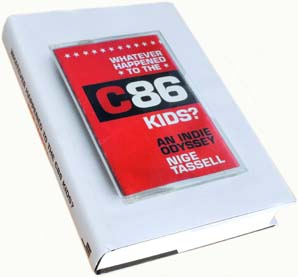
Book Review: Whatever Happened To The C86 Kids? by Nige Tassell

In 1986, legendary mag NME issued a famous cassette compilation called C86.

Arguably it defined a musical generation, bringing together figureheads of the burgeoning British indie scene from Primal Scream to Bogshed, Stump to The Pastels.

The NME’s timing could hardly have been better – in 1986, ‘indie’ music was beginning to get a sound of its own, John Peel was entering his imperial phase as a Radio 1 presenter, the music press was right on board and independent labels were springing up all over the shop.

The cassette had a huge impact, but did it have an impact on the bands? And what are they up to these days? Nigel Tassell’s hugely enjoyable book tracks them all down and hears their stories. Some, like Half Man Half Biscuit, The Wedding Present, Primal Scream and Fuzzbox are still going strong, others, like The Soup Dragons and The Bodines burnt brightly for a few years. Other band members ended up as social workers, bike shop owners, solicitors, driving instructors.

The result is a friendly, mostly uplifting tome, a bit like one of those old VH1 ‘Bands Reunited’ shows in book form. A few themes emerge: the major labels sniffing around; Peel Sessions; the ‘name’ producer enlisted for that unsuccessful second album; Alan McGee/Creation Records. But this is not a tale of rampant egos and prima donnas – it’s all refreshingly low-key (with the possible exception of the chapter on Primal Scream) with a side order of provincial British history too.

Like or loathe the music on C86, this book also perfectly captures the never-to-be-repeated thrill of first getting together in the teenage bedroom and trying to write and rehearse songs. Inadvertently, it’s also a sad comment on the loss of music in pubs and clubs across this isle of noises.

Tassell’s brisk, chatty style may divide opinion, but it’s entirely appropriate for a mostly heartwarming companion piece to Giles Smith’s ‘Lost In Music’ and Nick Duerden’s ‘Exit Stage Left’, outlining the pros and cons of youthful musical obsession. Highly recommended.

Tassell discusses ‘Whatever Happened To The C86 Kids’ in this interview.

The Redskins: Bring It Down

I first heard The Redskins’ ‘Bring It Down (This Insane Thing)’ circa 1985 on ‘The Max Headroom Show’ and was seriously impressed.
Listening back more than 35 years on, there are shades of early ’80s punk/funk: Gang Of Four, 23 Skidoo, A Certain Ratio, plus a bit of Dexys/Jo Boxers, courtesy of the spicey horn arrangements.

The lyrics seem fairly revelant in a post-Grenfell world and feature somewhat of a classic opening line, parodying Prime Minister Harold Macmillan’s famous 1957 speech: ‘You’ve never had it so good/The favourite phrase of those who’ve always had it better…’

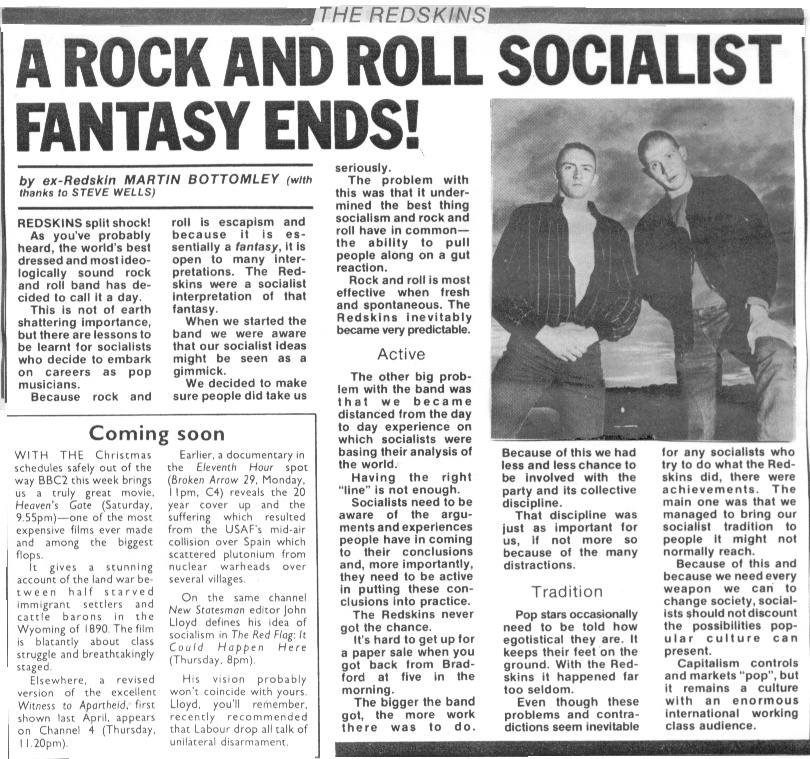
The band’s break-up as announced in the NME – click to enlarge

The band are a solid, funky little unit and I like singer Chris Dean’s chuckling Melle Mel homage and general swagger – it’s a classic ’80s vocal performance. His Afro-beat-flavoured rhythm guitar playing is pretty good too.

Their Wikipedia entry claims that The Style Council’s Steve White plays drums on this but it doesn’t particularly sound like him. The Redskins burned fairly brightly for four years, starting out as an NME-approved indie act and then graduating to a major-label deal in the classic ’80s style.

They split up after their Anti-Apartheid tour of 1986. ‘Bring It Down’ was their one and only UK top 40 single – a fairly poor return when such blue-eyed-soul inanities like The Blow Monkeys’ ‘It Doesn’t Have To Be This Way’ were just around the corner.

Where are they now? Who knows? No reunion. No sell-out. One near-hit.

Nik Kershaw: Radio Musicola 30 Years On

radio-musicola-527b885540974

The rather despairing NME headline during October 1986 said it all: ‘When The Little Girls Have All Grown Up…’

After releasing two albums in the space of barely six months, Kershaw took his time over the third. He settled in to North London’s Swanyard Studios for most of 1986 to work on the self-produced Radio Musicola, employing the cream of the English session scene (The Kick Horns, Charlie Morgan, Mark Brzezicki, Wix, Andy Richards, Simon Phillips etc).

Yes, Musicola was Kershaw’s chance to take on the Trevor Horns of this world and deliver a big-budget, endlessly-fussed-over studio ‘project’… Perhaps unsurprisingly, given his meteoric rise to fame, the main themes of the album are press intrusion and tabloid sensationalism.

And, in a neat irony, the rise of technology-led, assembly-line music was also in Kershaw’s sights, despite Musicola making liberal use of all the latest sampling and synthesizer technology. So let’s get Musicola‘s duff tracks out the way first – ‘What The Papers Say’, ‘Nobody Knows’ and ‘Running Scared’ are jarringly overproduced, though the latter had real potential.

But there are loads of treats elsewhere – ‘Life Goes On’ is a musically-rich, very pretty ballad with swooning chord changes and fine vocals from Kershaw. ‘LABATYD’ is pure class, a half-time shuffle with tasty Mark Brzezicki drums, an excellent Kick Horn arrangement and soaring synth by either Wix or Andy Richards.

The title track blew a lot of musicians’ minds back in 1986. It really was state-of-the art and still sounds pretty novel today, as striking as the title track of Level 42’s World Machine a year before. I remember eagerly tuning in to ‘The Tube’ to see Kershaw performing the song live. You can hear a lot of the ‘little girls’ turning off their TVs as he lays into the opening guitar solo…

‘Don’t Let Me Out Of My Cage’ is pretty damn ambitious fare for a pop album, a fast swing number featuring some cracking Phillips drums and effective close-harmony backing vox from Mrs Kershaw (Sheri). The excellent ‘James Cagney’ chugs along with a Level 42 groove (and features an interesting ‘New Man’ lyric) and it sounds uncannily like Mr King on bass (the bass is credited to ‘Felix Krish’ – a King pseudonym?).

‘When a Heart Beats’, an excellent, intricate slice of pop/prog in the It Bites mould, gave Kershaw his last top 40 chart appearance (peaking at a disappointing #27) when it was released in November 1985.

The closing ‘Violet To Blue’ is possibly Kershaw’s finest and most ambitious recording to date, featuring some rousing vocals from the London Community Gospel Choir and superb, driving drum work from Phillips (much imitated in my music room back in the day).

kershaw-tour

An interesting album which clearly fell between the stools of art and commerce, Radio Musicola reached a barely believable #46 in the UK album chart, just over a year after Kershaw had played Live Aid. It disappeared without trace in the US.

The little girls had definitely grown up. Or maybe it was the new haircut. But 18 months is a long time to leave between albums when you’re hot, though Kershaw didn’t seem bothered about his new ‘selective’ popularity; in fact, he seemed genuinely relieved, but wondered how MCA were going to sell him now that he was focused on being a musician rather than a pop star.

Despite the poor album sales, Kershaw embarked on a sold-out UK tour in early 1987 including three nights at London’s Town & Country Club. And he would be back once more before the ’80s were out to deliver perhaps his finest solo album to date.