
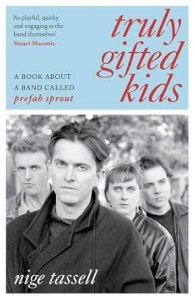
 Nige Tassell would appear to be a good choice for a book on Prefab Sprout, coming hot on the heels of his enjoyable ‘Whatever Happened To The C86 Kids?’
And ‘Truly Gifted Kids’ certainly adds something original to the pretty scant literature on Prefab. It’s an eccentric fan’s perspective (Tassell sets out his stall in the first chapter: ‘I would have taken a bullet for them’), starting with a fine summary of their status as 1980s pop-tribe outliers.
Rather than a chronological biography with access to any of the principals, Tassell offers chapters on various notable aspect of Prefab – the ‘God thing’, Thomas Dolby’s production skills, the influence of Jimmy Webb, the making of I Trawl The Megahertz, Paddy’s hearing problems, his legendary ‘lost’ albums etc. Along the way he delivers many unexpected treats for the serious Sprout fan.
As befitting Tassell’s vivid sense of place, he visits the McAloon family home near Newcastle, their famous petrol station in Witton Gilbert and even stays a night at the B&B which was once Paddy’s school (St Cuthbert’s).
He also visits the Brewers’ Arms in Durham, scene of Prefab’s first residency, and the site of Guardian Studios, where they laid down first single ‘Lions In My Own Garden (Exit Someone)’.
A real coup for the book is a lengthy interview with Muff Winwood, legendary Sony A&R man and brother of Steve, who reveals that he was played Swoon by manager Keith Armstrong and immediately offered them an advance of £100,000.
There are some gripes though. Some may balk at Tassell’s chatty, very modern, sometimes over-twee writing style (‘The King Of Rock’n’Roll’ is described as having ‘a chorus that invited the world to sing along’). And the chapter on replaying I Trawl in the London hotel room in which Yvonne Connors performed her narration is pretty excruciating.
It’s occasionally short on detail (which West London studio was used to record Stevie Wonder for ‘Nightingales’?) and there’s probably not enough info on Wendy Smith, and not much about Paddy’s early musical influences (and no index).
There are also some errors regarding the music (the wait goes on for a really decent technical analysis of Paddy’s songs): ‘Cruel’ is not a ‘shuffle’. It’s a bossa nova (straight 4/4, not swinging). The trombone solo on Thomas Dolby’s ‘Hyperactive’ is very much not a Fairlight sample – it was played by Peter Thoms (but there is a flute sample towards the end…). And Nile Rodgers didn’t have any input into Bowie and Jagger’s ‘Dancing In The Street’.*
But overall this is an enjoyably original take and a great summary of how Prefab were seen by the music press in the mid-1980s, especially useful for those were a bit too young to witness it (like this writer). It’s definitely not for the casual ’80s music fan though.
*Your correspondent was sent an uncorrected proof to review. These errors may have been corrected in the final edition – you’ll have to buy it to find out…
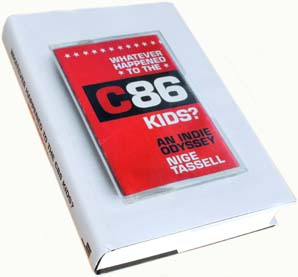 In 1986, legendary mag NME issued a famous cassette compilation called C86.

