Story Of A Song: David Bowie’s ‘Loving The Alien’ (1984)

The lead-off track and third single (UK #19 in May 1985, not released in the US) from 1984’s Tonight album, ‘Loving The Alien’ was arguably Bowie’s most committed piece of writing since Scary Monsters‘ ‘Teenage Wildlife’ four years earlier.

Recorded at Quebec’s Le Studio in May 1984, the song was musically rich with a striking set of lyrics and a superb, soaring vocal performance. Like a good Kubrick movie, it distills down weeks of research to just the crucial components.

Bowie was apparently doing a lot of reading about Christianity and the Catholic Church, influenced particularly by Donovan Joyce’s notorious book ‘The Jesus Scroll’ which posited that Jesus died in Masada at the age of 80 and wrote a scroll currently in Russian hands. The wider implications of this led Bowie into further thoughts on organised religion in general and Christianity in particular. He told writer Charles Shaar Murray:

‘It was always more of a power tool than anything else, which was not very apparent to the majority of us. My father encouraged me to become interested in other religions. It’s extraordinary considering all the mistranslations in the Bible that our lives are being navigated by this misinformation, and that so many people have died because of it. That’s how the song started out: for some reason, I was very angry…’

Using the bloodshed of The Crusades as its central image, the lyric uses various effective ploys, one of which is an almost Pinteresque juxtaposition of the banal and portentous. While Bowie blithely stated ‘It’s just a song of images’ in the above interview, each line is ripe for analysis.

Watching them come and go
The Templars and the Saracens
They’re travelling the holy land
Opening telegrams

Torture comes and torture goes
Knights who’d give you anything
They bear the cross of Coeur de Leon
Salvation for the mirror-blind

But if you pray
All your sins are hooked upon the sky
Pray and the heathen lie will disappear

Prayers, they hide the saddest view
(Believing the strangest things, loving the alien)

And your prayers they break the sky in two

And you’ll believe you’re loving the alien

Thinking of a different time
Palestine a modern problem
Bounty and your wealth in land
Terror in a best-laid plan

Watching them come and go
Tomorrows and the yesterdays
Christians and the unbelievers
Hanging by the cross and nail

Bananarama it ain’t. Both lyrically and musically, the song stands out a mile on Tonight. But despite Bowie’s fantastic vocal, it’s let down by an immense production with huge, gated drums (Omar Hakim’s entrée into rock drumming that arguably got him the gigs with Dire Straits and Sting), muddy bass, overwrought Arif Mardin string arrangement and a ponderous Carlos Alomar guitar solo.

More successful are Guy St Onge’s marimba and the sampled Bowie vocals at the top (apparently more influenced by Philip Glass’s ‘Einstein On The Beach’ than Laurie Anderson’s ‘O Superman’ – the kind of detail that was very important to Bowie!). Regular collaborator David Mallet directed the video, storyboarded – as usual – by Bowie. Though seemingly a fairly disparate series of arresting images, the clip was fairly successful as a surreal assault on religion’s materialistic symbols and commodification of women.

It also makes a fascinating companion piece to his ‘Blackstar’ video. Bowie’s cheery grin that accompanies the ‘Opening telegrams/Whoa-oh’ line is a thrillingly weird moment. Bowie performed ‘Loving The Alien’ throughout the ‘Glass Spider’ tour. Then, in 2002, DJ Scumfrog remixed the track to create a single called ‘The Scumfrog vs Bowie’, a top 10 hit in the UK Dance Chart.

A year later Bowie himself resurrected the song, cooking up a stripped-down version in duet with guitarist Gerry Leonard. They dropped the key from E-minor down to C-minor and dispensed with many of the original’s passing chords, arguably dissolving some of its power, but it’s certainly a unique reading.

According to Bowie, the best version of ‘Loving The Alien’ is his original home demo of the song, yet to see the light of day. Let’s hope we get to hear it sometime.

Victor Bailey (1960-2016)

800px-victor_bailey

Victor in 2008

I was really sad to hear of Victor Bailey’s passing today.

Born in 1960, he was part of the illustrious Philly bass fraternity alongside such luminaries as Christian McBride, Alphonso Johnson and Stanley Clarke.

He replaced Jaco in Weather Report at the age of just 21, teaming up with Omar Hakim to make one of THE great bass/drums team in music history. They featured on the albums Procession, Domino Theory, Sporting Life and This Is This, and appeared regularly on each other’s solo projects. They also toured with Madonna together in the mid-1990s.

I’m pretty sure I saw Victor five times in concert – first in an outrageous Weather Report gig at the Dominion Theatre (26 June 1984), then in a very cool jazz/funk/groove unit with drummer Lenny White at the Subterania, twice at Ronnie Scott’s with an electrifying Zawinul Syndicate, and finally about ten years ago in a trio with Larry Coryell and White at the Jazz Cafe. At all times, Victor’s playing was tasty, expressive, exciting.

I was pleased when he was recently the subject of a long, excellent feature in JazzTimes magazine in which he talked frankly about music, his bass playing and illness. I hoped the piece might be the start of a healthy, fruitful period for Victor. Sadly it wasn’t to be.

Victor Bailey (27 March 1960 – 11 November 2016)

Story Of A Song: Everything but the Girl’s ‘Driving’ (1990)

drivingThe 1980s are littered with Brit pop bands going ‘across the pond’ to work with US producers and musicians.

It was almost a rite of passage, or – according to some music critics of the slightly more cynical persuasion – a desperate attempt at credibility.

You could hardly level that accusation at Tracey Thorn and Ben Watt, AKA Everything but the Girl. They were headhunted by legendary producer Tommy LiPuma, who had just put the finishing touches to Miles Davis’s Amandla, and their ‘Driving’ single (released in early 1990 but recorded spring 1989) seems a near-perfect marriage of US and UK sensibilities.

I confess I hardly knew anything about EBTG when my brother first played me ‘Driving’. I just heard something extremely classy, with intriguing chord changes, a great singer and strong jazz flavour.

I didn’t know Tracey and Ben had spent much of the ’80s building up a considerable rep as ‘indie jazz/folk’ darlings of the music press and enjoying not inconsiderable commercial success too, but I was possibly vaguely familiar with Tracey’s gorgeous vocals on The Style Council’s ‘Paris Match’.

Taken from The Language Of Life album, the song was recorded in LA at the famous Ocean Way and Sunset Sound studios with pretty much the finest session players money can buy (Omar Hakim on drums, John Patitucci on bass, Larry Williams on keys/arrangements, Michael Brecker on tenor).

But, according to Tracey’s superb memoir ‘Bedsit Disco Queen’, the American musicians were totally ignorant of the fiercely independent English scene from which Tracey and Ben had emerged.

When Larry Williams found out that EBTG had recently recorded at Abbey Road, he blurted out: ‘Wow! Abbey Road! The home of the Beatles!’ Tracey’s reply: ‘God, I HATE the Beatles.’ There was a pregnant pause. Eventually Williams spluttered out: ‘You h-h-hate the Beatles?’

But such musical differences were all in a day’s work for EBTG.

‘Driving’ obviously sounds more like Anita Baker than, say, The Smiths. It’s sophisticated but still has bite, with rich chords and a glorious Brecker solo (inexplicably with a different, inferior take on my 7” vinyl version).


‘Driving’ became somewhat of an airplay hit in the States (though surprisingly only reached #54 in the UK), and led to several high-profile US gigs which unfortunately seemed to precipitate a crisis of confidence for Tracey.

The EBTG live band, which included future smooth jazz star Kirk Whalum on sax, whipped the crowds into a frenzy night after night, but there wasn’t much space for her subtle, low-key vocals any more.

Cue a few years of soul-searching and a distinct change of direction, exemplified by 1994’s Amplified Heart.

Omar Hakim, Drummer Of The ’80s: Seven Of The Best

omarhakim3Of the all-time-great drummers who emerged in the ’80s – a list that would have to include Manu Katche, Dave Weckl, Dennis Chambers and Trilok Gurtu – you could argue that Omar Hakim was the main man. His hip, funky, vibrant style typified all that was good about the music of the era.
Effortlessly versatile, endlessly creative and always musical, Hakim emerged from the early ’80s New York jazz and fusion scene and quickly became the drummer of choice for David Sanborn, David Bowie, Dire Straits, John Scofield, Weather Report and Sting. He could play everything from straight jazz to heavy rock’n’roll with total ease, great feel and a beautifully light touch.

I first became aware of Omar when he demonstrated his ‘Children’s Crusade’ beat on BBC TV’s ‘Rock School’. I was a major fan from that day on.

Here are seven great Omar performances from the ’80s:

7. Sting: ‘I Burn For You’ (1985)
Drum legend Jeff Porcaro waxed lyrical about this performance which appears in the 1985 film ‘Bring On The Night’. One of Omar’s specialities is soloing over a static vamp, and he really takes it out about as far as it can go here.

6. Dire Straits: ‘So Far Away’ (1985)
Omar can do slick, clean, laidback rock too, as heard on this Brothers In Arms opener. Check out his lovely fills, layered in at the end of each chorus, bringing the playing of Motown star Benny Benjamin into the ’80s.

5. David Sanborn: ‘Rush Hour’ (1982)
Omar dusts off a much-imitated ghost-note-inflected groove for this track from the As We Speak album, possibly influenced by the late great Little Feat sticksman Richie Hayward. Only Hayward could have nailed this with as much panache, drive and subtlety.

4. Weather Report: ‘Db Waltz’ (1984)
Omar pulls out all the stops on this ingenious 3/4 (or is it 6/8?) groove, the centrepiece of the Domino Theory album, falling somewhere between a swing feel and straight feel just the way the old guys used to do it on the R’n’B hits of the ’50s. He also demonstrates some jaw-dropping chops towards the end.

3. Special EFX: ‘Sabariah’ (1988)
The music comes uncomfortably close to smooth jazz on this opening track from the Confidential album but Omar’s grooving is just sublime. The controlled energy explodes from his kit.

2. David Bowie: ‘Neighbourhood Threat’ (1984)
Omar could also play heavy rock with the best of them as demonstrated by this underrated track from Tonight. And not even Jeff Porcaro could have conceived of the floor-shaking fill at 2:14.

1. John Scofield: ‘Techno’ (1985)
The lead-off track from the classic Still Warm album, this perfectly illustrates Omar’s intricate hi-hat playing, as distinctive as Stewart Copeland’s almost a decade before. I dig the way he takes the tune out with some sick china cymbal/snare combinations.

Weather Report: Sportin’ Life 30 Years Old Today

weather report

Sportin’ Life represented the second career peak for Weather Report after Heavy Weather.

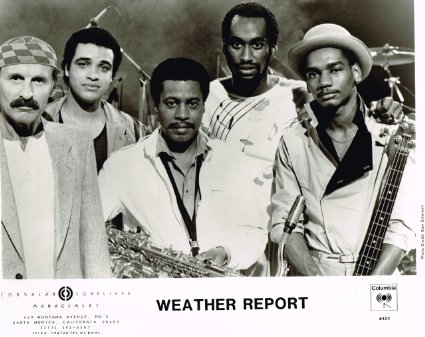
Featuring the incredible rhythm section of Victor Bailey on bass and Omar Hakim on drums, the band’s penultimate album showcased a line-up that had been building up a real head-of-steam since their debut on 1983’s Procession.

It’s not clear whether Zawinul named the album after the character in Gershwin’s Porgy And Bess but it wouldn’t be a surprise. The vitality of the music on offer here belies the fact that co-leaders Joe Zawinul and Wayne Shorter were aged 53 and 52 respectively when it was recorded.

Hakim was playing with David Bowie, Sting and Dire Straits while making this album, and he brought undeniable star quality to Weather Report.

weather report

Zawinul, Cinelu, Shorter, Hakim and Bailey

Sportin’ Life blew my mind when it came out in ’85. I was already a huge fan of Jaco-era Weather Report and could hear how their music had influenced my other favourites Level 42, Sting and Joni Mitchell, but this was something else altogether. And to say my drumming was influenced by Omar’s playing would be a gross understatement.

While Zawinul is very much in charge on Sportin’ Life (‘Hot Cargo’, ‘Indiscretions’ and ‘Ice Pick Willy’ are basically solo pieces), Wayne has returned to his best form, ex-Miles percussionist Mino Cinelu gets a lot of space and sounds as inventive as ever and Hakim has become a beautifully tasteful drummer. Bobby McFerrin and two other vocalists also contribute intriguing musical colours.

‘Corner Pocket’ may be the best-ever Weather Report album-opener, and that’s saying something. Over a superb drums-and-bass groove (possibly influenced by Trouble Funk/Chuck Brown?), Zawinul delivers a typically arresting, swinging melody and unhinged synth solo. The rhythm section gear-change when Shorter tears into his tenor break is perfectly judged.

‘Face On The Barroom Floor’ is a wonderfully enigmatic Shorter ballad featuring possibly the composer’s finest soprano playing on a Weather Report album. He lets rip here with some impassioned blowing over Zawinul’s moody synths with an uncharacteristically wide vibrato reminiscent of Sidney Bechet.

omarhakim550

The cover of ‘What’s Going On’ is funny and touching with Omar’s delicious half-time shuffle deftly moving between sticks and brushes.

Cinelu’s delightfully Santanaesque ‘Confians’ closes with another joyous Shorter soprano solo, one of his most resplendent in latter-period Weather Report.

It’s a shame there wasn’t much of an American audience for this kind of jazz in ’85, especially since Sportin’ Life represented a new high for Weather Report.

Unfortunately the band didn’t tour the album – their last major tour came around the release of ’84’s Domino Theory. I saw them at the Dominion Theatre in London and vividly recall the intense interplay between Zawinul and Hakim.

Shorter and Zawinul would soon go their separate ways but not before leaving us with this last classic. Dig it.


Miles Davis & Marcus Miller: Siesta

miles_davis__marcus_miller-music_from_siesta_a

I came across this gem in a big crate of reduced cassettes in the old Our Price shop in Richmond town centre.

I was a huge fan of Miles and Marcus’s ’80s work but Siesta had somehow passed me by. It was hardly reviewed anywhere despite the fact that it was the official follow-up to Tutu, possibly because it was ‘just’ a movie soundtrack and – even worse – the soundtrack to a really terrible movie.

But it quickly became the soundtrack to my summer of 1988 along with Prefab Sprout’s From Langley Park to Memphis, Prince’s Lovesexy, Thomas Dolby’s Aliens Ate My Buick and Scritti Politti’s Provision. Its Spanish-tinged melancholia, beautiful playing by Miles and stunning bass/keyboard work and production by Miller drew me in immediately.

Miles’s stock was rising high at the beginning of 1987. He was healthy, enjoying critical and commercial success with Tutu and playing to packed concert halls. The question was, how would he follow Tutu? A film soundtrack was definitely not the predictable option.

Of course, Davis was no stranger to the world of movie scoring, even though his famous Ascenseur Pour L’échafaud (Lift to the Scaffold) soundtrack was mostly improvised in just two days, and his music for Jack Johnson was similarly spontaneous though subject to detailed post-production work by Teo Macero.

But when Davis got a call from the producers of Siesta after their request to use Sketches Of Spain on the film’s soundtrack was turned down, he turned to the trusted Miller for help. Miller was also on a roll at the beginning of ’87. Fresh from co-producing and co-composing Tutu, his career was branching out in all directions.

He hadn’t done any soundtrack work before and embraced the project, thrilled to work with Miles again and rightly sensing that the movie’s Spanish elements might open up some dramatic musical possibilities. But the clock was ticking, the budget was tight and time was of the essence.

Siesta is a fascinating companion piece to Tutu and it features some of the most arresting and spontaneous Miles trumpet playing from the last decade of his life. Indeed, some Davis-watchers such as critic Paul Tingen reckon it’s the pinnacle of Miller and Miles’s ’80s collaborations.

Miles sounds fit and strong, investing the material with both power and pathos, consistently providing a sound that someone once described as ‘a little boy looking for his mummy’. Apparently when Miller played the elegiac ‘Los Feliz‘ to an assembled cast and crew, several people broke down in tears.

Miles solos at length with glorious open horn on several tracks. The dramatic, flamenco-tinged ‘Conchita‘ was used by American ice skater Nancy Kerrigan for her 1992 Olympic routine – she got a bronze medal.

The ghost of Sketches of Spain/Miles Ahead arranger Gil Evans looms large and the album is dedicated to him, ‘The Master’. One can only imagine how ‘Los Feliz’, ‘Siesta’ or ‘Lost In Madrid‘ might have sounded with Evans’ full orchestral backing and arranging, but Miller and main collaborator Jason Miles consistently find just the right musical ingredients with gorgeous piano voicings, subtle synths and fretless bass.

As George Cole pointed out in his great book ‘The Last Miles‘, only Michel Legrand, Gil Evans and Miller’s names have shared a Miles Davis album cover, and that really proves how highly Miles rated Miller’s efforts. According to Miller, there is much more Siesta music residing in the Warner Bros vaults – here’s hoping the album gets the ‘Special Edition’ treatment soon.