Movie Review: Killers Of The Flower Moon (2023)

Based on David Grann’s non-fiction book about series of mysterious deaths among the Osage Native American tribe in 1920s Oklahoma, Martin Scorsese’s new three-and-a-half hour movie is currently in the middle of a brief cinema run before showing on Paramount + (who also co-financed alongside Apple TV).

A new Scorsese movie is always an event. Co-starring Leonard DiCaprio, Robert De Niro and Lily Gladstone, ‘Killers Of The Flower Moon’ is another epic ‘creation of modern America’ movie, the flipside of ‘Goodfellas’, ‘Casino’, ‘The Irishman’, ‘Once Upon A Time In America’ and ‘The Godfather’, whilst also nodding to the oil boom of the 1920s and development of the FBI (‘Killers’ was reportedly reformatted during the Covid era to focus less on the FBI and more on the Osage).

The first thing to address is the giant running time. It’s quite extraordinary – and sometimes quite a challenge – watching a three-and-a-half-hour movie in 2023. And if, at times, it feels very much like an elongated TV show, its huge budget is all up there on the screen, with peerless attention to detail, meticulous mise en scene and truly hefty star performances.

You’re in the hands of a master, though Scorsese fans wanting elaborate camera movements and zippy set pieces will be disappointed – this is a sober, slow film, gaining its power from an accumulation of moods and images.

But ‘Killers’ is a true story of such simple, unremitting horror that you may also question why you are sitting so passively watching an exceptionally unpleasant, shameful episode in American history – all very apt in a long, non-fiction book or article, less so in a feature film of such extreme length.

One generally wants to look away from the casual, regular violence, unpleasantly forensic detail and focus on sometimes passive, unwell women. There’s exposure of intense anxiety and physical threat to child actors. There are also many longeurs, often undercut by Robbie Robertson’s pretty much wall-to-wall music (influenced by Kubrick’s ‘Barry Lyndon’ and ‘The Shining’?) with occasional Daniel Lanois-esque ‘funky’ breakdowns and slightly disconcerting inserts of blues and bluegrass.

But it’s the performances that linger longest in the mind after viewing. It’s thrilling watching intimate ‘behaviour’, as per Scorsese’s assessment of Marlon Brando in ‘On The Waterfront’, played out in the midst of such an epic, sprawling movie.

There are two key De Niro/DiCaprio stand-offs – it’s an absolute treat to see these two actors sparring on the big screen at such close quarters (and remember De Niro gave Leo his first big break in ‘This Boy’s Life’).

For his part, DiCaprio channels Brando, jutting out his bottom jaw, desperate to dial down the joie de vivre, excellently portraying a weak man who just wants to be left alone to enjoy money and gambling but is drawn into evil deeds. De Niro, in the meantime, seems to channel Trump. Gladstone burns very brightly during the first hour of the picture but fades fast, through no fault of her own, despite regrouping for a powerful final scene with DiCaprio.

There are shades of ‘Goodfellas’ and ‘The King Of Comedy’ in the film’s finale which summarises the hideous plot via a trite, ‘comic’ supper-theatre show, enjoyed by a middle-class audience and featuring a weird, uncharacteristically emotional cameo from the director.

So ‘Killers’ is not exactly Marty’s ‘Heaven’s Gate’ but a disappointment after ‘The Irishman’. Movingtheriver would put it alongside ‘Gangs Of New York’, ‘The Aviator’ and a few others in the ‘heroic failures’ camp. But is it worth seeing on the big screen? Of course. And Scorsese turns 81 on 17 November.
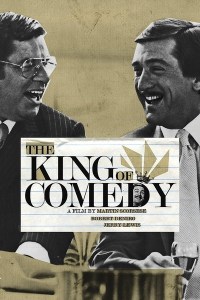
The Cult Movie Club: The King Of Comedy (1982)

Looking at the trailer and publicity for James Franco’s Tommy Wiseau biopic ‘The Disaster Artist’, it’s hard to ignore the ‘King Of Comedy’ comparisons. 
Featuring Robert De Niro’s fascinating and detailed turn as anti-hero Rupert Pupkin, Martin Scorsese’s classic black comedy was released 35 years ago today.

If Wiseau didn’t actually exist, Hollywood would probably have to invent him. Recent American cinema is full of Wiseaus and Pupkins – desperate characters, probably a few cards short of a full deck, who will do almost anything to make it.

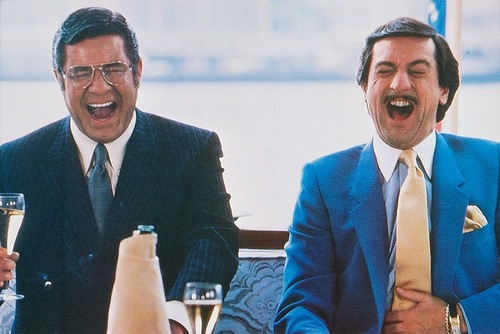
Pupkin passive-aggressively stalks celebrities for their autographs, but then comes to believe that he is owed a shot at fame. Talk-show host Jerry Langford (Jerry Lewis) is his passport to success – Pupkin and disturbed rich-girl Masha, brilliant played by Sandra Bernhard, kidnap him. Pupkin then demands the opening monologue on Langford’s nightly TV show.

Jerry Lewis and Robert De Niro in character

If ‘The King Of Comedy’ had been made today, it would probably be hailed as a modern classic, a fable for our times, a coruscating attack on narcissism, celebrity culture and unchecked ambition.

It’s ‘Nightcrawler’ meets ‘Curb Your Enthusiasm’. But it stiffed on its original release (not helped by a substandard trailer – see below), grossing barely $3 million against a $19 million budget.

The studio didn’t know how to market it, trying to sell it as a knockabout comedy. Scorsese sensed the bad vibes gathering around the film long before it was released, telling writer Peter Biskind, ‘A close friend of mine told me “The buzz is bad.” I hate that. When the buzz is bad, people don’t want to be associated with the picture. But they were right – the film was a bomb. It’s called “The King Of Comedy”, it’s Jerry Lewis, and it’s not a comedy. Already it’s a problem…’

Yes, it sometimes feels like a succession of skits strung together, almost in the style of Brian De Palma’s early films ‘Greetings’ and ‘Hi Mom’. And it would be nice to get a bit more access to Pupkin and Masha’s backgrounds.

But Scorsese, Lewis, De Niro and Bernhard, working instinctively from ex-Newsweek film critic’s Paul D Zimmerman’s slight but intriguing story, create something toxic and completely memorable.

Scorsese fills the screen with significant minor characters, mainly playing themselves and recruited from the ‘real’ TV world, and he obviously has deep respect for Lewis and all he stands for (though has less respect for the all-pervading, gossipy influence of TV culture).

Bernhard, prodded by De Niro, is superb, given free rein by Scorsese to improvise freely: ‘I cover the waterfront, remember that!’ she bawls at Pupkin, just before one of the director’s typically bracing cuts.

There are many excruciating moments: Pupkin’s arrival at the Langford house (De Niro apparently screamed antisemitic abuse at Lewis to elicit the correct level of outrage in his response to having his golf game interrupted) and Masha’s ‘seduction’ of Langford. Is his violence towards her ‘justified’?

And then there’s Pupkin’s monologue, shown in one long take with no cutaways – Scorsese and De Niro dare us to laugh at this schmuck, and it’s unsettling when one or two of his gags hit the spot.

‘The King Of Comedy’ is the De Niro/Scorsese collaboration I return to the most. Nobody gets killed, but a lot of people get hurt. Very hurt indeed.

And it bears repeated viewings: recently I noticed an intruder in the restaurant scene where Pupkin tries to persuade his ‘girlfriend’ Rita to accompany him to Langford’s. Check him out. He’s behind Pupkin, mocking him throughout. I take it he’s supposed to stand in for the entire film-going audience.

Magic Mickey: ‘Angel Heart’ 30 Years On

angel_heartIn 1987, Mickey Rourke was fast becoming one of the most controversial movie stars of the era, the go-to guy (alongside Michael Douglas) for potentially commercial but decidedly ‘off-colour’ material.

Even David Bowie rated Rourke as one of the coolest people on the planet in ’87 – to my knowledge, only Mickey, Iggy Pop, Tina Turner and Al B Sure! ever shared ‘lead vocals’ on a Bowie solo album (though their collaboration was less than essential…).

‘Angel Heart’ turns 30 this week. I’ve been a Mickey fan since randomly renting the video circa 1988. If, as Marlon Brando attested, acting (or at least good acting) is essentially ‘behaviour’, Rourke delivers one of the great modern screen performances.

He mumbles lines, adds strange emphases (‘Yeah, I could be free‘) and quirky ad-libs, smirks inappropriately and generally shambles around in his filthy linen suit; Pauline Kael memorably wrote that ‘he has enough dirt on him to sprout mushrooms’. But also he carries off the action sequences with aplomb, looking like he could take care of himself in a bar fight.

Most importantly, Rourke tempers the increasingly hokey supernatural elements of the film with a believable, sympathetic, relatively down-at-heel protagonist: Harry Angel seems to be a regular knockaround guy in Brooklyn. ‘He likes the simple life, going for a beer, getting laid whenever he can. He minds his own business. He just gets by. He works, reads the comics, he takes a walk,’ Rourke told his biographer Christopher Heard.

William Hjortsberg’s screenplay for ‘Angel Heart’, based on his New York-set novel ‘Falling Angel’ (described by Stephen King ‘as if Raymond Chandler had written “The Exorcist”’), had been hanging around Hollywood for a while.

First it looked like Robert Redford would produce and star. Then ‘Midnight Express’/’Fame’ director Alan Parker came onboard, rewrote the script (with the questionable decision to relocate most of the action to New Orleans) and offered the lead role to naysayers Jack Nicholson, Al Pacino and Robert De Niro, the latter taking the role of Louis Cyphre (geddit?) instead.

Enter Mickey. Parker made it clear to Rourke that he was nowhere near his first choice, but was interested in what he could bring to the role. Rourke was disillusioned with acting in general and Hollywood in particular but desperately needed the part: ‘I was about to lose my big-assed house in California and needed a big paycheck fast…’ Parker warned Rourke that he wouldn’t put up with any funny business, also apparently giving him many a dressing-down on set.

But how does ‘Angel Heart’ stack up these days? It’s still very watchable, salvaged by the Rourke/De Niro scenes and Mickey’s eccentric ‘behaviour’. Bonet is a refreshingly natural presence and De Niro hams it up semi-convincingly.

Trevor Jones’ original soundtrack (recorded at the aptly-named Angel Studios in Islington, North London) still holds the attention alongside some great crooner and blues tunes. But Parker searches in vain for his inner Nicolas Roeg (or Ken Russell?), showing his background in advertising with a succession of beautiful, if clichéd, images of ‘evil’ (a glistening, freshly-extracted human heart, ceiling fans, lift shafts, writhing bodies, blood-stained walls), memorable crane shots and disorientating flashbacks, but it all feels way too slick.

Kael again: ‘There’s no way to separate the occult from the incomprehensible. Parker simply doesn’t have the gift of making evil seductive, and he edits like a flasher.’ There’s also a lack of memorable secondary characters – Charlotte Rampling and Brownie McGhee seem miscast and barely register.

‘Angel Heart’ just about broke even at the box office but has enjoyed a healthy cult following since. My brother tells me that it most definitely worked on the big screen, delivering a real sense of impending doom. I don’t doubt it, ably aided by some classic Mickey.