The Cult Movie Club: The Border (1982)

Summer 1980. Jack Nicholson was in the middle of his busiest period. ‘The Shining’ had just wrapped and he had inked contracts to appear in both ‘Reds’ and ‘The Postman Always Rings Twice’.

But first up was ‘The Border’, one of his least known films but a fascinating watch these days and still relevant. It’s also one of his most serious, intense screen performances, rivalling ‘Five Easy Pieces’, ‘The Pledge’ and ‘The Passenger’.

Nicholson plays a downtrodden Texas border patrolman who, after years of viewing corruption and trapped in an unhappy marriage, decides to do something completely altruistic. When the baby of an underage Mexican girl is kidnapped with threats of being sold/adopted, Jack takes a stand against his spiritually-bankrupt superiors.

It’s possible that Nicholson was attracted to the project due to the involvement of director Tony Richardson, the Brit who helmed John Osborne’s legendary ‘Look Back In Anger’ on both stage and screen, and also the presence of co-stars Warren Oates and Harvey Keitel, with whom Jack does some great sparring.

Shot in El Paso, ‘The Border’ is a terse, angsty, mature movie with moments of dark humour and an interesting companion piece to both John Sayles’ ‘Lone Star’ and Tony Garnett’s ‘Handgun’.

But its third act moves uneasily into action territory – Richardson seems out of his depth here, searching in vain for his inner Peckinpah (and why the 18 certificate? My DVD warns of ‘strong sex, violence and language’, but none of the above feature, outside of one particularly poorly staged gore effect).

Still, apparently it was an interesting shoot, with a blitzed Dennis Hopper arriving to set up a huge prank for Jack involving the president of Mexico, a cadre of cheerleaders and some Hells Angels (see Robert Sellers’ book below for more). Sadly though, Ry Cooder’s soundtrack is rather phoned-in, despite featuring an early version of the classic ‘Across The Borderline’.

‘The Border’ was delayed for a year and crept out in February 1982 to minimal fanfare (though Siskel and Ebert both liked it) and rotten box office. In truth, it feels much more like a movie of the 1970s than the 1980s. But it features yet another gripping performance from Jack during arguably his peak period and it’s well worth a look – if you can find it…

Further reading: ‘Hollywood Hellraisers (Bad Boy Drive)’ by Robert Sellers
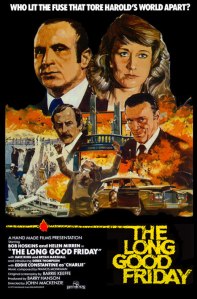
The Cult Movie Club: The Long Good Friday (1980)

Every post-1971 British crime movie has had ‘Get Carter’ and ‘Performance’ in its rearview mirror.
Made in summer 1979 but not released until 18 months later, ‘The Long Good Friday’ (original title: ‘The Paddy Factor’) has often been mentioned in the same breath as ‘Carter’. Is that justified?

Initially bankrolled by legendary impresario and producer Lew Grade, it was written by proper East Ender Barrie Keeffe (who reportedly knew Ronnie Kray), directed by Scotsman John Mackenzie and starred Brit acting ‘royalty’ Bob Hoskins and Helen Mirren.

When completed, the suits almost refused it a cinema run, deeming it too nasty, hoping to recut it and farm it out to television. A disgusted Mirren asked her friend Eric Idle to attend the premiere at the London Film Festival towards the end of 1980.

Idle was impressed and passed it on to his mate George Harrison, the main moneyman at newly-formed HandMade films. Harrison apparently loathed it but agreed it had hit potential. HandMade bought it for £700,000, funded by ‘Life Of Brian’ profits.

But how does ‘The Long Good Friday’ stack up in 2024? I watched the posh new 4K restoration – looks fabulous, but this film really belongs in a mid-’80s Cannon fleapit. With its casual racism/sexism/ableism and overlong dialogue scenes, it’s also now more redolent of ‘Sweeney!’, ‘The Squeeze’ and ‘Villiain’ than ‘Performance’ or ‘Get Carter’ – but is still fascinating and memorable.

There’s some real Brit nastiness, or ‘virtuoso viciousness’, as Pauline Kael called it in her ‘Carter’ review. Mackenzie comes up with three or four memorable set pieces (and a great final five minutes, apparently the first thing they shot, during which apparently the director drove the car and ‘fed’ Hoskins the entire plot of the film) which have given the movie legs. He also uses the London locations with some elan.

Keeffe comes up with some preposterously funny lines – ‘It’s like Belfast on a bad day!’ etc. – and Francis ‘Sky’ Monkman’s disco/prog/fusion score adds value. There’s also an amazing array of ‘Hey, it’s that guy/girl!’ actors, from Pierce Brosnan (whose swimming pool scene seems to have influenced Bronksi Beat’s ‘Smalltown Boy’ vid) to Gillian Taylforth.

Sadly though the key performance by Derek Thompson (Charlie in ‘Casualty’!) weighs the film down with its stoned insouciance and dodgy London accent (ironically, Thompson was born in Belfast).

And though some have compared Hoskins with Edward G Robinson and James Cagney (Keeffe apparently pictured a cockney Humphrey Bogart!), despite some amusing line readings these days he comes across more like Alan Sugar after a few too many espressos, whereas Michael Caine in ‘Carter’ had a kind of timeless, glacial rage.

Apparently under the influence of ‘Lock, Stock and Two Smoking Barrels’, Empire magazine – astonishingly – voted ‘The Long Good Friday’ the #1 greatest British film in a 2000 poll. Hard to think it would get that accolade today. Still, it’s a fascinating snapshot of London on the brink of Thatcher’s decade, and a must-see for fans of 1980s cinema.

Further reading: ‘Very Naughty Boys’ by Robert Sellers

The Cult Movie Club: Oliver Reed vs. David Letterman (1987)

Actor Ollie Reed became a bit of a media ‘sensation’ during the 1980s and early ‘90s, wheeled out on various chat-shows and late-night discussion programmes looking a bit worse for wear and usually causing embarrassment on various levels.

Look up ‘toxic masculinity’ in the Brewer’s Dictionary and you might see a picture of Ollie. To some he is just poisonous. His brand of industrial hellraising was born in the 1960s but definitely belonged more to the 1970s.

He presents so many ‘red flags’ – in the irritating modern parlance – that it’s a wonder his TV appearances and media pronouncements haven’t been consigned to the dustbin forever.

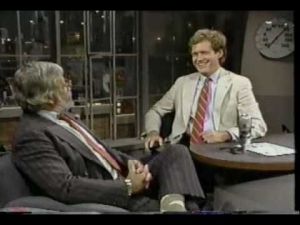
Thanks goodness they haven’t, because they make events like his live TV meeting with David Letterman on 5 August 1987 particularly fascinating (coming hot on the heels of equally controversial appearances with Michael Aspel and Des O’Connor in the UK).

In interviews, Reed often revealed a ‘quiet’, sensitive side – he was an avid writer of poetry – and claimed he was just giving the public what they wanted. No one could accuse him of being thick though – he makes the current crop of media regulars seem particularly one-dimensional.

But during this appearance – around the time that he was good mates with Alex ‘Hurricane’ Higgins, who once awoke in the sitting room of Reed’s home after a spectacular bender to find the actor brandishing an axe – Reed just seems hellbent on irritating Letterman, and does a superb job. The ‘Little Englander’ in me quite likes the way he sticks it to Dave (Reed reportedly referred to himself as ‘Mr England’!).

Is he doing a take-off of Sly Stallone, or generally ridiculing the all-American 1980s ‘action hero’? Who knows. He was chatting with Dave ostensibly to promote his 1987 movie ‘Castaway’ – another one that might seem fairly ‘toxic’ these days. ‘Enjoy’…

Further reading: ‘Hellraisers’ by Robert Sellers