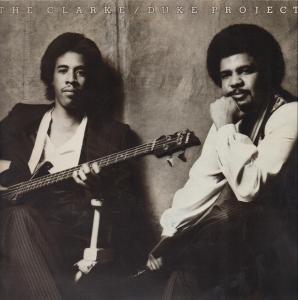
This one really divides people. The Clarke/Duke Project probably could and should have been a lot better given the talent involved and their stellar track record.
But the album shouldn’t be judged by jazz standards – by the early ’80s, these two protagonists of ‘fusion’ realised that jazz/rock had hit a massive dead end.
A fresh approach was called for. Earth, Wind & Fire’s effortless blending of funk, soul, disco, jazz, Latin and rock offered a new direction to all kinds of musicians, including Clarke and Duke.
So, leaving any kind of jazz credibility at the door, our heroes embraced their inner George Clintons, Frank Zappas and Stephen Bishops to make a really weird but occasionally enjoyable album of funk, disco, AOR and cheesy soul balladry (it’s surely up there in the ‘least classifiable albums of the ’80s’ list). In short, this was Stanley and George’s Tin Machine – you were either for or against.
My schoolfriend Seb and I were huge Stanley fans, but even we eyed this with some trepidation when we came across it around 1989. It had a pretty dodgy reputation even by ’80s Stanley standards. It’s certainly neither artists’ best work, but it’s worth a listen.
So, straight in at the deep end. It’s fair to say that most John Coltrane and Dexter Gordon fans will struggle with the ‘Louie Louie’ cover… But Clarke and Duke deliver great solos and the vocal jiving is good value.
Clarke’s ‘I Just Want To Love You’ is a minor disco/soul classic with a great bassline (later appropriated for Kylie’s ‘Spinning Around’). ‘Touch And Go’ is very pretty in a post-‘Sailing’ kind of way while the vapid ‘Sweet Baby’ miraculously delivered a big US hit (#19). The closing ‘Finding My Way’ is effective and quite unique in its way, a kind of pomp-funk/rock epic with a cool descending bridge and interesting structure.
JR Robinson’s ultra-solid, ultra-dry drums are very high in the mix and sometimes feel like they need a bit of air. Clarke impresses with a huge range of basses, guitars, sitars and cellos (and some very Santana-ish Piccolo lead bass playing) while Duke sticks mostly to squelchy synth basslines, acoustic piano and an occasional bit of trademark Mini Moog.
The album sounds very stripped back to modern ears and has a slightly ‘demo’ feel to it, but it was a hit. Two further collaborations followed, lasting into the early ’90s.
One thing’s for sure – Stanley and George were great friends until the latter’s death in 2013, and you can really hear it in the music they made together.
In 1979, Stanley recordedthe sprawling double I Wanna Play For You which had some brilliant moments but also veered uncomfortably towards disco.
It also featured some outrageous live recordings which suggested he was going in a more ‘rock’ direction, mainly thanks to the sonic possibilities opened up by putting his Piccolo bass (tuned a fifth higher than a standard bass, A to C rather than E to G) through various effects pedals (see correction in the comments section below).
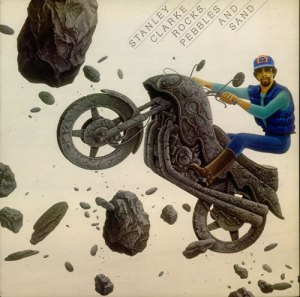
But how would Stanley start off the ’80s? On Rocks, Pebbles and Sand, he thankfully pushed the rock and prog-fusion rather than disco.It also really helps that it sounds very much like a ‘band’ project, apart from funk curio ‘We Supply’ which belongs on a different album altogether.
And what a band it is – Simon Phillips on drums, Charles Icarus Johnson on guitars and Steve Bach on keys. Phillips in particular is a perfect foil for Clarke with his meaty grooves and superchops. Though he was obviously coming from Billy Cobham with his prodigious double-bass playing, expansive tom fills and open-handed style (see below), his grooving on ‘Story of a Man and a Woman Part 2’ is just perfect.
Rocks, Pebbles and Sand‘s opener ‘Danger Street’ sounds like Stanley has been listening to The Who and Van Halen with its big drums, raucous guitar and gargantuan riff. Subtle it ain’t (and one can take or leave Stanley’s vocals), but it really works, mainly due to the mastering and mix – Rocks is one of the best-sounding albums of the era alongside Steely’s Gaucho, Lee Ritenour’s Rit and Zappa’s Sheik Yerbouti.
The duet vocals on ‘Underestimation’, ‘You/Me Together’ and ‘A Story of a Man and a Woman’ might put some people off, but isn’t that female voice familiar? A glance at the liner notes reveals a credit for one ‘Marcy Levy’ on vocals. It turns out to be none other than Marcella Detroit of Shakespeare’s Sister fame, an LA session singer in another life who had recorded and toured extensively with Eric Clapton (co-writing ‘Lay Down Sally’) before working with Stanley.
The funk/disco track ‘We Supply’ sticks out like a sore thumb but features a superb bassline from Louis Johnson and a hilarious spoken word intro from album engineer Dennis MacKay, proclaiming, ‘We supply all your funky needs!’ in the poshest voice you’ve ever heard. Git down and boogie with Dennis…
Stanley had a mixed ’80s to say the least, with a fair few misses but some big hits as well. Rocks is definitely one.
EXCLUSIVE! Level 42’s Mark King speaks to movingtheriver.com about his classic solo album Influences, released by Polydor in July 1984.
MP: Can you just briefly summarise the story behind Influences? Was it your idea or did Polydor come to you?
MK: I was signed to Polydor Records via Level 42 and had a young, heavily-pregnant wife and needed to buy somewhere to live. This was back in 1981 I hasten to add, so Influences showing up in 1984 was really down to my tardiness in addressing the fact that I had taken the advance (£5,000) and, apart from delivering a single ‘Freedom‘, had somehow neglected to fulfil my contractual obligations! Polydor were actually very sweet about it and just before the agreement was due to expire gently reminded me that I needed to deliver an album.
You’ve talked about having loads of ideas in the tank for the album but how did you piece them all together on ‘The Essential’? Did you have to demo all the different sections before recording?
I may have exaggerated the ‘loads of ideas in the tank’ bit, but when push came to shove I booked a few days at Chipping Norton Studio and dived in. The opening piece ‘The Essential’ began on the studio Hammond B3 which Mike Vernon informed me had been used on the Focus album Moving Waves. I’m no keyboard player, but I fired her up and just hit the notes. Next I programmed the drum machine with a pattern so I could lay down some bass and guitar, and the riff and melodies just wrote themselves really. I was jamming with myself I guess, ha! Anyway, that’s how all the sections came to be, and in the twinkling of an eye I was 20 minutes into the album.
What was it like getting back into drumming again for the album? ‘There Is A Dog’ is an amazing tour-de-force.
Ta. I never stopped drumming, that’s what I love to do!
Did you put your bass and guitar parts down with a drum machine first and then overdub your drums? Or did you record your drums first?
I laid the bass and drum box down first. I had an Oberheim DMX drum machine that sounded awful but was a great writing tool because you could programme some pretty accurate drum parts that were in time! You have to remember that these were early days in digital technology, so ears weren’t so tuned in to accurate tempo, but I loved the idea of being able to f*ck about all over the groove and lean on the drum box because it had the time nailed. I laid the drums down next, Gretsch incidentally. Speaking of time, the guy with the greatest meter I know is Gary Husband. He IS a human machine… The guy is a phenomenon with tempo. Never shifts. The Level 42 track ‘Take Care Of Yourself’ was a first take at The Summerhouse Studio played on some Ddrums. That is AWESOME! The great Bill Cobham quote sings to mind: ‘You are either in time or you are out of time.’ I’m usually out.
How did you come to work with producer Jerry Boys? ‘The Essential’ features some really effective edits and cross-fades between the different sections.
Jerry was a good friend and had engineered some Level 42 stuff, which is how we had met of course, and Polydor were keen for me to involve a third party to keep an eye on me as I was three years overdue already, so Jerry was the perfect choice. A really good engineer, plus I respected his opinions. I probably did a lot of the edits myself. I certainly did for the Level 42 stuff.
How did Drummie from Aswad come to play on ‘Clocks Go Forward’? That track has a lovely feel.
Aswad were working in the studio next door and I bumped into Drummie in the corridor. I had just been running over the parts for ‘Clock Go Forward’ with Mike Lindup so I had no hesitation in inviting Drummie in to play with us. The Gretsch kit I had hired had only just shown up in the studio, and there was no stool…aaaargh! But this didn’t faze Drummie at all; he just pulled up a plastic studio chair and got stuck in. The studio floor was highly-polished parquet and it was quite funny watching him sliding around as he played, hahaha! The song is called ‘Clocks Go Forward’ because that was the day we recorded it on.
You play some great lead guitar on Influences – who are your favourite players apart from John McLaughlin?
Cheers. I love JM of course, but Clapton, Hendrix, Gary Moore and Bill Connors are all in there somewhere. So many, really. I love Al Holdsworth too and working with him on Guaranteed was a real privilege.
You played a lot of Influences at an amazing Ronnie Scott’s gig a few years ago – what was it like playing it live?
A lot of fun actually. I was so chuffed at how the guys were able to recreate the sounds for me. Nathan (King) in particular was fantastic on all the guitar parts. It didn’t feel like we were playing music from nearly 30 years before, and having not listened to any of it since then I was quite proud of what I had created way back when.
Thanks, Mark!
Find out much more about Mark and Level 42 at level42.com
More about my history with Influences below.
Some of these basses and guitars were used during the making of ‘Influences’…
Even though I’d been a huge Level 42 fan from the day I bought A Physical Presence in 1985, I didn’t even know Influences existed until two or three years after its initial release. I came upon a cassette copy in a ramshackle shop near the Swanage seafront while on a family summer holiday. It would be an understatement to say I couldn’t get it onto the hi-fi quickly enough.
And it didn’t disappoint. The sharp crack of the snare drum on opener ‘The Essential’ led me to believe that Level’s Phil Gould was behind the kit. But a quick look at the album credits blew my mind: Mark was playing all the drums, guitars and bass? Yep. Influences takes the ‘one-man-band’ ethos and runs with it. Not for a second does one rue the lack of a conventional band; this music swings, snaps, crackles and pops.
With a few decades’ more listening experience, I now hear some of the ingredients that went into the Influences brew – Chick Corea’s Latin excursions, Spectrum-era Billy Cobham, Mahavishnu and also Stanley Clarke’s mind-bending prog/fusion – but Mark’s musical voice also comes through loud and clear. ‘There Is A Dog’ could almost have graced Return to Forever’s Light As a Feather album. ‘Clocks Go Forward’ and ‘Picture On The Wall’ are in a Level style and wouldn’t have sounded out of place on True Colours or Standing In The Light.
To date, Mark has not returned to such unhinged jazz/rock outside of the Level 42 ‘day job’ (apart from a fabulous gig at Ronnie Scott’s in 2012), but this is one of the great British fusion albums, or fusion albums period. Influences also deserves a place alongside Innervisions, Lewis Taylor’s self-titled debut and Prince’s Sign O’ The Times in the pantheon of great one-man-band albums.

 This one really divides people. The Clarke/Duke Project probably could and should have been a lot better given the talent involved and their stellar track record.


 movingtheriver.com