
 Though the American guitarist’s 1980s sonic explorations with the likes of John Zorn, Power Tools and on solo albums such as Before We Were Born are long gone, Frisell’s fascinating (and much quieter) late-career boom continues abound.
He’s a regular visitor to the Big Smoke but, revelling in his newfound freedom at Blue Note Records, this Cadogan Hall gig felt like his most ‘jazz’ outing for years.
That’s chiefly due to the presence of A-list collaborators, in concert and on recent album Four: Gerald Clayton on piano, Gregory Tardy on various reed instruments and Johnathan Blake on drums. Close readers will notice one word notable by its absence: bass. It’s a credit to Frisell that the instrument wasn’t really missed here, nor did he or Clayton particularly resort to vamps to make up for the absent low-end.
Consequently, the meticulously arranged and rehearsed set, strongly foregrounding collective improvisation, had a lovely ‘floating’ atmosphere. (Two touchstones may be Louis Armstrong’s Hot Five and The Jimmy Guiffre 3, the latter of course featuring Frisell hero Jim Hall on guitar.)
Themes came and went, with many segues. Somewhat sombre recent compositions such as ‘Waltz For Hal Willner’ and ‘Claude Utley’ – both named for recently departed friends of Frisell – bumped up against familiar pieces such as Paul Motian’s ‘Conception Vessel’ (taken at a very leisurely clip) and Bacharach/David’s ‘What The World Needs Now’, as well as two fast bebop-style heads which nodded to Ornette Coleman (though the Monk-ish treat ‘Holiday’ was sadly missing).
In short, it was business as usual for Frisell, who unapologetically places melody at the heart of everything he does, whether playing ‘60s pop, country, avant-garde or bebop. Hall really does seem to be his totem these days, though he still knows when to add disconcertingly witty moments of found sounds and dissonant loops via his pedal board.
And while the ensemble occasionally felt like it was kept on unusually tight leash, Clayton added much-needed harmonic colour and elaborate flourishes, touching variously on stride piano, systems music and glorious call-and-response lines reaching back to Tatum and Hines. Tardy brought the blues feeling, laying down three or four fantastic solos, while Blake – the man with the lowest drum set in the world, barely above his knees – played at a perfect volume in the very boomy Cadagon Hall, and with great taste.
All in all, this quartet has legs. One would hope they could gather for another album on Blue Note, and we might get another enjoyable gig like this too. The standing ovation seemed to come as quite a surprise to this most modest master of the electric guitar.
 It’s a great era for jazz documentaries. The latest exhibit is Alain Gomis’s ‘Rewind & Play: Thelonious Monk’, based around some long-lost footage of the jazz piano giant filming a French TV special at the end of his 1969 European tour.
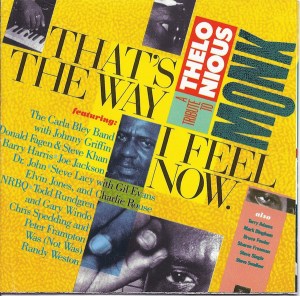 Duke Ellington famously said that there are only two types of music: good and ‘the other kind’.
  Most jazz players don’t really seem to ‘get’ the music of Thelonious Monk.

 movingtheriver.com