1980s Rock/Pop Acts I Should Like But Don’t

Everyone knows a few: those acts that got great reviews, named some of your favourite bands as influences and sold a few records in the process, but there was just something about their music that you couldn’t hack.

Maybe it was their vocals, their outlook, their politics, their songwriting, or a mixture of all four.

Well I know some too. Here’s a totally subjective, wildly judgemental – no offence intended – list of 1980s pop and rock artists who leave me cold, despite most being critical and commercial successes. Believe me, I’ve tried. Like they could care less…

King’s X
My muso mates waxed lyrical about their tricky riffs and tight musicianship but I’ve never got beyond the guy’s not very good singing, their weirdly unmemorable songs and rather naff pomp-rock tendencies.

World Party
Perpetually spoken about in hushed tones of reverence when I was at college but their music singularly failed to grab, despite the Beatles/XTC/Prince influences, possibly due to Karl Wallinger’s rather wimpy voice. See also: Crowded House, REM, Waterboys

The Blow Monkeys
Somehow got filed under the ‘sophistipop’ banner courtesy of their flirtation with ‘slinky’ grooves and soul influences, but for me Dr Robert’s absurd voice and the lack of songwriting imagination never got them past first base. See also: Kane Gang, Simply Red, Johnny Hates Jazz, Black, The Big Dish.

Marillion
Decade-ending Season’s End had some brilliant moments but for me most of the Fish era was a succession of quite badly-played/badly-sung rip-offs of Gabriel-era Genesis. It Bites did it better and added some much-needed pizzazz and groove. See also: IQ, Jadis, Tony Banks/Chris Squire/Mike Rutherford solo albums…

Deacon Blue
I liked the soppier/poppier elements of their debut album Raintown but the game was up when the truly irritating ‘Wages Day’ and ‘Real Gone Kid’ swept the airwaves at the end of the decade. They took Prefab Sprout’s basic concept to the bank whilst shaving off the weird edges.

Paul McCartney
Sheer melodic brilliance time and time again of course, but for me his 1980s work generally flatters to deceive, outside of a few random favourites (‘Pipes Of Peace’, ‘Once Upon A Long Ago’). Yes, even the album he did with Elvis Costello (of whom more below…).

The Style Council
Only a musical moron would deny the power of ‘You’re The Best Thing’ and ‘Walls Come Tumbling Down’ and you have to admire Paul Weller’s songcraft, politics, guitar playing and ability to laugh at himself, but generally it was hard to shake off the naffness. Mick Talbot must take a lot of the blame…

Mick Jagger
He employed some of my favourite producers and musicians (Jeff Beck, Sakamoto, Bill Laswell, Herbie Hancock, Doug Wimbish, Simon Phillips etc. etc.) but failed to produce even one memorable or interesting single or album track during the 1980s. See also: Pete Townshend, Eric Clapton, Nick Heyward, Jerry Harrison

Pages
This yacht rock supergroup had a great singer (Richard Page) and sh*t-hot musicians (Vinnie Colaiuta, Jay Graydon, Jeff Porcaro, Steve Lukather etc.) but the songs weren’t strong or memorable enough. See also: most of Toto, Mr Mister

Elvis Costello
Weirdly his ‘Less Than Zero’ was one of the first singles I loved as a kid, but his desperation to be a serious ’80s ‘artist’ fell on deaf ears despite the fact that he obviously knew a lot of chords and retained some of that new-wave angst (but even I couldn’t resist his fine run of 1990s form, from the superb ‘London’s Brilliant Parade’ to Bacharach). See also: The Cars, The The, Squeeze.

Van Morrison
To my ears his 1980s music is like Joni Mitchell and John Martyn without the melodic/harmonic/lyrical depth, apart from the sublime ‘Rave On John Donne’. People tell me he always uses great bands though, but they often barely register…

Todd Rundgren
I’m more of a fan of his 1980s producing work (Pursuit Of Happiness, XTC etc) than his solo music. Never bought into this whole ‘he’s a genius’ thing, save the wonderful ‘The Verb To Love’ – but that’s from the 1970s, innit…? See also: Lenny Kravitz.

Depeche Mode
Yes they’ve got a few pop hooks, the Mute Records cred and ‘edgy’ image but never been able to shake off an ineffable naffness for me. And despite being ‘synth pioneers’, they didn’t seem to push the sonic envelope much in the 1980s at all. ‘Everything Counts’ was superb though and I got on board later with Ultra. See also: Kraftwerk, New Musik, Visage, Ultravox, New Order, Howard Jones

Pink Floyd
If you want to put me to sleep, put on any of Pink Floyd’s 1980s work. Bring back Syd. See also: Fleetwood Mac, Pink Floyd solo projects, except Nick Mason’s Fictitious Sports, which is brilliant…

Bad Brains
Dub/thrash/funk pioneers and a huge influence on bands I really like such as Living Colour, Fishbone and 24-7 Spyz, but their music seems a little amateurish to me and, again, their singer was not blessed with a great set of pipes (unlike the singers of bands above).

Housemartins
Fondly remembered until you actually hear those singles again – ‘Build’, ‘Happy Hour’, ‘Caravan Of Love’. Annoying, a bit puny, and apparently the more irritating side of the C-86 generation.

The Jesus and Mary Chain
Bowie summed them up well for me: ‘I tried the Jesus and Mary Chain but I just couldn’t believe it. It’s awful! It was so sophomoric – like the Velvets without Lou. I just know that they’re kids from Croydon! I just can’t buy it…’

Thelonious Monk: That’s The Way I Feel Now

Most jazz players don’t really seem to ‘get’ the music of Thelonious Monk.

Decent cover versions are hard to come by, of course with some notable exceptions (Steve Khan, Kenny Kirkland, Lynne Arriale, Paul Motian and probably a few more).

During the centenary of the genius’s birth, it seems as good a time as any to revisit a classic 1980s Thelonious tribute album which puts his miraculous compositions front and centre (plus the fact that I’ve just acquired a brilliant new cassette player* which is bringing it to life again after years stuck in the proverbial drawer).


That’s The Way I Feel Now was masterminded by producer/curator Hal Willner and inspired by bad Monk cover versions. Willner told writer Howard Mandel:

‘I was sitting at Carnegie Hall at some jazz memorial to Monk, getting freaked out that all these other people who really had a love of Monk weren’t performing. Monk’s music was never boring.’

So, at New York’s Mediasound Studios in early 1984, he set about assembling an extraordinary cast of fans including Todd Rundgren, Donald Fagen, Joe Jackson, Carla Bley, Peter Frampton, John Zorn, Was (Not Was), Dr John, Gil Evans, Bobby McFerrin, John Scofield and Elvin Jones to celebrate Monk.

(Willner has gathered similarly eclectic casts for albums celebrating Mingus, Nino Rota, Kurt Weill and the music of Walt Disney films, as well as producing records by Lou Reed and Marianne Faithful and movie soundtracks including ‘Short Cuts’.)

Listened to in one sitting, That’s The Way I Feel Now still makes for a gloriously psychedelic celebration of Monk’s ouevre. Over 22 tracks, I can only make out three duds. It’s also a triumph of sequencing, holding the attention with ease.

First, the ‘rock’: Rundgren’s take on ‘Four In One’ is a gloriously anarchic, Gary Windo’s sax blaring out over a cacophony of samples, cheap drum machines and amateurish keyboards. Was (Not Was)’s take on ‘Ba-Lue-Bolivar-Ba-Lues-Are’ features a knockout multi-tracked guest spot from vocalist Sheila Jordan, while Donald Fagen and Steve Khan mesh perfectly on beautiful ballad ‘Reflections’.

NRBQ’s take on ‘Little Rootie Tootie’ comes near to perfection, as does Chris Spedding/Peter Frampton’s surf-rock-tinged ‘Work’ featuring a classic Marcus Miller bass performance. Only Joe Jackson didn’t get the memo, delivering an overly-lush – though obviously heartfelt – ‘Round Midnight’.

Then there’s the ‘jazz’: John Zorn lays down an outrageous ‘Shuffle Boil’ featuring babbling vocals, bubble-blowing, chainsaw guitar, Bontempi organ and hilariously remedial drumming; Elvin Jones and Steve Lacy deliver a memorable ‘Evidence’; Randy Weston, Dr John and Barry Harris’s contributions are solo piano masterworks; John Scofield and Mark Bingham smash ‘Brilliant Corners’ out of the park, as do vocalists Bobby McFerrin and Bob Dorough on ‘Friday The 13th’.

Finally, Carla Bley’s ‘Misterioso’ is possibly the album standout, an affecting symphony for Monk featuring electrifying performances from Kenny Kirkland on piano, Johnny Griffin on tenor and Hiram Bullock on guitar.

The Rundgren tune aside, to my ears That’s The Way I Feel Now could have been recorded yesterday. The only problem is that it’s almost impossible to buy these days. So I’m bloody glad I held onto my ancient cassette version. Here’s hoping for a CD/download re-release soon.

*a Denon DRR 6.5, if you’re interested…

XTC: Skylarking Uncovered

It’s only natural that a young(ish) man’s fancy should turn to Skylarking at this time of year.

And though I must have listened to it tens of times, Steven Wilson’s new instrumental mix uncovers many of the album’s sonic secrets.

Though lead songwriter/vocalist Andy Partridge had a somewhat ‘strained’ relationship with producer Todd Rundgren, this version demonstrates once and for all that Todd played a blinder on Skylarking, as arranger, sound designer, occasional keys player and backing vocalist.

And the others (Dave Gregory, Colin Moulding, Prairie Prince, sundry guest players) weren’t too shabby either.

Things to listen out for: the charmingly ramshackle 12-string guitars and Mellotron underpinning ‘Summer’s Cauldron’, the dramatic cello gracenotes that punctuate ‘Grass’, Partridge’s Stax-flavoured guitar and Todd’s synths on ‘That’s Really Super Supergirl’, Gregory’s superb piano on ‘Ballet For A Rainy Day’ and ‘Season Cycle’ and intricate guitar on ‘Earn Enough For Us’, the mad mariachi trumpets that kick off ‘Big Day’, Prairie’s subtle drums on ‘Mermaid Smiled’, and…well, you get the idea.

It seems unlikely that this will appeal to any but the most hardcore XTC fans, but who knows? The top-notch songcraft and synaesthetic textures may even draw in some new punters.

XTC: Skylarking 30 Years Old Today

xtcVirgin Records, released 27 October 1986

Produced by Todd Rundgren

Recorded at Utopia Studios, Woodstock, upstate New York

UK album chart position: #90 (!)
US album chart position: #70 (!)

terry-thomas

Terry-Thomas in ‘School For Scoundrels’

Side One:

1. ‘Summer’s Cauldron’

Andy Partridge (composer): ‘Something about the words reminded me of Dylan Thomas. Not that I’m saying I’m a Dylan Thomas. More of a Terry-Thomas, really…’

2. ‘Grass’

Colin Moulding (composer): ‘A lot of people think the song’s about marijuana – it isn’t. Todd said: “Don’t sing so deep. You sound like a bit of a molester.” So I just did the Bowie thing and added an octave above it…’

3. ‘The Meeting Place’

Moulding: ‘Because the riff was a bit like “Postman Pat”, we were just figures on a Toytown landscape viewed from above. It was me meeting her (future wife Carol) at the gates for a sandwich in The Beehive pub, embroidered with the suggestion of a lunchtime quickie…’

4. ‘That’s Really Super, Supergirl’

Partridge: ‘I’d go into his (guitarist Dave Gregory) little room, smelling of aftershave and guitar wax and dead mice, and he’d be rehearsing this solo over and over again. I can still see him playing it. I remember when we were recording the song that Todd was trying to master it on keyboard, and Dave whispered to me, “He’s got the chords wrong!” He thought the chords were major, and they’re not. I was hearing it a lot more clangorous…’

5. ‘Ballet For A Rainy Day’ (Partridge)

6. ‘1000 Umbrellas’

Partridge: ‘There was very little time to do the strings. They had one run-through and then recorded it. Their balls were on the line but they turned in a pretty fine performance…’

7. ‘Season Cycle’

Partridge: ‘I felt that I had maybe laid the ghost of Ray Davies ‘fore me and written a song that could stand up against “Shangri-La” or even, dare I suggest, “Autumn Almanac”.’

Side Two:

8. ‘Earn Enough For Us’ (Partridge)

9. ‘Big Day’

Moulding: ‘I’d been messing around with the chords of Labi Siffre’s “It Must Be Love” and, with a little moving around, it became this sort of fanfare to a big event, a ticker-tape parade for a big day.’

10. ‘Another Satellite’

Partridge: ‘I regret writing it because things turned out so marvellously with the person (Erica Wexler) it’s all about. The story had a happy ending because Erica and I finally got to express the emotional bond that was always there.’

11. ‘Mermaid Smiled’ (Partridge)

12. ‘The Man Who Sailed Around His Soul’

Partridge: ‘It just says you’re born, you live and you die. Why look for the meaning of life when all there is is death and decay? Todd said, “Let’s do a John Barry thing” and, literally overnight, came up with his arrangement with brass and flutes. It’s bang on. Cod spy music.’

13. ‘Dying’ (Moulding)

It frightens me when you come to mind
The day you dropped in the shopping line
And my heart beats faster when I think of all the signs, all the signs
When they carried you out your mouth was open wide
The cat went astray and the dog did pine for days and days
And I felt so guilty when we played you up
When you were ill, so ill
What sticks in my mind is the sweet jar on the sideboard
And your multicoulored tea cozy

What sticks in my mind is the dew drop hanging off your nose
Shrivelled up and blue
And I’m getting older, too
But I don’t want to die like you

14. ‘Sacrificial Bonfire’

Moulding: ‘There was a touch of “The Sorcerer’s Apprentice” and a bit of Arthur Brown’s “Fire” in it, I suppose. But I wasn’t moralising. It was just that this was an evil piece of music and good would triumph over it. (The strings) were a bit too Vivaldi for me, but it had to go somewhere, I suppose…’

Further reading: ‘XTC Song Stories‘ by Neville Farmer

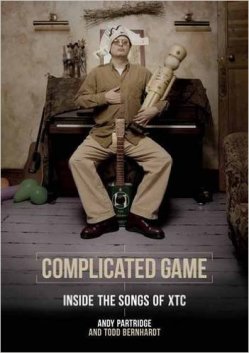
‘Complicated Game’ by Todd Bernhardt/Andy Partridge

Book Review: Inside The Songs Of XTC

complicated gameBooks about songwriting are a small but fast-growing and fascinating subgenre of music journalism.

Alongside such classic tomes as Paul Zollo’s ‘Songwriters On Songwriting’, Omnibus Press’s ‘Complete Guides’ and Bob Dylan’s ‘Chronicles’, we’ve also recently had Daniel Rachel’s excellent ‘Isle Of Noises’. And now here comes another cracker.

XTC fans, however, may be slightly surprised about the publication of ‘Complicated Game: Inside The Songs Of XTC’, a gripping new book of interviews with mainman Andy Partridge, seeing as they may possibly feel that it would hard to better Neville Farmer’s ‘XTC Song Stories’.

But, while obviously covering similar ground, ‘Complicated Game’ zooms in with forensic detail on a select group of Partridge songs, particularly ones that may well have been overlooked throughout his stellar career (‘Travels In Nihilon’, ‘No Language In Our Lungs’, ‘Beating Of Hearts’, ’25 O’Clock’ etc).

He once said that XTC’s music explores the unexplored nooks and crannies of the guitar neck; this book does the same for their discography.

Essentially, ‘Complicated Game’ is a transcription of over 30 interviews by American rock journalist/musician Todd Bernhardt. Though some of Partridge’s legendary West-Country repartee and clever wordplay occasionally get a bit lost in translation, these conversations are candid, detailed and never less than engaging.

Discussions about a rhyming couplet can suddenly give way to painful memories of Partridge’s divorce, or asides about Swindon or 9/11.

The ‘Dear God’ controversy gets a whole chapter. The thorny subject of record company wrangling is never far from the surface, and Andy’s troubled relationships with producers is also a constant theme, with Steve Nye, Todd Rundgren and Gus Dudgeon taking centre stage (the former being described as ‘possibly the grumpiest guy we’ve ever worked with’!)

There’s just enough musical theory discussed too, and – not surprisingly, given that Bernhardt once interviewed Partridge at length for Modern Drummer magazine – a lot of emphasis on the role of the rhythm section, with much talk about Colin Moulding’s superb bass playing and many hilarious anecdotes about original XTC drummer Terry Chambers and later sticksmen Pete Phipps, Prairie Prince and Dave Mattacks.

But, most importantly, Partridge is able to give detailed and fascinating answers about where he gets his songwriting inspiration, looking in detail at how unusual – and often completely accidental – chords can set off images and themes, and also how much he associates music with colours. There’s also a lot of advice for songwriters about how to develop initial ideas.

Andy_Partridge

Of course, the real measure of a great music book is how quickly one is drawn back to the records, and ‘Complicated Game’ works a treat in that regard – I rushed first to the CD and then to the guitar to try and nail down ‘That’s Really Super, Supergirl’ and ‘Church Of Women’.

The orchestral arrangements and song structures of the truly singular ‘River Of Orchids’ and ‘I Can’t Own Her’ are also discussed in great detail.

There are a few minor quibbles: some of the interviews have a slightly ‘flogging a dead horse’ feel to them, and also there’s a strange reluctance to talk about Partridge’s contemporaries – Sting, Weller, McAloon, Gartside et al go unmentioned, and Elvis Costello is only referred to once in terms of his huge bank balance!

But hey, enough of my nitpicking. ‘Complicated Game’ is another fine book about songwriting, a good holiday read for ’80s music fans and a great companion piece to ‘XTC Song Stories’. I devoured it almost in one sitting and will definitely be reaching for it regularly.