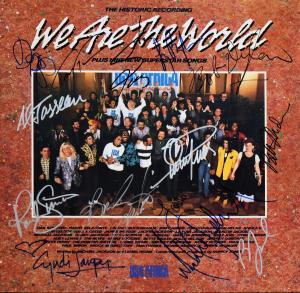
USA For Africa: We Are The World @ 40

Released 40 years ago this month and officially the fastest-selling single in American music history, USA For Africa’s ‘We Are The World’ shifted over 20 million copies and raised a huge amount of money for African famine relief.

Co-written by Michael Jackson and Lionel Richie during a few sessions at the former’s house in Encino, the song divides opinion but only the hardest heart could fail to be moved by its recording (even if one can definitely feel the vibe of some major agent/star power – no arriving in the manager’s battered old car for this lot…).

It brought together a fairly astonishing cast list of the great and good. And, inadvertently, it also arguably represented a last gasp for classic 1980s R’n’B and yacht rock.

The basic track was recorded at Kenny Rogers’ Lion Share Studios on 22 January 1985 with king-of-the-cross-stick John ‘JR’ Robinson on drums, bassist Louis Johnson and pianist Greg Phillinganes, closely monitored by a huge press corps, co-producers Quincy Jones and Michael Omartian and engineer Humberto Gatica. According to Robinson, all the musicians were sight-reading a chart and a click track was used, and they didn’t do more than two takes.

A few days later, Lionel sat down with Quincy and vocal arranger Tom Bahler to prep who would sing which lines (the decision was also made to mainly record vocals live and ‘in the round’ with no or at least very few ‘punch-ins’, unlike ‘Do They Know It’s Christmas’). All the major vocalists were then sent a copy of the basic track featuring Jackson’s guide vocal and with an enclosed letter from Lionel.

The featured singers then assembled at A&M Studios at around 9pm on Monday 28 January, most arriving after the American Music Awards (which Richie hosted). Notable absentees: Madonna (who was apparently bumped in favour of Cyndi Lauper), Prince (check out Duane Tudahl’s superb book for the details), George Benson, Dolly Parton, Donna Summer, Michael McDonald, Pat Benatar, Rod Temperton, Stevie Nicks, Joni Mitchell, Billy Idol? And is it odd that Smokey Robinson didn’t sing a solo line?

The complete footage of the recording session is still fascinating. We see how some of the biggest names in music history found different ways of preparing. Steve Perry waits for his line with eyes shut, looking down, listening intently. Diana Ross does just the opposite.

Bob Geldof gives a stirring pep talk and Stevie Wonder brings in two Ethiopian women to address the singers, moving many to tears. It’s hard not to be touched by Stevie, Kenny Rogers, Dionne Warwick, Diana, Steve Perry, Ray Charles and Cyndi Lauper’s vocals. But Harry Belafonte, Ray Charles, Bob Dylan and Bruce Springsteen seem to get the most respect from the assembled stars.

Other observations: Brucie – who had finished the latest leg of the Born In The USA tour the night before – looking like Judd Nelson in ‘The Breakfast Club’. Al Jarreau struggling throughout. Lionel the team player. Stevie giggling like a naughty schoolkid when Quincy gets annoyed. James Ingram hiding behind Kenny Rogers after a boo-boo.

Paul Simon twice saying to Rogers: ‘Can I help?’ Lauper sharing vocal tips with Kim Carnes. MJ holding hands with Diana and Stevie. Quincy and Stevie rehearsing with Bob Dylan. Stevie and Ray Charles using their braille machine. Quincy reading the score as he conducts the soloists, and his witty asides: ‘Who you gonna call?’ etc.

It looks like they recorded the first half of the song first (up to and including Daryl Hall) and then spent some time on the middle eight with Huey Lewis, Lauper and Carnes.

How does it sound now? Phillinganes’ piano playing is a pleasure to hear, typically tasty and gospel-inflected. But the track is inundated with synths – no less than four players are credited, including David Paich and Steve Porcaro from Toto – and probably why it reminded many of a Pepsi ad.

And it’s odd that the song features no guitar, though Prince offered to play a solo – Quincy reportedly told Prince’s manager Bob Cavallo: ‘I don’t need him to play guitar, we got f*ckin’ guitars’!
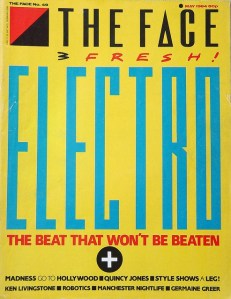
The Face Magazine: Culture Shift @ National Portrait Gallery, London

Any British music fan who came of age during the 1980s must surely have a soft spot for The Face magazine.

Launched by Smash Hits founder/NME editor Nick Logan in May 1980, the monthly rag – so named because of its Mod allegiances – quickly become known as a first-rate style mag (it covered fashion, music, culture, clubbing and cinema too), with its many famous covers reaching the level of high-quality pop art.

Indeed, looking again at issue #1, it’s remarkable how many of its listed writers and photographers would turn out to be key documentors of the decade – Janette Beckman, Julie Burchill, Gary Crowley, Anton Corbijn, Ian Cranna, Jill Furmanovsky, David Hepworth, Tony Parsons, Sheila Rock, Pennie Smith (and that issue alone features iconic photos of Madness, The Specials, The Clash, John Lydon and Paul Weller, amongst others).

It was also unique amongst 1980s music mags in paying as much attention to reggae, hip-hop, electro, house, rare groove and jazz as it did to post-punk, 2-Tone and sophistipop.

But movingtheriver also remembers it most for its superb long-form interviews: I still have issues featuring in-depth pieces on Miles Davis, Trouble Funk, Dennis Hopper, David Sylvian, David Byrne, Robert Smith, Daryl Hall and Ken Russell.

The Face’s iconic imagery is celebrated at the excellent if compact new exhibition at London’s National Portrait Gallery. Predictably it’s photos from those post-punk/New Pop salad days of 1980-1983 which produce the most smiles of recognition/pleasure – Bowie in Japan, Adam Ant, Phil Oakey, John Lydon, Annie Lennox.

But there are great pics/stories from later in the decade too – Bros with their mum at home in Peckham, Shane MacGowan, Sade, Nick Kamen, Felix et al. There’s also a great chronology of 1980s clubbing, from Goth to Acid House, and a focus on long- lost London nightspots.

As the 1980s became the 1990s, The Face arguably reflected a gradual coarsening of the culture with more focus on fashion and lifestyle – but you knew that anyway. But this exhibition is a must-see for any music fan who loved the 1980s, and it was also refreshing to see such a broad range of ages attending.

The Face Magazine: Culture Shift runs at the National Portrait Gallery until 18 May 2025.

The Worst Album Titles Of The 1980s

It was one of the many issues that probably had managers and marketing people tearing their hair out during the 1980s.

What to name your album? It might be a low-risk strategy to name it after the first single – even better if that song is a big hit – or, if you were feeling clever, after a ‘pivotal’ album track.

But oftentimes 1980s acts went out on a limb, looking for a ‘poetic’ title, something ‘novel’, something… You get the picture.

Here’s a selection (to be regularly updated) of 1980s album titles that went off-piste. Some are pretentious, some weird, some have needless word repetition (hello Sting), some fudge punctuation or foreign words in an infuriating way, some are rubbish puns, some are desperate to shock, some are way too high-falutin’, some throw concepts together in a seemingly random way. But the reaction to most is: eh?

Of course a bad title didn’t stop some of these being great albums, though, tellingly, very few were big hits…

Talking With The Taxman About Poetry (Billy Bragg)

Three Hearts In The Happy Ending Machine (Daryl Hall)

The Secret Value Of Daydreaming (Julian Lennon)

Steve McQueen (Prefab Sprout)

Shooting Rubberbands At The Stars (Edie Brickell & The New Bohemians)

The Uplift Mofo Party Plan (Red Hot Chili Peppers)

Mother’s Milk (Red Hot Chili Peppers)

As Falls Wichita, So Falls Wichita Falls (Pat Metheny/Lyle Mays)

Into The Dragon (Bomb The Bass)

Angst In My Pants (Sparks)

Tennis (Chris Rea)

Love Over Gold (Dire Straits)

North Of A Miracle (Nick Heyward)

Misplaced Childhood (Marillion)

Script For A Jester’s Tear (Marillion)

Boys & Girls (Bryan Ferry)

Journeys To Glory (Spandau Ballet)

Through The Barricades (Spandau Ballet)

Seven And The Ragged Tiger (Duran Duran)

Big Thing (Duran Duran)

Modern Romans (The Call)

The Secret Of Association (Paul Young)

Shabooh Shoobah (INXS)

Remain In Light (Talking Heads)

If This Bass Could Only Talk (Stanley Clarke)

Blood & Chocolate (Elvis Costello)

A Salt With A Deadly Pepa (Salt’n’Pepa)

Splendido Hotel (Al Di Meola)

Within The Realm Of A Dying Sun (Dead Can Dance)

The Moon Looked Down And Laughed (Virgin Prunes)

Architecture & Morality (OMD)

The Dream Of The Blue Turtles (Sting)

In-No-Sense? Nonsense! (Art Of Noise)

In Square Circle (Stevie Wonder)

Lawyers In Love (Jackson Browne)

The Story Of A Young Heart (A Flock Of Seagulls)

The One Giveth, The Count Taketh Away (Bootsy Collins)

You Shouldn’t-Nuf Bit Fish (George Clinton)

All The Best Cowboys Have Chinese Eyes (Pete Townshend)

Difficult Shapes And Passive Rhythms Some People Think It’s Fun To Entertain (China Crisis)

Working With Fire And Steel (China Crisis)

Franks Wild Years (Tom Waits)

So Red The Rose (Arcadia)

Café Bleu (The Style Council)

The F**king C*nts Treat Us Like Pricks (Flux Of Pink)

Chalk Mark In A Rainstorm (Joni Mitchell)

I, Assassin (Gary Numan)

Civilised Evil (Jean-Luc Ponty)

Introducing The Hardline According To Terence Trent D’Arby

Children (The Mission)

Casa Loco (Steve Khan)

The First Of A Million Kisses (Fairground Attraction)

Bebop Moptop (Danny Wilson)


More crap 1980s album titles? Of course. Let us know in the comments below (particularly looking for more in the metal, Goth and prog genres).