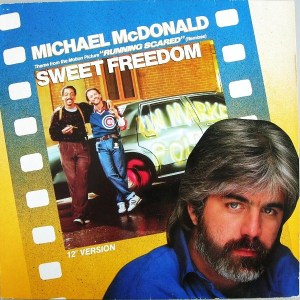
Michael McDonald: Sweet Freedom (Extended)

It’s always a nice surprise when a classic 1980s track suddenly appears on streaming services out of the blue.

Michael McDonald’s ‘Sweet Freedom’, written by Rod Temperton and co-produced by Temperton, Bruce Swedien and Dick Rudolph, is one such single, but the only version currently available is the superb seven-minute extended mix.

It was a good period for McDonald (weird that he wasn’t involved with ‘We Are The World’?). Despite a now-very-dated 1985 album No Lookin’ Back, he had recorded fine duets with James Ingram, Patti Labelle and Joni Mitchell.

As for Temperton, hot off the back of Thriller he had worked on Steven Spielberg’s ‘The Color Purple’ soundtrack, then ‘Running Scared’, nowadays a pretty-much-forgotten Billy Crystal/Gregory Hines vehicle. Recorded at Westlake in Los Angeles, where most of Thriller was laid down, ‘Sweet Freedom’ was the movie’s key song and arguably Temperton’s final masterpiece. The verses owe a little to Lionel Richie’s ‘All Night Long’ and Temperton finally gets his ‘starlight’ motif into the middle eight (‘Starlight’ was an early title for the song ‘Thriller’).

The extended version is a brilliant little pop/soul symphony, with every performer getting a feature. Greg Phillinganes adds his special sauce on keys and there are some beautiful backing vocals from Siedah Garrett. The horn section (Bill Reichenbach, Chuck Findley, Jerry Hey, Larry Williams) contribute brief solos as does guitarist Paul Jackson Jr.

It would have been nice to have heard a real rhythm section (JR Robinson and Nathan East?) let loose on this but no matter. And people who say McDonald isn’t a soulful singer need to hear his performance in the second half of this extended version.

Released in June 1986, ‘Sweet Freedom’ reached #7 in the US and #12 in the UK.

Yngwie J Malmsteen: Rising Force 40 Years On

When movingtheriver started playing guitar and buying muso magazines in the late 1980s, the name Yngwie J Malmsteen seemed to inspire awe throughout the whole ‘scene’.

But there was no way you could just happen upon Malmsteen’s music in the UK unless you listened to ‘The Friday Rock Show’ with Tommy Vance.

Then my interest was piqued again when It Bites’ Francis Dunnery mentioned him in a Guitarist magazine interview from October 1989. Almost immediately after that I found Malmsteen’s debut solo album Rising Force – released 40 years ago this month – in a bargain bin at the Richmond Our Price.

You could make an argument that the Swede – born Lars Lannerback! – was THE rock guitarist of the 1980s, having as much of an impact as Eddie Van Halen did five years before. Rising Force was a perfect bridge between the UK, Genesis and Yes albums I was investigating and the heavier influences coming in from Steve Vai and Van Halen.

But, as with any freaky guitar virtuoso, the main issue was finding the right musical context. Rising Force has its duff songs (though always with brilliant guitar playing) but delivers two of the most stunning instrumentals in rock history, ‘Black Star’ and ‘Icarus Dream Suite Op.4’. And to think he was just 20 when he recorded them.

With Malmsteen’s scalloped Strat and nods to Paganini, Bach, Albinoni and Mozart, he achieved (and achieves) a remarkable control of vibrato, both via fingers and whammy bar – demonstrating possibly influences from Allan Holdsworth and Al Di Meola at this early stage – and superb tone, plus a mastery of those baroque passing chords.

I saw Yngwie live once at The Marquee on Charing Cross Road on 11 June 1994. It was thrilling seeing him at such close quarters but I kept wanting the singer to shut up. Eventually said vocalist got into a spat with someone at the front and smashed the mic stand down on his head.

Yngwie then set his Strat alight, kicked it to pieces and chucked the neck towards the sound desk, just missing my head and landing about 15 feet away. The venue was evacuated, and as we chatted nervously outside, a laughing kid ran past brandishing the smoking neck. Wonder where it/he is now.

I no longer have the CD of Rising Force for some reason – wish I had held onto it because the album is not on any streaming platforms at the time of writing. Malmsteen’s career continues at great pace – he’s just played two gigs in London and done a great interview with Rick Beato.

And for those who like reaction videos, The Daily Doug has put together a neat musical analysis of ‘Icarus Dream Suite’ here.

Book Review: Withnail & I (From Cult To Classic) by Toby Benjamin

The ‘Withnail’ cult shows no sign of waning. Writer/director of the 1987 movie Bruce Robinson spent some of lockdown discussing the film while co-star Richard E Grant posted regular line-readings on social media. And now there’s news of a long-awaited, Robinson-endorsed stage play.

So Toby Benjamin’s excellent ‘From Cult To Classic’ seems to have arrived at the perfect time. Authorised by Robinson and written with his full co-operation, it assembles a veritable cornucopia of ‘Withnail’ info.

The brilliantly blunt Robinson foreword almost had movingtheriver punching the air with excitement. Elsewhere letters from his personal collection show correspondence around the film’s financing and script editing. There are anotated script pages, detailed location administration and premiere tickets. We even see Robinson’s London to Cumbria train tickets for the shoot. Richard Curtis and Richard E also donate personal letters.

There are brilliant on-set photos, many by official snapper Murray Close, some donated by Robinson and the cast (including a great one of a clearly mullered Ringo Starr). All the main cast members give long, interesting interviews, as do many key bit-part players (The Irishman, the ‘Get in the back of the van!’ cop, Farmer Parkin) and the hairdresser, stills photographer, makeup artist, cinematographer, production manager, costume designer and soundtrack composers Rick Wentworth and David Dundas. We even hear from the owner of Crow Crag (Sleddale Hall).

There are a few minor quibbles – the book is dotted with ‘celebrity’ endorsements of the film but you’d be hard pressed to recognise any of them, outside of Matt Johnson, Charlie Higson and Diane Morgan, and no biographies are provided. Also the book’s ‘distressed’ interior design will probably divide opinion.

But if you’ve seen ‘Withnail’ more than once, you have to have this book. Absolutely unreservedly recommended to scrubbers and terrible c*nts everywhere.

The Samantha Fox/Mick Fleetwood BRIT Awards Fiasco: 35 Years On

Memorable for all the wrong reasons, the 1989 BRIT awards, broadcast live 35 years ago this month, has long gone down as one of the most shambolic, embarrassing  TV shows ever.

It took place at the Royal Albert Hall during the Jason/Kylie/Rick Astley/Brother Beyond/Bros-inspired pop peak of the late 1980s, less than six months after the first Smash Hits Poll Winners Party at the same venue. Madchester was just around the corner but it seemed like another world.

Cool Britannia this wasn’t. Firstly, there was the the two presenters (wasn’t Phillip Schofield available?). Apart from anything else, Fox is 5’1” and Mick 6’6”. Then there was their extremely unnatural, awkward presentation styles, though, to this day, Fox swears that the autocue was broken.

Various bad-tempered Stones came and went, Boy George was introduced as The Four Tops, Tina Turner and Annie Lennox looked desperately awkward, other ‘dignitaries’ were wheeled out and MPs were booed.

Rounding things off perfectly, Cliff Richard was then given a Lifetime Achievement Award and delivered a brilliantly sniffy speech for the plebs. All in all, it’s no surprise that this was the last time the BRITS went out live on TV for 18 years…


Arvo Pärt: Tractus (2023)

Can music bring about social change, get people to put down their guns, retire their drones? Can ‘religious’ music affect the atheist/agnostic as powerfully as it affects the ‘believer’?

Ted Gioia may have some answers but in the meantime the Estonian composer Arvo Pärt has been making special music for decades.

His work was particularly revered in the 1980s as ambient/minimalism gained a bigger following than ever before, his ‘Fratres’ becoming a classic, performed by everything from a string quartet to cello octet and featuring on countless movie soundtracks.

Pärt’s mesmerising new ECM New Series album Tractus – probably movingtheriver’s album of 2023 – was recorded during September 2022 in Tallinn’s Methodist Church. It features music written between 1988 and 2019 for string orchestra, soprano voice, choir, piano and assorted percussion.

The title refers to a series of theological writings published between 1833 and 1845 by
English cardinal John Henry Newman, and also an ancient form of singing first noted as early as the third century AD. There are other historical precedents to both the title and compositional style, outlined in great detail within the CD’s liner notes.

Sadly the people who should listen to Tractus will probably never get to hear it.

Culture Club: ‘Karma Chameleon’ Hits US #1 40 Years Ago Today

The Second British Invasion hit its imperial phase 40 years ago today, a week after Newsweek had put Annie Lennox and Boy George on its cover.
Off the back of Eurythmics’ ‘Sweet Dreams’ hitting #1 in the US during September 1983, ‘Here Comes The Rain Again’ peaked at #4 at the beginning of February 1984.

In the same week, Culture Club’s ‘Karma Chameleon’ hit #1, their only American chart-topper to date. The band then won Best New Artist at the 1984 Grammy Awards on 28 February, Boy George giving one of the most famous music-award thank-yous of all time:

Regarding the Newsweek photoshoot, George later reported in his autobiography ‘Take It Like A Man’: ‘I heard Annie telling the make-up artist Lynne Easton not to make her look like Boy George. Annie was my female counterpart, the tomboy to my tomgirl. I enjoyed the irony of my being photographed with her; I was the fan made good, even if she didn’t want Boy George eyebrows.’

Both Culture Club and Eurythmics then toured the US during April 1984, the latter enjoying a famous residency at The Ritz in New York City. Did you see either of them live in ’84? Let us know your memories below.

John Lennon/Yoko Ono: Milk and Honey @ 40

Milk and Honey – planned as the followup to Double Fantasy long before John Lennon’s death on 8 December 1980 – was finally released 40 years ago this weekend, on 27 January 1984.

I believe it was the second vinyl album owned by movingtheriver – the first was The Beatles’ Magical Mystery Tour soundtrack.

Polydor did John and Yoko proud, with striking front/back photos and a gatefold sleeve complete with Ono’s liner notes, Lennon’s ‘Grow Old With Me’ lyrics and some Robert/Elizabeth Barrett Browning poetry.

But Milk and Honey was somewhat of a commercial disappointment, reaching #3 in the UK and just #11 in the US. And it seems one of the least remembered Lennon-related albums these days. Why? Listening again after a few years this weekend was a pleasurable experience, with a few exceptions, and the breadth of musical styles (reggae, calypso, new-wave, piano balladry, rock’n’roll) is impressive.

Six John solo tracks recorded during and before the Double Fantasy sessions made it onto the album. They’re all pretty good, a few classic, mostly tougher than the previous material. John sounds on great form. His spoken-word moments and count-ins are amusing and he’s frequently heard ‘coaching’ the band (and studio staff) through the songs, Prince-style, with various instructions: ‘Boogie!’, ‘Hold it down’, ‘Groove!’, ‘All right, you can get out now’ etc.

The Lennon tracks also showcase a great band playing pretty much live in the studio. John plays lots of guitar – in that famous Jann Wenner interview, he said ‘I can make a guitar speak’, and you can hear it here. Drummer Andy Newmark lays off the hi-hat most of the time, letting the rhythm guitars fill in the top end.

Three UK singles were released from the album, with diminishing returns: ‘Nobody Told Me’ got to #6, ‘Borrowed Time’ (studio sessions reveal that John used an interesting reference source for the song) #32 and ‘I’m Stepping Out’ #88.

Yoko recorded her tracks during 1982 and 1983, mostly with a very good NYC rhythm section (Neil Jason on bass, Yogi Horton on drums), and they range from the intriguing to extremely corny. ‘Don’t Be Scared’ possibly influenced David Bowie, particularly the title track of Tonight, recorded three months after Milk and Honey was released:

Yoko also enlisted some ‘remix engineers’ who apparently added a lot of post-production effects to John’s vocals, the drums and guitars (she had fallen out with Double Fantasy producer Jack Douglas over unpaid royalties and refused to credit him on the album).

Revisiting Milk and Honey was certainly a bittersweet experience, but it’s an easy album to recommend, and it only makes you miss John all the more. The dunderheaded/ill-informed contemporary critical reactions are explored in this very good video:

Nik Kershaw: Wouldn’t It Be Good @ 40

Bristol-born, Ipswich-raised Nik Kershaw had a spiffing 1984 – no other solo artist spent more time on the UK singles charts during the year.

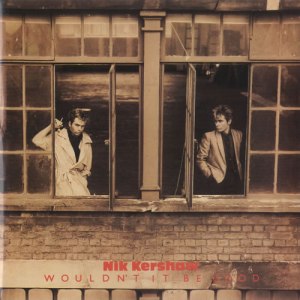
‘Wouldn’t It Be Good’, released 40 years ago this weekend (on the same day as Echo & The Bunnymen’s ‘The Killing Moon’) and reaching #4, was his second single – ‘I Won’t Let The Sun Go Down On Me’ initially flopped in September 1983.

‘Wouldn’t It Be Good’ was predominantly recorded at Sarm East studios on Osborn Street, Aldgate (don’t look for it – it’s not there any more). Peter Collins produced soon after helming Musical Youth’s ‘Pass The Dutchie’ and Tracy Ullman’s solo output (he later worked with Rush, Alice Cooper and Queensryche). The song’s original title was ‘Wouldn’t It Be Nice’ – Collins demanded a better word than ‘nice’.

It’s a great single, the beginning of movingtheriver’s love affair with Kershaw’s music, and its ominous lyrics have the slight whiff of ‘In The Air Tonight’ about them, as well as a subtle social conscience. I also always liked the weird emphases he placed on some words/syllables – ‘You must be JOKING/You don’t know A thing about it/You got no probLEM‘ etc…

I distinctly remember watching him perform the song on ‘Top Of The Pops’ for the first time – who was this tramp on telly, with the snood and fingerless gloves? My parents liked the track too, which was a bit disarming.

The song’s overdriven guitars were layered/overdubbed, Brian May-style (best heard on the 12” remix), and their major-seventh chords create some strange timbres. Its structure is seriously weird too – the second chorus comes right at the end, after a lengthy guitar/horn solo. The delayed gratification is clever and totally outside the norm.

The video was directed by Storm Thorgersen, mostly filmed in a large, disused building opposite Buckingham Palace, apart from a bit at the Mullard Radio Astronomy Observatory in Cambridge. An extremely odd cover version features on the ‘Pretty In Pink’ movie soundtrack. Nik fluffed the words at Live Aid but hardly anyone noticed.

Happy birthday to another classic single from 1984.

Big Country: ‘Wonderland’ Kicks Off One Of The Greatest Ever Pop Years

Big Country kicked off 1984 – one of the greatest ever pop years – with their between-album, standalone A-side ‘Wonderland’. It reached #8, their second most successful single in the UK.

Also 40 years ago this week, Radio 1 DJ Mike Read ‘banned’ Frankie Goes To Hollywood’s ‘Relax’ and the Second British Invasion was sweeping the States, led by Eurythmics, Duran Duran, Culture Club, A Flock Of Seagulls and The Police (a remarkable Hot 100 chart of April 1984 featured 40% British acts).

Meanwhile, Big Music of a distinctly Celtic hue was sweeping the UK: The Waterboys, Simple Minds, U2, Echo & The Bunnymen and Big Country. They made ‘elemental’ music, as the cliché goes, with lots of space and lyrics about wars, work, glaciers, mountains, seas and skies.

You could make the case that Big Country were the best musicians of the lot (see the live clip below). And they had an extraordinary run of singles success between 1983 and 1986 – after their debut (‘Harvest Home’) missed the top 40, all the next ten reached the top 30. They also made some serious inroads into the US market.

Tommy Vance liked ‘Wonderland’, reviewing it in Kerrang! magazine thus: ‘Should be heard by anyone who likes fine music. I’m a real fan of Steve Lillywhite’s productions and he’s done a superb job here. The guitar sound is good and the drumming superb.’ Indeedy. Ver Country’s second album Steeltown (sans ‘Wonderland’) emerged in October 1984 and went to #1 in the UK. Cool times.

RIP the terrific Annie Nightingale.

Greg Osby: Season Of Renewal

Of all the musical scenes that emerged during the 1980s, M-BASE – a Brooklyn-originated fusion of jazz and funk with many other influences thrown in – may be the least understood/remembered.

The term was co-authored by saxophonists Greg Osby and Steve Coleman. The M stands for ‘Macro’, BASE is an acronym for ‘Basic Array of Structured Extemporizations’.

The music’s other key practitioners were saxophonists Gary Thomas, vocalist Cassandra Wilson, keyboard player Geri Allen, guitarists Kevin Eubanks, David Gilmore and Kelvyn Bell, bassist Lonnie Plaxico and many more.

M-BASE was an attempt to draw attention away from ‘jazz’ as a catch-all term, and also showcase original material over standards and show tunes. But it certainly has its own sound once you hear a few key albums, totally different to ‘fusion’ or ‘jazz/funk’, relying on tightly structured drum patterns (often in odd-time signatures), funk bass, ‘modal’ keyboards, chattering rhythm guitars and Charlie Parker-influenced horn improvisations.

A key artefact was Osby’s arresting album Season Of Renewal, released 35 years ago on now-defunkt German-based label JMT (which also released many other key M-BASE recordings). Checking it out again now for the first time in a few years, it makes for fascinating, rewarding listening.

Themes are mainly outlined by the bass (Plaxico) and/or keyboards (Renee Rosnes and Edward Simon). Osby’s alto or soprano saxes generally only enter during solo sections. The guitarists (Eubanks and Kevin McNeal) are superb. The synths may bring to mind the 1980s music of Mark Isham. Drummer Paul Samuels produces solid grooves and seems to have been issued with a ‘no tom-toms’ decree by Osby.

‘Dialogue X’, featuring just synths and Osby, hints at the political animus always underlying the M-BASE movement. The closing ‘Spirit Hour’ is absolutely spellbinding, like a waking dream, its haunting melody expertly outlined by Cassandra Wilson.

Osby has gone on to a varied, impressive career, including a well-regarded period on Blue Note Records. But none of his JMT albums are currently on streaming platforms (except for a fairly good quality burn on YouTube, see below) – in fact M-BASE is poorly served there, though a so-so compilation has recently surfaced. Best to search for Osby’s 1980s music via CD marketplaces – a fruitful voyage for the uninitiated.