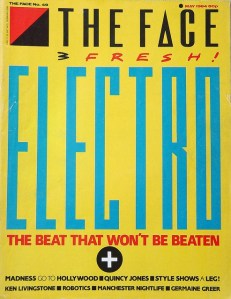
Any British music fan who came of age during the 1980s must surely have a soft spot for The Face magazine.
Launched by Smash Hits founder/NME editor Nick Logan in May 1980, the monthly rag – so named because of its Mod allegiances – quickly become known as a first-rate style mag (it covered fashion, music, culture, clubbing and cinema too), with its many famous covers reaching the level of high-quality pop art.
Indeed, looking again at issue #1, it’s remarkable how many of its listed writers and photographers would turn out to be key documentors of the decade – Janette Beckman, Julie Burchill, Gary Crowley, Anton Corbijn, Ian Cranna, Jill Furmanovsky, David Hepworth, Tony Parsons, Sheila Rock, Pennie Smith (and that issue alone features iconic photos of Madness, The Specials, The Clash, John Lydon and Paul Weller, amongst others).
It was also unique amongst 1980s music mags in paying as much attention to reggae, hip-hop, electro, house, rare groove and jazz as it did to post-punk, 2-Tone and sophistipop.
But movingtheriver also remembers it most for its superb long-form interviews: I still have issues featuring in-depth pieces on Miles Davis, Trouble Funk, Dennis Hopper, David Sylvian, David Byrne, Robert Smith, Daryl Hall and Ken Russell.
The Face’s iconic imagery is celebrated at the excellent if compact new exhibition at London’s National Portrait Gallery. Predictably it’s photos from those post-punk/New Pop salad days of 1980-1983 which produce the most smiles of recognition/pleasure – Bowie in Japan, Adam Ant, Phil Oakey, John Lydon, Annie Lennox.
But there are great pics/stories from later in the decade too – Bros with their mum at home in Peckham, Shane MacGowan, Sade, Nick Kamen, Felix et al. There’s also a great chronology of 1980s clubbing, from Goth to Acid House, and a focus on long- lost London nightspots.
As the 1980s became the 1990s, The Face arguably reflected a gradual coarsening of the culture with more focus on fashion and lifestyle – but you knew that anyway. But this exhibition is a must-see for any music fan who loved the 1980s, and it was also refreshing to see such a broad range of ages attending.
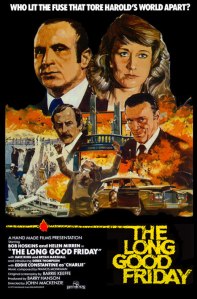
Every post-1971 British crime movie has had ‘Get Carter’ and ‘Performance’ in its rearview mirror.
Made in summer 1979 but not released until 18 months later, ‘The Long Good Friday’ (original title: ‘The Paddy Factor’) has often been mentioned in the same breath as ‘Carter’. Is that justified?
Initially bankrolled by legendary impresario and producer Lew Grade, it was written by proper East Ender Barrie Keeffe (who reportedly knew Ronnie Kray), directed by Scotsman John Mackenzie and starred Brit acting ‘royalty’ Bob Hoskins and Helen Mirren.
When completed, the suits almost refused it a cinema run, deeming it too nasty, hoping to recut it and farm it out to television. A disgusted Mirren asked her friend Eric Idle to attend the premiere at the London Film Festival towards the end of 1980.
Idle was impressed and passed it on to his mate George Harrison, the main moneyman at newly-formed HandMade films. Harrison apparently loathed it but agreed it had hit potential. HandMade bought it for £700,000, funded by ‘Life Of Brian’ profits.
But how does ‘The Long Good Friday’ stack up in 2024? I watched the posh new 4K restoration – looks fabulous, but this film really belongs in a mid-’80s Cannon fleapit. With its casual racism/sexism/ableism and overlong dialogue scenes, it’s also now more redolent of ‘Sweeney!’, ‘The Squeeze’ and ‘Villiain’ than ‘Performance’ or ‘Get Carter’ – but is still fascinating and memorable.
There’s some real Brit nastiness, or ‘virtuoso viciousness’, as Pauline Kael called it in her ‘Carter’ review. Mackenzie comes up with three or four memorable set pieces (and a great final five minutes, apparently the first thing they shot, during which apparently the director drove the car and ‘fed’ Hoskins the entire plot of the film) which have given the movie legs. He also uses the London locations with some elan.
Keeffe comes up with some preposterously funny lines – ‘It’s like Belfast on a bad day!’ etc. – and Francis ‘Sky’ Monkman’s disco/prog/fusion score adds value. There’s also an amazing array of ‘Hey, it’s that guy/girl!’ actors, from Pierce Brosnan (whose swimming pool scene seems to have influenced Bronksi Beat’s ‘Smalltown Boy’ vid) to Gillian Taylforth.
Sadly though the key performance by Derek Thompson (Charlie in ‘Casualty’!) weighs the film down with its stoned insouciance and dodgy London accent (ironically, Thompson was born in Belfast).
And though some have compared Hoskins with Edward G Robinson and James Cagney (Keeffe apparently pictured a cockney Humphrey Bogart!), despite some amusing line readings these days he comes across more like Alan Sugar after a few too many espressos, whereas Michael Caine in ‘Carter’ had a kind of timeless, glacial rage.
Apparently under the influence of ‘Lock, Stock and Two Smoking Barrels’, Empire magazine – astonishingly – voted ‘The Long Good Friday’ the #1 greatest British film in a 2000 poll. Hard to think it would get that accolade today. Still, it’s a fascinating snapshot of London on the brink of Thatcher’s decade, and a must-see for fans of 1980s cinema.
It was fascinating watching the long American cut of ‘The Shining’ recently with a packed, young crowd at the BFI Southbank.
They clapped and cheered at the end, and many flinched and jumped out of their seats during Jack’s manic outbursts. It was also fascinating to re-evaluate Shelley Duvall’s performance after her sad recent death (and re-watching her superbly odd turn in Robert Altman’s ‘3 Women’ in the same venue recently).
But, despite the doc ‘Room 237’ and terrific work by Rob Ager (most of it on his Collative Learning YT channel), what surprised me was how many aspects of the film still mystified and enthralled after numerous viewings. Here are some of my jottings (with spoilers):
The Gold Room
It’s not in Stephen King’s book. Ager has investigated the possible motivations for Kubrick including it. But unless I’m very mistaken Ager doesn’t discuss the strange photos on the sign by the entrance. What are they? The look suspiciously like late-1970s singer-songwriters rather than crooners of a 1920s vintage…
The lighting
There’s weird lighting everywhere. Lamps, blazing sun through windows, fluorescent beams. Lucifer – bringer of light?
Madness, misogyny and suggestions of child sexual abuse
The idea that a father could have malicious thoughts about his wife and son is terrifying and probably hits home to most general viewers. Plus Jack’s pure rage aimed at his wife. But possibly the film goes very much further than that – Ager’s excellent video explores even more troubling aspects. As for the misogyny, the Sunday Times recently reported that Duvall was shown the baseball bat scene during a 2016 interview, and broke down in tears, saying: ‘I can only imagine how many women go through this kind of thing.’
The shape in the river of blood
What the hell is it? A body? An octopus?
The sound design
It’s NOT perfect. During Danny’s pedal-car rides on the rugs/floors, the sound still doesn’t seem correctly sync’d…
People walking backwards
Once you first notice it, it’s quite funny clocking how many characters walk backwards during the movie…
Danny and ‘Tony’
Did Kubrick watch the 1977 BBC documentary about the Enfield Poltergeist?
Shelley Duvall
Hers is a thankless role in a way and you can be sure it was cut to shreds in the edit. She told Roger Ebert that her experience on the film was ‘unbearable’ and claimed that she had to cry for 12 hours a day for nine months straight to get what Stanley was after. But it was worth it. Watch the scene where she brings Jack lunch at his typewriter and finally realises what she’s up against. Apparently a sweetheart too if this interview is anything to go by.
Influences of ‘The Amityville Horror’ and ‘The Exorcist’?
In ‘Amityville’, a family man goes mad with an axe. And it only came out a year before ‘The Shining’. As for ‘The Exorcist’, ‘Tony’ and Captain Howdy? Then there’s the fade to black and the ‘open your eyes’ in the long US version of ‘The Shining’ – there’s an almost identical cut in ‘The Exorcist’.
Mirrors
Jack only sees ‘ghosts’ when he’s opposite a mirror. Check it out. Even his ‘rant’ as he walks down the corridor towards the Gold Room seems to be ‘activated’ by mirrors.
Two Jacks and two Gradys?
Is Jack crazy from the start? Is he the ‘chosen’ man to get the ghosts going or is he driven crazy by the hotel? Also note that during his job interview, his boss Ullman says Jack has come ‘well recommended by our people in Denver’. Sounds dodgy and taps into the strange mythology that has grown up since around Denver… And why is Grady given two names – Charles and Delbert?
Hallorann
Seeing as he’s an absolute expert ‘shiner’, why would he work at such an evil place as The Overlook? You’d think he would avoid it like the plague. Is this a piece of social commentary by King/Kubrick?
Vivian Kubrick
Stanley’s daughter was reportedly an almost daily presence on the set, helming her making-of documentary and helping out in the production office. She also has an uncredited cameo in the film and it’s a doozy. She even ‘toasts’ the camera. She’s sitting on the sofa nearest Jack when Delbert Grady spills advocaat on him.
Jack Daniel’s
Kubrick was a genius. In the first Gold Room scene, Jack asks Lloyd for a bourbon – but he doesn’t get one. He gets a Jack Daniel’s: Jack and Daniel (Danny). Geddit? Also see the baseball bat Wendy brandishes, a Louisville Slugger. What’s the symbolism of that? You can bet Kubrick didn’t include it by chance.
Working with children
What an amazing performance by Danny Lloyd as young Danny (big credit to Leon Vitali – check out ‘Filmworker’). He doesn’t blink. The troubling themes are a lot to pin on the young boy but he seems to have turned out OK.
Jack Nicholson
He wasn’t nominated for an Oscar. Why the hell not? Someone (Stanley Donen? Nicholas Ray? Jean-Luc Godard?) once said a good movie only needs three or four great scenes on which to hang its hat – Jack’s in all of them.
It’s hard to think of a movie that better captures an end-of-the-1970s/beginning-of-the-1980s vibe than ‘Being There’.
Directed by Hal Ashby (‘Shampoo’, ‘Harold & Maude’, ‘Coming Home’) and starring Peter Sellers, it was released on the same day as Steven Spielberg’s ‘1941’ just before Christmas 1979 and became one of the first critical and commercial successes of the ’80s.
Based on Jerzy Kosinski’s book (the Polish author became somewhat of a celebrity in the States before he committed suicide in 1991), ‘Being There’ is a political satire, the story of a simpleton who moves effortlessly to within spitting distance of the very highest echelons of American power.
Still, despite featuring one of the most famous final shots in cinema history, some classic catchphrases and Sellers’ penultimate screen performance as Chance the gardener (for which he was Oscar-nominated), ‘Being There’ inexplicably now seems somewhat forgotten.
Not round these parts. A recent re-watching was a revelation – it’s far better than I remembered it. It’s also surely another one for the relatively small ‘the film’s better than the book’ file. Here’s what I wrote in my notebook:
Shirley MacLaine
She barely gets a mention in all the literature I’ve read about ‘Being There’. A shame, because she delivers a fine comedy performance. Yes, the ‘I like to watch’ sequence is embarrassing and often subject to critical scrutiny, but it’s Sellers who is really the focus of that scene. You’ll certainly never think of Fred Rogers in the same way.
Stanley Kubrick
With its beautiful widescreen compositions, deep, rich colours, iconoclastic/irreverent humour and a brilliant central performance from Sellers, it’s surely a film of which Mr K would approve (and visitors to ‘Being There’ during Christmas 1979 would also have seen a teaser trailer for Kubrick’s ‘The Shining’). This guy’s interesting video finds a link between ‘Being There’ and ‘2001: A Space Odyssey’. Also, close viewing reveals that there’s a shot in ‘Being There’ of a TV – being watched by Chance – which doesn’t have a plugged-in cable, just like the similar shot in ‘The Shining’. Coincidence?
The Oscars
Sellers apparently channelled Stan Laurel for his blanked-out, mid-Atlantic accent, and worked diligently on line readings in the mirror. He was nominated for a Best Actor Oscar, but lost out to Dustin Hoffman for ‘Kramer vs. Kramer’. Sellers looks unwell, pale and drawn (he died just six months after the film’s release), but apparently surprises both himself and the actors around him with his wonderful comic creation.
Modern Culture
The film has a lot to say about where popular culture was headed. It’s no coincidence that Chance has been ‘brought up’ on television. When he appears on a chat show, Chance is told by the producer: ‘You’ll be seen by more people tonight than have been to the theatre in the last 40 years’. The movie relentlessly emphasises the more inane elements of TV throughout its duration.
Tom Cruise
Promoting the new ‘Mission Impossible’ film in a recent Sunday Times interview, Cruise recently said he would hitherto only make movies that audiences immediately understood – no puzzles, fables or anything demanding too much thought. No more ‘Eyes Wide Shut’s. Or ‘Being There’s. There’s not an iceberg’s chance in hell that this film would get made today.
Chance
How does Chance the gardener get so far up the totem pole so quickly? The film emphasises that you can get a very long way by ‘looking the part’ and having friends in high places. And of course there’s luck. But there are still one or two anomalies – why does he unquestioningly leave the house in which he has lived all his life just because the lawyers tell him he’s going to be evicted? Would he really have a clue what an eviction was? It seems more likely that he would stay put for as long as possible.
Washington DC
As Chance leaves his house, there’s a famous, striking montage of his sojourn through DC soundtracked by Deodato’s ‘Also Sprach Zarathustra’. We are initially shocked to realise that, despite his natty threads and luxurious pad, he’s been living in the poor part of town. We see a graffito which reads: ‘America ain’t shit cos the white man’s got a God complex’, later referenced by Public Enemy (the film in general has a lot to say about racial issues in America, superbly summarised by this video). Then there’s the famous shot of Chance walking down Pennsylvania Avenue, the moment we realise this is going to be rather a special movie.
Minor Characters
‘Being There’ is full of memorable secondary characters, each with a very specific role, from the lawyers to newspaper/magazine editors, TV producers, elevator orderlies and doctors. And fans of John Carpenter’s ‘The Thing’ will relish seeing Richard Dysart and David Clennon playing key roles.
The President
The President isn’t a sympathetic character – in fact he is a boorish, somewhat weak buffoon who doesn’t seem to have much power. But still, there’s plenty of evidence that he’s onto Chance from the beginning. The film ends with an internal cabal about to oust the president and move the government much further to the Right, possibly a portent of the upcoming Reagan years. The film also spends an inordinate amount of time on the more ‘fascistic’ elements of the US – the all-white, thrusting security detail and Secret Service operatives, the ridiculous vehicle cavalcades, the huge government properties in the countryside that look eerily like Nazi strongholds. Also watch out for the Eye of Providence on Ben Rand’s burial pyramid. A YouTube comment: ‘This movie tells us how the world really works’.
Vinnie Colaiuta
The drummer/composer released a great ‘tribute’ to Chance (or Chauncey, as he is mistakenly named by Eve Rand in the film) on his 1994 solo album, featuring Sting on bass.
It’s no coincidence that alto saxist/composer David Sanborn’s purple patch (1980-1982) came about just when genres (yacht rock, soul, funk, jazz, R’n’B) were breaking down to create one of the most egalitarian musical eras.
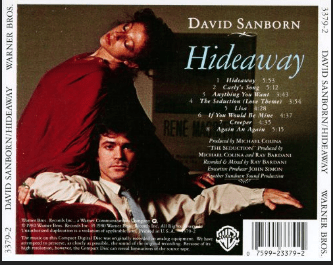
Hideaway, his fifth studio album, was the breakthrough, and I love it. Released in February 1980, it made #2 on the Jazz chart, hung around in the Urban Contemporary charts for over a year and was nominated for a Best R&B Instrumental Performance Grammy.
For some, Sanborn’s solo material will always be ‘smooth jazz’, but I’d point to four aspects of his music that elevate it above similar material, particularly on Hideaway – his tone and his note choices, both born of the ‘50s and ‘60s St. Louis jazz and R’n’B scenes; his writing; and also the playing of top-notch guests. On Hideaway, the stars are drummer Steve Gadd (Gadd fans, this is the album for you), bassist Neil Jason and keyboard player Don Grolnick.
The title track remains a classic. Sanborn lays down rich Fender Rhodes soul chords while Gadd constructs a perfectly judged post-disco drum part heavily involving cross-stick and floor tom, laying just behind the beat, with an unexpected, explosive fill just before the fade. Jason is given free rein and comes up with an outrageous bass performance.
Hideaway also benefits from Steely/Doobies man Michael McDonald co-writing two tracks. Sanborn doesn’t have anything much catchier than ‘Anything You Want’ and ‘Again An Again’ in his repertoire. ‘Carly’s Song’ and ‘Lisa’ are memorable ballads with beguiling harmony, while Gadd provides another brilliant commentary on ‘If You Would Be Mine’.
Rick Marotta appears to expertly marshal ‘Creeper’ through its slow half-time groove – guitarist and frequent Sanborn collaborator Hiram Bullock was so taken with it he later wrote a sequel called ‘Son Of Creeper’.
Hideaway’s packaging helps too – its minimalist cover is a winner, as is the photo featuring Dave reclining in his apartment with a Magritte over his left shoulder and paramour draped over his right. Warner Bros. were just realising he wasn’t the worst looking guy in the world.
The only downside: in a classic bit of Warners penny-pinching, they add the very dull (and certifiably smooth-jazz) ‘The Seduction’ from the ‘American Gigolo’ soundtrack to the streaming and CD versions but in the process edit down ‘Anything You Want’ and the title track to ‘single’ length. Best try to find Hideaway on vinyl.
There must be a huge cache of unreleased material in the George Clinton vaults – we’re probably talking Prince/James Brown/Frank Zappa amounts here.
And will it be Warners, BMG or Universal who get control of his recorded legacy (unless the deal has already been done…)?
As it is, you could probably spend a lifetime listening to his existing work. And just when you think you’ve got a handle on it, new things keep trickling through, like Sweat Band’s self-titled 1980 debut album.
The P-Funk side project, mainly written and performed by Bootsy Collins and Maceo Parker and recorded at United Sound Studios in Detroit, was the first release on Clinton’s short-lived Uncle Jam label, distributed by CBS.
In truth the album is very patchy (not helped by the cover which probably should have made my worst of the 1980s list) and shows the decline also encountered by Parliament/Funkadelic and Bootsy (whose Ultra Wave was released in the same week) around the same period, when funk was getting watered down by disco and commercial R’n’B.
But the track ‘Jamaica’ is brilliant. It’s gone straight into my 1980s Funk playlist with a bullet. It features legendary London music writer Lloyd Bradley (credited as Lloyd Bridges) talking rubbish all over it plus a seriously arse-over-teacup groove, catchy chants, underwater bass and fantastic horns.
And is that an uncredited Harvey Mason on drums? It sure sounds like him. Bring on the Clinton vaults if there’s a lot more like this lying around.
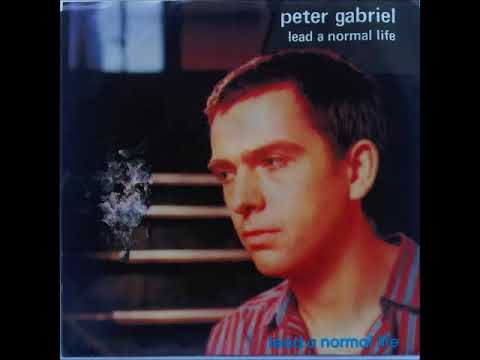
Peter Gabriel’s brilliant 1980 self-titled album is probably best known for its much-discussed ‘gated reverb’ drum sound, the ‘no cymbals’ rule and the tracks ‘Games Without Frontiers’ and ‘Biko’.
The record portrayed various characters on the fringes of society, whether due to war, intolerance, mental illness, crime or racism.
But its penultimate track, the somewhat forgotten ‘Lead A Normal Life, is a chilling, minimalist classic whose power grows with each passing year. It’s set in an unnamed, uncharacterised institution – a borstal, high-security prison, crisis centre or mental asylum? The latter seems most likely.
It’s fair to say mental illness was a taboo in late-1970s Britain, even while the borstals were subject to Thatcher’s ‘short, sharp shock’ doctrine (in the era of Alan Clarke’s devastating film ‘Scum’), unemployment and institutional racism were rife, crime was on the increase, the Yorkshire Ripper rampant and The Troubles in Northern Ireland very much on the agenda.
In short, it sometimes felt like this song WAS normal life in 1979. And many aspects of life in 2021 may lead one to a similar conclusion.
Legendary Atlantic A&R man Ahmet Ertegun, upon hearing Peter Gabriel III, reportedly asked if Peter had recently spent any time in an asylum. This may have hit closer to home than is often reported.
Gabriel elaborated a little on ‘Lead A Normal Life’ in September 2013’s MOJO magazine: ‘I think the assumption was that you couldn’t write about something like that unless you had experience of it. I later discovered I had depression around the time of my marriage breaking up (in early 1987). But maybe there was something more there.’
The lyric is very brief, but its power comes from colloquial, off-hand phrases, as if spoken by a (somewhat blithe) visitor of an inmate (or an ‘official’ visitor – ‘A Clockwork Orange’ came to mind while listening again recently). Despite the calming view of the trees, surely the institution is anything but ‘nice’.
Musically, the track is built around Morris Pert’s minimalist marimba (and slung mugs or child’s xylophone?), Peter’s haunting Yamaha CP-70 piano figure/ominous chords and Fritched, primal-scream vocals (with treatments courtesy of Larry Fast), Jerry Marotta’s tribal toms, David Rhodes’ guitar loop (or feedback?) and Dick Morrissey’s brief, stacked tenor saxes.
Producer Steve Lillywhite expertly uses muting/fading-in and deep reverb to create big black holes in the track, crafting a cogent arrangement in the process which easily holds the attention for four-plus minutes. It’s an object lesson in how to use silence to enhance a mix.
‘Lead A Normal Life’ is a masterpiece on a subject rarely touched in ‘rock’, evoking loneliness and disturbance in equal measure, shot through with Peter’s trademark compassion. He’s even played it live a few times, to chilling effect.
In the late 1980s, some ‘long-lost’ cult tracks took on almost mythical status amongst my musician friends and I.
There was Frank Zappa’s ‘The Black Page’, Rush’s ‘YYZ’ and ‘La Villa Strangiato’, UK’s ‘In The Dead Of Night’ and Bill Bruford’s ‘Five G’ and ‘Travels With Myself And Someone Else’.
Guitarist Allan Holdsworth, who died four years ago today, of course featured on the latter three tracks (he originally came to my attention when It Bites’ Francis Dunnery waxed lyrical about him in a 1989 Guitarist magazine interview).
Pre-YouTube and Spotify, the problem was that you just couldn’t get hold of this stuff (even though it was barely ten years old!). So it was a thrill when I finally tracked down a copy of Bruford’s One Of A Kind album – featuring ‘Five G’ and ‘Travels With Myself’ – sometime in the mid-1990s.
And now this landmark collection has received the posh reissue treatment, as part of a box set or as a double CD set featuring a new stereo remix, carried out by Bruford and Level 42/King Crimson guitarist Jakko Jakszyk, and a DVD containing the remastered original mix and a new surround-sound mix.
You could argue that the album is the most complete work by all of the participants. Recorded at Soho’s Trident Studios, One Of A Kind was released on the cusp of the 1980s and pointed to where all the four members’ music would take them in the new decade.
There’s no quantizing here – it’s music that breathes (check out the ‘bendy’ time on ‘Hells Bells’, ‘Travels’ and the title track) played by empathetic, truly virtuosic musicians. But is it rock, jazz, prog or fusion? Who knows, but it’s some of the greatest British instrumental music of all time.
Bruford stuns with one of the tightest drum sounds on record – whipcrack snare, cutting Rototoms – with great phrasing and ideas, some fantastic tuned percussion (marimba, xylophone) and excellent compositions. Bassist Jeff Berlin is an astonishing talent – logical, inventive, technically perfect but never boring.
Dave Stewart (not to be confused with David A Stewart of Eurythmics) is a revelation, layering superbly with his new Prophet 5 synth and adding some effective solos. The liner notes report Holdsworth returning to the studio after a break, hearing Stewart overdubbing on ‘Travels With Myself’ and finding himself in tears.
For his part, Allan was by all accounts rather unhappy during the recording, but delivers brilliant, moving solos, particularly on ‘Travels’ and ‘Sahara Of Snow Part 2’. He also contributes the excellent composition ‘The Abingdon Chasp’, apparently named for a beloved brand of real ale.
Then there’s the resplendent ‘Fainting In Coils’, complete with the ‘Alice In Wonderland’ excerpts and tricky time signature which sounds completely natural in Bruford’s hands. But how does the new remix sound? First, the good news: the title track, ‘Fainting In Coils’ and ‘Hells Bells’ sound fresh and thrilling; it’s like hearing them for the first time.
But now the bad news: ‘Travels’ inserts some new Stewart solo licks, inaccurately mutes some of his synth pads and then inexplicably mixes his acoustic piano way down and drenches it in muddy reverb (though Holdsworth’s comping is brought forward in the mix).
Then there’s ‘Five G’ – it’s mixed totally dry, with all reverb removed, again with Stewart’s keys too low and Berlin’s bass too high and too ‘middly’. And the packaging? Sid Smith’s liner notes are excellent, with some lovely, previously-unpublished photos from rehearsal rooms and pub gardens (both in Kingston, Surrey!).
But there’s no sign of the tracklisting or song/composer credits on the digipack – you have to search around for the inner pamphlet to find the details printed in the middle, so quick reference while listening is not easy.
Still – even if the remix is patchy (I can’t comment on the surround mix), the whole package is well worth getting. Any excuse to celebrate a classic album and brilliant band, and a rich voyage of discovery if you don’t know this music.
One Of A Kind Expanded & Remixed is available at Burning Shed.
Couldn’t let 2020 squeak by without celebrating 40 years of Flesh + Blood.
As a young whippersnapper, along with Sgt. Pepper’s, it was probably the first LP I enjoyed all the way through. But these days it’s often mentioned as an afterthought to Avalon and the early albums (maybe Peter Saville’s cover rankles?).
It featured not one but three classic singles (‘Oh Yeah’, ‘Same Old Scene’, ‘Over You’), two distinctive cover versions, and was arguably one of the most influential collections of the 1980s.
It also perfectly compliments such contemporary new-wave/disco work from Blondie, Duran Duran and Japan (also sharing with those acts a reliance on the Roland CR-78 rhythm box, heard prominently in the intro of the below).
Flesh + Blood is the last Roxy studio album where Andy Mackay (sax) and Phil Manzanera (guitar) were major players if not songwriters (all tracks were written by Ferry apart from the covers, though Manzanera had a hand in ‘Over You’, ‘No Strange Delight’ and ‘Running Wild’). Both add memorable solos and nice ensemble work throughout.
It’s also a classic early-’80s bass album: reliably excellent Alan Spenner and Neil Jason joined new boy Gary Tibbs, fresh from his acting role in Hazel O’Connor’s ‘Breaking Glass’ movie and about to become one of Adam’s Ants.
The great Andy Newmark piled in on drums, having just completed work on Lennon/Ono’s Double Fantasy, alongside fellow NYC sessionman Allan Schwartzberg (who plays a blinder on ‘Same Old Scene’).
Londoner Rhett Davies was on board as co-producer, fresh from groundbreaking work with Brian Eno (both are apparent influences on the psychedelic/ambient outros to ‘My Only Love’ and ‘Eight Miles High’, and atmospheric overdubbing throughout), working with the band at his favourite Basing Street Studios (later Sarm West) in London’s Notting Hill. There were also occasional sessions at Manzanera’s Gallery Studios in Chertsey, Surrey.
Burgeoning star NYC mixing engineer Bob Clearmountain took time off his work with Chic to add some hefty bottom-end and fat drums at the fabled Power Station studios. Bob Ludwig’s ‘definitive’ 1999 CD remaster is one of the loudest, bassiest re-releases of the last few decades (but not a patch on the original cassette!).
But basically Flesh + Blood is very much Ferry’s show, layering Yamaha CP-80 piano (in his trademark ‘no thirds’ style) and synths to great effect, and even adding some amusingly sleazy guitar on the title track. He also sings superbly, delivering a particularly impassioned performance on ‘Running Wild’.
Even when he veers slightly out of tune, as on ‘Rain Rain Rain’, it’s an artful, conscious move (unlike these days…), a la Dylan or Bowie. His lyrics are generally fascinating – dreamlike, elliptical, odes to unrequited love and possibly one or two illicit substances.
Flesh + Blood was a big hit in the UK, reaching #1 on two separate occasions between May and September 1980. But surprisingly it didn’t quite work in the States, just scraping into the top 40, possibly not helped by a stinking review in Rolling Stone (‘…such a shockingly bad Roxy record that it provokes a certain fascination…’!).
But Ferry could see a path ahead, and would repeat the winning formula (drum machine + piano + painstaking overdubs + much-pondered-over lyrics/melody lines) for the rest of the decade. Rhett Davies had his work cut out – he moved on to work with Robert Fripp on the classic King Crimson reunion album Discipline.
For many Americans, 1980 hoped to offer a break from the recent past: the Watergate scandal, defeat in Vietnam, the Iran hostage crisis, a major recession. Disco.
A Presidential Election was also pending in November. At the beginning of the year, Jimmy Carter stood at 62% in the polls, Ronald Reagan at 33.
Reagan promised to return America to a pre-countercultural era, prioritising family values and social order. He courted the Fundamentalist vote; evangelists and motivational speakers suddenly popped up all over the radio.
Something pinged in David Byrne’s head, and he later outlined the febrile atmosphere of early 1980 in Simon Reynolds’ book ‘Totally Wired’: ‘The text was saying “Thou shalt not” but the preacher’s performance was this completely sensual, sexual thing. I thought, “This is great – the whole conflict is embodied right there…”’
Byrne and Brian Eno explored some of these themes on their groundbreaking My Life In The Bush Of Ghosts (named after the 1954 book by Nigerian writer Amos Tutuola) with a particular emphasis on Islam and its contrasts with Christianity.
The project was originally supposed to be a three-way collaboration between Jon Hassell, Eno and Byrne, a fake ‘field work’ complete with ethnography, liner notes and photos, but Hassell dropped out at the eleventh hour. The album is strikingly original, still relevant and sometimes terrifying.
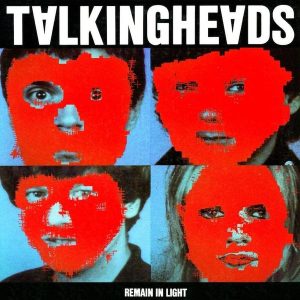
A month before the Presidential Election, on 8 October 1980, Talking Heads released their masterpiece Remain In Light, also a collaboration with Eno. The album’s key tracks, ‘Once In A Lifetime’ and ‘Listening Wind’, went even further than Bush Of Ghosts: the former showed that Byrne had completely assimilated the ‘sensual preacher’ persona, while the latter outlined a young Arab’s act of terror.
Mojique resents the rich ‘foreigners in fancy houses’ turning up in his country, makes a bomb ‘with quivering hands’ and dispatches it to his American enemy. It’s a unique, powerful piece of work, and one wonders whether its inclusion on Remain In Light contributed to the album being their worst-ever seller in the USA.
Reagan was elected on 4 November 1980 with 50.7% of the national vote. His famous Election Eve speech mentioned ‘that shining city on the hill’, invoking both Jesus’s Sermon On The Mount and noted Puritan John Winthrop. But Byrne’s New York had been under the cosh: more murders, robberies, burglaries and subway breakdowns were reported in 1980 than in any other year since records began 49 years earlier.
Reagan was inaugurated on 20 January 1981. My Life In The Bush Of Ghosts was finally released – after several postponements – almost exactly a month later.

 Any British music fan who came of age during the 1980s must surely have a soft spot for The Face magazine.
 Every post-1971 British crime movie has had ‘Get Carter’ and ‘Performance’ in its rearview mirror.
 It was fascinating watching the long American cut of ‘The Shining’ recently with a packed, young crowd at the BFI Southbank.
 It’s hard to think of a movie that better captures an end-of-the-1970s/beginning-of-the-1980s vibe than ‘Being There’.



 movingtheriver.com