Book Launch: John McLaughlin (From Miles and Mahavishnu to The 4th Dimension)

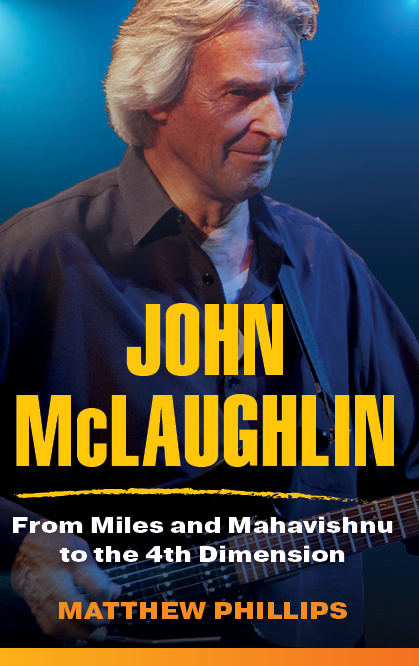
Matt’s new book ‘John McLaughlin: From Miles and Mahavishnu to The 4th Dimension’ is available now and can be ordered via the links below.

‘A must-have in every aspiring musician’s personal library.’ Billy Cobham, Mahavishnu Orchestra drummer

‘A wonderful insight into a true innovator and colossus of the guitar.’ Mark King, Level 42 bassist/vocalist

‘Scrupulously researched… A fluent career overview.’ **** MOJO, December 2023

‘The most comprehensive overview of McLaughlin’s career to make it into print thus far.’ **** Shindig!, January 2024

‘Comprehensive and thoroughly researched, Phillips’ book is a revelation. A must-read for guitar aficionados and McLaughlin devotees.’ Bill Milkowski, author of ‘Jaco’ and ‘Michael Brecker’

‘Riveting… Meticulous storytelling… The book is not just a narrative, it’s a visual feast.’ Jazz In Europe

‘Paints the fullest picture yet of the guitarist’s life.’ Jazzed

‘Thorough and impassioned… The first book to fully illuminate the least-appreciated, least-documented periods in the extraordinary career of this wondrously free-spirited, prolific, perpetually questing artist.’ Booklist

UK orders:

UK Bookshops

Rowman & Littlefield (Enter discount code RLFANDF30 to save 30% off the list price)

World Of Books

Hive

Blackwell’s

Waterstones

Foyles

WHSmith

USA orders:

Rowman & Littlefield (Enter discount code RLFANDF30 to save 30% off the list price)

Barnes & Noble

BooksaMillion

It’s an exhaustive look at John’s catalogue, live career and spiritual life, with an introductory note by Robert Fripp, testimonials from Mark King, Billy Cobham and Bill Milkowski, interviews with key collaborators and lots of exclusive photographs. I cover John’s early sessions with David Bowie and Donovan, his remarkable sideman work with Tony Williams and Miles Davis, the fabled solo career fronting The Mahavishnu Orchestra and Shakti and various projects alongside the likes of Sting, Jeff Beck, Herbie Hancock and Carlos Santana.

If you’ve enjoyed this website in any capacity, please consider buying this book and getting it to the toppermost of the poppermost… Thank you!

Book Review: Formation (Building A Personal Canon Part 1) by Brad Mehldau

There’s a history of controversial jazz autobiographies that would have to include Mezz Mezzrow’s ‘Really The Blues’, Charles Mingus’s ‘Beneath The Underdog’, Sidney Bechet’s ‘Treat It Gentle’, Billie Holiday’s ‘Lady Sings The Blues’, Dizzy Gillespie’s ‘Dizzy’ and Art Pepper’s ‘Straight Life’.

It may be somewhat of a surprise to report that the apparently mild-mannered, urbane Mehldau – modern master jazz pianist and probably best known for his majestic Radiohead and Beatles covers – joins that list with ‘Formation’, charting his musical and personal rites of passage from the mid-’70s to late 1990s.

The general fan may have heard Mehldau make vague references to his previous junkie life – here we get the full story, and it’s both revelatory and somewhat disturbing. Also, unlike some of the books listed above, ‘Formation’ is certainly not ghostwritten, hardly a surprise when one considers some of the extensive liner essays Mehldau has penned, particularly 2000’s Places.

Growing up in mid-‘70s New Hampshire, Mehldau’s young life is all very Judy Blume, soundtracked by Billy Joel, Beethoven, Fleetwood Mac, the Eagles, Steve Miller and Supertramp, with the twin undercurrents of organised religion and the Cold War.

At the turn of the new decade, piano lessons become increasingly important and he becomes a major prog fan, Pink Floyd and Rush becoming key touchstones, though he also relates the loneliness in his own life to the music of Miles, Billie Holiday and Brahms.

A move to Hartford, Connecticut, precipitates the first major instances of bullying, outlined in shocking detail, a theme that will echo throughout his time in formal education. It’s hardly surprising that alcohol and drug use become regular companions during his late-teenage life, as do doubts about his sexuality.

In the age of Reagan, Stallone and Schwarzenegger, Mehldau becomes a true ‘outsider artist’, finding solace in the works of Thomas Mann, the Beats, German philosophers and Bob Dylan. Meanwhile high school hastens the flowering of his jazz piano talent.

From there, it’s a short ride to Mehldau’s relocation to New York in the late 1980s, and his jazz piano initiation at great lost venues such as Augie’s and the Village Gate. It’s hard to think of another book which better explores that fabled NYC jazz scene of the late 1980s to mid 1990s, nor one that better explores the thought processes and doubts of a nascent jazz pianist.

There are touching tributes to his piano teachers and also contemporary ivory-ticklers such as Larry Goldings, Bill Charlap and Kevin Hays. The book closes with lengthy accounts of his time playing with Joshua Redman, David Sanchez and Pat Metheny, undertaken in the shadow of heroin addiction, though the book ends with hope and a sense of rebirth.

Though always engaging, Mehldau’s writing style is wildly unpredictable – sometimes intimate and conversational, sometimes dry and analytical, often shockingly fly, with scant consideration for political correctness. But his intelligence flies off the page, hardly a surprise to anyone who’s heard him weave magic at the piano.

He’s honest about his own faults as well as the faults of others, and there’s no getting away from it – he paints a mostly harsh, violent picture of America in the 1980s, certainly no country for old men or those of a sensitive disposition. ‘Formation’ is also graced with the author’s own sizeable photo collection.

A fine if sometimes shocking addition to the pantheon of great jazz autobiographies, we eagerly await part two of ‘Formation’. Meanwhile Brad’s playing career goes from strength to strength – I’m looking forward to the Wigmore Hall solo gig in September.

Book Review: Adventures In Modern Recording by Trevor Horn

It was surely only a matter of time before arguably the most important producer of the last 50 years put pen to paper, but Trevor Horn’s memoir ‘Adventures In Modern Recording’ was still one of the nicest surprises of 2022.

The opening section outlines his upbringing in the tough, industrial North East of England, and then each chapter is centred around one key track that made his name as a producer, from The Buggles’ ‘Video Killed The Radio Star’ to Seal’s ‘Crazy’.

We trace Horn’s early days as a Beatles and Dylan fanatic, self-taught guitarist (his musician father buys him a knackered old four-string which gets broken and is never replaced) and upright bass player in the school orchestra.

There’s the constant fear of going down the mines, a fate that had befallen most of his relatives. Young Trevor eventually has to move in with his grandparents (sharing a bed with Uncle John), though they are supportive of his musical talent.

Horn moves to Leicester and starts playing double bass with big bands whose repertoire includes pop covers and light jazz. By this time, he has become an ace sight-reader, something that he values throughout his career.

He relocates to Blackpool to take up a residency with the band, his dad dropping him off with the words: ‘Well, you’re on your own now, son. You just watch it.’ Horn then hits London to play with a band called Canterbury Tales and pick up various function gigs.

As disco takes hold, Horn finds himself on the studio scene, getting a regular gig with Tina Charles and ‘fixing’ a lot of duff songs, including Leicester City’s ‘This Is The Season For Us’. The penny drops – he suddenly realises he’s a record producer.

This becomes his driving force as he moves away from the bass and meets Jill Sinclair, studio manager of SARM West (formerly Island’s Basing Street studio) and soon to be both his manager and wife. We get the fascinating story of Buggles’ ‘Video Killed The Radio Star’, Horn literally having to construct a hit out of various disparate elements.

We learn that Horn sacks ABC’s bass player Mark Lickley just before the recording of Lexicon Of Love (Horn reports that U2 later got wind of this and refused to work with him!) – he is fairly ruthless as a young producer, always with Jill in his corner, but is now repentant.

There’s a very funny chapter on working with Malcolm McLaren and The Supreme Team on Duck Rock and a toe-curling account of cooking up Yes’s US #1 single ‘Owner Of A Lonely Heart’.

We get the inside story on making Frankie’s ‘Relax’ and Holly Johnson’s court case plus Horn’s involvement with the 12” version of ‘Do They Know It’s Christmas’. Horn reports that when he first meets Bob Geldof, the Boomtown Rats frontman immediately tells him he preferred Bruce Woolley’s version of ‘Video Killed The Radio Star’ to the Buggles’. Horn reacts thus: ‘What a twat. After filing him under “Rude Fucker”, I moved on…’ (They later made up.)

There are tales of painstakingly piecing together ‘Slave To The Rhythm’, Seal turning up for his 2004 Wembley charity gig (see below) at the last minute, and a trained Special Branch dog making an immediate bee-line for his bag in the dressing room. You can read the book for the funny punchline.

‘Adventures In Modern Recording’ is the very definition of the muso page-turner. Full of interesting titbits and amusing gossip, you need it if you have even the slightest interest in 1980s and 1990s pop.

New John McLaughlin book: your feedback

Movingtheriver.com wants YOU!

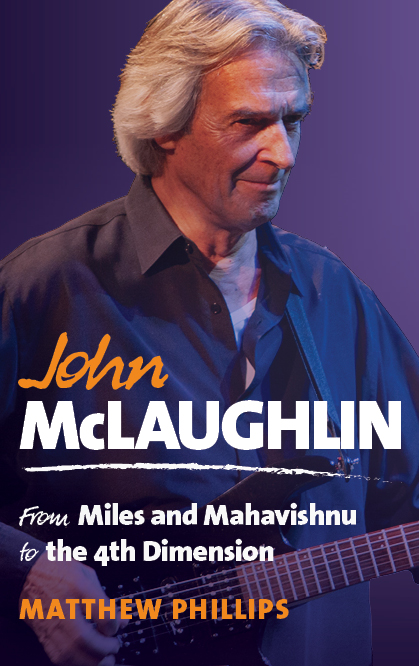
My new book on master musician John McLaughlin will be published worldwide by Rowman & Littlefield in September. The design department have put together a few draft covers, and I’d like to know which one YOU most like the look of. It would be good to get your feedback, and you’ll get a thanks in the book.

Please have a look at these three images and let me know your favourite by commenting below or dropping me an email. Many thanks in advance.

Cover #1:

Cover #2:

Cover #3:

Book Review: Elegant People (A History of the band Weather Report) by Curt Bianchi

‘The baddest shit on the planet’ – that was Weather Report keyboardist/co-founder/chief composer Joe Zawinul’s assessment of his band’s music.

He wasn’t alone – many credit them as the greatest jazz/rock unit in history, pretty impressive considering they developed out of a ‘scene’ that also included The Mahavishnu Orchestra, Return To Forever and Herbie Hancock’s Head Hunters.

Curt Bianchi has run the acclaimed Weather Report Discography website for many years and now expands his study to create the excellent ‘Elegant People’, an elaborate history of the band which features a myriad of exclusive interviews, photographs and information.

It has Brian Glasser’s effective Zawinul biography ‘In A Silent Way’ in the rear-view mirror but emerges as a very different proposition. Bianchi initially looks in detail at the formative years of Zawinul and co-founder/saxophonist Wayne Shorter, with sobering tales of the young Zawinul’s experiences in wartime Vienna and fascinating insights into Shorter’s extended periods in the bands of Maynard Ferguson, Art Blakey and Miles Davis.

The sections on Weather Report’s formation around 1970 are fascinating. Columbia’s marketing of them as a ‘progressive’ – rather than ‘jazz’ – band led to some interesting dichotomies; Shorter and Zawinul were already established superstars in their field but often had to engage in fairly menial/minor promotional work just to get a foot in the door with rock audiences. We also learn about the other potential band names that hit the cutting-room floor before ‘Weather Report’ appeared.

Bianchi then expertly traces the group from those early days as a kind of ‘chamber’ jazz/rock unit to their status as a ‘power band’ around the arrival of bassist Alphonso Johnson and drummer Chester Thompson in 1975, and the subsequent boost with the recruitment of Jaco Pastorius and Peter Erskine.

Bianchi brings the albums to life with great gusto. There’s a rare photo from the Night Passage sessions at The Complex in Los Angeles, and the last-ever photo of the Jaco/Erskine band taken at the Power Station in NYC, with Jaco almost a ghost at the back of the shot (shades of that famous final Syd Barrett photo with Pink Floyd). Elsewhere there are ticket stubs and even session track sheets.

And fans of Weather Report’s 1980s music can rest assured that Bianchi doesn’t give that era short shrift – there’s almost as much about the last few albums Sportin’ Life and This Is This (and many of Zawinul and Shorter’s post-Weather Report projects) as there is about commercial breakthroughs Black Market and Heavy Weather.

So ‘Elegant People’ is surely the ultimate Weather Report book – it’s an absolute must for fans and those wanting a deeper dive into the band’s music.

Spotify Guilt/How The LP Saved Our Lives

Reading David Hepworth’s ace book ‘A Fabulous Creation: How The LP Saved Our Lives’ brought back memories of a lifetime’s album-buying.

As he says, if you were a music fan and under 30 in the 1970s, 1980s or 1990s, you probably spent every penny of your disposable income on albums. And there were serious decisions to be made. If you were in the HMV Megastore and found a couple of US rarities but only had enough cash for one, it was a very big call. Mike Stern’s Time In Place or Lyle Mays’ Street Dreams? Better choose right, it might be a few months before you could afford another cassette.

If you were awaiting a new album, after spotting the release date in Q or the Melody Maker, it wasn’t abnormal to visit your nearest record shop twice in a few days to check if it had arrived. In my teens, I remember enduring a 30-minute bus ride (each way) to my local Our Price specifically to buy It Bites’ Eat Me In St Louis and Larry Carlton’s Last Nite.

There were definitely a lot of moody ‘High Fidelity’-style shop keepers (always men), but some were more friendly/forthcoming. In a classic discounted store in Soho, I think Sister Ray’s, I remember handing over my Prefab Sprout Protest Songs and Van Halen Women And Children First CDs and the assistant grinning and saying, ‘I thought I was the only person in the world who liked both of these albums!’

So I gave the record business a huge amount of my money in the latter half of the 1980s and 1990s. And, as we keep reading, ‘old’ music is hugely outselling ‘new’ music in 2022. Which brings us to my troubled relationship with Spotify. I’m hardly buying any new physical music at the moment. Convenient as it is, Spotify Premium is a lazy option.

I scour the music mags (these days mainly JazzTimes and Classic Pop) and always take the time to listen to every album that piques my interest. But unless it’s an absolute corker, I fillet the two or three good tracks onto a playlist, just as in the 1990s when I used to make cassette tapes of brilliant songs from less-than-brilliant albums. I’ve rounded a lot of them up on this playlist.

I’ve also recently bought a very long audio cable which connects my laptop to the big speakers in my living room, so I can listen properly to this stuff, albeit with all the attendant audio quality issues, but it still gives the illusion that I’m listening to an album ‘as the artist intended’. Balls. The artist is making close to no money from Spotify, unless the streaming numbers are in their multimillions.

So my troubled relationship with Spotify continues, especially as the cost of living rises and rises. Yes we take music where we find it and pay for ‘convenience’ but a far more conscious decision is needed to save ‘new’ stuff. And of course it would help if artists made sure every album track was a winner. Great artwork wouldn’t hurt too.

Book Review: Exit Stage Left (The Curious Afterlife Of Pop Stars) by Nick Duerden

The story goes that The Human League’s Phil Oakey smashed the phone to pieces immediately after hearing from his manager that ‘Don’t You Want Me’ had gone to number one in America.

There was a creeping suspicion that he had peaked too early, and the only way was down.

Maybe it was a natural reaction in those competitive, cut-throat pop years of the early 1980s, but little did he know that that song would probably come in very handy over the years and pay for kids’ school fees, parents’ homes, tax bills, etc etc.

Nick Duerden’s gripping, important new book ‘Exit Stage Left’ doesn’t interview Oakey but does many others from the pop pantheon who have had some early success and then swiftly asked ‘Is that all there is?’ after a career downturn or ‘change of musical direction’.

Duerden has a formidable contacts book and gets candid quotes from some surprisingly big names. Shaun Ryder tells of having to pay back huge debts after being hit with a legal bill in 1998. Robbie Williams discusses his surprisingly lonely, low-key bachelor life when moving to Los Angeles after becoming the UK’s biggest pop star.

Suzanne Vega relates the shame of having to ‘downsize’ her band and crew mid-tour when audiences failed to fill large enues and The Boo Radleys’ Martin Carr discusses saying no to licensing requests for ‘Wake Up Boo’, trying to hold onto his punk credentials, but then ‘teaching himself to say yes’. Ex-Frankie Goes To Hollywood guitarist Brian ‘Nasher’ Nash talks about his PTSD diagnosis (as do a few other artists).

Elsewhere there are fascinating interviews with Lloyd Cole, Natalie Merchant, Roisin Murphy and Wendy James on the relative benefits of success and the words of Kevin Rowland, Musical Youth’s Dennis Seaton and Ed Tudor-Pole are touching and somewhat humbling.

Duerden writes with compassion and has a winning way of summing up his interviewees’ physical essences – Stereo MC’s Rob Birch ‘never rose to his full height but rather hovered in a perpetual half crouch, as if his bones were made from elastic bands.’ Billy Bragg ‘looked like he would sunburn easily and so was best kept far from exotic beaches.’

‘Exit Stage Left’ is a sobering read and will ring true to anyone who’s ever been stung by the business, or had their dream job whipped from beneath them. Thanks to Duerden’s witty, fast-moving style, it’s pithy and powerful but never too depressing.

The book also touches on areas generally not touched with a ten-foot (Tudor) pole by the music biz – mental illness, poverty, shame, family estrangement, divorce, burnout. Like any other industry, the music biz sure has its casualties. And if the more discerning, slightly cynical reader may at points be shouting: ‘Why don’t you just go and get a NORMAL job?’ – well, a surprising amount of the interviewees did just that.

Along with Simon Garfield’s ‘Expensive Habits’, Eamonn Forde’s ‘The Final Days Of EMI’ and Seymour Stein’s ‘Siren Song’, ‘Exit Stage Left’ is one of the most illuminating books this correspondent has read about the music industry – how it really operates. As Duerden says, ‘Successful businesses tend to be the most ruthless, and the music business is very successful indeed.’ Don’t miss.

Duerden talks about ‘Exit Stage Left’ in this recent WORD podcast.

Book Review: Red Machine (Liverpool FC In The 1980s) by Simon Hughes

If Liverpool weren’t your favourite football team in the 1980s, they were probably your second or third team.

They set new standards with their ‘pass and move’ philosophy, brilliant goalscorers (Ian Rush, John Aldridge etc), probing wingers/midfielders and a famously tight defence (Alan Hansen, Mark Lawrenson et al).

But of course the team saw more than its fair share of tragedy during the decade too, the Heysel and Hillsborough stadium disasters looming large to this day.

Simon Hughes (namesake of the ex-cricketer/journalist) has interviewed many of the key players from that fabled 1980s Liverpool unit, plus notoriously strict coach Ronnie Moran, to create a candid, funny, sometimes touching account of the decade.

Aided by Hughes’s crisp, witty scene-setting, ‘Red Machine’ is chock-full of amusing anecdotes (frequently homesick Ian Rush’s nickname amongst the team was ‘E.T.’ – he was always phoning home…) and pithy observations.

It’s fair to say that many of these players have intriguing backstories. Bruce Grobbelaar (lest we forget, the most decorated goalkeeper in the history of English football) talks about fighting in the Rhodesian Bush War before his time at Liverpool, while John Barnes and Howard Gayle discuss their experiences of racism inside the game and outside it.

Craig Johnston’s life story would make a great movie, and many probably don’t know that he retired at the peak of his footballing career to care for his chronically-ill sister.

Heysel and Hillsborough are discussed in detail by all who were present, with player/manager Kenny Dalglish emerging as a hero. Margaret Thatcher’s regime and Liverpool’s social, economic and racial divisions are regular talking points.

Football-wise, Graeme Souness is frequently named as the team’s greatest player of the era (indeed many describe him as Europe’s best during the 1980s).

But ‘Red Machine’ also scores highly by offering the views of players who didn’t quite ‘make it’ – Michael Robinson, Gayle, Kevin Sheedy – and also exploring what it was like for a true southerner (Nigel Spackman) to establish himself on Merseyside.

I had also been looking for a decent history of English football in the 1980s – ‘Red Machine’ does that very nicely too. It’s highly recommended, and spawns memories of a great time to be a football fan, despite the obvious issues.

Book Review: Letters To Gil by Malik Al Nasir

Gil Scott-Heron’s work could hardly be more relevant as we move into 2022.

The singer, songwriter, musician, novelist, poet and activist, who died in 2011, was arguably one of the most influential recording artists to emerge since the 1960s.

Malik Al Nasir, the poet, musician and activist formerly known as Mark Watson, has quite a story to tell in his memoir ‘Letters To Gil’. Essentially it’s an extended riff on a great obituary that originally appeared in The Guardian.

At the age of nine, Al Nasir was taken into care when his father became paralysed after a stroke. The early part of the book is a moving, grim portrait of Liverpool care homes in the late 1970s and 1980s, a system which turns out to be mostly abusive, racist, neglectful and exploitative (some lawsuits roll on to this day). This is the situation that lead up to the Toxteth riots of summer 1981 writ large.

But then Al Nasir’s life completely changes in 1984 at 18 years old when he gets into Scott-Heron’s performance at the Liverpool Royal Court and manages to meet his hero.

From then on, the two become firm friends, and Scott-Heron becomes his mentor, educating him on the music business and Black history, reading and critiquing his poetry (despite Al Nasir being virtually illiterate when they first meet).

Al Nasir also joins Scott-Heron on several tours, becoming his trusted confidante and PA, and the most gripping sections of the book deal with the machinations of travelling alongside a world-class musician. Later there’s a moving section when Al Nasir visits Scott-Heron in prison during a very dark time in the latter’s life, and we hear a lot of detail about Gil’s sad death and the various heartfelt tributes that emerged in its wake.

‘Letters To Gil’ is a must for anyone with even the slightest interest in Scott-Heron’s work and its relation to other key proto-rap act The Last Poets (whom Al Nasir also befriended and worked with).

But there are issues with the book: there’s a lack of self-awareness/reflection at times, which seems a stylistic device rather than deliberate evasion. It could also have benefitted from more rigorous editing/proofing – there’s lots of repetition. It’s a shame that several lovely photos included in The Guardian article are missing here. It also has to be said that Al Nasir’s poetry, sprinkled throughout the book, leaves quite a lot to be desired, despite its powerful message.

Perhaps it’s telling that the most moving words in the book come not from Al Nasir but from Scott-Heron himself. He talked about the mantra his grandma had taught him, and then went on to sum up his experience of mentoring Al Nasir:

‘If you could help someone, why wouldn’t you? Take the opportunity, take the chance that you’re offering them and run with it, and become a fully-fledged adult and an artist and a gentleman and a father and husband and a brother of peace and generosity. You feel as though the spirits have touched you in a special way, because they have seen one of your dreams fulfilled.’

Book Review: Sophisticated Giant (The Life And Legacy Of Dexter Gordon) by Maxine Gordon

Jazz books written by ‘jazz widows’ are pretty rare. Only a few come to mind: Laurie Pepper’s ‘Art: Why I Stuck With A Junkie Jazzman’, Sue Mingus’s ‘Tonight At Noon’ and Jo Gelbart’s ‘Miles And Jo: Love Story In Blue’.

But, as Val Wilmer’s ‘As Serious As Your Life’ demonstrated some 50 years ago, behind a great jazzman is often a great jazzwoman, and usually one equally worthy of a tome.

And so it proves with Maxine Gordon’s excellent ‘Sophisticated Giant’. She was the wife and tour manager of Dexter Gordon – bebop pioneer, Blue Note saxophone great and Oscar-nominated actor – in the years leading up to his death in 1990.

The book serves as a gripping biography and much more besides. It came about as a direct result of Dexter’s unfulfilled ambition to publish his autobiography. He wrote periodically throughout his life, and many illuminating excerpts are included here.

The early pages portray an oft-neglected, Los Angeles-centred survey of how the swing scene developed into the bebop revolution; we get an inside story of Dexter’s work with the Louis Armstrong Orchestra and famous Billy Eckstine Band, hothouse for future stars Art Blakey, Gene Ammons and Sonny Stitt.

We move onto Dexter’s productive spell with fellow bebop pioneer and close friend Dizzy Gillespie, and then his famous Savoy and Dial sessions (though there are sobering details of the contracts he signed throughout his life).

We get the story of Dexter’s dark years from 1955 to 1960, when he had frequent struggles with addiction and crime. He considered them ‘un’ years and planned to leave them out of his autobiography completely.

But things very much look up with his signing for Blue Note Records on 7 November 1960. This is the most gripping section of the book and the one that will hook most jazz fans. We learn about the recording of classic albums Our Man In Jazz and Go, and read many touching letters that Dexter sent label owners Alfred Lion and Francis Wolff while on tour.

We learn about Dexter’s move to Paris and subsequent settlement in Copenhagen, Denmark, where he was resident for 12 years and became a much-loved local face, frequently visible riding his bicycle around the city.

Maxine then explores Dexter’s triumphant return to New York in 1977, when he was welcomed back like a hero with a shiny new Columbia record deal and a host of memorable albums and gigs.

Finally there’s a long, arresting section on the making of classic 1987 jazz film ‘Round Midnight’, which almost gave Dexter a Best Actor Oscar and earned him plaudits from none other than Marlon Brando.

‘Sophisticated Giant’ slots right into the canon of great jazz books, a must for the general fan and anyone who loves Dexter’s Blue Note sides or performance in ‘Round Midnight’. It’s also notable for featuring some previously unseen photos, including a beautiful shot of Dexter, Alfred Lion and Francis Wolff, taken by Rudy Van Gelder.

‘Sophisticated Giant’ by Maxine Gordon is published by the University Of California Press.