
Shifty: the new Adam Curtis BBC doc

Those wanting to understand the mess in which Britain finds itself may get some answers from ‘Shifty’, Adam Curtis’s new BBC documentary series. It’s also a classic bit of 1980s reportage.

A rather po-faced press release announced the launch of the show on iPlayer (it’s also on YouTube) – Curtis has now been ‘moved on’ from terrestrial TV, and has alluded to the ‘freedom’ that streaming platforms give him.

But the new series certainly delivers, not a surprise given his track record of superb, unsettling docs such as ‘The Century Of The Self’, ‘The Mayfair Set’ and ‘HyperNormalisation’. Using long- forgotten/lost BBC footage mainly shot during the 1980s, ‘Shifty’ traces the death of Britain’s role as a technological superpower, showing how the decimation/privatisation of national industries ushered in an uncertain era when dark, long-dormant secrets bubbled up to the surface, and the tabloid press ran riot.

We see how Thatcherism (read monetarism) was based on a false belief – that money always acted predictably. Meanwhile the privatisation of state industries (a policy invented by the Nazis) handed fortunes to private capitalists, a system which the Tory government knew would lead to industrial ’empires’ and the creation of huge private fortunes. They were essentially buying the support of the financial elites, and this has been convulsive.

Re-editing the work of those brilliant, groundbreaking (uncredited) TV directors and technicians who plied their trade at the dawn of the 1980s, Curtis uncovers the ‘real’ decade. There are many striking juxtapositions; the death of a commercial airline pilot after a crash on the Isle of Sheppey uncovers tales of wartime mental distress.

We see what the Falklands Islands looked like just before the 1982 invasion, a National Front rally in Brixton, the birth of video dating in London, dub sound systems in Birmingham, a pop lookalike competition of 1981 with hilarious Midge Ure. Freemasonry is debated openly on national terrestrial TV.

We see Thatcher during down time, pottering in the kitchen, schmoozing with Jimmy Savile, discussing her wardrobe, teenagers dancing to Bee Gees in Belfast and Hawkwind’s ‘Silver Machine’ in Kent, sex pests calling mental-health helplines, abject poverty in Bradford, the first known personal surveillance camera in North Kent, Sus operations in West London, Princess Di opening the Broadwater Farm Estate just six months before the deadly riots, Dodi Fayed interviewed about his father and producing movies such as ‘Chariots Of Fire’, Stephen Hawking as an undergraduate at Cambridge University.

All in all, ‘Shifty’ is a fascinating look at a mostly forgotten Britain and a great companion piece to Simon Reynolds’ ‘Rip It Up’ book and Steve McQueen’s ‘Small Axe’ films. So The Beeb is still doing a few things right but it’s a shame the series wasn’t given a cursory showing on terrestrial TV.

Rewind & Play: Thelonious Monk

It’s a great era for jazz documentaries. The latest exhibit is Alain Gomis’s ‘Rewind & Play: Thelonious Monk’, based around some long-lost footage of the jazz piano giant filming a French TV special at the end of his 1969 European tour.

Some of the edited footage was shown on French TV as ‘Jazz Portraits: Thelonious Monk’ in 1970 (and used in Charlotte Zwerin’s classic 1989 Monk doc ‘Straight No Chaser’), but this film reinstates many outtakes.

We see a broadly-smiling Monk touching down at the airport, travelling by car to the TV studio with wife Nellie and tour manager Jules Colomby, nervously drinking in a hotel bar, petting a dog, eating a boiled egg.

Then Monk is interviewed in the studio by Henri Renaud, a section that is awkward, embarrassing, occasionally a little offensive. Monk answers the questions willingly, honestly and with no little humour. But, as endless retakes are suggested, he becomes frustrated, visibly tiring when no answer is deemed good enough without any explanation given.

(Robin D.G. Kelley has a far more sympathetic take on these proceedings in his peerless Monk biography, though he may well have not seen the outtakes we are privy too here.)

But the sections that really elevate ‘Rewind & Play: Thelonious Monk’ to classic status are the solo piano performances. There are superb renditions of ‘Reflections’, ‘Light Blue’, ‘Nice Work If You Can Get It’, ‘Blue Monk’, ‘Crepescule With Nellie’ and ‘Played Twice’.

Seen on the big screen, we get an oft-forgotten impression of the sheer weight of Monk’s playing, sweat pouring down his face. It’s moving, exciting, essential viewing if you are a fan or just a fan of great piano playing, and telling too: a few months later, he informed his wife that he was ‘really very ill’ and was never quite the same again.

Sinead O’Connor: Nothing Compares

It’s easy to forget just how massive Sinead O’Connor was back in the early 1990s. Her remarkable voice, forthright views, striking looks and of course THAT ‘Nothing Compares To U’ video made her a household name on both sides of the Atlantic.
But there’s also no doubt she was one of the most provocative and outspoken pop stars of her generation, then virtually ‘cancelled’ due to her very public stance on the Catholic Church. ‘Nothing Compares’, a superb new documentary from director Kathryn Ferguson, reinstates O’Connor to her rightful place as important artist and fearless trailblazer.

Ferguson nods to Julien Temple’s classic Sex Pistols doc ‘The Filth & The Fury’ by relying on O’Connor and her friends/collaborators to narrate her story off-screen, while using a huge collection of archive material and home movies – much of it previously unseen – to drive the narrative.

There are troubling details about her childhood shot through with some remarkable footage from the Magdalene Laundries. O’Connor escapes Ireland as soon as possible and we cut to the exciting London live music scene of the mid-to-late 1980s with spellbinding archive of her in her pomp, an artist who absolutely has to make music.

Then there’s a fair deal about her early dealings with the industry, and a lot of it isn’t pretty – to say that the male record-company paymasters do not come out of this period well would be a huge understatement. Interview footage of the time shows her to be softly-spoken, polite and intelligent, even during a Gay Byrne chat show in the presence of her parents.

And then we revisit the 18 months or so when O’Connor was virtually persona non grata in the USA, courtesy of her extraordinary appearances on ‘Saturday Night Live’ and the Bob Dylan tribute concert. If you haven’t seen these moments, I won’t spoil them for you, suffice it to say that if Pussy Riot carried them out today they’d be seen as cutting-edge protest/performance art.

A minor criticism of ‘Nothing Compares’ would be that it ends very abruptly – we don’t hear much about O’Connor’s life and career post-1995, but no matter: it leaves recent docs about Bowie and Leonard Cohen in the dust. It’s moving, exciting, important and a must-see.

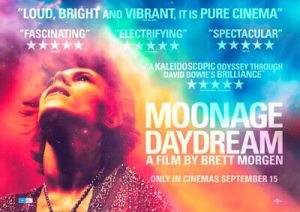
Movie Review: David Bowie in ‘Moonage Daydream’ (2022)

The hype for ‘Moonage Daydream’ is presenting it as a very different kind of David Bowie documentary (and music doc in general), and in some ways that’s true – it’s certainly ‘non-linear’ (which creates a few problems, as we’ll see later) and not yet another retelling of the Bowie story replete with talking heads (David alone ‘narrates’ the movie).

It’s undoubtedly best seen in the cinema, with its striking sound collages, surreal jump cuts and sometimes startling imagery taken from many sources, cult movies (including Canadian curio ‘Universe’, apparently also an influence on Kubrick and Lynch) to Hollywood’s golden age.

Director Brett Morgen is best known for his Kurt Cobain and Rolling Stones documentaries (neither of which your correspondent has seen), and apparently he got complete family approval to sift through countless hours of Bowie’s personal archive – though reportedly David was less than convinced by Morgen’s credentials/pitch when they met in 2007.

But Morgen has certainly got hold of some coups: there’s madly exciting, previously unseen DA Pennebaker footage from the Earls Court and Hammersmith Odeon Ziggy gigs in 1973, including Jeff Beck’s guest spot on ‘Jean Genie/Love Me Do’ – what a thrill to see him trading licks with Mick Ronson.

There’s also some terrific David Hemmings-directed 35mm Earls Court footage from 1978, and you’ll be doing well if you don’t get a lump in the throat during ‘Heroes’ (when is the complete footage finally going to get a proper release?). Then there are tantalising glimpses of Bowie’s many paintings and some intriguing footage from his mid-1970s video experiments. Morgen also borrows large sections of Serious Moonlight tour curio ‘Ricochet’ and ‘The Man Who Fell To Earth’.

But the film really comes into its own with its sound design. Tony Visconti has donated audio stems from Bowie’s studio masters so there are interesting reversions of material like ‘Ashes To Ashes’, ‘DJ’ and ‘Absolute Beginners’. I almost cheered when Dennis Davis’s ‘Sound And Vision’ groove exploded into action and it’s a delight hearing Rob Sabino’s solo’d piano from ‘Modern Love’.

But there are issues with ‘Moonage Daydream’. The frenetic editing sometimes leads to jarring moments. If you were being kind you’d say it was ‘non-linear’, if you weren’t you might say it was completely random. Again, not a problem in itself, given Bowie’s use of cut-up techniques and mistrust of linear narratives by the mid-1990s.

Then there are the obvious omissions/Morgen’s perceived irrelevances. Tin Machine isn’t mentioned by name, nor are there any images of the band. In fact the period of 1989-2005 is scarcely covered, save for some interesting outtakes from Samuel Bayers’ videos from that time, some footage from Bowie’s 50th birthday concert and a section on his marriage to Iman.

There is a fairly lengthy exploration of his family background, suburban upbringing and half-brother Terry Burns, though very little about his early Mod days and art-school contemporaries. And Bowie purists may be troubled (well, I was!) by the use of the Pet Shop Boys remix of ‘Hallo Spaceboy’ rather than the original to kick off the film.

Of course the question is, if you’re a big Bowie fan – and I presume you are if you’ve read this far – do you need to see ‘Moonage Daydream’? I’d say a qualified ‘yes’… But ultimately it’s still like a very expensive-looking YouTube greatest hits, with many bits of familiar interview footage and a lot of previously seen live stuff. But even that is a thrill to see on the big screen with good sound. Is the film pretentious? Of course, but that was never a criticism for Bowie. He even described his collaborations with Brian Eno as ‘the new school of pretension’…

Further reading: ‘Sight & Sound’ October 2022

1981: Uprising & Blood Ah Go Run

40 years ago, I was a young football-and-music-mad whippersnapper living a relative life of Riley out on the South Coast of England, but my hometown of London was catching hell.

Not that I was particularly aware. For most sections of the media, summer 1981 was all about Prince Charles’ marriage to Lady Di and Ian Botham’s Ashes (his crushing 149 not out at Headingley, 40 years ago this month, was the first time I remember being totally gripped by live cricket).

But of course there was a whole other side to 1981, a world brilliantly evoked by The Specials on their epochal #1 ‘Ghost Town’, and by directors Steve McQueen and James Rogan in their important, sadly still-relevant ‘Uprising’ series of new BBC documentaries.

The gripping but shattering films show how the St Pauls riots in Bristol, New Cross Fire tragedy of January 1981 and policing policies during the Black Peoples Day of Action in March (and throughout the late-1970s and early-80s) sparked uprisings all over the country, from Brixton to Toxteth, 35 years before the formation of Black Lives Matter.

Co-opting footage from the late, groundbreaking London filmmaker Menelik Shabazz’s 1981 film ‘Blood Ah Go Run’ and featuring interviews with most of the survivors of the New Cross fire, plus Linton Kwesi Johnson and various activists, ‘Uprising’ is a vital – at times devastating – piece of social history. And of course it’s a brilliant London film.

It’s also a grave warning to governments about the tragic pitfalls of acquiescing to racists. Don’t miss – ‘Uprising’ is on iPlayer until July 2022 if you’re in the UK.

Milford Graves (1941-2021)

One of the most memorable music documentaries broadcast in Britain during the late 1980s was ‘Speaking In Tongues’, directed by Doug Harris for German TV and originally shown in 1982.

It began with John Coltrane’s funeral on 21 July 1967, featuring music from drummer Milford Graves, trumpeter Donald Ayler and saxophonists Ornette Coleman and Albert Ayler, then mused on the mysterious death of the latter before opening up to focus on Graves’ extraordinary life and some coruscating duets with saxophonist David Murray.

Born 20 August 1941 in South Jamaica, Queens, New York, Milford Graves was a ‘drummer’, but, equally importantly, a truly evolved human being, a strict vegetarian, herbologist, acupuncturist, teacher and trained martial artist. He was famous locally for his backyard dojo and basement laboratory.

He began his career playing bongos and timbales, including a short-lived Latin-jazz band with a very young Chick Corea. At the urging of superstar percussionist Don Alias, he moved over to the drum kit in 1963 and found his true metier.

Alongside Sunny Murray, Andrew Cyrille, Ronald Shannon Jackson and a few others, he freed the drummer from purely a timekeeping role, introducing new melodic and tonal textures for the kit. But this wasn’t a po-faced, technical endeavour – it led to some of the most intense, high-volume work of the last 50 years. He described each of his limbs as playing ‘a different feeling’ (see below).

Legendary jazz writer Nat Hentoff apparently made a prediction in the late 1960s that the greats of the avant-garde jazz movement would eventually get lecturing jobs in universities, such was the importance and rigour of their conceptual flow.

It was true. Since 1973, Graves had been teaching at Bennington College in Vermont, a variety of courses including those touching on the healing aspect of music. He performed regularly across the world, including at a school for autistic children in Japan. From the late 1960s on, he eschewed nightclub and club gigs, restricting his live performances to festivals, community centres and outdoor shows.

He recorded astonishing duets with pianist Don Pullen, Andrew Cyrille (Dialogue Of The Drums) and David Murray on the classic 1991 album The Real Deal. He worked with Albert Ayler on various albums including Love Cry. He toured extensively during the 1980s, producing a sound as heavy as anything Black Flag or Metallica came up with.

Tragically, though he had studied the heartbeat as a source of rhythm since the 1970s, Milford died of congestive heart failure on 12 February. ‘It turns out, I was studying the heart to prepare for treating myself,’ he told The New York Times last year.

Last autumn, his life and work had just been subject to a residency at the ICA in Philadelphia, including a screening of ‘Speaking Of Tongues’ and a wide-ranging interview with Jason Moran.

RIP to a true one-off. To paraphrase Art Blakey, if jazz was about washing away the dust of everyday life, Milford Graves did it.

Milford Graves (20 August 1941 – 12 February 2021)

Further reading: ‘As Serious As Your Life’ by Val Wilmer


The Cult Movie Club: Fourteen Days In May (1987)

It doesn’t happen very often, but occasionally a documentary comes along that makes you question everything, puts a new slant on life and death, the whole shebang.

Or just gives you a damn good scare. Paul Hamann’s ‘Fourteen Days In May’ definitely fits the bill.

Shot over two weeks during the summer of 1987 at the infamous Mississippi State Penitentiary – AKA Parchman Farm – ‘Fourteen Days In May’ follows a young black man Edward Johnson as he prepares for – and, with the help of his lawyer Clive Stafford Smith, tries to evade – the gas chamber.

First shown on the BBC over 30 years ago, it has become a landmark film. Similar areas have recently been explored by Werner Herzog, Louis Theroux and Nick Broomfield, but arguably ‘Fourteen Days In May’ trumps all of them for sheer emotional impact.

It explores the inner workings of a prison geared up for taking human life. Astonishing shots shed light on a kind of modern slavery, with policemen on horseback brandishing shotguns, calling out loud reprimands and instructions to large groups of (almost exclusively) young black detainees as they dig ditches or clear roadside vegetation.

Elsewhere we are witness to the last few minutes of another (white) inmate’s life as he is strapped into the electric chair, though thankfully we don’t see the moment of truth. The gallows humour of both the killers and killed will linger long in the memory.

As ‘Fourteen Days In May’ moves painfully and inexorably on, it becomes increasingly clear that Johnson is innocent. But no-one can do anything about it. Various (black and white) prison officers bravely profess their doubts as to his guilt, while Johnson’s family rally around the quiet, unfailingly polite young man, singing him songs to keep his spirits up.

Hamann breaks the fourth wall to says his goodbyes to Johnson in a memorable scene. But shorn of a voiceover or title cards, ‘Fourteen Days In May’ offers no explicit critique of capital punishment. It doesn’t need to. The facts do that for themselves.

It would seem churlish and pointless not to reveal the ‘ending’ of the film here – Edward Johnson meets his maker. The crushing coda reveals that a young black woman came forward after the execution to verify that she saw him in a pool hall during the time of the alleged crime, but when reporting this to a white police officer soon after was threateningly advised to mind her own business.

What do we take away from ‘Fourteen Days In May’? The only correct response would seem to be rage. And fear. But after that, there’s a helplessness and a slow-burning disgust.

The only slight light at the end of the tunnel is the knowledge that it was in direct response to this documentary that the Lifelines organisation was set up, arranging pen pals for death row prisoners. Stafford Smith has also founded Reprieve.

Is America still like this? The suspicion would have to be that it is.

The Cult Movie Club: Driving Me Crazy (1988)

In the ’70s and ’80s, documentarian Nick Broomfield’s focus was mainly on societal concerns – the British class system (‘Proud To Be British’), urban decay (‘Behind The Rent Strike’), juvenile delinquency (‘Tattooed Tears’) the US Army (‘Soldier Girls’), legalised prostitution (‘Chicken Ranch’). All are superb and worth seeking out.

But 1988’s ‘Driving Me Crazy’ marked a lightening of tone and the birth of Broomfield’s post-modern style, where he became a ‘character’ in the film – and, it has to be said, often an irritant.

The movie came about when the financiers of big-budget, all-black musical ‘Body And Soul’ – booked for a six-month run in Munich – sought out Broomfield to make a ‘Fame’-style documentary about the extended rehearsal process in New York. All well and good, thought Broomfield. It was a chance to extend his range and do something different, a little more light-hearted.

But then it all went pear-shaped. The financiers reduced the documentary budget from $1.6 million to $300,000. They also wanted to incorporate a ‘fictional’ element into the film, with writer Joe Hindy and his agent playing themselves. Egos ran wild and sensibilities were messed with.

Broomfield considered bailing but decided to hang around and document the resulting drama. So ‘Driving Me Crazy’ became a film about not being able to make a film, in the tradition of ‘Waiting For Fidel’. The good news is that it’s one of the funniest but also most awkward movies of Broomfield’s career. ‘Body And Soul’ choreographers George Faison/Mercedes Ellington and assistant director Howard Porter don’t take kindly to the film crew and give them hell.

Broomfield almost becomes persona non grata. Though this must have sometimes been painful, he almost seems to relish it. He also flirts outrageously with the PA of show producer Andre Heller and there are uncomfortable suggestions of racism from some of the suits.

But Broomfield and his DoP Rob Levi also document some stunning rehearsal footage. There are memorable jazz, hip-hop, soul and doo-wop performances and beautiful images of late ’80s New York, with shades of ‘Fatal Attraction’ and ‘9 1/2 Weeks’. There’s a particularly notable panoramic cityscape shot towards the end, soundtracked by one of many fractious but funny Broomfield phone calls.

Entertaining, unsettling and sometimes exhilarating, the oft-neglected ‘Driving Me Crazy’ is well worth another look.

Whitney Houston: Can I Be Me?

Whitney is seldom mentioned in the list of ’80s biggies (Prince, Bruce, Bon Jovi, Madonna, Jacko, Hall & Oates etc.) – strange considering her 1985 debut album sold 22 million copies, her second 25 million and she’s still the only artist in history to have seven consecutive US number one singles (one more than The Beatles).

Her death in 2012 at the age of just 48 followed decades of worldwide success but also attendant tabloid speculation and a multitude of legal problems (her father John sued her for $100 million in 2002).

Her marriage to R’n’B ‘badboy’ Bobby Brown was endlessly analysed, as was her close friendship with Robyn Sampson. Nick Broomfield’s ‘Can I Be Me?’ (Rudi Dolezal gets a co-director credit for the inclusion of his scintillating 1999 concert/backstage footage) is the first Whitney doc out of the blocks – another ‘authorised’ film is apparently on the way shortly – and it’s a significant change of style for Broomfield.

He dials down the quirkiness, resists on-screen cameos and cranks up the gravitas, seeming far more affected by Whitney’s demise than he was by the deaths of Biggie, Tupac, Kurt Cobain or Aileen Wuornos. There are no obvious laughs in this one and it’s by far his most commercial film, possibly reflecting the influence of Asif Kapadia’s similarly-themed ‘Amy’.

But other things haven’t changed – Broomfield’s impressive range of interviewees (including Whitney’s brothers, friends, bodyguard, hair stylist, drug counselor, musical director and backing singers) are shown in unflattering close-up, but all speak with sometimes breathtaking candour.

The only notable no-shows are Bobby Brown and best friend Robyn Crawford, for reasons which become abundantly clear. We get a strong sense of Whitney’s childhood in Newark, New Jersey – ‘the hood’ – when ‘Nippy’ was a lovable, caring, somewhat mischievous kid brought up singing gospel in church and mucking around with her brothers.

Inheriting a formidable set of pipes from her mum Cissy Houston, legendary impressario Clive Davis signed Nippy as a charming, cheeky 20-year-old and demanded a debut album that would appeal to White America; as an Arista A&R man says on camera, ‘He DIDN’T want George Clinton music.’

Broomfield analyses this as the crux of the problem, in the sense that Whitney achieved her huge early success without ever referencing the sort of music she was passionate about. The title of the film comes from her catchphrase developed when touring in the late ’90s when she would insist on bringing in elements of gospel, jazz and R’n’B (presumably against the wishes of her record company).

Broomfield doesn’t fudge the drug issue, and finds plenty of self-criticism from Whitney as well as corroboration from various sources. Bobby Brown comes across as somewhat of a loose cannon but essentially harmless. Despite his posturing, the intimate backstage footage demonstrates that he certainly loved Whitney and vice versa. Their Ike and Tina ‘abuse’ skits are amusing, though may offend some.

More troubling was Brown’s relationship with Robyn Crawford, who allegedly was having an affair with Whitney throughout much of her career. Broomfield hasn’t been able to secure the rights to any of Houston’s recorded catalogue, so the film arguably relies too much on Nick Laird-Clowes’ mournful, somewhat clichéd original score.

But Rudi Dolezal’s concert footage is evocative and moving. Love or hate ‘I Will Always Love You’, it’s hard not to be affected by Houston’s mesmerising live performance during a 1999 gig in Germany, one of many great musical moments in the film. Michael Baker’s yin/yang bass-drum skin from that 1999 tour says it all – ‘Whitney: Can I Be Me’ is finally another very sad music-biz story. But it’s well worth catching even if it (understandably) lacks the anarchic zeal of Broomfield’s best work.

One interviewee who might have been worth tracking down is Bill Laswell, who to the best of my knowledge was the first producer to tap into Whitney’s potential when he helmed this early gem, recorded when she was just 19 years old.

Sonny Rollins: Saxophone Colossus

51dnFsTtIPLEvery serious jazz fan seems to have a favourite Sonny Rollins story.

A good one is recited by musician Matt Glaser in Ken Burns’ ‘Jazz’ documentary. Sonny was playing a late-night Carnegie Hall gig on Easter Saturday during the 1990s. He embarked on a typically Herculean solo at around 11:30pm. This went on for quite a while. At EXACTLY ten seconds to midnight he quoted from Irving Berlin’s ‘Easter Parade’…

Truth or fiction, it’s the kind of story that has followed the brilliant Harlem-born saxophonist around throughout his career. It also speaks volumes about his intellectual and musical vigour.

Robert Mugge’s excellent 1987 documentary ‘Saxophone Colossus’ spawns yet more Sonny stories, inadvertently filming an extraordinary moment during an outdoor New York gig. Jumping off the stage mid-solo to join the audience, he misjudges the height and breaks his heel in the process. Lying stricken on the floor, alone and unaided though still holding his horn, there’s the briefest of pauses before he continues soloing as if nothing was amiss.

The film also features fascinating interviews with Sonny and his wife/manager/producer (and now sadly departed) Lucille. Writers Gary Giddins, Francis Davis and Ira Gitler contribute intelligent, revealing summations of Rollins’ career. There’s also some superb concert footage of Sonny’s ‘Concerto For Tenor Saxophone And Orchestra’ premiere in Japan.

Watching the film again has led to a period of Sonny woodshedding, and I’m unearthing some real gems. It’s exciting that he has continued to be an absolutely vital presence on the jazz scene, performing when possible and frequently contributing to media debates about the music.

He has also written obituaries for his long-time producer Orrin Keepnews and long-time bassist Bob Cranshaw in recent issues of JazzTimes magazine. More power to Mr Rollins. Here’s some of that woodshedding, in chronological order: